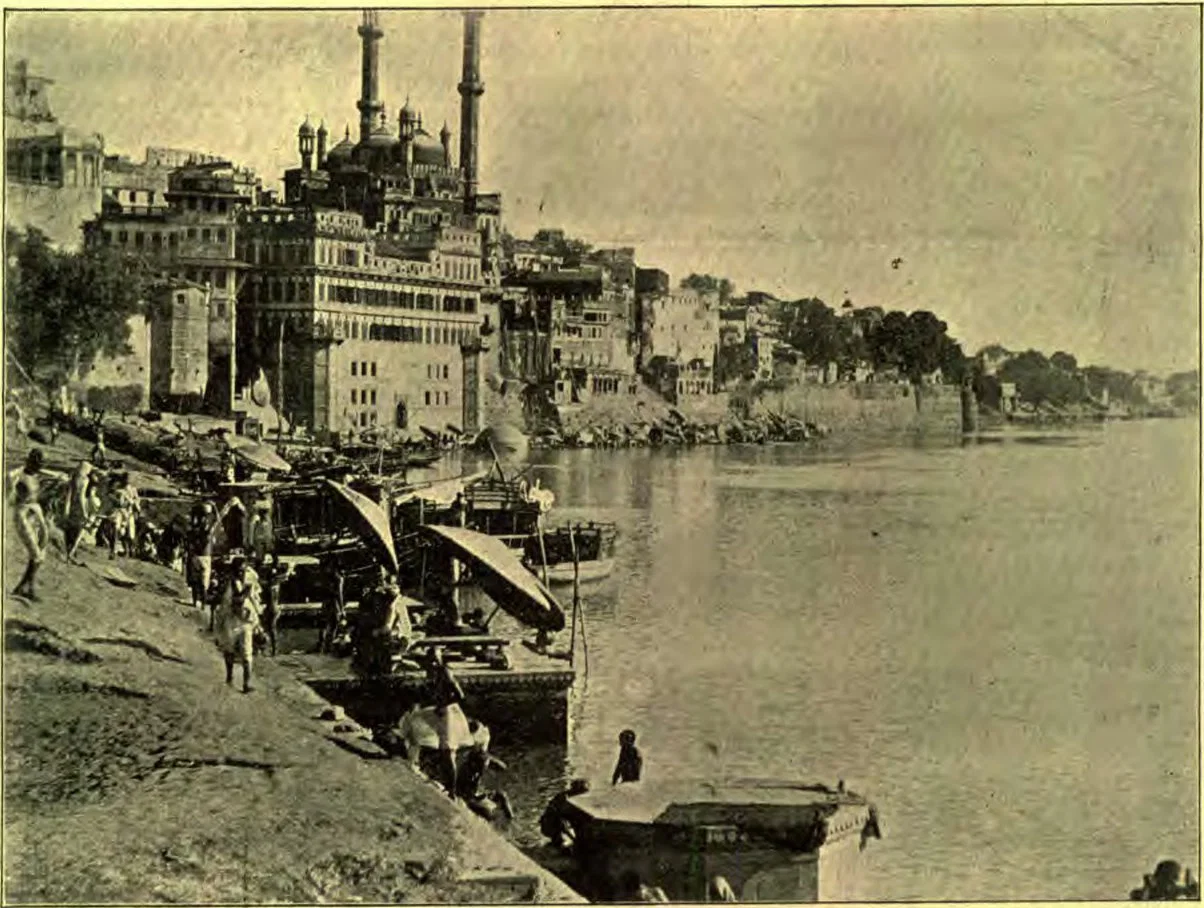
HINDUISM has many so-called sacred places, but Benares is the chief. Before ever Rome was built on the Tiber, Benares, on the Ganges, was the resort of the devout of India. Still to-day the pilgrims throng its streets and temple areas. With its resident and transient population, it is as like a human beehive as any city in the world.
Kasee, the Hindus call it,—“Kasee the Splendid.” My first view of it was from across the river, in the early morning, just as the rising sun was touching temple and tower and minaret with gold. It really is an imposing sight. I could fancy a pilgrim’s heart thrilling with ecstasy of feeling as the view burst upon his eyes,—the city toward which the hearts of his fathers have turned for thirty centuries, a very gateway to the Hindu heaven.
To me, however, it meant a very citadel of superstition and ignorance of God, the fruits of which we meet everywhere in darkened India.
High over the city rise the minarets of the Mosque of Aurungzeb, one of the Mogul conquerors of India. He tore down the chief Hindu temple of Bisheswar in order to plant his mosque above its ruins. But the Mohammedan sword could not pull down the traditions and social fabric of Hinduism; so alongside the mosque new temples sprang up and multiplied, and the idolatry of Bisheswar, “lord of all,” still fills the sacred city.
I walked with the crowd along the highway from the Kasee railway station to the temple district and the river terraces. The fascinating study in Benares, as everywhere else in the East, is the crowd, the people themselves. Many of these pilgrims come to die in Kasee; others have spent their all to make the journey in order to win deliverance from sin. One is struck with the serious and businesslike manner in which the multitudes take up the performances connected with this way of self-salvation. Poor souls! I know from having talked with some, that, in spite of all their wearisome toil, they feel still the burden of sin upon them. Of course they must. Not a soul can come up from the bathing in the Ganges, or return from making the round of the fifteen hundred temples, without being conscious of the fact that God’s law, written by nature in the heart, still speaks in order that every mouth may be stopped, and all the world become guilty before God.
The Brahman priests are everywhere in evidence. Under great umbrellas the gunga-putras—“sons of the Ganges”—earn a living by caring for the effects of the bathers, and by setting the proper mark of their god upon the foreheads of the devotees.
A VIEW IN BENARES
To my mind, the saddest sight in all this sad city is the spectacle of old age waiting for the summons into eternity. Here at almost any morning hour, among the bathers, companies of aged widows may be seen, with shaven heads, washing and worshiping in the Ganges, hoping at last to atone for the sin that is supposed to have brought the curse of widowhood upon them.
Benares is not altogether dependent upon its reputation as a shrine. Rare tapestries and silks are made in its old-time factories. In the brass market, skilled workmen produce chased and decorated brazen articles that are famous the world over. It is rather a center for publishing interests in the Hindi language. We ought erelong to have workers enough in India to allow of making some effort among the hundreds of thousands of Benares.