1 Kings 11:30
And Ahijah caught the new garment that was on him, and rent it in twelve pieces:
Translations
American King James Version, King James Version, Webster Bible
And Ahijah caught the new garment that was on him, and rent it in twelve pieces:
and Ahijah caught the new garment that was on him, and rent it in twelve pieces:
Revised Version, American Standard Version
And Ahijah laid hold of the new garment that was on him, and rent it in twelve pieces.
and Ahijah layeth hold on the new garment that [is] on him, and rendeth it — twelve pieces,
Then Ahijah seized the new garment that was on him, and rent it in twelve pieces;
Then Ahijah laid hold of the new mantle, that was upon him,—and rent it into twelve pieces;
Berean Standard Bible, Majority Standard Bible
And Ahijah took hold of the new cloak he was wearing, tore it into twelve pieces,
Ahijah took the new garment that was on him, and tore it in twelve pieces.
And Ahijah took his new robe in his hands, parting it violently into twelve.
Then Ahiiah caught the newe garment that was on him, and rent it in twelue pieces,
Douay-Rheims (Challoner revision)
And Ahias taking his new garment, wherewith he was clad, divided it into twelve parts:
Pictures
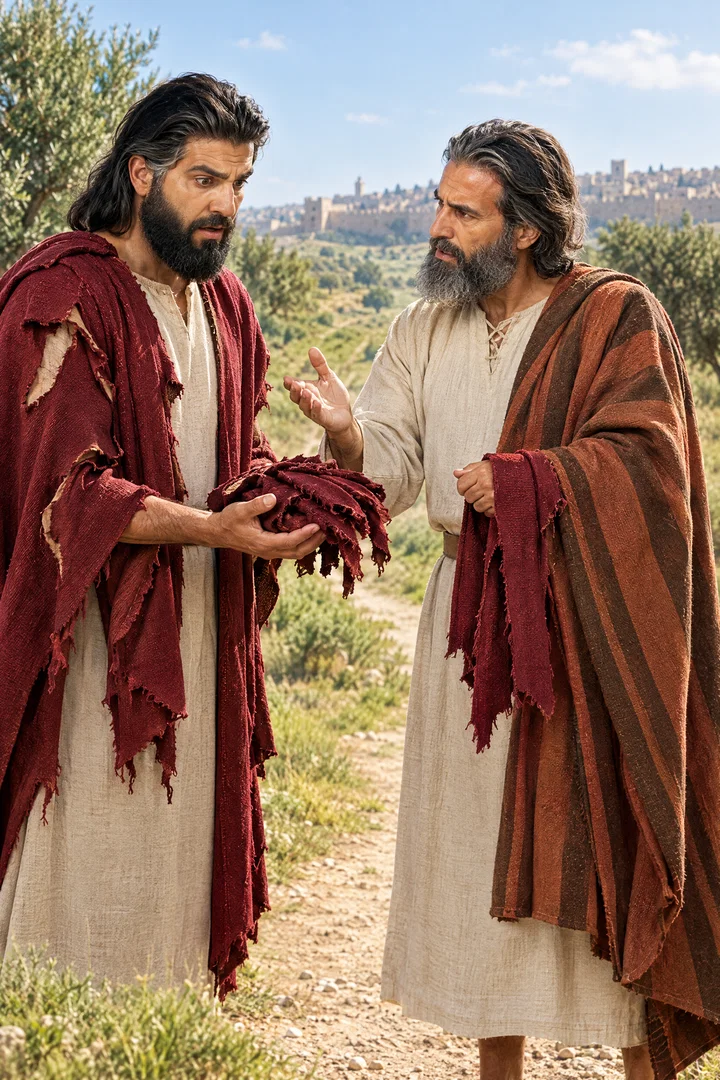
Cross-references
- 1 Kings 11:34-36
Howbeit I will not take the whole kingdom out of his hand: but I will make him prince all the days of his life for David my servant’s sake, whom I chose, because he kept my commandments and my statutes:
The Lord explains the kingdom’s division and the tribe retained for David’s house.
- 1 Kings 12:19-20
So Israel rebelled against the house of David unto this day.
Israel separates from David’s house, leaving Judah under Rehoboam and making Jeroboam king over Israel.
- 1 Kings 14:10
Therefore, behold, I will bring evil upon the house of Jeroboam, and will cut off from Jeroboam him that pisseth against the wall, and him that is shut up and left in Israel, and will take away the remnant of the house of Jeroboam, as a man taketh away dung, till it be all gone.
Ahijah foretells the destruction of Jeroboam’s house.
- 1 Kings 12:28-30
Whereupon the king took counsel, and made two calves of gold, and said unto them, It is too much for you to go up to Jerusalem: behold thy gods, O Israel, which brought thee up out of the land of Egypt.
Jeroboam sets up golden calves as objects of worship.
- 1 Kings 11:38
And it shall be, if thou wilt hearken unto all that I command thee, and wilt walk in my ways, and do that is right in my sight, to keep my statutes and my commandments, as David my servant did; that I will be with thee, and build thee a sure house, as I built for David, and will give Israel unto thee.
A sure throne is promised on condition of obedience.
- 1 Kings 14:15-16
For the LORD shall smite Israel, as a reed is shaken in the water, and he shall root up Israel out of this good land, which he gave to their fathers, and shall scatter them beyond the river, because they have made their groves, provoking the LORD to anger.
Ahijah’s torn garment signified Israel’s coming uprooting and scattering for its sins.
- 1 Kings 12:15
Wherefore the king hearkened not unto the people; for the cause was from the LORD, that he might perform his saying, which the LORD spake by Ahijah the Shilonite unto Jeroboam the son of Nebat.
The kingdom’s division fulfills the Lord’s word through Ahijah.
- 1 Kings 11:40
Solomon sought therefore to kill Jeroboam. And Jeroboam arose, and fled into Egypt, unto Shishak king of Egypt, and was in Egypt until the death of Solomon.
Solomon sought to kill Jeroboam after the prophecy.
- 2 Samuel 7:12-16
And when thy days be fulfilled, and thou shalt sleep with thy fathers, I will set up thy seed after thee, which shall proceed out of thy bowels, and I will establish his kingdom.
The promise concerning David’s line underlies the tribe retained for Solomon’s heir.
- Psalms 132:11
The LORD hath sworn in truth unto David; he will not turn from it; Of the fruit of thy body will I set upon thy throne.
The Lord’s oath to David is cited as the reason one tribe remains.
Commentary
Each commentary is drawn from primary sources: the writings of Ellen G. White and Adventist pioneers and periodicals. Each commentary is separate. Its own words are not a quotation; follow the references to read the source passages.
Ellen G. White
4 sources
The meeting took place when Ahijah the Shilonite encountered Jeroboam alone in the field outside Jerusalem.Ms 1, 1912, par. 3–4 He seized the new garment that was on himself and tore it into twelve pieces, acting out in visible form God's prediction of division.Ms 1, 1912, par. 3–4 The twelve pieces symbolized the twelve tribes and the rending of Israel's kingdom.Ms 1, 1912, par. 3–4RH Jul 10, 1913 The sign meant that the Lord God of Israel would rend the kingdom out of the hand of Solomon and give ten tribes to Jeroboam.Ms 1, 1912, par. 3–4 Solomon himself would remain prince all his life for the sake of David, who kept God's commandments and statutes, with the kingdom to be taken out of his son's hand.Ms 1, 1912, par. 3–4
The reason for the rending was that Israel had forsaken God and worshiped Ashtoreth the goddess of the Zidonians, Chemosh the god of the Moabites, and Milcom the god of the Ammonites.Ms 1, 1912, par. 3–4 They had not walked in God's ways to do what is right and to keep His statutes and judgments, as David had done.Ms 1, 1912, par. 3–4 The tearing belongs to Ahijah's prophecy concerning Jeroboam and Israel, which foretold both that Jeroboam would become king and the ruin that would follow apostasy.RH Jul 24, 1913PK 107.3 Because of its idolatry and the sins by which Jeroboam led the people away from God, the kingdom would be uprooted and scattered.RH Jul 24, 1913PK 107.3
Sources
Pioneers and periodicals
21 sources
Ahijah tore his own new outer garment into twelve pieces, though some hold the garment torn was Jeroboam's.ST Dec 9, 1897ST Jul 23, 1885ST Jun 22, 1904ST Dec 16, 1889 The tearing was an acted sign declaring that the Lord would take the kingdom from Solomon and divide it, with the twelve pieces representing the twelve tribes and the coming rending of Israel's kingdom.RH Jul 10, 1913ST Dec 9, 1897ST Jul 23, 1885ST Jun 22, 1904 Ten pieces represented the ten tribes that would revolt from the house of David and be given to Jeroboam to rule over, though the division was not to take place during Solomon's lifetime.ST Jul 23, 1885RH Mar 31, 1910RH Aug 1, 1871 Through Ahijah God gave Jeroboam the opportunity to follow Him, announcing his future sovereignty and promising that if he would walk in the way of the Lord's commandments his throne would be made sure like the throne of David.ST Jan 17, 1884RH May 9, 1871 Jeroboam turned from that opportunity to selfishness and idolatry, causing Israel to sin, and the same prophet who announced his elevation later announced his utter overthrow, while Solomon's decline from wisdom into idolatry warns that even great prosperity cannot keep a person from falling.RH Jan 12, 1869ST Dec 16, 1889ST Jan 17, 1884RH May 9, 1871ST Dec 10, 1896
Torn Garment And Setting
Ahijah caught the new outer garment that was upon himself and rent it into twelve pieces.RH Jul 10, 1913ST Dec 9, 1897ST Jun 22, 1904ST Dec 16, 1889ST Jun 25, 1885 Those who held the garment to be Jeroboam's taught that Ahijah tore Jeroboam's new garment into twelve pieces.ST Jul 23, 1885 The tearing was an acted sign declaring that the Lord would take the kingdom from Solomon and divide it, marking the coming division and separation of the tribes.ST Dec 9, 1897ST Jul 23, 1885ST Jun 22, 1904ST Jun 25, 1885 It belongs to the meeting of Ahijah with Jeroboam in which the division of Israel and Jeroboam's rule over the ten tribes was predicted.RH Mar 31, 1910
The twelve pieces represented the twelve tribes and the coming rending of Israel's kingdom.RH Jul 10, 1913ST Jul 23, 1885ST Jun 22, 1904 Ten of the pieces represented the ten tribes that would revolt from the house of David and be given to Jeroboam to rule over.ST Jul 23, 1885RH Mar 31, 1910RH Aug 1, 1871ST Jun 25, 1885ST Jan 17, 1884 That separation of the ten tribes from Solomon's house and their giving to Jeroboam was declared by God but was not to take place during Solomon's lifetime.RH Jun 23, 1903ST Jun 25, 1885 The account is part of the history of how the ten tribes were separated and of Ahijah meeting Jeroboam and predicting the division in 1 Kings 11:29-39.RH Aug 1, 1871RH Jun 23, 1903
The verse belongs to 1 Kings 1 to 11, the history of the undivided kingdom under Solomon, relating the same events as 2 Chronicles 1 to 9.RH May 11, 1916 It stands at the close of Solomon's reign amid the account of his promises, transgressions, and decline, after he favored the idolatrous worship of his wives, built shrines for false gods, and faced revolts from Syria and Edom, when Jeroboam rebelled against him.ST Dec 16, 1889ST Dec 10, 1896ST Apr 23, 1912 The surrounding history looks forward to the division after Solomon's death, which is the history of Israel after the kingdom was divided following Solomon's death.ST Jul 30, 1885 That division left ten tribes in Israel and two and a half tribes in Judah, arising from Solomon's mistakes and transgression during his reign, and led to continuing war and strife between them.ST May 20, 1913ST Apr 23, 1912
Promise Judgment And Warning
Jeroboam was lifted from obscure life, and ambition made him impatient to grasp what had been promised, unlike David who waited for the Lord's time, and after Ahijah met him and foretold the division of the kingdom he rebelled against Solomon.ST Dec 16, 1889RH Jun 23, 1903ST Dec 10, 1896 In that encounter God gave him a full opportunity to follow Him, announcing through Ahijah his coming sovereignty over the ten tribes that would revolt from the house of David, with the promise that his throne would be made sure like the throne of David if he would walk in the way of the Lord's commandments.ST Jan 17, 1884RH May 9, 1871 Ahijah himself stands in the moral darkness of that reign as one of God's witnesses matching evil with goodness, a striking example of godliness and virtue, true to God and filled with His power, whose life relieved the surrounding darkness.ST Jan 17, 1884
When Solomon heard the prophecy he sought to kill Jeroboam, so Jeroboam fled to Egypt and returned only after Solomon died.ST Dec 16, 1889ST Jun 16, 1898 Jeroboam turned from his magnificent opportunity to selfishness and idolatry, setting up idolatrous worship, causing Israel to sin, casting God behind his back, and doing evil above all that were before him as a powerful ruler leading ten tribes into idolatry.ST Dec 16, 1889ST Jan 17, 1884RH May 9, 1871 The same prophet who announced his elevation later announced his utter overthrow and rejection for all the iniquities he had committed.ST Jan 17, 1884RH May 9, 1871
The prophecy foretold the ruin that followed Israel's apostasy, that for Jeroboam's sins in leading Israel away from God the kingdom would be uprooted and scattered.RH Jul 24, 1913 The later division fulfilled what the Lord had spoken through Ahijah to Jeroboam concerning the rending of the kingdom.ST Jul 23, 1885 Behind it lay Solomon's disastrous decline from wisdom and piety into idolatry and apostasy, when he favored the idolatrous worship of his wives, built shrines for false gods, and faced revolts from Syria and Edom, warning that even great wisdom and prosperity cannot keep a person from falling when he forgets the lessons of God's people.RH Jan 12, 1869ST Dec 10, 1896
Sources