1 Kings 12:28
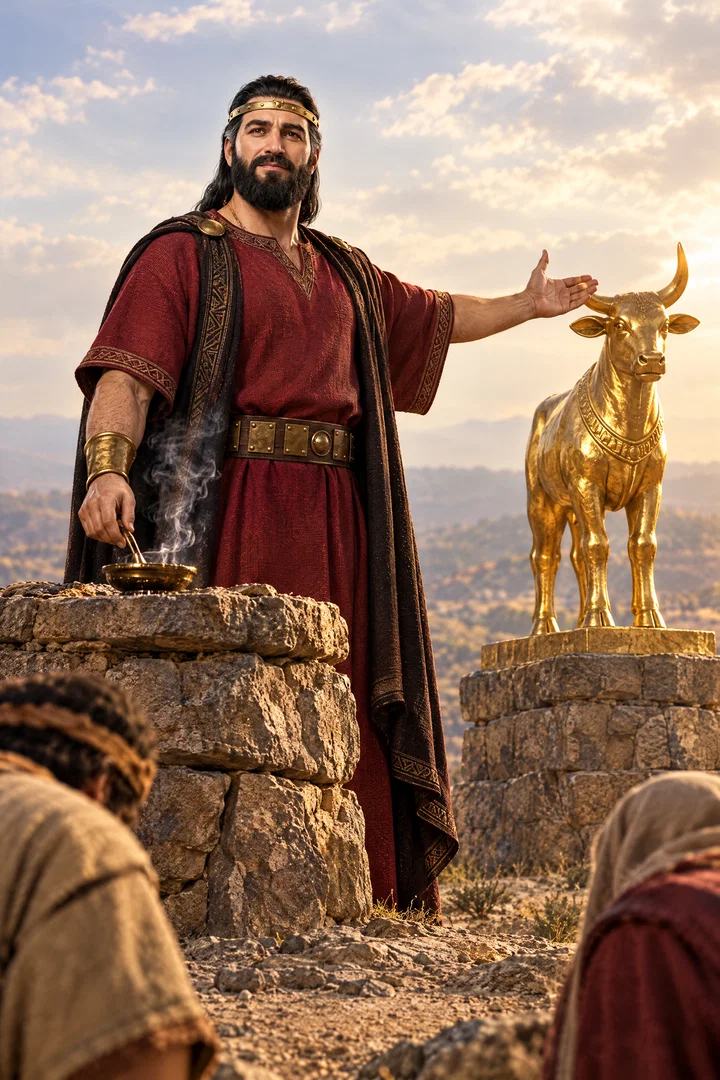
Whereupon the king took counsel, and made two calves of gold, and said unto them, It is too much for you to go up to Jerusalem: behold thy gods, O Israel, which brought thee up out of the land of Egypt.
Translations
Whereupon the king took counsel, and made two calves of gold, and said to them, It is too much for you to go up to Jerusalem: behold your gods, O Israel, which brought you up out of the land of Egypt.
King James Version, KJV Cambridge Paragraph Bible
Whereupon the king took counsel, and made two calves of gold, and said unto them, It is too much for you to go up to Jerusalem: behold thy gods, O Israel, which brought thee up out of the land of Egypt.
Upon which the king took counsel, and made two calves of gold, and said to them, It is too much for you to go up to Jerusalem: behold thy gods, O Israel, which brought thee out of the land of Egypt.
Whereupon the king took counsel, and made two calves of gold; and he said unto them, It is too much for you to go up to Jerusalem; behold thy gods, O Israel, which brought thee up out of the land of Egypt.
Whereupon the king took counsel, and made two calves of gold; and he said unto them, It is too much for you to go up to Jerusalem: behold thy gods, O Israel, which brought thee up out of the land of Egypt.
And the king taketh counsel, and maketh two calves of gold, and saith unto them, 'Enough to you of going up to Jerusalem; lo, thy gods, O Israel, which brought thee up out of the land of Egypt.'
And the king took counsel, and made two calves of gold. And he said to them, It is too much for you to go up to Jerusalem: behold thy gods, Israel, which brought thee up out of the land of Egypt!
Whereupon the king took counsel, and made two calves of gold,—and said unto them—It is, too much for you, to go up to Jerusalem, Lo! thy gods, O Israel, that brought thee up out of the land of Egypt;
Berean Standard Bible, Majority Standard Bible
After seeking advice, the king made two golden calves and said to the people, “ Going up to Jerusalem is too much for you. Here, O Israel, are your gods, who brought you up out of the land of Egypt.”
So the king took counsel, and made two calves of gold; and he said to them, “ It is too much for you to go up to Jerusalem. Look and behold your gods, Israel, which brought you up out of the land of Egypt!”
So after taking thought the king made two oxen of gold; and he said to the people, You have been going up to Jerusalem long enough; see! these are your gods, O Israel, who took you out of the land of Egypt.
Whereupon the King tooke counsell, and made two calues of golde, and saide vnto them, It is too much for you to goe vp to Ierusalem: beholde, O Israel, thy gods, which brought thee vp out of the lande of Egypt.
Douay-Rheims (Challoner revision)
And finding out a device he made two golden calves, and said to them: Go ye up no more to Jerusalem: Behold thy gods, O Israel, who brought thee out of the land of Egypt.
Pictures
Cross-references 20 of 34
- Exodus 32:4
And he received them at their hand, and fashioned it with a graving tool, after he had made it a molten calf: and they said, These be thy gods, O Israel, which brought thee up out of the land of Egypt.
Both identify a golden calf as Israel’s gods who brought them out of Egypt.
- 1 Kings 13:1-2
And, behold, there came a man of God out of Judah by the word of the LORD unto Beth-el: and Jeroboam stood by the altar to burn incense.
A man of God condemns Jeroboam’s altar and calf worship.
- Exodus 20:4-5
Thou shalt not make unto thee any graven image, or any likeness of any thing that is in heaven above, or that is in the earth beneath, or that is in the water under the earth:
Jeroboam’s golden calves violate the command against making and worshiping images.
- 1 Kings 11:38
And it shall be, if thou wilt hearken unto all that I command thee, and wilt walk in my ways, and do that is right in my sight, to keep my statutes and my commandments, as David my servant did; that I will be with thee, and build thee a sure house, as I built for David, and will give Israel unto thee.
Jeroboam’s promised rule and sure house contrast with his distrustful idolatry.
- 1 Kings 16:31-33
And it came to pass, as if it had been a light thing for him to walk in the sins of Jeroboam the son of Nebat, that he took to wife Jezebel the daughter of Ethbaal king of the Zidonians, and went and served Baal, and worshipped him.
Ahab carried Jeroboam’s idolatry further by serving Baal and rejecting the LORD.
- Amos 7:13
But prophesy not again any more at Beth-el: for it is the king’s chapel, and it is the king’s court.
Bethel is identified as the king’s sanctuary associated with rival worship.
- 1 Kings 14:9
But hast done evil above all that were before thee: for thou hast gone and made thee other gods, and molten images, to provoke me to anger, and hast cast me behind thy back:
God condemns Jeroboam for making idols and leading Israel into sin.
- 1 Kings 12:32-33
And Jeroboam ordained a feast in the eighth month, on the fifteenth day of the month, like unto the feast that is in Judah, and he offered upon the altar. So did he in Beth-el, sacrificing unto the calves that he had made: and he placed in Beth-el the priests of the high places which he had made.
Jeroboam established a rival feast and worship at Bethel.
- 2 Kings 17:16
And they left all the commandments of the LORD their God, and made them molten images, even two calves, and made a grove, and worshipped all the host of heaven, and served Baal.
Israel’s worship of the golden calves is condemned as idolatry.
- Romans 1:23-25
And changed the glory of the uncorruptible God into an image made like to corruptible man, and to birds, and fourfooted beasts, and creeping things.
Israel exchanges worship of God for worship of a created image.
- Hosea 10:5-6
The inhabitants of Samaria shall fear because of the calves of Beth-aven: for the people thereof shall mourn over it, and the priests thereof that rejoiced on it, for the glory thereof, because it is departed from it.
The calves are carried to Assyria, bringing shame to Israel.
- Amos 8:14
They that swear by the sin of Samaria, and say, Thy god, O Dan, liveth; and, The manner of Beer-sheba liveth; even they shall fall, and never rise up again.
Names the gods of Dan and Samaria that their worshippers swear by.
- 1 John 5:21
Little children, keep yourselves from idols. Amen.
Golden Text warns against the idolatry shown
- Judges 18:30
And the children of Dan set up the graven image: and Jonathan, the son of Gershom, the son of Manasseh, he and his sons were priests to the tribe of Dan until the day of the captivity of the land.
Both establish idolatrous worship at Dan.
- Exodus 32:8
They have turned aside quickly out of the way which I commanded them: they have made them a molten calf, and have worshipped it, and have sacrificed thereunto, and said, These be thy gods, O Israel, which have brought thee up out of the land of Egypt.
Israel’s calf worship parallels Jeroboam’s image worship.
- 2 Chronicles 13:8
And now ye think to withstand the kingdom of the LORD in the hand of the sons of David; and ye be a great multitude, and there are with you golden calves, which Jeroboam made you for gods.
Both texts describe Jeroboam’s golden calves as gods.
- Hosea 8:6
For from Israel was it also: the workman made it; therefore it is not God: but the calf of Samaria shall be broken in pieces.
Calls Samaria’s calf man-made and foretells its destruction.
- 2 Kings 10:29-31
Howbeit from the sins of Jeroboam the son of Nebat, who made Israel to sin, Jehu departed not from after them, to wit, the golden calves that were in Beth-el, and that were in Dan.
Jehu destroyed Baal worship but retained Jeroboam’s golden calves.
- 1 Kings 14:16
And he shall give Israel up because of the sins of Jeroboam, who did sin, and who made Israel to sin.
Jeroboam caused Israel to sin through idolatry.
- 2 Kings 17:21
For he rent Israel from the house of David; and they made Jeroboam the son of Nebat king: and Jeroboam drave Israel from following the LORD, and made them sin a great sin.
Jeroboam led Israel away from the Lord and made them sin.
Commentary
Each commentary is drawn from primary sources: the writings of Ellen G. White and Adventist pioneers and periodicals. Each commentary is separate. Its own words are not a quotation; follow the references to read the source passages.
Ellen G. White
10 sources
Jeroboam feared that the regular journeys of the ten northern tribes to Jerusalem and its temple would draw them back into allegiance to the ruler in Jerusalem of the house of David, and since God intended such worship at Jerusalem to restore unity toward a united kingdom again, he worked to keep the tribes from going up to Jerusalem.PK 100.2PK 99.2Ms 103a, 1899, par. 35–37 He took counsel and made two calves of gold and set them up at Bethel and Dan as alternative centers of worship, inviting the tribes to gather there instead.PK 100.2PK 99.2PK 99Ms 103a, 1899, par. 35–37PK 285.3 He told them it was too much and too difficult to go up to Jerusalem, hailing the calves as the gods that brought Israel up out of the land of Egypt.PK 100.2Ms 103a, 1899, par. 35–37PK 114.1 The calves used a heathen representation familiar from the ancestors' time in Egypt, turning the people away from the true and established worship of God toward idolatry and strange forms of worship.PK 100.2PK 102.3PK 282.2
His altar and its dedication stood in opposition to worship at the temple and should have led him to repent and abandon his plans, but he hardened his heart and chose his own way.PK 102.3 A second place of worship divides God's people, so the verse warns against establishing two places for worship and two places for tithe-paying, since medical missionary work and ministry and church work are all one interest laboring to one end with no division or separation.Ms 103a, 1899, par. 35–37 The setting up of the calves began the apostasy and departure of the ten tribes from established worship and became a sin that led to violence and crime under idolatrous priests as leaders in crime.RH Feb 5, 1914PK 282.2PK 285.3 It led on to grosser idolatry, until nearly all the people forgot their Maker, corrupted themselves, and gave themselves to the alluring practices of nature worship, going to Baal-peor and separating themselves unto shame with abominations according as they loved, sacrificing to Baalim and burning incense to graven images and abandoning every uplifting and ennobling principle.RH Feb 5, 1914PK 282.2
The calves became the religious practices that Ahab continued, while his greater apostasy went beyond them to the worship of Baal.PK 114.1 The people later reaped the consequences of that apostasy, for the calf was a human-made idol and not God, and it would be broken and carried away to Assyria as a present to King Jareb, identified as Sennacherib, while the people and the priests who had rejoiced over the calves would mourn.PK 285.3 Jeroboam's spirit and plans put into operation led the children of Israel away from God into idolatry and caused them to perform and permit terrible evils, and the Judge of all the earth lays the awful results of his course to his charge.Lt 113, 1903, par. 14 People today are in danger of manifesting the same spirit and doing a work similar in character, and the results of their wrong course will be laid to the charge of those who follow his example.Lt 113, 1903, par. 14
Sources
Pioneers and periodicals
61 sources
After Solomon's death the ten tribes revolted against Rehoboam and chose Jeroboam as king, and Jeroboam feared that if his people continued going up to Jerusalem to worship they would return in allegiance to Judah and he would lose his kingdom.RH Jul 17, 1913ST Apr 26, 1910RH Sep 8, 1853ST Sep 7, 1904 Taking counsel with men of like mind as a political measure to secure his rule, he made two calves of gold and set them at Dan and Bethel as rival sanctuaries to draw the northern tribes away from God's sanctuary at Jerusalem.ST Jun 29, 1904RH Apr 7, 1910ST Apr 26, 1910ST Apr 24, 1901 He told Israel it was too much to go up to Jerusalem and presented the calves as the gods that brought them up out of Egypt, using familiar sacred memory to make the new worship seem legitimate.RH May 5, 1868ST Jun 29, 1904ST Jul 2, 1885ST Jul 2, 1885ST Jul 2, 1885 At first the calves were set forth as symbols and representatives of Jehovah rather than another god outright, and in this making images of the true God violated the second commandment and turned the people from the living God to great sin.RH May 5, 1868ST Sep 8, 1881RH Apr 7, 1910RH May 13, 1875RH Aug 14, 1868 That setting up of the calves became the sin of Jeroboam by which he made Israel to sin, continued by all the kings of the ten tribes until captivity, and it stands as a warning against choosing worship for convenience and ease on one's own terms while claiming still to worship God.ST Jul 2, 1885ST Apr 26, 1910RH Jul 17, 1866ST Apr 17, 1907
Kingdom Divided After Solomon
The verse belongs to the division of the kingdom after Solomon's death, when the ten tribes revolted and chose Jeroboam as king.ST Jul 2, 1885ST Dec 7, 1882ST Apr 28, 1909 Rehoboam's stubborn and foolish rejection of the people's complaints lost him those tribes, for he is described as weak and foolish and his stubbornness cost him much of the kingdom.ST Dec 7, 1882ST Jul 30, 1885 After the rebellion and choice of Jeroboam there, he made Shechem his capital.ST Jul 2, 1885 The account stands in a record of Israel and Judah showing general moral decline interrupted by periods of revival, in which Jeroboam ruled Israel but was not devoted to God.ST Apr 26, 1910
The chapter is part of a history covering about eighty years and several kings, marked by idolatry.ST Apr 26, 1910RH May 25, 1916 That idolatry was punished by loss of treasures from the temple and royal palace.RH May 25, 1916 The two kingdoms then continued separately after Solomon's death until Israel's overthrow in 721 B.C.ST Jul 30, 1885 The ten tribes that separated from Judah and Benjamin under Jeroboam carried their copies of the books of Moses with them.RH May 1, 1879
God had given Jeroboam the kingdom by prophecy, yet Jeroboam deliberately disregarded God's commands and was not devoted to God.ST Apr 26, 1910ST Dec 7, 1882 The division came because Solomon multiplied wives to himself and turned his heart from God, leaving his deplorably weak son Rehoboam on the throne.ST May 20, 1913 Against him Jeroboam, a strong young man, led the ten tribes of Israel to revolt.ST May 20, 1913 Having gained the kingdom, he set up altars against the altar of God.ST May 20, 1913
Jeroboam's Motive and Counsel
Jeroboam took counsel with men of like character with himself who thought the division must be kept up by human planning.ST Jun 29, 1904ST Jun 29, 1904 The counsel issued in a political measure to protect his rule, setting up a state religion different from the rival kingdom so that religious authority would strengthen civil rule.ST Jun 29, 1904ST Apr 26, 1910ST Apr 24, 1901ST Apr 24, 1901 To make sure of the continued allegiance of his people he determined to maintain peace by building up enmity.ST Jun 29, 1904
He feared that if the people went up to Jerusalem to worship God as appointed, their hearts would return in allegiance to Rehoboam and Judah and he would lose the kingdom he had been given.RH Jul 17, 1913RH Sep 8, 1853ST Dec 7, 1882ST Apr 24, 1901 That fear showed lack of faith in God's promise to build him a sure house if he kept the commandments, rather than trusting that God could preserve the kingdom He had given him.ST Sep 7, 1904ST Jun 29, 1904 He could not see that two nations could remain politically separate yet united in the worship of God.ST Jun 29, 1904
His lack of faith and his Egyptian upbringing after fleeing Solomon shaped this policy of keeping Israel from traveling to Jerusalem.ST Jul 2, 1885 The calves were images of Egyptian gods whose worship he had learned during his time in Egypt, degraded like the worship of the gods of Ammon, Moab and Zidon, though without burning children in the fire.ST Jul 2, 1885 Selfish considerations took supreme possession of his soul and turned him to idolatry, despite the magnificent opportunity expressly given him to follow God and have his throne over the ten tribes that revolted from the house of David made sure like the throne of David.RH May 9, 1871
His plea that it was too much for them to go up to Jerusalem meant they had gone up long enough.ST Jun 29, 1904 It was a play of false sympathy to make the people believe he was solicitous for their convenience and comfort, playing on their break from oppressive labor and taxes by presenting the religious convocations at Jerusalem as too exacting and burdensome.ST Jul 2, 1885ST Jul 2, 1885RH Jul 17, 1866ST Jun 29, 1904RH Apr 17, 1900 He told Israel the journey was too difficult and offered worship nearer home through the calves, when faithfulness in religious duty would have strengthened the people to carry out God's purpose for the kingdom.RH May 5, 1868ST Jul 2, 1885RH Jul 17, 1866ST Jun 29, 1904
Calves Words and Worship
Upon that counsel two calves of gold were made and set at Dan and Bethel as rival sanctuaries and places of worship to draw the northern tribes away from Jerusalem and from the living God and His sanctuary.RH Apr 7, 1910RH Mar 11, 1858RH Feb 3, 1853ST Jul 1, 1880 Bethel became a rival sanctuary with its golden calves, priests and likely a temple, where ten tribes were turned from worship of the living God at Jerusalem to worship of the calves by the plea that going up to Jerusalem was too difficult.RH Mar 11, 1858RH Feb 3, 1853ST Jul 1, 1880RH Feb 15, 1870 The figures at Dan and Bethel were identified with the gods who brought Israel out of Egypt, and at first the change appears to have been intended to redirect worship of Jehovah nearer home rather than to abandon Him altogether.RH Apr 7, 1910RH Feb 15, 1870
The plea to Israel was not to go to Jerusalem because it was too much for them, presenting the calves as their gods who had brought them up out of Egypt and establishing an alternative worship that turned the people away from Jerusalem and the worship of the Lord.RH Jul 17, 1913RH May 5, 1868ST Jun 29, 1904ST Jul 2, 1885ST Dec 7, 1882 The course was justified to the people on the ground that going up to Jerusalem to worship was too much for them, and the idols were introduced as their gods who had delivered them from Egypt to protect the kingdom.RH May 5, 1868ST Jun 29, 1904ST Dec 7, 1882 The memory of the exodus was used to present the golden calves as representations of the God who had brought their ancestors out of Egypt, and Bethel's sacred history was used to make this idolatrous worship seem familiar and legitimate while turning the people from worship at Jerusalem.RH Jul 17, 1913ST Jul 2, 1885ST Jul 2, 1885 The appeal offered worship nearer home and made obedience to God's appointed way seem too difficult, substituting worship chosen for convenience and exposing how insisting on worshiping on one's own terms is worshiping self instead.RH Jul 17, 1913ST Jul 2, 1885ST Jul 2, 1885
At first the calves were presented as representatives and symbols of Jehovah to keep Israel from going to Jerusalem, not to introduce another god outright, so that the people mistakenly pretended still to worship the Lord while violating the second commandment by representing God with images.ST Sep 8, 1881RH Apr 7, 1910RH Aug 14, 1868RH Aug 1, 1871ST Apr 26, 1910 This image worship was distinguished from Ahab's later substitution of Baal for Jehovah in violation of the first commandment, and it prepared the way and laid the foundation for Israel to forsake the true God and for ruin.ST Sep 8, 1881RH Aug 14, 1868RH Aug 1, 1871 The worship became a curse to the ten tribes by which Israel was made to sin, and the sin continued despite solemn warnings, having begun as a political measure to keep Israel from Jerusalem.ST Sep 8, 1881RH Aug 14, 1868ST Apr 26, 1910 The calves were images of Egyptian gods whose worship had been learned during the sojourn in Egypt after flight from Solomon, modeled on the Egyptian sun-god Apis and other Egyptian gods.RH Apr 7, 1910ST Apr 26, 1910ST Jul 2, 1885 Their worship was degraded like the worship of the gods of the Ammonites, Moabites and Zidonians, though it did not include burning children in the fire.ST Jul 2, 1885
Dan was chosen in part because idolatrous worship was already established there, where the tribe had taken idols and a priest from Micah's house and set up that worship in the city of Dan.ST Jul 2, 1885 That prior worship had been maintained until the ten tribes went into captivity, making it easier to establish the calf worship there and to turn the people toward idolatry.ST Jul 2, 1885
Violation of God's Commandments
The golden calves were set forth as representations of the true God who had brought Israel out of Egypt, not at first as an attempt to replace Jehovah with another god.ST Sep 8, 1881RH Aug 14, 1868RH Aug 1, 1871 This was done to keep the people from going up to Jerusalem to worship, and it stands as the sin of Jeroboam.ST Sep 8, 1881RH Aug 14, 1868RH Aug 1, 1871 To make an image of the true God in this way violated the second commandment, which forbids representing God.ST Sep 8, 1881RH Aug 14, 1868RH Aug 1, 1871RH Apr 2, 1867 That offense is distinct from Ahab's later substitution of Baal for Jehovah, which violated the first commandment.ST Sep 8, 1881RH Aug 1, 1871 Such image worship prepared the way and opened the way for Israel to forsake God altogether and leave the worship of the true God for idolatry, even though Jeroboam offered an excuse for setting up the calves at Bethel and Dan.ST Sep 8, 1881RH Aug 1, 1871ST Feb 3, 1881 His command required the people to abandon the Lord's altar and worship the images he had set up, a legalized temptation whose long acceptance did not make it less sinful and which left a lasting stain of great sin.RH Apr 2, 1867
The words spoken over the calves, that going to Jerusalem was too much and too difficult, established an alternative worship that turned the people away from Jerusalem and the worship of the Lord.RH May 5, 1868RH May 13, 1875RH Mar 11, 1858 A rival place of worship and a rival sanctuary were established at Bethel, drawing ten tribes from God's sanctuary and from worship of the living God to the worship of the calves.RH Mar 11, 1858RH Feb 3, 1853ST Jul 1, 1880 By making two golden calves and urging the people not to worship at Jerusalem, Jeroboam led Israel into idolatry.RH May 5, 1868RH May 13, 1875 This turning of Israel from sight of Jehovah to the calves forsook all God's commandments and is identified as a great sin against God and the great sin of Samaria.RH May 5, 1868RH May 13, 1875
The king's direction of Israel into idolatry opposed God's law, so that to obey the king in this matter was sin.RH May 12, 1868 Obedience to a ruler is sinful when the ruler's command conflicts with God's law, as shown when a king instituted false worship and directed Israel away from Jerusalem.RH May 12, 1868 Jeroboam turned from God to idolatry and led the people into the same sin, so that Israel's apostasy became part of his own iniquity.ST Jan 17, 1884RH Apr 2, 1867
Lasting Sin and Judgment
The setting up of the calves became the sin of Jeroboam by which he made and caused Israel to sin, a policy meant to keep Israel from going up to Jerusalem that grew out of lack of faith in God and an Egyptian upbringing.ST Apr 26, 1910ST Apr 12, 1883RH Jan 16, 1872 Though his own dynasty ended within two generations, the practice continued despite solemn warnings and was kept by all the kings of the ten tribes who followed, including Omri in his strong twelve-year reign from Samaria with its new capital, until captivity and dispersion.ST Apr 26, 1910ST Apr 17, 1907ST Apr 12, 1883 It made him a powerful force for evil and brought a curse on Israel that lasted to the end.RH Mar 4, 1873ST Apr 30, 1912
It marked the beginning of Israel's backsliding by turning the people away from God to worship the calves at Bethel and Dan.ST Jun 27, 1911RH Mar 4, 1873 What was presented as a small alteration while claiming still to retain the worship of Jehovah widened within less than fifty years until a temple to Sidonian Baal stood in Samaria and Baal worship was corrupting Israel.ST Such departures from God and His law show that symbolic and sensuous aids introduced into worship quickly become hindrances and lead far beyond their starting point.ST
The sin brought violence and crime with idolatrous priests as leaders in crime, and led to grosser forms of idolatry until nearly all gave themselves to the alluring practices of nature worship, forgetting their Maker and abandoning every uplifting and ennobling principle.RH Feb 5, 1914 They went to Baal-peor and separated themselves unto shame, sacrificing to Baalim and burning incense to graven images.RH Feb 5, 1914 The fashions of heathen neighbors prevailed even when judges and rulers arose as reformers, so that the people worshiped the golden calves along with Baal, Ashtoreth, Milcom, Chemosh and other abominations, with groves replanted and high places thronged by a mixed host of worshipers. As powerful ruler of ten tribes he turned the people into idolatry and brought a fearful tide of apostasy and moral darkness, casting God behind his back and doing iniquity above all before him, so that God in righteous indignation determined to root his house and posterity from the land of the living.RH May 9, 1871
Bethel became the principal center of this false worship established as rival worship at Bethel and Dan to keep the people from Jerusalem and from being drawn back to Judah.ST May 11, 1891RH Dec 14, 1905 God did not immediately abandon the city, for it still had a school of the prophets and God-fearing people.RH Dec 14, 1905 The calf was an idol in which Israel trusted, and when it was carried to Assyria with the treasures Israel was shamed because the object of its trust became a trophy of its enemies.ST May 11, 1891 Ephraim and Dan's leadership in this idol worship explains the omission of their names from the tribes listed in Revelation 7.ST
Though God sent a prophet to warn Israel against this idolatrous worship established from ambition to strengthen the kingdom, most turned away while a remnant remained faithful.ST Sep 8, 1898 His purpose in drawing Israel from the temple in Jerusalem was wicked, and he should have repented and renounced it when confronted with God's message.RH Jul 17, 1913RH May 9, 1871 Instead anger hardened his heart to reject the warning and seize the messenger.RH Jul 17, 1913
Warnings for Later Worship
The verse exposes worship chosen for convenience and ease, offering a nearer home in place of the appointed journey to Jerusalem and making God's appointed way seem too difficult and burdensome.ST Jul 2, 1885RH Jul 17, 1866RH Apr 17, 1900 The substitute repeats the language of true worship, declaring the calves to be the gods that brought Israel out of Egypt, while directing the people to idols which God did not accept.ST Jul 2, 1885RH Jul 17, 1866 To insist on worshiping on one's own terms is to worship self instead of God, turning the house of God into a personal chapel and court and the path of the Lord's commandments into the bypath of man's tradition.ST Jul 2, 1885RH Dec 23, 1915 It is the example of being almost religious yet lost.RH Apr 17, 1900
The same inducement is applied to those urged to keep the Sabbath and look for Christ's coming, who are warned of social and economic loss and offered attractions while still claiming to worship the same God without obeying what He commanded.ST Jul 2, 1885 Adopting new gods leads to choosing new days in rivalry with the true God's institutions, no longer wishing to remember His memorials but establishing a worship like His with a changed appointed time.RH May 5, 1868RH May 5, 1868 That change of time marks separation from God's people.RH May 5, 1868 Sunday observance is compared to those calves as a false, usurping religious institution, not itself a means of salvation or cause of moral goodness, which God blesses only in spite of and not because of.ST Sep 10, 1894
Jeroboam's principle is that a desired end justifies the means, using a religiously questionable method to keep the people from Jerusalem.RH Apr 7, 1910 The same principle is at work when questionable methods are used to promote unity or retain influence.RH Apr 7, 1910 Such methods degrade the understanding of God, undermine faith, corrupt the church, and lead people into sin and ruin.RH Apr 7, 1910
The calves also illustrate professed Christians who claim zeal for Jehovah while setting up substitutes for true worship, turning from Christ to seek earthly power while idolatrous pursuits displace worship of the living God even among church members.ST Dec 4, 1893 Money becomes a golden calf for those who exalt riches and status, a direct parallel to making and worshiping golden calves as substitutes for God.ST Dec 23, 1903 Such calves are idolatrous policy, not a nation's honor or security, for a nation is exalted by righteousness rather than by such worship, military strength, wealth, or political power.RH Nov 15, 1870
The verse shows an attempt to combine worship of Jehovah with Baal, compromising the worship of Jehovah by introducing calf worship while still presenting it as service to God.ST Jun 17, 1886 That service is double-minded rather than wholly devoted to God, an attempt to serve two masters instead of giving whole devotion.ST Jun 17, 1886 The compromise persisted despite God's efforts to reclaim Israel and ultimately led to captivity.ST Jun 17, 1886
Sources