1 Kings 12:14
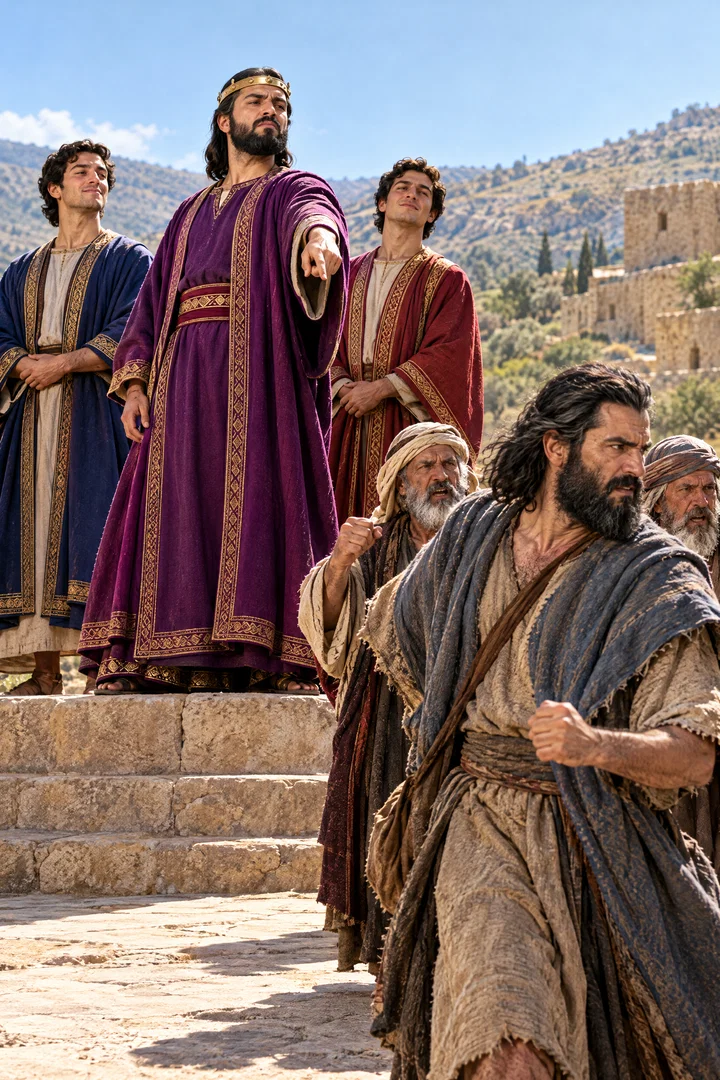
And spake to them after the counsel of the young men, saying, My father made your yoke heavy, and I will add to your yoke: my father also chastised you with whips, but I will chastise you with scorpions.
Translations
American King James Version, Webster Bible
And spoke to them after the counsel of the young men, saying, My father made your yoke heavy, and I will add to your yoke: my father also chastised you with whips, but I will chastise you with scorpions.
And spake to them after the counsel of the young men, saying, My father made your yoke heavy, and I will add to your yoke: my father also chastised you with whips, but I will chastise you with scorpions.
and spake to them after the counsel of the young men, saying, My father made your yoke heavy, and I will add to your yoke: my father also chastised you with whips, but I will chastise you with scorpions.
and spake to them after the counsel of the young men, saying, My father made your yoke heavy, but I will add to your yoke: my father chastised you with whips, but I will chastise you with scorpions;
and spake to them after the counsel of the young men, saying, My father made your yoke heavy, but I will add to your yoke: my father chastised you with whips, but I will chastise you with scorpions.
and speaketh unto them, according to the counsel of the lads, saying, 'My father made your yoke heavy, and I add to your yoke; my father chastised you with whips, and I — I chastise you with scorpions;'
and he spoke to them according to the advice of the young men, saying, My father made your yoke heavy, but I will add to your yoke: my father chastised you with whips, but I will chastise you with scorpions.
and spake unto them after the counsel of the young men, saying, My father, made your yoke heavy, but, I, will add unto your yoke,—My father, chastised you, with whips, but, I, will chastise you, with scorpions.
Berean Standard Bible, Majority Standard Bible
and spoke to them as the young men had advised, saying, “Whereas my father made your yoke heavy, I will add to your yoke. Whereas my father scourged you with whips, I will scourge you with scorpions.”
and spoke to them according to the counsel of the young men, saying, “ My father made your yoke heavy, but I will add to your yoke. My father chastised you with whips, but I will chastise you with scorpions.”
But giving them the answer put forward by the young men, saying, My father made your yoke hard, but I will make it harder; my father gave you punishment with whips, but I will give it with snakes.
And spake to them after the counsell of the yong men, saying, My father made your yoke grieuous, and I will make your yoke more grieuous: my father hath chastised you with rods, but I will correct you with scourges.
Douay-Rheims (Challoner revision)
And he spoke to them according to the counsel of the young men, saying: My father made your yoke heavy, but I will add to your yoke: my father beat you with whips, but I will beat you with scorpions.
Pictures
Cross-references
- 1 Kings 11:29-31
And it came to pass at that time when Jeroboam went out of Jerusalem, that the prophet Ahijah the Shilonite found him in the way; and he had clad himself with a new garment; and they two were alone in the field:
Ahijah foretells that ten tribes will be taken from Solomon’s house and given to Jeroboam.
- 1 Kings 11:35
But I will take the kingdom out of his son’s hand, and will give it unto thee, even ten tribes.
Solomon’s son loses ten tribes to Jeroboam.
- 1 Kings 11:40
Solomon sought therefore to kill Jeroboam. And Jeroboam arose, and fled into Egypt, unto Shishak king of Egypt, and was in Egypt until the death of Solomon.
Jeroboam fled to Egypt from Solomon and returned after Solomon’s death.
- 2 Samuel 7:14
I will be his father, and he shall be my son. If he commit iniquity, I will chasten him with the rod of men, and with the stripes of the children of men:
The promised chastening of David’s son contrasts with Rehoboam’s harsher punishment.
- 2 Chronicles 10:14
And answered them after the advice of the young men, saying, My father made your yoke heavy, but I will add thereto: my father chastised you with whips, but I will chastise you with scorpions.
Both texts repeat the threat of harsher rule.
- 2 Chronicles 10:3-7
And they sent and called him. So Jeroboam and all Israel came and spake to Rehoboam, saying,
Gives the parallel account of the people’s request and the elders’ counsel.
- 1 Kings 12:3-5
That they sent and called him. And Jeroboam and all the congregation of Israel came, and spake unto Rehoboam, saying,
gives the plea for relief he answers
- 1 Kings 12:9
And he said unto them, What counsel give ye that we may answer this people, who have spoken to me, saying, Make the yoke which thy father did put upon us lighter?
Rehoboam seeks advice on how to answer the people.
- 1 Kings 11:43
And Solomon slept with his fathers, and was buried in the city of David his father: and Rehoboam his son reigned in his stead.
identifies Rehoboam as the king who speaks
- 1 Kings 12:20
And it came to pass, when all Israel heard that Jeroboam was come again, that they sent and called him unto the congregation, and made him king over all Israel: there was none that followed the house of David, but the tribe of Judah only.
gives the rebellion that followed the refusal
- 1 Kings 11:11
Wherefore the LORD said unto Solomon, Forasmuch as this is done of thee, and thou hast not kept my covenant and my statutes, which I have commanded thee, I will surely rend the kingdom from thee, and will give it to thy servant.
The Lord announces that Solomon’s kingdom will be torn away.
- 1 Kings 11:13
Howbeit I will not rend away all the kingdom; but will give one tribe to thy son for David my servant’s sake, and for Jerusalem’s sake which I have chosen.
One tribe is reserved for Solomon’s son for David’s sake.
Commentary
Each commentary is drawn from primary sources: the writings of Ellen G. White and Adventist pioneers and periodicals. Each commentary is separate. Its own words are not a quotation; follow the references to read the source passages.
Ellen G. White
3 sources
On the third day at Shechem, Rehoboam answers Jeroboam and all the people.RH Jul 3, 1913 He forsakes the counsel of the old men and speaks after the counsel of the young men, his chosen younger advisers.RH Jul 3, 1913PK 89.1–90.1RH Jul 10, 1913 He answers the people roughly and harshly, refusing to lighten their burdens and disregarding their request for decided reforms in the administration of government.RH Jul 3, 1913PK 89.1–90.1RH Jul 10, 1913
He declares he will make heavier the heavy yoke imposed under Solomon and will punish more severely than before, with chastisement by scorpions in place of whips, thus perpetuating and adding to the oppressive evils introduced in Solomon's reign.RH Jul 3, 1913PK 89.1–90.1RH Jul 10, 1913 The answer is an irreparable mistake that reveals pride of position and authority, a determination to rule by force, action without wisdom or feeling in the exercise of power, and failure to understand God's purpose for Israel.PK 89.1–90.1RH Jul 10, 1913 His refusal to listen happens because the cause is from the Lord to perform what the Lord had spoken by Ahijah the Shilonite to Jeroboam the son of Nebat, and the Lord does not allow Rehoboam to carry out the policy he proposes.RH Jul 3, 1913RH Jul 10, 1913
When all Israel sees the king will not listen, the tribes, thoroughly aroused by Solomon's oppressive measures, rebel against the house of David in harmony with the prediction of the rending of the kingdom.RH Jul 3, 1913RH Jul 10, 1913 They disown any portion in David and any inheritance in the son of Jesse, telling Israel to return to their tents and David to care for his own house, and departing to their tents.RH Jul 3, 1913 So the twelve tribes are divided with Judah and Benjamin under Rehoboam and the ten northern tribes under Jeroboam, while Rehoboam continues to reign over those who dwell in the cities of Judah.RH Jul 3, 1913RH Jul 10, 1913
Sources
Pioneers and periodicals
26 sources
At Shechem after Solomon's death Rehoboam sought the throne when Jeroboam and the northern tribes came to ask relief from the heavy taxes, forced labor and oppression laid upon them under Solomon.RH Jul 3, 1913ST Dec 7, 1882ST Jul 23, 1885 He forsook the counsel of the old men and heeded his young, inexperienced counselors, answering the people roughly and refusing to lighten their service while threatening to make his father's already heavy yoke still heavier.RH Jul 3, 1913ST Apr 28, 1909ST Jun 22, 1904ST Dec 7, 1882ST Jun 22, 1904 Whips were the lash used to drive compulsory labor and punish stubbornness, and scorpions were thongs set with sharp iron points used in castigating slaves, so the contrast promised a still harsher rule.ST Jun 22, 1904ST Jun 22, 1904 That weak and foolish answer divided the kingdom, causing the ten tribes to revolt to Jeroboam and leave only Judah and Benjamin under Rehoboam.RH Jul 3, 1913RH May 25, 1916ST Apr 28, 1909ST Jul 30, 1885 Yet his refusal to listen was from the Lord to fulfill what had been spoken by Ahijah the Shilonite to Jeroboam, in judgment on Solomon for breaking the covenant, showing pride going before destruction and the heavy responsibility of leaders to heed wise counsel and seek the people's welfare.RH Jul 3, 1913ST Jun 25, 1885ST Jun 22, 1904ST Jun 22, 1904ST Sep 7, 1904
Setting and Meaning
The setting is the national assembly at Shechem after Solomon's death, when Rehoboam sought the throne and Jeroboam and all the people, the northern tribes, came to him on the third day to ask relief from the heavy taxes, forced labor, and oppression imposed under Solomon.RH Jul 3, 1913ST Dec 7, 1882ST Jul 23, 1885RH Apr 7, 1910ST Jun 22, 1904 The request was for lighter service, for an easing of the taxes and compulsory labor exacted in Solomon's reign.ST Jul 23, 1885ST Jun 22, 1904ST Sep 8, 1898 The answer recorded here was given on that third day to Jeroboam and all the people, and it became the turning point that led the tribes outside Judah and southern Benjamin to revolt and choose Jeroboam as king.RH Jul 3, 1913ST Jul 23, 1885RH Apr 7, 1910
Rehoboam forsook the counsel of the old men and spoke after the counsel of the young men, heeding inexperienced counselors and disregarding the older advisers.RH Jul 3, 1913ST Jun 22, 1904ST Jun 22, 1904ST Jul 23, 1885ST Dec 1, 1914 He answered the people roughly and harshly, refusing to regard their welfare and refusing their request to lighten taxes and service.RH Jul 3, 1913ST Jun 22, 1904ST Jun 22, 1904ST Jul 23, 1885RH Apr 23, 1908 This arbitrary course brought disaster, breaking the kingdom so that only two tribes would submit to him instead of his ruling over all Israel as Solomon his father had done.RH Apr 23, 1908
He admitted his father's yoke was heavy and threatened to make it still heavier, declaring his father had chastised with whips but he would chastise with scorpions.ST Apr 28, 1909ST Jun 22, 1904ST Dec 7, 1882ST Apr 28, 1909ST Jul 30, 1885 The contrast is between an already heavy burden and a still harsher rule, with scorpions describing a harsher chastisement than whips and with the promise to increase the burdens and punish more severely than his father had.ST Jun 22, 1904ST Dec 7, 1882ST Dec 1, 1914 Whips were the lash freely used to drive the compulsory labor exacted in aggrandizing Jerusalem and to punish indolence or stubbornness, and scorpions were thongs thickly set with sharp iron points commonly used in castigating slaves.ST Jun 22, 1904 They were given both as an illustrative comparison of the harsher treatment to be expected in place of what was received under Solomon and as literal means of enforcing labor.ST Jun 22, 1904
The harsh answer was the weak, foolish, unsteady, and deplorable act of Rehoboam, Solomon's son.ST Apr 28, 1909ST Apr 28, 1909ST May 20, 1913 It marks the unsteady reign of the weak Rehoboam and the division of the kingdom between Judah and Israel, belonging to the account of the revolt of the ten tribes and the beginning of the separate kingdoms.RH May 25, 1916ST Apr 28, 1909ST Apr 28, 1909 It caused the ten tribes to revolt to Jeroboam, separating Israel from Judah and Benjamin.ST Dec 7, 1882ST May 20, 1913
By that answer Rehoboam lost a large part of his kingdom, ten of Israel's twelve tribes, through his stubbornness and his listening to inexperienced counselors.ST Jul 30, 1885ST Dec 1, 1914 When all Israel saw that the king would not listen to them, they declared they had no portion in David and no inheritance in the son of Jesse, told Israel to go to their tents and David to see to his own house, and departed to their tents, while Rehoboam continued to reign over the children of Israel who dwelt in the cities of Judah.RH Jul 3, 1913RH Jul 10, 1913 The result left Judah and Benjamin under Rehoboam and the ten northern tribes under Jeroboam, with war and strife between the two divisions from that time on and with the kingdom of the ten tribes stormy from that rebellion onward.RH Jul 10, 1913ST May 20, 1913ST Apr 17, 1907
Providence and Instruction
The king's refusal to listen to the people was from the Lord, to perform what the Lord had spoken by Ahijah the Shilonite to Jeroboam the son of Nebat, that ten tribes would be given to Jeroboam.RH Jul 3, 1913ST Jul 23, 1885ST Jun 22, 1904 It fulfilled the Lord's judgment on Solomon for breaking the covenant and turning to other gods, that the kingdom would be torn from Solomon's house though one tribe would remain for David's sake.ST Jun 25, 1885 On the third day he answered Jeroboam and all the people roughly, forsaking the counsel of the old men and speaking after the counsel of the young men to make the yoke heavier and the punishment more severe.RH Jul 3, 1913ST Jun 22, 1904ST Jul 23, 1885 That answer refused the request to lighten taxes, service, and forced labor, and brought the turning point by which the tribes outside Judah and southern Benjamin revolted and chose Jeroboam as king.ST Jun 22, 1904RH Apr 7, 1910ST Jun 22, 1904 The turn the Lord foresaw and foretold in Solomon's day was thus performed through this harsh reply.ST Jun 25, 1885ST Sep 7, 1904
The division stood at the end of Solomon's failures, for his mistake in multiplying wives to himself and turning his heart from God left division with war and strife between the divisions from that time on.ST May 20, 1913 His oppressive measures thoroughly aroused the tribes, and Rehoboam announced his intention to perpetuate and add to the oppressive evils introduced in Solomon's reign.RH Jul 10, 1913 Had Solomon used his God-given wisdom faithfully throughout his reign, he would not have left a weak, vacillating, pampered son, and the division would not have taken place. The Lord did not allow Rehoboam to carry out the oppressive policy he proposed.RH Jul 10, 1913
The reply shows pride and a haughty spirit going before destruction and a fall, for in answer to the people's petition he refused to regard their welfare and threatened a heavier yoke and harsher chastisement than his father had imposed.ST Jun 22, 1904 His rashness, foolish stubbornness, and disregard of wise counsel hastened the division, and his conduct led to the loss of the ten tribes.ST Sep 7, 1904 He and his chosen counselors acted unwisely and without feeling in the exercise of power and revealed pride of position and authority, instead of understanding God's purpose for Israel and listening to the request for decided reforms in the administration of government.RH Jul 10, 1913 Had he acted wisely the ten tribes would have remained with him, and Jeroboam, the energetic, ambitious agitator, might have been content to fill some important office under him, but instead Jeroboam became the first king of the turbulent ten tribes, and that northern kingdom was stormy from the rebellion onward.ST Apr 17, 1907
Leaders bear heavy responsibility, since faithful leaders strongly shape the people toward right ways, while leaders who fail lead the people to fail as well.ST Apr 26, 1910 Rehoboam's arbitrary course in refusing the counsel of the old men and speaking after the counsel of the young men brought disaster, breaking the kingdom so that only two tribes would submit to him instead of his ruling over all Israel as Solomon his father had done.RH Apr 23, 1908 Young workers therefore need old men of experience joined with them as counselors, and faithful aged workers who have remained loyal should be honored and given place in new fields.RH Apr 23, 1908 Such honored aged workers bring fresh life and joy and courage to themselves and to their younger brethren.RH Apr 23, 1908
The histories beginning with the revolt of the ten tribes and the separate kingdoms of Judah and Israel are traced for about eighty years, through the death of Jehoshaphat.RH May 25, 1916 The northern kingdom that resulted from that division later faced a 215-year trial before its final rejection.ST Dec 7, 1904 After Solomon's death the ten tribes separated from Judah and Benjamin under Jeroboam, and they carried their copies of the books of Moses with them.RH May 1, 1879
Jeroboam's rule began after the ten tribes were separated from Solomon's son and given to him.RH Aug 1, 1871 Although he believed in the true God, he made golden calves as representations of God and directed Israel to worship before them so the people would not return to Jerusalem.RH Aug 1, 1871 This was a violation of the second commandment, not initially a rejection of the true God for another deity.RH Aug 1, 1871
The escalation from whips to scorpions contrasts an already heavy burden and punishment with a still harsher rule, with scorpions representing greater severity than whips.ST Dec 16, 1886 Seeking punishments harsher than existing penalties for disturbing worship is likened to that escalation, in demands for Sunday laws whose real target is Sunday work that challenges the advocates' doctrine, not disturbance of worship.ST Dec 16, 1886 The same image teaches that hasty actions may later be reconsidered with painful regret, as though second thought carried a whip of scorpions.RH Jan 12, 1860
Sources