1 Kings 12:9
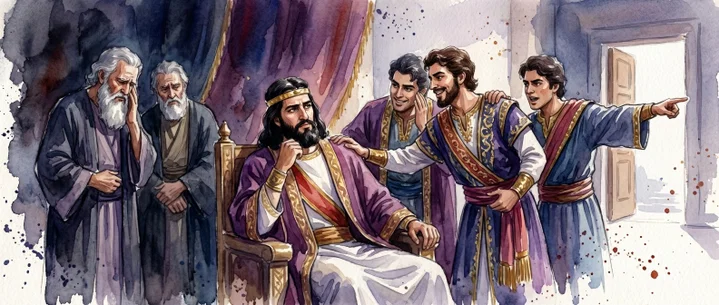
And he said unto them, What counsel give ye that we may answer this people, who have spoken to me, saying, Make the yoke which thy father did put upon us lighter?
Translations
And he said to them, What counsel give you that we may answer this people, who have spoken to me, saying, Make the yoke which your father did put on us lighter?
And he said unto them, What counsel give ye that we may answer this people, who have spoken to me, saying, Make the yoke which thy father did put upon us lighter?
and he said unto them, What counsel give ye that we may answer this people, who have spoken to me, saying, Make the yoke which thy father did put upon us lighter?
And he said to them, What counsel give ye that we may answer this people, who have spoken to me, saying, Make the yoke which thy father did put upon us lighter?
Revised Version, American Standard Version
And he said unto them, What counsel give ye, that we may return answer to this people, who have spoken to me, saying, Make the yoke that thy father did put upon us lighter?
and he saith unto them, 'What are ye counselling, and we answer this people, who have spoken unto me, saying, Lighten [somewhat] of the yoke that thy father put upon us?'
And he said to them, What advice give ye that we may return answer to this people who have spoken to me saying, Lighten the yoke which thy father put upon us?
and said unto them—What counsel do, ye, give as to how we shall answer this people who have spoken unto me, saying—Make a lightening of the yoke which thy father put upon us?
Berean Standard Bible, Majority Standard Bible
He asked them, “ What message do you advise that we send back to these people who have spoken to me, saying, ‘ Lighten the yoke your father put on us’?”
He said to them, “ What counsel do you give, that we may answer these people who have spoken to me, saying, ‘ Make the yoke that your father put on us lighter’?”
And said to them, What is your opinion? What answer are we to give to this people who have said to me, Make less the weight of the yoke which your father put on us?
And he said vnto them, What counsell giue ye, that we may answere this people, which haue spoken to me, saying, Make the yoke, which thy father did put vpon vs, lighter?
Douay-Rheims (Challoner revision)
And he said to them: What counsel do you give me, that I may answer this people, who have said to me: Make the yoke which thy father put upon us lighter?
Pictures
Cross-references
- 2 Chronicles 10:3-7
And they sent and called him. So Jeroboam and all Israel came and spake to Rehoboam, saying,
The parallel account records the people’s request and the elders’ counsel.
- 1 Kings 12:15
Wherefore the king hearkened not unto the people; for the cause was from the LORD, that he might perform his saying, which the LORD spake by Ahijah the Shilonite unto Jeroboam the son of Nebat.
Rehoboam’s decision and the resulting revolt fulfilled the Lord’s purpose.
- 1 Kings 11:11-13
Wherefore the LORD said unto Solomon, Forasmuch as this is done of thee, and thou hast not kept my covenant and my statutes, which I have commanded thee, I will surely rend the kingdom from thee, and will give it to thy servant.
The foretold division of Solomon’s kingdom is fulfilled when the people demand a lighter yoke.
- 1 Kings 11:31-37
And he said to Jeroboam, Take thee ten pieces: for thus saith the LORD, the God of Israel, Behold, I will rend the kingdom out of the hand of Solomon, and will give ten tribes to thee:
Ahijah foretells the kingdom’s division and Jeroboam’s rule over ten tribes.
- 1 Kings 12:4
Thy father made our yoke grievous: now therefore make thou the grievous service of thy father, and his heavy yoke which he put upon us, lighter, and we will serve thee.
The people’s request to lighten the yoke prompted Rehoboam’s question.
- 1 Kings 11:13
Howbeit I will not rend away all the kingdom; but will give one tribe to thy son for David my servant’s sake, and for Jerusalem’s sake which I have chosen.
The sentence against Solomon precedes the kingdom’s revolt and division.
Commentary
Each commentary is drawn from primary sources: the writings of Ellen G. White and Adventist pioneers and periodicals. Each commentary is separate. Its own words are not a quotation; follow the references to read the source passages.
Ellen G. White
4 sources
The yoke complained of was grinding taxation laid on the poor of the nation to pay for extravagance practiced in selfish indulgence.Ms 164, 1902, par. 17 That oppressive burden came because God was not made guide and counselor, self-indulgence became god, fine sensibilities were blunted, and the conscientious, considerate spirit of the early reign was changed.Ms 164, 1902, par. 17 Evil counselors swayed the once noble, independent mind toward severe judgment and cruel tyranny, changing the wisest king that ever swayed a scepter into a despot, and because the king was the idol of the nation, what he did and said was copied.Ms 164, 1902, par. 17
The people had asked Rehoboam to lighten the heavy yoke and burden imposed by his father Solomon, and the question in the verse is his asking for counsel on how to answer them.PK 89.1–90.1RH Jul 10, 1913RH Jul 3, 1913Ms 164, 1902, par. 17 He directed that question to the younger men he had grown up with, his young companions.PK 89.1–90.1RH Jul 3, 1913 Their counsel was to reject the request for reform, to rule harshly and resist interference, and to threaten to preserve and increase the people's burdens, oppressive policies, and harsh treatment.PK 89.1–90.1RH Jul 10, 1913RH Jul 3, 1913
Rehoboam chose that advice of the younger men over the older men's counsel to treat the people kindly.PK 89.1–90.1 His rough answer therefore promised to increase their burden rather than lighten it.PK 89.1–90.1RH Jul 10, 1913 That mistake helped bring about the division of the kingdom, as the people's revolt fulfilled the prophet's prediction and the ten northern tribes separated from Judah and Benjamin.RH Jul 10, 1913
Sources
Pioneers and periodicals
19 sources
Rehoboam, Solomon's weak and vacillating son and successor, spoke these words at the national assembly at Shechem after Solomon's death when the people reasonably asked for relief from the heavy taxation and oppression his father had laid upon them.RH May 25, 1916ST Apr 28, 1909ST Dec 7, 1882RH Dec 14, 1905 The crisis followed Solomon's failure, whose idolatry and multiplying of wives turned his heart from God and brought the Lord's declaration that the kingdom would be torn from him and given to his servant, with one tribe retained for David's sake.ST Jun 25, 1885ST May 20, 1913 Though he first sought the counsel of Solomon's older counselors, Rehoboam rejected it and turned to the young men who had grown up with him, who urged him to answer with greater severity and threaten increased burdens and harsh treatment.RH Jul 3, 1913RH Dec 14, 1905RH Sep 8, 1853 By following that counsel and harshly refusing reform while announcing that he would preserve and increase the oppressive policies, his imprudent stubbornness cost him the ten northern tribes, who separated from Judah and Benjamin and made the stronger and ambitious Jeroboam king, fulfilling the prophet's prediction.RH Jul 10, 1913RH Sep 8, 1853ST Jul 30, 1885ST May 20, 1913ST Apr 17, 1907 The history stands as an object-lesson in leadership, that when leaders are faithful to God they influence the people toward faithfulness and when they fail to lead rightly the people fail with them, showing the value of experienced older counselors and the disastrous danger of rejecting them for arbitrary rule.ST Apr 26, 1910ST Apr 28, 1909RH Apr 23, 1908
Setting and Request
The verse stands in the account of the revolt of the ten tribes at the national assembly at Shechem after Solomon's death, which divided the kingdom and began the separate kingdoms of Judah and Israel.RH May 25, 1916ST Apr 26, 1910ST Dec 7, 1904 It belongs to the story of Israel's separation from Judah and Benjamin under Jeroboam, told in 1 Kings 12 to 16.ST Dec 7, 1882RH May 1, 1879 That division began the northern kingdom's 215-year period of trial before its final rejection.ST Dec 7, 1904 The separated tribes carried copies of the books of Moses with them into that division.RH May 1, 1879
The division followed Solomon's failure, for his idolatry turned his heart from God and the Lord declared the kingdom would be torn from him and given to his servant, with one tribe retained for David's sake.ST Jun 25, 1885 It came through his mistake in multiplying wives to himself and turning away his heart from God, leaving two and a half tribes in Judah and ten tribes in Israel, with war and strife between the two divisions from that time on.ST May 20, 1913 It followed from his failure to use his God-given wisdom for God throughout his reign.
Rehoboam, Solomon's son and successor, was weak, foolish, unsteady, unsettled, vacillating and stubborn.ST Apr 28, 1909ST Jul 30, 1885 He was a deplorably weak king and a pampered son of Solomon, whose imprudent stubbornness in handling the people's request cost him a large part of the kingdom.ST Jul 30, 1885ST May 20, 1913ST Apr 17, 1907 Jeroboam, who induced Israel to revolt, was in some respects a much stronger king than he.ST May 20, 1913 That energetic and ambitious agitator became the first king of the turbulent ten tribes, beginning their stormy history.ST Apr 17, 1907
In the verse Rehoboam asks his advisers how to answer the people's request to lighten the heavy yoke his father put on them.ST Apr 28, 1909ST Dec 7, 1882ST Apr 26, 1910 He asks especially the young men who had grown up with him, and his young companions, what answer he should give.RH Jul 3, 1913RH Dec 14, 1905ST Jun 25, 1885 The people's grievance was reasonable and real, for Solomon had taxed and oppressed them with heavy demands.ST Dec 7, 1882ST Apr 17, 1907ST Jun 25, 1885 Those heavy demands were what Samuel had warned would happen under a king.ST Jun 25, 1885
Outcome and Lessons
Rehoboam first sought the counsel of Solomon's older counselors and then rejected it, turning instead to the young men who had grown up with him to ask how to answer the people's request to lighten the heavy yoke his father had put on them.RH Dec 14, 1905RH Sep 8, 1853ST Jun 25, 1885 The people's grievance was real and reasonable, for Solomon had laid heavy demands and taxation upon them, as Samuel had warned a king would do.ST Apr 17, 1907ST Jun 25, 1885 The young companions urged him to reject the plea for relief and to answer with greater severity, threatening increased burdens and harsher treatment.RH Jul 3, 1913RH Dec 14, 1905ST Jun 25, 1885
Following that advice he rejected reform and refused the reasonable demand for relief, announcing that he would preserve and even increase the oppressive policies and answering harshly.RH Jul 10, 1913RH Sep 8, 1853ST Apr 17, 1907 Had he acted wisely and answered well, the ten tribes would have remained with him.ST Apr 17, 1907 His imprudent stubbornness in handling the request cost him a large part of the kingdom.ST Jul 30, 1885ST Apr 17, 1907
Israel then rebelled against the house of David, and the ten northern tribes separated from Judah and Benjamin and made Jeroboam king, while only Judah followed Rehoboam.RH Jul 10, 1913RH Sep 8, 1853ST May 20, 1913 Instead of ruling over all Israel as Solomon his father had, only two tribes would submit to him, for his arbitrary rule divided the kingdom.ST May 20, 1913RH Apr 23, 1908 This revolt fulfilled the prophet's prediction.RH Jul 10, 1913 From that time war and strife lay between the two divisions, beginning the stormy history of the turbulent northern kingdom under the energetic and ambitious agitator Jeroboam who had induced Israel to revolt.ST May 20, 1913ST Apr 17, 1907 That division opened the northern kingdom's 215-year period of trial before its final rejection.ST Dec 7, 1904
The separated tribes carried copies of the books of Moses with them when the ten tribes separated from Judah and Benjamin under Jeroboam after Solomon's death.RH May 1, 1879 Jeroboam's concern was to keep the people from going up to Jerusalem to worship, and to do so he represented the true God by golden calves, violating the second commandment rather than at first turning them from the true God.RH Aug 1, 1871 That image worship prepared the way for Ahab to replace Jehovah with Baal, openly violating the first commandment.RH Aug 1, 1871
The history stands as an object-lesson of the fruits of righteousness and of backsliding and sin in the weak, unsteady and unsettled reign of Rehoboam and the division between Judah and Israel.ST Apr 28, 1909 It shows that the conduct of leaders matters greatly, for when leaders are faithful to God they influence the people toward faithfulness, and when they fail to lead rightly the people fail with them.ST Apr 26, 1910 It teaches the value of experienced older counselors and the disastrous danger of rejecting them for arbitrary rule.RH Apr 23, 1908
Sources