1 Kings 12:10
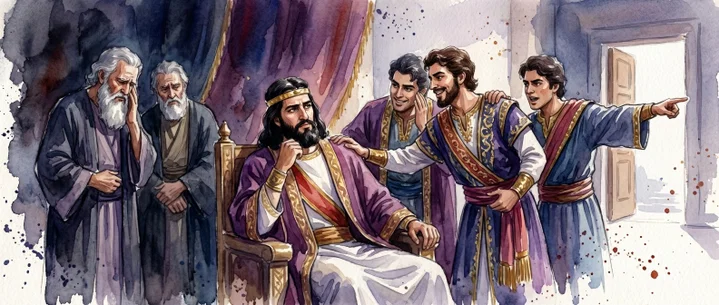
And the young men that were grown up with him spake unto him, saying, Thus shalt thou speak unto this people that spake unto thee, saying, Thy father made our yoke heavy, but make thou it lighter unto us; thus shalt thou say unto them, My little finger shall be thicker than my father’s loins.
Translations
And the young men that were grown up with him spoke to him, saying, Thus shall you speak to this people that spoke to you, saying, Your father made our yoke heavy, but make you it lighter to us; thus shall you say to them, My little finger shall be thicker than my father’s loins.
King James Version, KJV Cambridge Paragraph Bible
And the young men that were grown up with him spake unto him, saying, Thus shalt thou speak unto this people that spake unto thee, saying, Thy father made our yoke heavy, but make thou it lighter unto us; thus shalt thou say unto them, My little finger shall be thicker than my father’s loins.
And the young men that had grown up with him spoke to him, saying, Thus shalt thou speak to this people who spoke to thee, saying, Thy father made our yoke heavy, but make thou it lighter to us; thus shalt thou say to them, My little finger shall be thicker than my father's loins.
Revised Version, American Standard Version
And the young men that were grown up with him spake unto him, saying, Thus shalt thou say unto this people that spake unto thee, saying, Thy father made our yoke heavy, but make thou it lighter unto us; thus shalt thou speak unto them, My little finger is thicker than my father’s loins.
And they speak unto him — the lads who had grown up with him — saying, 'Thus dost thou say to this people who have spoken unto thee, saying, Thy father made our yoke heavy, and thou, make [it] light upon us; thus dost thou speak unto them, My little [finger] is thicker than the loins of my father;
And the young men that had grown up with him spoke to him saying, Thus shalt thou say to this people that have spoken to thee saying, Thy father made our yoke heavy, and lighten thou it for us, — thus shalt thou say to them: My little [ finger] is thicker than my father's loins;
Then spake unto him the young men who had grown up with him, saying, Thus, shalt thou say to this people that have spoken unto thee, saying—Thy father, made our yoke heavy, thou, therefore lighten it upon us, Thus, shalt thou speak unto them, My little finger, is thicker than my father’s loins;
The young men who had grown up with him replied, “ This is how you should answer these people who said to you, ‘ Your father made our yoke heavy, but you should make it lighter.’ This is what you should tell them: ‘ My little finger is thicker than my father’s waist!
The young men who had grown up with him replied, “ This is how you should answer these people who said to you, ‘ Your father made our yoke heavy, but you must make it lighter.’ This is what you should tell them: ‘ My little finger is thicker than my father’s waist!
The young men who had grown up with him said to him, “ Tell these people who spoke to you, saying, ‘ Your father made our yoke heavy, but make it lighter to us’— tell them, ‘ My little finger is thicker than my father’s waist.
And the young men of his generation said to him, This is the answer to give to the people who came to you saying, Your father put a hard yoke on us; will you make it less? say to them, My little finger is thicker than my father's body;
Then the yong men that were brought vp with him, spake vnto him, saying, Thus shalt thou say vnto this people, that haue spoken vnto thee, and said, Thy father hath made our yoke heauie, but make thou it lighter vnto vs: euen thus shalt thou say vnto them, My least part shalbe bigger then my fathers loynes.
Douay-Rheims (Challoner revision)
And the young men that had been brought up with him, said: Thus shalt thou speak to this people, who have spoken to thee, saying: Thy father made our yoke heavy, do thou ease us. Thou shalt say to them: My little finger is thicker than the back of my father.
Pictures
Cross-references
- 2 Chronicles 10:10
And the young men that were brought up with him spake unto him, saying, Thus shalt thou answer the people that spake unto thee, saying, Thy father made our yoke heavy, but make thou it somewhat lighter for us; thus shalt thou say unto them, My little finger shall be thicker than my father’s loins.
Rehoboam’s advisers urge him to answer with the same boast about making the yoke heavier.
- 1 Kings 12:4
Thy father made our yoke grievous: now therefore make thou the grievous service of thy father, and his heavy yoke which he put upon us, lighter, and we will serve thee.
The people ask Rehoboam to lighten their burden, but his advisers urge him to increase it.
- 1 Kings 12:16-19
So when all Israel saw that the king hearkened not unto them, the people answered the king, saying, What portion have we in David? neither have we inheritance in the son of Jesse: to your tents, O Israel: now see to thine own house, David. So Israel departed unto their tents.
The people reject Rehoboam after his harsh reply, dividing the kingdom.
- 1 Kings 11:11-13
Wherefore the LORD said unto Solomon, Forasmuch as this is done of thee, and thou hast not kept my covenant and my statutes, which I have commanded thee, I will surely rend the kingdom from thee, and will give it to thy servant.
God’s announcement of the kingdom’s division sets the context for the revolt.
- 1 Kings 11:29-39
And it came to pass at that time when Jeroboam went out of Jerusalem, that the prophet Ahijah the Shilonite found him in the way; and he had clad himself with a new garment; and they two were alone in the field:
Rehoboam’s harsh answer leads to the kingdom’s division, fulfilling Ahijah’s prophecy.
- 1 Kings 12:28-30
Whereupon the king took counsel, and made two calves of gold, and said unto them, It is too much for you to go up to Jerusalem: behold thy gods, O Israel, which brought thee up out of the land of Egypt.
Jeroboam’s golden calves led Israel into idolatrous worship.
- 1 Samuel 8:11-17
And he said, This will be the manner of the king that shall reign over you: He will take your sons, and appoint them for himself, for his chariots, and to be his horsemen; and some shall run before his chariots.
Both texts describe a king burdening the people with demands and service.
Commentary
Each commentary is drawn from primary sources: the writings of Ellen G. White and Adventist pioneers and periodicals. Each commentary is separate. Its own words are not a quotation; follow the references to read the source passages.
Ellen G. White
3 sources
Solomon's later reign exchanged a conscientious, considerate, noble and independent spirit for severe judgment and cruel tyranny, because he failed to make God his guide and counselor, allowed evil counselors to sway his mind, let his fine sensibilities become blunted, and made self-indulgence his god, falling from the wisest king ever to rule to a despot whom the nation idolized and copied.Ms 164, 1902, par. 17 That harsh, tyrannical spirit produced the heavy yoke, which was grinding taxation laid on the poor of the nation to support the extravagance of his selfish indulgence.Ms 164, 1902, par. 17
At Shechem the people asked Rehoboam for relief in lighter burdens and for decided reforms in the administration of government.RH Jul 10, 1913RH Jul 3, 1913 The young men grown up with him and chosen as his counselors urged him to answer with a threat of harsher rule, that his rule would perpetuate and increase his father's oppressive rule and be even more oppressive than Solomon's.RH Jul 10, 1913RH Jul 3, 1913 In taking that advice he made an irreparable mistake at Shechem, using power unwisely and without feeling from pride of position and authority, failing to understand God's purpose for Israel, refusing the requested reforms, and announcing he would continue and add to the oppressive evils introduced under Solomon.RH Jul 10, 1913 God did not permit him to carry out that harsh policy, for the tribes, already thoroughly aroused by Solomon's oppression, rebelled against the house of David, dividing the twelve tribes with Judah and Benjamin under Rehoboam and the ten northern tribes under Jeroboam, in fulfillment of the prophet's prediction of the rending of the kingdom.RH Jul 10, 1913
Sources
Pioneers and periodicals
20 sources
After Solomon's death the ten northern tribes met Rehoboam at Shechem asking relief from the heavy yoke Solomon had laid on them, and when he refused they revolted from Judah and Benjamin and made Jeroboam king over Israel.RH May 25, 1916ST Apr 26, 1910ST Apr 28, 1909 Rehoboam was a weak and unsteady son of Solomon who rejected the counsel of the older men and followed the young men grown up with him.ST Apr 28, 1909ST Apr 28, 1909ST Jul 30, 1885 Those conceited advisers told him to treat the plea for lighter burdens as rebellion and to threaten still harsher rule, that his little finger would be thicker than his father's loins, meaning where his father chastised with whips he would chastise with scorpions.RH Dec 14, 1905ST Dec 7, 1882 His harsh answer helped provoke the tribes, already aroused by Solomon's oppression, to rebel against the house of David, so only two tribes submitted to him while Jeroboam became king of the turbulent ten.RH Dec 14, 1905ST Dec 7, 1882ST Apr 28, 1909 The division was rooted in Solomon's unfaithfulness to God's covenant in multiplying wives and failing to use his wisdom for God, and it stands as an object-lesson that a leader's refusal of right counsel and decided reforms adds evil to evil, where gentleness could have conciliated the people and saved the kingdom from anarchy and ruin.ST Jun 25, 1885ST Apr 26, 1910ST May 20, 1913ST Apr 17, 1907
Setting and Counsel's Meaning
The rending of the kingdom was rooted in Solomon's unfaithfulness, for he forsook God's covenant and statutes.ST Jun 25, 1885 He multiplied wives to himself and let them turn his heart from God, and he failed to use his God-given wisdom for God.ST May 20, 1913 His course left Israel with a weak, vacillating son, and the division would not have taken place if he had remained faithful. In his last days he repented when he penned Ecclesiastes, yet the division came because of transgression and because of his mistakes.ST May 20, 1913ST Apr 23, 1912
After Solomon's death the ten tribes revolted at Shechem and separated from Judah and Benjamin under Jeroboam.RH Jul 10, 1913RH May 1, 1879 Judah and Benjamin remained under Rehoboam, while the ten northern tribes stood under Jeroboam as Israel.RH Jul 10, 1913 The reckoning was ten tribes in Israel and two and a half tribes in Judah, with war and strife between the two divisions from that time on.ST May 20, 1913 This took place in harmony with the prophet's prediction of the rending of the kingdom, and in that separation the tribes carried their copies of the books of Moses with them.RH Jul 10, 1913RH May 1, 1879 The account belongs to the division into the kingdoms of Judah and Israel after Solomon's death and Rehoboam's reign.RH May 25, 1916ST Apr 26, 1910ST Apr 28, 1909
Rehoboam, Solomon's pampered son, was a weak, unsteady and unsettled king, described as deplorable, degenerate and effeminate.ST Apr 28, 1909ST Apr 28, 1909ST Apr 17, 1907ST Apr 26, 1910 His imprudent stubbornness, foolish stubbornness, and unwise refusal of the people's reasonable request for relief made him fail to keep the Ten Tribes with him.ST Jul 30, 1885ST Apr 17, 1907 He rejected the older men's counsel and followed his chosen young counselors.RH Jul 10, 1913RH Apr 23, 1908
Those young men grown up with him were conceited young advisers.RH Jul 10, 1913 They urged him to treat the people's request to lighten the heavy yoke imposed by Solomon as rebellion and to answer with a threat of even harsher rule.RH Dec 14, 1905RH Sep 8, 1853RH Apr 23, 1908 Their prescribed boast that his little finger would be thicker than his father's loins meant his rule would be far more oppressive, that where his father chastised with whips he would chastise with scorpions.ST Dec 7, 1882 In this he revealed pride of position and authority and used power unwisely and without feeling.RH Jul 10, 1913 Instead of understanding God's purpose for Israel and granting decided reforms in the administration of government, he announced his intention to perpetuate and add to the oppressive evils introduced in Solomon's reign.RH Jul 10, 1913
His harsh response helped provoke the ten tribes, thoroughly aroused by Solomon's oppression, to rebel against the house of David and separate from Judah and Benjamin.RH Jul 10, 1913RH Dec 14, 1905ST Dec 7, 1882 By that course a large portion of the kingdom was taken from him, and only two tribes submitted to his rule.ST Jul 30, 1885RH Apr 23, 1908 God did not allow him to carry out that harsh policy.RH Jul 10, 1913 His refusal made Jeroboam, an energetic, ambitious and stronger agitator, the first king of the turbulent Ten Tribes, whose kingdom was stormy from that rebellion onward and whose idolatry marked the ten tribes.ST Apr 28, 1909ST May 20, 1913ST Apr 17, 1907
Lessons and Later Uses
The account to which the verse belongs is the history of the division of the kingdom after Solomon's death under the reign of Rehoboam.ST Apr 26, 1910 That history, centered on the weak Rehoboam and his unsteady and unsettled reign that divided the kingdom between Judah and Israel, including the idolatry of Jeroboam over the ten tribes, stands as an object-lesson of the fruits of righteousness and of backsliding and sin.ST Apr 28, 1909 It belongs to the record showing that when leaders failed to lead rightly, the people failed with them.ST Apr 26, 1910
Rehoboam, the pampered son of Solomon, failed to act wisely to keep the ten tribes with him by his unwise refusal of the people's reasonable demand to lighten the heavy yoke put upon them.ST Apr 17, 1907 He followed the harsh counsel of the conceited young men instead of answering Israel's request to lighten the heavy yoke imposed by his father, and his severity added evil to evil.ST Apr 17, 1907RH Dec 5, 1865 Gentleness could have conciliated the people and saved the kingdom from anarchy and ruin, while his rule brought tumult, wars, rebellion, separation, and captivity.RH Dec 5, 1865 Had he yielded, the ten tribes would have remained with him and Jeroboam might have been content to fill some important office under him, but his refusal caused their rebellion and made Jeroboam, an energetic and ambitious agitator, the first king of the turbulent ten tribes, whose kingdom was stormy from that rebellion onward.ST Apr 17, 1907
The division in Rehoboam's time began the northern kingdom's 215-year period of probation, which ended in rejection because its people persisted in the same sins as the nations displaced to make room for Israel.ST Dec 7, 1904 Those who persist in breaking God's law are eventually cast out.ST Dec 7, 1904 The verse also supplies the comparison that Rome was harsher than the kingdoms that came before it, for just as the advisers claimed Rehoboam's rule would weigh more heavily than his father's, Rome's rule and civil wars brought greater suffering than the three universal kingdoms preceding it.ST Aug 1, 1916 Its phrase about the little finger being thicker than the loins supplies a comparison of superior strength or standing, applied to physicians of profound research whose knowledge of tobacco's harmful effects is far greater than the speaker's.RH Jan 30, 1866
Sources