1 Kings 13:8
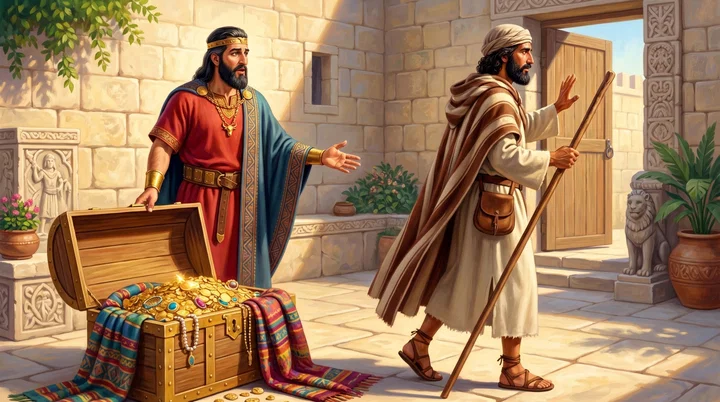
And the man of God said unto the king, If thou wilt give me half thine house, I will not go in with thee, neither will I eat bread nor drink water in this place:
Translations
And the man of God said to the king, If you will give me half your house, I will not go in with you, neither will I eat bread nor drink water in this place:
King James Version, KJV Cambridge Paragraph Bible, Revised Version
And the man of God said unto the king, If thou wilt give me half thine house, I will not go in with thee, neither will I eat bread nor drink water in this place:
And the man of God said to the king, If thou wilt give me half thy house, I will not go in with thee, neither will I eat bread nor drink water in this place:
And the man of God said unto the king, If thou wilt give me half thy house, I will not go in with thee, neither will I eat bread nor drink water in this place;
And the man of God saith unto the king, 'If thou dost give to me the half of thine house, I do not go in with thee, nor do I eat bread, nor do I drink water, in this place;
And the man of God said to the king, If thou wilt give me half thy house, I will not go in with thee, neither will I eat bread nor drink water in this place;
But the man of God said unto the king—If thou wouldst give me the half of thy house, I would not go in with thee,—neither would I eat bread or drink water, in this place;
Berean Standard Bible, Majority Standard Bible
But the man of God replied, “If you were to give me half your possessions, I still would not go with you, nor would I eat bread or drink water in this place.
The man of God said to the king, “ Even if you gave me half of your house, I would not go in with you, neither would I eat bread nor drink water in this place;
But the man of God said to the king, Even if you gave me half of all you have, I would not go in with you, and I would not take food or a drink of water in this place;
But the man of God saide vnto the King, If thou wouldest giue me halfe thine house, I would not goe in with thee, neither woulde I eate bread nor drinke water in this place.
Douay-Rheims (Challoner revision)
And the man of God answered the king: If thou wouldst give me half thy house I will not go with thee, nor eat bread, nor drink water in this place:
Pictures
Cross-references
- 1 Kings 13:18-22
He said unto him, I am a prophet also as thou art; and an angel spake unto me by the word of the LORD, saying, Bring him back with thee into thine house, that he may eat bread and drink water. But he lied unto him.
A false angelic message persuades him to disobey, and judgment is pronounced.
- 1 Kings 13:23-26
And it came to pass, after he had eaten bread, and after he had drunk, that he saddled for him the ass, to wit, for the prophet whom he had brought back.
The man of God’s disobedience is followed by his death, fulfilling the announced judgment.
- 1 Kings 13:17
For it was said to me by the word of the LORD, Thou shalt eat no bread nor drink water there, nor turn again to go by the way that thou camest.
States the Lord’s command behind the man of God’s refusal to return, eat, or drink.
- 1 Kings 13:21-22
And he cried unto the man of God that came from Judah, saying, Thus saith the LORD, Forasmuch as thou hast disobeyed the mouth of the LORD, and hast not kept the commandment which the LORD thy God commanded thee,
He is judged for disobeying the Lord’s command not to eat or drink there.
- 2 Kings 23:16-18
And as Josiah turned himself, he spied the sepulchres that were there in the mount, and sent, and took the bones out of the sepulchres, and burned them upon the altar, and polluted it, according to the word of the LORD which the man of God proclaimed, who proclaimed these words.
Josiah fulfills the man of God’s prophecy concerning the altar at Bethel.
Commentary
Each commentary is drawn from primary sources: the writings of Ellen G. White and Adventist pioneers and periodicals. Each commentary is separate. Its own words are not a quotation; follow the references to read the source passages.
Ellen G. White
7 sources
The man of God firmly refused the king's invitation, hospitality and reward, declaring that even if the king would give him half his house he would not go in with him nor eat bread nor drink water in that place.Ms 153, 1906, par. 3–6Ms 153, 1906Ms 1, 1912, par. 12PK 106.1PK 105.2 His refusal was obedience to the Lord's direct command not to eat bread or drink water in Bethel.Ms 153, 1906, par. 3–6Ms 153, 1906Ms 1, 1912, par. 12PK 106.2PK 106.1 That same divine charge also required him not to return home by the way he had come.Ms 153, 1906, par. 3–6Ms 1, 1912, par. 12PK 106.2PK 105.2
At first he obeyed, but afterward he accepted the old prophet's invitation, returned with him, and sat at table eating and drinking in disobedience to the word of the Lord, misled by a false claim of a message from God.Ms 153, 1906, par. 3–6PK 106.2PK 106.3 That disobedience led to his death, fulfilling the judgment that had been announced against him for violating the command.Ms 153, 1906, par. 3–6PK 106.3 The episode teaches that a claimed message from another prophet must never be allowed to overturn a clear, direct command from God.Ms 153, 1906, par. 3–6 He should have held to his purpose and continued on his way home without delay.PK 106.1
Sources
Pioneers and periodicals
21 sources
The man of God from Judah was sent to Bethel to cry against Jeroboam, his altar, and his sin of setting up two golden calves for the ten tribes to worship.RH May 13, 1875 When the king offered hospitality and reward, even half his house, the man refused to enter, eat bread, or drink water there, because the Lord had charged him not to do so in Bethel nor to return by the way he came, so he left by another way.RH Mar 17, 1904ST Dec 24, 1885ST Dec 2, 1880 God means exactly what He says and requires exact obedience in every particular to the letter.ST Mar 31, 1898ST Dec 7, 1882ST Dec 7, 1882 That command remained binding despite strong urging and could not be altered by another person, even one claiming angelic or spiritual authority, but only by the same God who gave it with equal explicitness.ST Feb 7, 1911ST Dec 3, 1894ST Dec 7, 1882 His refusal was noble and courageous obedience before an open enemy of the Lord, yet when he later turned back at the word of the aged prophet of Bethel and ate and drank in disobedience, he was slain by a lion for violating God's command.RH Jul 17, 1913RH May 13, 1875ST Mar 31, 1898ST Dec 7, 1882ST Mar 4, 1880
Setting and Refusal
The verse stands in the history of the division of the kingdom after Rehoboam son of Solomon met complaints that his father had overtaxed and oppressed the men of Israel by declaring that his little finger would become greater than his father's loins and that whereas his father had chastised them with whips he would chastise them with scorpions.ST Dec 7, 1882 Upon that answer the ten tribes of Israel revolted from Judah and Benjamin and completely severed connection so that they were never united again under the same government.ST Dec 7, 1882 In that separation Jeroboam was elected king over the ten tribes.ST Dec 7, 1882
It belongs to the mission of an unknown man of God from Judah, sent to Bethel while Jeroboam was leading the ten tribes into idolatry.RH May 13, 1875 He was sent to cry against Jeroboam, his altar, and his sin of making two golden calves at Bethel and Dan for the people to worship.RH May 13, 1875 His refusal to go in with the king and to eat bread or drink water in that place was given in obedience to God's positive charge not to eat bread, nor drink water, nor return by the same way he came.RH May 13, 1875
After the king's hand was restored, the king invited the man of God to come home with him to refresh himself and receive hospitality and reward.RH Mar 17, 1904ST Dec 24, 1885ST Dec 2, 1880RH Apr 6, 1905ST Feb 7, 1911 The offer was put even as half his house or great riches.RH Mar 17, 1904ST Dec 24, 1885 But the man declared he would not go in with him, nor enter a house, nor tarry with anyone, nor eat bread nor drink water in that place.RH Mar 17, 1904ST Dec 24, 1885ST Dec 2, 1880RH Apr 6, 1905ST Feb 7, 1911 The reason was that the Lord had positively charged him not to enter a house, eat or drink in Bethel, nor return by the way he came.RH Mar 17, 1904ST Dec 24, 1885ST Dec 2, 1880RH Apr 6, 1905ST Feb 7, 1911 He understood the command and obeyed it, leaving hungry and worn out by another way back toward Judah rather than letting hospitality, reward, or any other person turn him from what God had commanded.ST Dec 24, 1885ST Dec 2, 1880RH Apr 6, 1905ST Feb 7, 1911
Obedience and Disobedience
God means exactly what He says and insists on exact obedience in every particular, to be carried out to the letter with its specific requirements just as explicitly as words could make it.ST Mar 31, 1898ST Dec 7, 1882ST Dec 7, 1882ST Dec 7, 1882 The refusal to enter, take lodging, tarry, eat bread or drink water in that place kept a strict charge that had to be followed as given, including its specific requirements.ST Dec 7, 1882ST Dec 7, 1882ST Dec 7, 1882 That instruction does not change, even when the prophet is deceived into thinking otherwise, and its lesson applies to God's people in every age.ST Mar 31, 1898ST Dec 7, 1882
The command remained binding despite the king's strong urging and offer of hospitality, refreshment and reward.ST Feb 7, 1911ST Dec 3, 1894ST Oct 23, 1884ST Oct 23, 1884RH Mar 11, 1873 It could not be altered or revoked by another person, even one claiming to speak for God, angelic authority, later revelation, or spiritual authority.ST Feb 7, 1911ST Dec 3, 1894ST Dec 7, 1882ST Oct 23, 1884 Only the same God who gave it could revoke it with equal explicitness and emphasis by a Thus saith the Lord, a word from God Himself.ST Dec 7, 1882 No utterance from an irresponsible party whom God never commanded to be listened to, a party controlled by the devil, could revoke it, and a human claim of divine authority could not cancel the command God had already given.ST Dec 7, 1882ST Oct 23, 1884 Obedience is owed to God's plain word rather than to any person or institution that contradicts it, even when that authority claims God has directed otherwise, and duty known from God is not to be set aside because another person, even one claiming to speak for God, seeks to turn one from it.ST Feb 7, 1911ST Dec 3, 1894ST Oct 23, 1884
The refusal was a noble and courageous answer showing firm obedience and the boldness needed to deliver a rebuke without being swayed, cajoled, or intimidated by an open enemy of the Lord, even if offered half his house or great riches.RH Jul 17, 1913ST Dec 7, 1882ST Mar 4, 1880 It stands in contrast to his later sin when accepting a contrary instruction from the aged prophet of Bethel led him to turn back, eat and drink in disobedience to the same command, and lose his life.ST Dec 7, 1882ST Mar 4, 1880 His refusal expresses obedience to God's command, while yielding to one who claimed angelic authority was disobedience to the mouth of the Lord.ST Dec 7, 1882ST Mar 4, 1880
On his way home another way he was persuaded by an old lying prophet to turn back and eat bread, and while they were eating the word of the Lord declared that because he had eaten and drunk where the Lord forbade him his carcass should not come to the sepulcher of his fathers.RH May 13, 1875 He was slain by a lion on his return for violating God's command and died in that sin, so by Ezekiel 18:26 he fell from grace into the second death.RH May 13, 1875 God's condemnation of that course and visitation of wrath in delivering the disobedient man to the lion that slew him was just, not harsh, unreasonable, or unjust, and keeping the command would have kept him safe.ST Dec 7, 1882 Men are sometimes responsible for having been deceived, for leaving the refusal and being deceived into eating and drinking there was disobedience.ST Dec 7, 1882
Prophecy and Inspiration
The chapter holding the refusal belongs to the proclamation against Jeroboam that Josiah carried out centuries afterward exactly as the Lord had announced.ST May 10, 1910ST Jun 3, 1913 The refusal to enter the king's house and to eat bread or drink water in that place forms part of the record of that disobedient prophet whose prediction Josiah later fulfilled.ST May 10, 1910ST Jun 3, 1913
The man who made the refusal was a disobedient prophet and yet the inspired word of God was spoken through him.ST Oct 1, 1894ST Dec 26, 1892 His disobedience did not make the message originate with himself rather than with God.ST Oct 1, 1894 His delivering of God's message while himself disobedient shows that inspiration does not depend on the moral perfection of the person used as its instrument.ST Oct 1, 1894ST Dec 26, 1892
Sources