Translations
American King James Version, Webster Bible
And the word of the LORD came to him, saying,
King James Version, Revised Version
And the word of the LORD came unto him, saying,
And the word of the Lord came unto him, saying,
And the word of Jehovah came unto him, saying,
And the word of Jehovah is unto him, saying,
And the word of Jehovah came to him saying,
Then came the word of Yahweh unto him, saying:
Berean Standard Bible, Majority Standard Bible
Then a revelation from the LORD came to Elijah:
Then the LORD’s word came to him, saying,
Then the word of the Lord came to him, saying,
And the worde of the Lord came vnto him, saying,
Douay-Rheims (Challoner revision)
And the word of the Lord came to him, saying:
Pictures

Cross-references
- 1 Kings 17:9
Arise, get thee to Zarephath, which belongeth to Zidon, and dwell there: behold, I have commanded a widow woman there to sustain thee.
God sends Elijah to the widow at Zarephath, who sustains him during the famine.
- 1 Kings 18:1
And it came to pass after many days, that the word of the LORD came to Elijah in the third year, saying, Go, shew thyself unto Ahab; and I will send rain upon the earth.
God later directs Elijah to present himself to Ahab.
- James 5:17-18
Elias was a man subject to like passions as we are, and he prayed earnestly that it might not rain: and it rained not on the earth by the space of three years and six months.
Elijah’s prayers are linked with the withholding and return of rain.
- 2 Kings 2:1-11
And it came to pass, when the LORD would take up Elijah into heaven by a whirlwind, that Elijah went with Elisha from Gilgal.
Records Elijah’s translation, for which God was preparing him.
- Luke 4:26
But unto none of them was Elias sent, save unto Sarepta, a city of Sidon, unto a woman that was a widow.
Jesus recalls Elijah being sent to the widow of Sarepta.
- 1 Kings 19:9
And he came thither unto a cave, and lodged there; and, behold, the word of the LORD came to him, and he said unto him, What doest thou here, Elijah?
God’s question contrasts true sendings with flight.
- Matthew 17:11
And Jesus answered and said unto them, Elias truly shall first come, and restore all things.
Elijah is associated with the promised work of restoring all things.
- 1 Kings 17:14-16
For thus saith the LORD God of Israel, The barrel of meal shall not waste, neither shall the cruse of oil fail, until the day that the LORD sendeth rain upon the earth.
God sustains Elijah and the widow through the continuing supply of meal and oil.
Commentary
Each commentary is drawn from primary sources: the writings of Ellen G. White and Adventist pioneers and periodicals. Each commentary is separate. Its own words are not a quotation; follow the references to read the source passages.
Ellen G. White
18 sources
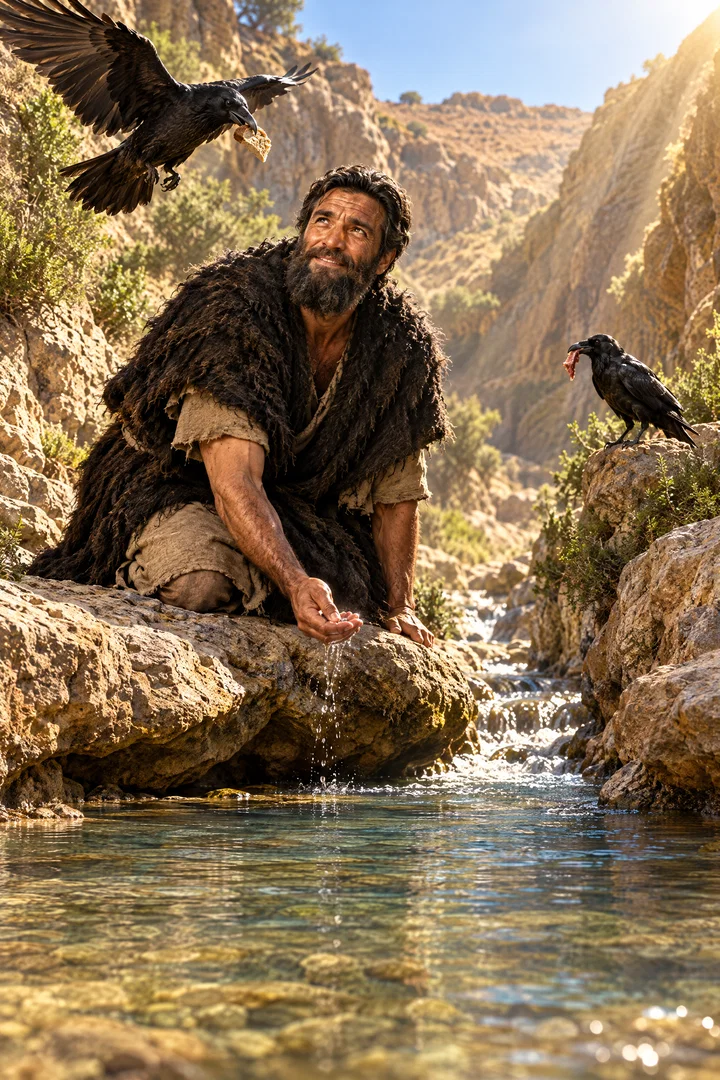
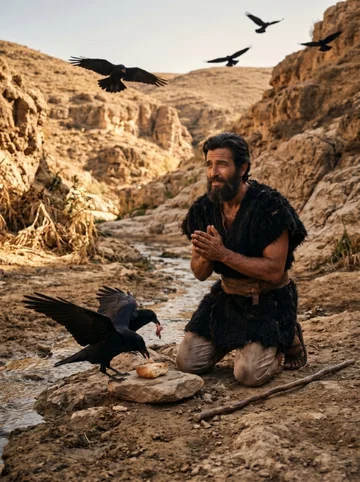
After he had warned Ahab of coming drought, the word of the Lord came to Elijah a second time directing him away from Jezebel's power to hide in safety by the brook Cherith, where water and food by ravens were promised.RH Oct 22, 19013T 288.1–2RH Oct 7, 1873 It came to Elijah the Tishbite, a man of faith and prayer dwelling in a mountain retreat in Gilead, who in anguish over Israel's deep idolatry had pleaded for God to arrest the nation in wickedness even by judgments so they would repent.PK 119.2PK 119.1 Its coming put confidence and a word of faith and power on his lips to go fearlessly to rebuke sin and press back apostasy as a reformer crying in the wilderness.PK 119.1PK 116B.1 It shows that God does not abandon His self-sacrificing people in hardship but sustains their needs, so that even when the wicked perish for lack of bread, the bread and water of those who trust Him will be sure.SG2 243.1–245.1GC88 629.2–4RH Nov 26, 1857 It is an example of waiting for God to reveal the next step and then moving as He directs from place to place, from Cherith to the widow at Zarephath to Carmel to Jezreel, to keep from settling into ease and to prepare for wider usefulness, an evidence of protecting care that should forever keep from distrust.GW 269.3RH Oct 7, 1873PK 159.1–3PK 168.1Lt 16c, 1892, par. 7
Context and Divine Direction
The word of the LORD came to Elijah the Tishbite in the days of Ahab, a man of faith and prayer dwelling in a mountain retreat among the mountains of Gilead east of the Jordan, far removed from any city of renown and occupying no high station in life.PK 119.2PK 119.1 He had watched Israel sink deeper into idolatry with distress, indignation and overwhelming sorrow, for unbelief was separating the chosen nation from the Source of their strength and God's beneficent designs were well-nigh forgotten, though He had delivered them from bondage and given them the lands of the heathen that they might observe His statutes and keep His laws.PK 119.2 In anguish of soul he pleaded for God to arrest the once-favored people in their wicked course and to visit them with judgments if need be, that they might see in its true light their departure from Heaven and be brought to repentance before they went so far in evil-doing as to provoke the Lord to destroy them utterly.PK 119.2 The coming of the word came in answer to that anguished prayer and made him confident that God would prepare the way before him and give him abundant success, putting the word of faith and power upon his lips.PK 119.2PK 119.1
That word sent him on a fearless mission devoted to reform and destined to check the rapid spread of apostasy in Israel, as the voice of one crying in the wilderness to rebuke sin and press back the tide of evil, while as a reprover of sin his message offered the balm of Gilead to the sin-sick souls of all who desired to be healed.PK 119.1 This "there shall not be dew nor rain" announcement to Ahab begins the account of the prophets of the northern kingdom, showing that the ways of the Lord are right, the just shall walk in them and transgressors shall fall therein.PK 119.1PK 116B.1 After Elijah delivered God's warning of drought to Ahab, the word came to him again and directed his course away from Jezebel's power to a place of safety in hiding by the brook Cherith in the mountains.RH Oct 22, 19013T 288.1–2RH Oct 7, 1873 There God would give him water of the brook and command food to be sent him morning and evening by ravens, by an angel of Heaven, an act of honor and loving care marking God's continuing guidance and protection after the warning was delivered.RH Oct 22, 19013T 288.1–2RH Oct 7, 1873
When the brook dried up because of the drought, the same directing word sent him to Zarephath, or Sarepta, in a heathen land, where a widow was appointed to give him refuge and sustain him.RH Aug 28, 19133T 288.1–2RH Oct 7, 1873 There God wrought a daily miracle to keep Elijah and the widow's household supplied with food.3T 288.1–2RH Oct 7, 1873 He could no longer find safety in Israel, for he was safer among heathen than among those who had rejected light from Heaven and hardened their hearts against the gospel, and driven by hostility against God's message he sought safety among the heathen at the widow of Sarepta as Paul afterward turned to the Gentiles for protection when Jewish leaders rejected heavenly light.RH Aug 28, 1913AA 429.3–430.3RH Nov 9, 1911
This directing belongs to a period when God moved Elijah from place to place to keep him from settling down into ease and to prepare him spiritually for translation and for wider usefulness and influence in helping others.GW 269.3 The going to Cherith was God's own sending with a definite commission, errand and place to be, and not Elijah's own choice.PK 168.1 It stands in line with God's afterward sending him to the widow of Sarepta, commissioning him to return to Israel and stand on Carmel, and girding him with strength to go to Jezreel, and in contrast to his later hasty flight into the wilderness, where God had not sent him and where he had no errand.PK 168.1
Provision and Trusting Obedience
The word coming to Elijah belongs to God's care for him in famine, showing that He does not abandon His self-sacrificing people in hardship but sustains them and provides for their needs.SG2 243.1–245.1GC88 629.2–4RH Nov 26, 1857 That care assures self-sacrificing people who trust Him that He will provide for them, so that even when the wicked around them perish for lack of bread, their bread and water will be sure.SG2 243.1–245.1GC88 629.2–4RH Nov 26, 1857 As shown when God provided food for Elijah at the brook through a raven, God will provide for His faithful people so they need not disobey His commands out of fear of lacking food.ST Oct 25, 1910
The verse is an example of waiting for God to reveal the next step and then moving as He directs, for Elijah followed the directions given through His word.Lt 16c, 1892, par. 7 By this word, after Elijah had first appeared before Ahab denouncing God's judgments because of his and Israel's apostasy, God directed his course away from Jezebel's power and hatred and Ahab's search to a place of safety in the mountains by the brook Cherith.RH Oct 7, 1873PK 159.1–3RH Oct 16, 1913 The command was an act of honor and loving care, for God sent food to him there morning and evening by an angel of Heaven, and when the brook became dry He sent him to the widow of Sarepta and wrought a daily miracle to keep Elijah and the widow's family supplied with food.RH Oct 7, 1873
In the later crisis Elijah forgot that God had previously guided and commissioned him to a place of refuge, and fled in fear instead of trusting God's protection.RH Oct 7, 1873PK 159.1–3RH Oct 16, 1913 He forgot this earlier evidence of protecting care when he should instead have trusted the God who had commissioned him to protect him.PK 159.1–3RH Oct 16, 1913 These evidences of love and care should have kept him from ever distrusting God.RH Oct 7, 1873
Sources
Pioneers and periodicals
37 sources
After Elijah told Ahab there would be no dew nor rain except by his word, the word of the Lord came to him again with direction for his next steps, telling him to leave and turn eastward and hide himself by the brook Cherith before Jordan.ST Jun 23, 1898ST Jul 27, 1904ST Jul 27, 1904ST Jun 23, 1898 There God promised him water from the brook and commanded ravens to feed him morning and evening with bread and flesh, which was fulfilled when Elijah obeyed.RH Oct 22, 1901ST Oct 22, 1902 When the brook dried up God directed him onward to Zarephath, where He sustained him through a poor widow by continually replenishing her oil and meal.RH Aug 28, 1913RH Dec 17, 1914RH Jul 9, 1867 This supplying of Elijah first by ravens and then by a stranger outside Israel shows God's providence sustaining His servants through unexpected agents and means where help would not naturally be sought.RH Dec 17, 1914RH Apr 9, 1914RH Apr 9, 1914RH Apr 9, 1914 It begins the account of God's care for Elijah through the famine, assuring those who trust and obey Him that He has ways and means to care for His own in every emergency and will make their bread and water sure.RH Nov 26, 1857ST Sep 7, 1904
Historical Setting and Context
After Elijah told Ahab there would be no dew nor rain except by his word, the word of the Lord came to him telling him to leave and turn eastward and hide himself by the brook Cherith before Jordan.ST Jun 23, 1898ST Jun 23, 1898 After Elijah announced the drought to Ahab, the Lord spoke to him again with a further message directing his next steps.ST Jul 27, 1904ST Jul 27, 1904 The following direction specified that he was to go east and hide by the brook Cherith, where God would provide for him.ST Jul 27, 1904
The verse comes in the days of Ahab, king of Israel, contemporary of Jehoshaphat of Judah and Elijah the Tishbite, the seventh king of Israel and second ruler of the third Israelitish dynasty, who reigned twenty-two years early in the ninth century before Christ.RH Nov 7, 1912 All recorded of Ahab as man and king was written for the learning and profit of men and kings of after generations, showing that he sold himself to worship of a plurality of heathen deities and later enforced their worship upon his people.RH Nov 7, 1912 The verse belongs to the account of the great apostasy in Elijah's days, when God found a faithful remnant who responded to the call of His prophet.
The verse marks the Lord's word coming to Elijah after he announced that Israel would suffer drought, bringing parched land, dry streams, famine, and distress.ST Mar 14, 1878 In that distress the worshipers of Baal by cries and sacrifices cannot bring rain.ST Mar 14, 1878 The verse places Elijah's prophetic warning under the Lord's direction: he had truthfully announced coming trouble, and Ahab's hostility forced him to hide.RH Jan 10, 1865
God's Guidance and Provision
After Elijah had delivered God's warning of drought to Ahab, the word of the Lord came to him again and directed him to hide by the brook Cherith, where God would give him water from the brook and command ravens to feed him, marking God's continuing guidance and protection of him after the warning was delivered.RH Oct 22, 1901 During the famine the Lord directed him to hide by the brook Cherith, promised him water from the brook, and commanded ravens to provide food morning and evening, bringing bread and flesh twice a day.ST Oct 22, 1902 The promise was fulfilled when Elijah obeyed, drank from the brook, and received bread and meat from the ravens, and the simple food thus supplied was sufficient.ST Oct 22, 1902
The word introduces God's instructions to Elijah in famine and need, which led him to the brook Cherith where ravens fed him and the brook supplied water.ST Feb 11, 1913ST Jan 19, 1915ST Jun 24, 1889 The account that follows shows God sustaining His prophet when food was scarce, and it stands as an example of bread supplied by miracle.RH Nov 21, 1907ST Feb 11, 1913ST Jun 24, 1889 After Elijah fled from Ahab, God directed him to a solitary place and sustained him there, sending ravens to bring him food while he drank from a brook.RH Dec 17, 1914 When the brook dried up, God directed him to Zarephath, where He provided for him through a poor widow, continually replenishing her oil and meal to sustain Elijah and the widow and her son for a full year, showing tender practical care through unexpected means and in places where help would not naturally be sought.RH Dec 17, 1914
After the drought dried up the brook Cherith, God sent him to Zarephath in a heathen land, where a widow was appointed to give him refuge and sustain him because he could no longer find safety in Israel.RH Aug 28, 1913 God provided Elijah a hiding-place among the heathen because Israel had departed from the living God in unbelief, pride, and self-exaltation.ST Jun 16, 1887 Though the Lord warned backsliding Israel by prophets calling them to humility and faith, the life-giving message became death to them, offending pride and stirring hatred against the messenger until multiplied sins and guilt brought judgment and they sought to destroy Elijah to stop his words.ST Jun 16, 1887 Their unbelief closed the door of good and made it necessary to pass by the many widows in Israel and entrust His servant to the kindness and liberality of a heathen widow in Sarepta, who lived according to all the light she possessed and appreciated and responded to light and favors from Heaven.ST Jun 16, 1887
The word marks God's direction of Elijah during Israel's drought, when he was hidden by the brook Cherith and later stayed with the widow of Zarephath whose meal and oil were miraculously supplied.RH Jul 9, 1867 After Elijah first appeared to Ahab denouncing God's judgments for his and Israel's apostasy, God in honor and loving care directed his course away from Jezebel's power to a place of safety in the mountains by the brook Cherith.RH Oct 7, 1873 There God sent food to him morning and evening by an angel of Heaven, and when the brook became dry He sent him to the widow of Sarepta and wrought a daily miracle to keep Elijah and the widow's family supplied with food.RH Oct 7, 1873 These evidences of love and care should have kept Elijah from ever distrusting God.RH Oct 7, 1873
Prophetic Authority and Prayer
The word of the Lord came to Elijah commissioning him to prophesy that there would be no rain for three years, and it happened according to his word, proving that he was a prophet of the Lord who alone remained as His prophet.RH Dec 6, 1864 His word shutting heaven so that it did not rain stands as an example of the testimony of the two witnesses and their power to bring judgment.ST May 10, 1883 The account is one of answered prayer, in which the heavens were kept from rain and rain afterward descended again in answer to prayer.RH Nov 21, 1912
The direction to Elijah during drought and famine came as he waited in prayer for God's appointed time to act against Israel's idolatry. The word telling him to go eastward and hide himself by the brook Cherith after he announced the drought gave him experience that formed part of the training and discipline preparing him for his later work at Carmel.RH Oct 12, 1916
Faith Obedience and Providence
The word of the Lord came to Elijah in famine and danger and directed all that followed, guiding him to the brook Cherith and ordering his supply there through ravens bringing food morning and evening.RH Apr 9, 1914RH Apr 9, 1914 First ravens and then a poor widow were arranged to furnish his daily food, so that deliverance came by agents no one would have expected.RH Apr 9, 1914RH Apr 9, 1914 Strangers and those outside the faith were made the means of sustaining the servant of God, and the same power still prompts such help for those in need.RH Apr 9, 1914RH Apr 9, 1914RH Apr 9, 1914
This was direct miraculous support given when to secure provision by his own labor was beyond human power.ST Feb 11, 1886 What was done for Elijah will be done again under like helpless circumstances, because the promise cannot fail.ST Feb 11, 1886 Yet there is no warrant for expecting such a direct miracle for food while provision by the means God has ordained remains possible, and to demand miraculous supply instead of using available means is not faith.ST Feb 11, 1886
Elijah in the wilderness trusted God to sustain him when he left his former security for the sake of truth, and was fed by ravens.RH May 6, 1852 As God provided food for him at the brook by a raven, so He will provide for His faithful people.ST Oct 25, 1910 Therefore they need not disobey His commands from fear of lacking food, but can trust and obey Him through changing circumstances.ST Oct 25, 1910
Links to Other Scripture
God's word came directly to Elijah, whom He chose to bring His message to Israel when the nation was corrupted by idolatry under Ahab and Jezebel.ST Dec 17, 1912 Elijah exemplifies how God sends messages suited to each age through His own people.ST Dec 17, 1912 In every age that choice falls not on the great, learned, or popular, but on humble, teachable, loyal seekers of truth.ST Dec 17, 1912
Elijah's experience serves as a pattern for those who remain faithful to God's commandments when earthly powers persecute them.ST Aug 20, 1885 His fleeing for his life during drought applies to a future time when dissenters will face persecution and will find refuge and provision in desolate places.ST Aug 20, 1885 Driven by hostility against God's message to seek safety among the heathen, including at the widow of Sarepta, his course parallels Paul's need to turn to the Gentiles for protection after Jewish leaders rejected heavenly light.RH Nov 9, 1911 The verse belongs to the miracles of Elijah which are true events of Old Testament history to be taught as true throughout and not as pious legends and myths.ST Jan 24, 1906 To call them legends, to pass them over in silence, or to explain them away denies the absolute authority of the Holy Scriptures and spreads skepticism and infidelity.ST Jan 24, 1906
Encouragement and Application Today
The word coming to Elijah opens the account of God's care for him through the three and a half years of famine, showing that God has ways and means to care for His own in every emergency and will never leave nor forsake those who trust and obey Him.ST Sep 7, 1904 That care in famine assures self-sacrificing people who trust Him that He will provide for them, so that even when the wicked around them perish for lack of bread, their bread and water will be sure.RH Nov 26, 1857 His miraculous provision of food for Elijah in time of need stands as an example of the perfect faith by which His people, when the plagues come and the wicked suffer hunger, will depend wholly on Him for food and receive bread and water to sustain them.
His directing and feeding Elijah by the brook proves that He carries every one of His people on His great, almighty, loving heart.ST Feb 18, 1886 Therefore the weary who drop superfluous anxieties and pitch off sinful desires and heave overboard worry and cast their care on Him will receive from Christ strength enough to carry every legitimate load in life.ST Feb 18, 1886 His directing Elijah and providing for him at the brook teaches, even to children, that God can sustain His people in danger and remains their help.RH Sep 26, 1907
He had by this word directed Elijah beforehand to a place of refuge from Jezebel's hatred and Ahab's search.RH Oct 16, 1913 When Elijah later fled in fear he forgot this earlier evidence of protecting care, whereas he should have trusted the God who had commissioned him to protect him.RH Oct 16, 1913
Sources