1 Kings 17:14
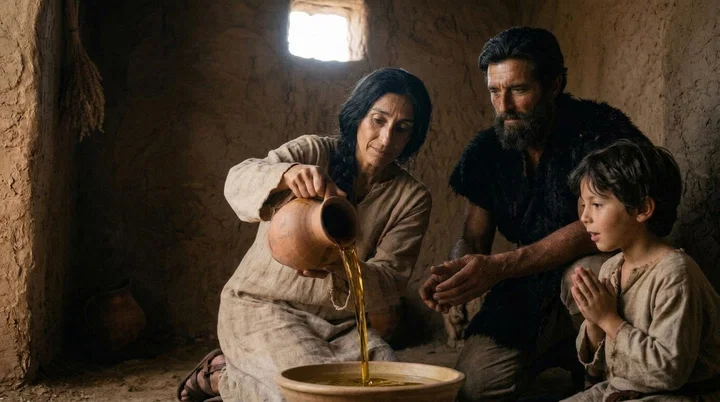
For thus saith the LORD God of Israel, The barrel of meal shall not waste, neither shall the cruse of oil fail, until the day that the LORD sendeth rain upon the earth.
Translations
For thus says the LORD God of Israel, The barrel of meal shall not waste, neither shall the cruse of oil fail, until the day that the LORD sends rain on the earth.
King James Version, Webster Bible
For thus saith the LORD God of Israel, The barrel of meal shall not waste, neither shall the cruse of oil fail, until the day that the LORD sendeth rain upon the earth.
For thus saith the Lord God of Israel, The barrel of meal shall not waste, neither shall the cruse of oil fail, until the day that the Lord sendeth rain upon the earth.
For thus saith the LORD, the God of Israel, The barrel of meal shall not waste, neither shall the cruse of oil fail, until the day that the LORD sendeth rain upon the earth.
For thus saith Jehovah, the God of Israel, The jar of meal shall not waste, neither shall the cruse of oil fail, until the day that Jehovah sendeth rain upon the earth.
for thus said Jehovah, God of Israel, The pitcher of meal is not consumed, and the dish of oil is not lacking, till the day of Jehovah's giving a shower on the face of the ground.'
For thus saith Jehovah the God of Israel: The meal in the barrel shall not waste, neither shall the oil in the cruse fail, until the day that Jehovah sendeth rain upon the face of the earth!
For, thus, saith Yahweh, God of Israel, The jar of meal, shall not waste, and, the cruse of oil, shall not fail,—until the day that Yahweh giveth rain upon the face of the ground.
Berean Standard Bible, Majority Standard Bible
for this is what the LORD, the God of Israel, says: ‘ The jar of flour will not be exhausted and the jug of oil will not run dry until the day the LORD sends rain upon the face of the earth.’”
For the LORD, the God of Israel, says, ‘ The jar of meal will not run out, and the jar of oil will not fail, until the day that the LORD sends rain on the earth.’”
For this is the word of the Lord, the God of Israel: The store of meal will not come to an end, and the bottle will never be without oil, till the day when the Lord sends rain on the earth.
For thus saith the Lord God of Israel, The meale in the barrel shall not be wasted, neither shall the oyle in the cruse be diminished, vnto the time that the Lord send rayne vpon the earth.
Douay-Rheims (Challoner revision)
For thus saith the Lord the God of Israel: The pot of meal shall not waste, nor the cruse of oil be diminished, until the day wherein the Lord will give rain upon the face of the earth.
Pictures
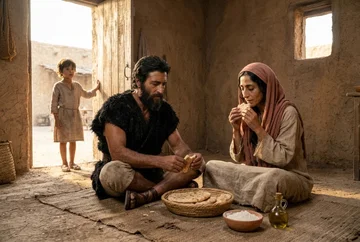
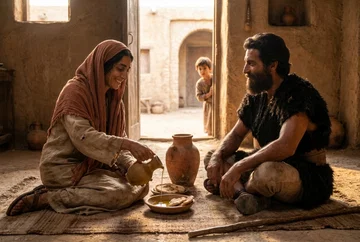
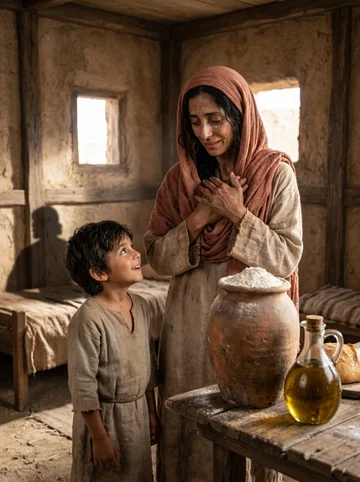
Cross-references
- Luke 4:25-26
But I tell you of a truth, many widows were in Israel in the days of Elias, when the heaven was shut up three years and six months, when great famine was throughout all the land;
Jesus cites Elijah’s famine-era mission to the widow at Sarepta as an example of God’s favor beyond Israel.
- 1 Kings 17:6
And the ravens brought him bread and flesh in the morning, and bread and flesh in the evening; and he drank of the brook.
God feeds Elijah by ravens during the drought.
- James 5:17-18
Elias was a man subject to like passions as we are, and he prayed earnestly that it might not rain: and it rained not on the earth by the space of three years and six months.
Elijah prayed, and rain was withheld until it returned.
- 1 Kings 17:9
Arise, get thee to Zarephath, which belongeth to Zidon, and dwell there: behold, I have commanded a widow woman there to sustain thee.
God directs Elijah to the widow who will sustain him.
- Exodus 16:4-15
Then said the LORD unto Moses, Behold, I will rain bread from heaven for you; and the people shall go out and gather a certain rate every day, that I may prove them, whether they will walk in my law, or no.
Both describe God miraculously providing food over time.
- 1 Kings 17:1
And Elijah the Tishbite, who was of the inhabitants of Gilead, said unto Ahab, As the LORD God of Israel liveth, before whom I stand, there shall not be dew nor rain these years, but according to my word.
Elijah’s drought brings famine, making the provision miracle necessary.
- Matthew 14:17-21
And they say unto him, We have here but five loaves, and two fishes.
Jesus feeds more than five thousand with five loaves and two fish.
- Exodus 16:35
And the children of Israel did eat manna forty years, until they came to a land inhabited; they did eat manna, until they came unto the borders of the land of Canaan.
Both describe God sustaining people with food through a prolonged lack.
- 2 Kings 2:8
And Elijah took his mantle, and wrapped it together, and smote the waters, and they were divided hither and thither, so that they two went over on dry ground.
Elijah’s miracles are linked together.
- Matthew 6:25-34
Therefore I say unto you, Take no thought for your life, what ye shall eat, or what ye shall drink; nor yet for your body, what ye shall put on. Is not the life more than meat, and the body than raiment?
Both assure that God provides for his people’s needs.
- 2 Kings 4:1-7
Now there cried a certain woman of the wives of the sons of the prophets unto Elisha, saying, Thy servant my husband is dead; and thou knowest that thy servant did fear the LORD: and the creditor is come to take unto him my two sons to be bondmen.
Both recount miracles in which a widow’s provisions do not run out.
- Isaiah 33:16
He shall dwell on high: his place of defence shall be the munitions of rocks: bread shall be given him; his waters shall be sure.
It promises bread and secure water to those who trust God.
- 1 Kings 18:38-39
Then the fire of the LORD fell, and consumed the burnt sacrifice, and the wood, and the stones, and the dust, and licked up the water that was in the trench.
Both show God honoring Elijah with signs that should have prevented distrust.
- 2 Kings 4:42-44
And there came a man from Baal-shalisha, and brought the man of God bread of the firstfruits, twenty loaves of barley, and full ears of corn in the husk thereof. And he said, Give unto the people, that they may eat.
Elisha feeds one hundred men with twenty loaves.
- Revelation 11:6
These have power to shut heaven, that it rain not in the days of their prophecy: and have power over waters to turn them to blood, and to smite the earth with all plagues, as often as they will.
identifies Elijah shutting heaven as their word
- Luke 12:24
Consider the ravens: for they neither sow nor reap; which neither have storehouse nor barn; and God feedeth them: how much more are ye better than the fowls?
Both describe God providing food for those who do not store it.
- 1 Kings 17:22
And the LORD heard the voice of Elijah; and the soul of the child came into him again, and he revived.
Elijah’s petition is answered when the widow’s son is restored to life.
- Psalms 34:10
The young lions do lack, and suffer hunger: but they that seek the LORD shall not want any good thing.
It echoes the assurance that those who seek the Lord lack no good thing.
- Isaiah 58:11
And the LORD shall guide thee continually, and satisfy thy soul in drought, and make fat thy bones: and thou shalt be like a watered garden, and like a spring of water, whose waters fail not.
God promises to sustain and satisfy those who help the hungry.
- John 6:11
And Jesus took the loaves; and when he had given thanks, he distributed to the disciples, and the disciples to them that were set down; and likewise of the fishes as much as they would.
God provides abundantly through a few loaves and fish.
Commentary
Each commentary is drawn from primary sources: the writings of Ellen G. White and Adventist pioneers and periodicals. Each commentary is separate. Its own words are not a quotation; follow the references to read the source passages.
Ellen G. White
30 sources
God promised through Elijah that the believing Gentile widow's nearly exhausted supply of meal and oil would be miraculously sustained day by day until rain returned to end the drought.6T 345.4–346.1RH Aug 28, 1913PK 129.1–3PK 130.1–2 It was spoken at Zarephath on the very day she expected to cook her last handful for herself and her son and die, when she was asked not to fear but to share that last morsel with God's prophet first, testing her trust to the utmost.PK 129.1–3PK 130.1–2 She received this favor because she walked in all the light she had and willingly received and cared for God's servant, while many needy widows in Israel were passed over because apostasy, unbelief and rejection of light shut them off from help.DA 238.2–239.12SP 113.2–3ST Feb 17, 18812SP 112.2–113.1 Jesus recalled it at Nazareth to show that God's power is displayed for hearts open to faith rather than for an unbelieving people, challenging claims to special favor and provoking national pride and hostility.LC1 56.1LC1 53.2–54.1DA 239.2–240.1 Her preservation with her son shows that God rewards faith and generosity to those who help others in need, assuring self-sacrificing believers that even in persecution and famine their bread and water will be sure and they will not be left to perish.6T 345.4–346.1PK 131.52T 28.2SG2 243.1–245.1RH Nov 26, 1857
Setting and Promise
The promise was given in Elijah's work as prophet to the northern kingdom during the drought, when he stood in stern confrontation with King Ahab with the charge that Ahab and his father's house had troubled Israel.PK 129 After Elijah had been hidden by the brook Cherith and miraculously fed there for many months, the continued drought dried the brook.PK 129.1–3RH Oct 7, 1873 With no safety for him in Israel, God sent him to find refuge and asylum in a heathen land at Zarephath, which belongs to Zidon and was known in New Testament times as Sarepta.PK 129.1–3 The widow God had commanded to sustain him there was not an Israelite and had never had the privileges and blessings of the chosen people, yet she was a believer in the true God who had walked in all the light shining on her pathway.PK 129.1–3
Elijah met her at the gate of the city gathering sticks and asked her for water to drink and a morsel of bread.PK 129.1–3 At that time famine pressed sore on her poverty-stricken home and her meager food was about to fail.PK 130.1–2 It was the very day she expected to cook a last handful of meal with a little oil for herself and her son and then die.PK 130.1–2 Spoken by Elijah as God's word, the promise was that the barrel of meal would not waste and the cruse of oil would not fail until the day the Lord sent rain upon the earth.6T 345.4–346.1RH Aug 28, 1913PK 130.1–2DA 238.2–239.1 Her small supply therefore sustained the widow, her son, and Elijah for many days.6T 345.4–346.1RH Aug 28, 1913
Food was supplied daily and renewed every day until rain returned, so that meal and oil did not run out during the drought.ST Feb 17, 1881ST Feb 17, 1881RH Oct 7, 1873 Elijah told her not to fear but to share that last morsel with him first and then provide for herself and her son.PK 130.1–2 The promise tested to the utmost her faith in the power of the living God to provide for her needs.PK 130.1–2 Even in dire extremity her compliance bore witness to that faith, trusting the God of Israel to supply every need regardless of suffering to herself and her child.PK 130.1–2
Faith, Favor, and Care
The widow of Zarephath, though a foreigner and a heathen, received this sustaining favor because she had walked faithfully in all the light shining on her pathway and then responded with faith and openness to the greater light God sent through Elijah.DA 238.2–239.12SP 113.2–3ST Feb 17, 1881ST Feb 17, 18814RED 5.3–7.1 Her willingness to receive and care for God's servant made her a recipient of divine power, and her unfailing meal and oil until rain returned stood as a sign of God's power and provision toward one who lived by the light she had.DA 238.2–239.1ST Feb 17, 1881ST Feb 17, 18814RED 5.3–7.1Ms 40, 1887, par. 8–11 Many widows in Israel in severe need during the famine were passed over because Israel was in apostasy and unbelief, with self-exaltation, abused privileges, hardened hearts, and rejection of heavenly light shutting them off from help.2SP 113.2–3ST Feb 17, 18812SP 112.2–113.1Ms 40, 1887, par. 8–11LC1 53.2–54.1 Because she lived up to the light she had, this heathen woman was counted more righteous and more favorably placed before God than backslidden Israelites who had received great light and privileges but had not lived according to them.SLP 229.1–230.2AA 416.2–417.1Ms 8, 1888, par. 9–14 Those Israelites had sacrificed principle for convenience and worldly honor and had become hardhearted and resistant to the truth.SLP 229.1–230.2AA 416.2–417.1Ms 8, 1888, par. 9–14
When the widow shared her nearly gone provisions with Elijah and made a home for him, God miraculously kept her supply from running out and preserved her life and her son's for many days.6T 345.4–346.1PK 131.52T 28.2RH Aug 28, 1913 Her lack did not prevent hospitality, and God rewarded her faith and generosity with daily preservation, showing that He blesses those who help others in need and that His power and promises remain sure.6T 345.4–346.1PK 131.52T 28.2RH Aug 28, 1913 Through this Gentile widow God gave Elijah refuge, asylum, safety, succor, and help when hatred and persecution drove him to flee Israel.SLP 250.3ST May 22, 1884AA 430.4–431.2RH Nov 9, 1911ST May 22, 1884 He was safer living among heathen than among those who had hardened their hearts against the truth, for he could not be trusted with Israel.SLP 229.1–230.2ST May 22, 1884ST May 22, 1884
Jesus recalled this sending to Sarepta at Nazareth to show that God's help reached a widow outside Israel when many widows in Israel were in need.LC1 56.1LC1 53.2–54.1DA 239.2–240.1 It illustrated that God displayed His power through a prophet for people whose hearts were open to faith rather than for an unbelieving, hard-hearted people, and the reference challenged His hearers' claim to special favor as God's people and provoked their national pride and hostility toward Him.LC1 56.1DA 239.2–240.1 God's directing Elijah away from Jezebel's power to safety in the mountains by Cherith, feeding him there morning and evening by an angel, and then keeping Elijah and the widow's family alive at Sarepta by food renewed every day are evidences of God's love and care that should have kept Elijah from ever distrusting God.RH Oct 7, 1873 That same care in famine assures self-sacrificing believers that He will provide for their needs, so that even when the wicked lack bread and His faithful children suffer persecution, privation, and want of food, they will not be left to perish, for their bread and water will be sure and He will satisfy them in a time of famine.SG2 243.1–245.1RH Nov 26, 1857GC88 629.2–4
Sources
Pioneers and periodicals
79 sources
The Lord promised through Elijah that the widow of Zarephath's barrel of meal would not be used up and her cruse of oil would not run dry until He sent rain again, bidding her not to fear but to make him a little cake first and then for herself and her son, which she obeyed so that she and her house ate many days.ST Jun 23, 1898ST Jun 23, 1898RH Mar 17, 1903 The word was fulfilled exactly, the scant handful of meal and little oil being replenished day by day so that a little served as much as much and sustained Elijah, the widow, her son and her household for a full year of drought and famine.RH Aug 28, 1913RH Jun 24, 1902ST Jul 27, 1904ST Apr 6, 1888RH Jun 12, 1900 Her obedience in putting God's servant and God's cause first and sharing what she had instead of holding it back preserved their lives and made her giving the way of receiving, the supply continuing while it was shared.RH Jun 24, 1902RH Mar 17, 1903RH Jan 16, 1872RH Jun 24, 1902ST Mar 26, 1885 This unfailing provision proves God's care for His own in famine and extremity, that He is prepared for every emergency and will never leave nor forsake those who trust and obey Him even when no other support remains.ST Sep 7, 1904RH Sep 15, 1859ST Nov 27, 1884 The same miraculous care shows how He will sustain the remnant in the time of trouble and famine at the end, interposing to feed them if necessary by ravens or by keeping their handful of meal from failing until He delivers them.RH Feb 25, 1915RH Oct 1, 1861
Words and Historical Setting
The promise was spoken in the name of the Lord God of Israel through Elijah to the widow of Zarephath that her barrel of meal would not waste and her cruse of oil would not fail until the day the Lord sent rain upon the earth.ST Jun 23, 1898ST Jun 23, 1898ST Oct 22, 1902 It was given after telling her to fear not and to make him a little cake first and afterward for herself and her son, when she had only a handful of meal and a little oil and was gathering sticks to bake a last cake that she and her son might eat and die.ST Jun 23, 1898RH Jan 16, 1872RH Feb 25, 1873 She went and did according to the saying of Elijah, trusting his word and giving him food first despite having almost nothing, and she and he and her house ate many days.ST Jun 23, 1898ST Jun 23, 1898ST Oct 22, 1902 By putting God's cause first she preserved their lives through the famine, and the supply continued with greater blessings in her home.RH Mar 17, 1903RH Jan 16, 1872ST Oct 22, 1902
The promise belongs to the extraordinary ministry of the prophet Elijah during the history of the kingdoms of Israel and Judah in the time of Ahab.RH May 25, 1916RH Dec 6, 1864ST May 20, 1913 It stands in the account of Israel's apostasy in Elijah's day, when God found a faithful remnant who responded to the call of His prophet and when Elijah used suffering and want to call Israel from idolatry to allegiance to God.RH Dec 6, 1864 Elijah prophesied a three-year drought which came to pass according to his word, and God sustained Elijah and the widow during the drought and cared for Elijah during three and a half years of famine.RH Dec 6, 1864ST Sep 7, 1904 Rain was withheld in answer to prayer and later sent again in connection with prayer, and God later answered his prayer by sending rain.RH Nov 21, 1912ST May 20, 1913
God sent Elijah during the famine caused by the drought to a widow at Zarephath in Sidon, called Sarepta, in the region of Tyre and Sidon outside Israel.ST Jul 4, 1900ST Feb 19, 1894 She was a heathen Gentile woman who lived according to the light she had and received God's servant in faith, and her faithfulness and care for Elijah made her a recipient of God's power and an example of one favored by God.ST Feb 17, 1881ST Feb 17, 1881ST Dec 23, 1889 The many widows among God's professed people in Israel were passed by because of backsliding, unbelief, pride, rejection of reproof, abused privileges, and hatred of the messenger.ST Feb 17, 1881ST Feb 17, 1881ST Dec 23, 1889 Jesus later pointed out that Elijah was sent to one widow rather than to the many widows in Israel, showing that God has precious souls in every nation and that Elijah was safer and found help among the heathen than among those who hardened their hearts.ST Dec 23, 1889
God had commanded the widow to sustain Elijah, making her one of the agents He commanded to provide food for the prophet.RH Nov 9, 1911RH Apr 9, 1914ST Apr 17, 1907 After the brook Cherith dried, Elijah found refuge in her humble home and poor dwelling at Zarephath, which with Cherith served as a hiding-place from the wrath of Ahab and from Jezebel's persecution when hatred drove him from Israel.RH Nov 9, 1911ST Oct 22, 1894ST May 28, 1885 There the Lord sustained, protected, and provided for Elijah and the widow while he sheltered there, preserving and keeping alive the prophet through the famine.ST Mar 14, 1878ST Apr 17, 1907ST Oct 22, 1894 God preserved his life through a poor widow of Sidon, miraculously keeping her meal and oil from running out so she could feed him, and making the prophet a blessing to her by keeping her supply from failing until rain came again.RH Nov 9, 1911ST Apr 17, 1907ST Oct 22, 1894
Promise and Miraculous Fulfillment
The spoken word pledged that the small store of meal would not be exhausted and the cruse of oil would not become empty until the Lord sent rain upon the earth, and it came to pass exactly as spoken.RH Aug 28, 1913RH Jun 24, 1902ST Jul 27, 1904ST Jul 27, 1904RH Mar 13, 1900 The meal did not waste and the oil did not fail, but lasted and sustained Elijah, the widow, her son, and her whole household for many days through the drought.RH Aug 28, 1913RH Jun 24, 1902ST Jul 27, 1904ST Jul 27, 1904CO 73.5 Her household resources were thus restored and upheld until rain returned to the land, even while scarcity was felt by the wealthy.RH Aug 28, 1913CO 73.5RH Mar 13, 1900
The supply was replenished day by day, so that a little was made to provide as much as much.ST Apr 6, 1888RH Dec 17, 1914RH Dec 17, 1914RH Apr 23, 1857RH Sep 7, 1911 What began as only a handful of meal and a little oil, with no means to buy more, was kept sufficient and preserved through the famine for a full year.ST Apr 6, 1888RH Jun 12, 1900RH Dec 17, 1914RH Dec 17, 1914RH Apr 23, 1857 As it was shared to meet repeated need it did not run out, but continued to furnish food for Elijah and the widow's family.RH Jun 12, 1900RH Dec 17, 1914RH Dec 17, 1914RH Apr 23, 1857RH Sep 7, 1911
The preservation and increase of the flour and oil was a true miracle by direct creative power, not merely a suspension or acceleration of natural law.ST Jun 6, 1900RH Jul 25, 1854ST Jan 24, 1906 It is true history to be taught as true throughout, not myth, allegory, fancy, or pious legend, and denial of its truthfulness is soul-destroying error leading at last to denial of every essential saving truth.RH Jul 25, 1854ST Jan 24, 1906 It stands with the feeding by ravens, the manna, and Elisha's feeding of one hundred men as proof of God's mighty miraculous power manifested through the whole Bible and centered in Jesus Christ.ST Jun 6, 1900
Elijah's hard experience of leaving the country in severe trial, when the scorching sun had burned up every green thing and dried the rivers, placed him in the humble hut of a poor widow whose sole sustenance was a handful of flour and a little oil in the cruse. Standing, so far as he knew, alone against the whole apostate nation with its usages, customs, priests and rulers, and with no promising outlook for carrying on any reformation, demanded living faith and courage. That unpromising discipline developed in him a firm, stable, living faith that conquers everything, strong enough to shut heaven, raise the dead, be answered by fire, receive rain, and finally be prepared for translation without seeing death, proving such faith grows best in the soil of adversity rather than in smooth sailing.
The same account shows the widow's son restored to life, with hospitality and temporal provision joined to this further deliverance.CO 73.5ST Oct 12, 1876RH Sep 16, 1902 That raising was accomplished by virtue of the sacrifice of the Son of God, not then accomplished but established in the purpose of God.ST Oct 12, 1876 God thus answered the mother's anguish when her son died and brought her to recognize the truth of the Lord's word.CO 73.5ST Oct 12, 1876RH Sep 16, 1902
Faith Obedience and Giving
The promise called for trust and obedient action on the word spoken through Elijah, to fear not and to make the little cake for him first despite having almost nothing left.ST Jul 27, 1904ST Jun 23, 1898RH Mar 17, 1903RH Jan 16, 1872ST Oct 22, 1902 The widow was to be faithful to the light she had and to receive God's servant into her need, and because she had faith enough to obey in her scarcity she and Elijah and her household ate many days.ST Feb 17, 1881ST Feb 17, 1881ST Jul 27, 1904ST Feb 19, 1894ST Jan 14, 1886 That faithfulness made a heathen woman of Sarepta a recipient of sustaining power until rain returned, while many in Israel with greater light and abused privileges were left unhelped through backsliding and unbelief.ST Feb 17, 1881ST Feb 17, 1881ST Feb 19, 1894
By putting God's cause first and giving food to Elijah before feeding herself and her son, she preserved their lives through the famine.RH Jun 24, 1902RH Mar 17, 1903RH Jan 16, 1872ST Oct 22, 1902ST Mar 25, 1903 She shared from only a handful of meal and a little oil when supplies were nearly gone, and her trust in his word was met by a supply that was not used up and did not run out until the Lord sent rain.RH Jun 24, 1902RH Mar 17, 1903ST Oct 22, 1902RH Apr 2, 1914ST Mar 25, 1903 Her hospitality and service brought divine provision through an unlikely and poor source, with continued eating for many days and greater blessing resting on her home.RH Jan 16, 1872ST Oct 22, 1902RH Apr 2, 1914ST Mar 25, 1903
As she gave rather than holding back she suffered no loss, for the meal and oil kept being supplied while they were shared and remained inexhaustible until rain came.RH Jun 24, 1902RH Jun 24, 1902ST Mar 26, 1885RH Jun 24, 1902 Giving in faith is the way to receive, and what is given and used wisely proves greater than what is kept back.RH Jun 24, 1902ST Jan 14, 1886ST Jan 27, 1904 Believers are therefore to give to the Lord's cause and to pass on spiritual light, trusting that God will provide more as they impart.RH Jun 24, 1902ST Jan 27, 1904 Sharing comfort in famine makes scanty fare serve both giver and neighbor through all the years of want, for giving is living and denying is dying, and sunshine created for others returns in health and comfort to the giver.ST Mar 26, 1885ST Jan 27, 1904
Divine Care and Providence
The unfailing meal and oil show a care for God's own in famine and extremity that has no human equal, for He is ready for every emergency and will never leave nor forsake those who trust and obey Him.ST Sep 7, 1904RH Sep 15, 1859 The same God who kept the barrel undiminished and the cruse unfailing while Elijah stood as the agent of divine judgment against sin will just as surely bring help and sustenance to tried, tempted, and afflicted Christians, because He knows their frame is dust and their spirit fails in extremity, and with the extremity He makes a way of escape.RH Sep 15, 1859RH Feb 25, 1873 That help is promised to those who faithfully do every required duty, whether by a raven sent to feed them, water drawn from flinty rock, or an angel sent to strengthen them for conflict, even when supplies look scant and no other support remains.ST Sep 7, 1904RH Sep 15, 1859 The lesson belongs to the three and one-half years of famine, and to the severe famine of three years in which Elijah was fed by ravens with bread and flesh morning and evening until he was sent to Zarephath, where the widow was gathering sticks to bake her last cake that she and her son might eat and die, yet was told to bake for him first with the promise that meal and oil would not run out.ST Sep 7, 1904RH Feb 25, 1873
Trusting God when warehouses and bags are full and tables are spread is no hard thing, but the wisdom of Christian grace appears when only a handful of meal and a cruse of oil are left, all ways of relief are stopped, purses are empty, and outward need presses so that faith and patience are tested and trust becomes difficult.ST Nov 27, 1884 In that last extremity it is safe to do right and trust God to provide, for the household's resources remained undiminished despite substantial expenses through the time of scarcity until rain came, while dependence on human support proved unreliable.RH Feb 25, 1873RH Dec 5, 1871
The sustaining of the widow's meal and oil by divine life and power was no more wonderful than God's daily work of sustaining people through food.RH Jan 28, 1902RH Jan 9, 1900 The bread eaten through crops and human labor is also His gift, given through ordinary means rather than by sudden miracle, just as her supply was kept through a year by that same power.RH Jan 28, 1902RH Jan 9, 1900
He who replenishes the cruse is inexhaustible, so fretting for time to come is folly; today's good should not be slighted in anxiety for good to come, nor today's oil wasted in fruitless attempts to procure tomorrow's supply, but God should be trusted for daily happiness and provision.RH Dec 8, 1863 When provisions seem almost spent He can send fresh supplies even from an unseen source, and if no further supply comes the believer may be nearer the end of life and the journey to heaven than expected, where every need will be met.RH Dec 8, 1863
The promise kept the widow's flour and oil from running out until rain returned in the drought, and Elijah depended on a poor widow for food at a time when scarcity was felt even by the wealthy, so that God's provision sustained both His servant and the needy widow.ST Jul 27, 1904ST Jul 23, 1912 The small supply became an instrument of divine power in the famine, an example of succor provided through people who welcome and care for those in need.ST Jul 23, 1912RH Sep 10, 1872
Prophecy of Final Deliverance
Elijah's work in sustaining life through drought stands as a type of the reformatory work linked with John the Baptist and, in its later fulfillment, with those making ready for the Lord's coming.RH Jul 9, 1901 The keeping of the widow's meal and oil from running out until rain returned shows how God will sustain the remnant in the time of trouble when the seven last plagues are poured out.RH Feb 25, 1915RH Oct 1, 1861 Though the living saints will share in measure in that trouble, no plague will come near their dwelling, and angels will supply them with food and water while the wicked suffer hunger and thirst.RH Feb 25, 1915RH Oct 1, 1861 When famine comes and those who rejected the final warning turn their rage against the saints as the cause of their troubles and seek to destroy them for their faith and Sabbath observance, God will interpose for them and feed them if necessary by ravens or by keeping their handful of meal from failing, then deliver them from their enemies and take them to heaven as Elijah was taken.RH Feb 25, 1915RH Oct 1, 1861
The LORD God of Israel who replenished the barrel of meal and cruse of oil for the widow of Zarephath so that they did not waste or fail until rain came is the same yesterday, today, and forever.RH Dec 31, 1903 He still miraculously provides food and material supply for obedient believers who suffer loss for keeping the Sabbath, filling an empty bread box, removing the need to buy goods, and prospering faithful work.RH Dec 31, 1903 The preserved handful that was all the widow had to live on, by which God kept alive the widow with her child and Elijah, also pictures the small remnant of truth in a spiritual famine for hearing God's word.RH Nov 1, 1853 Its fruit would grow and spread.RH Nov 1, 1853
Practical Uses and Figures
Sharing scanty comforts and food turns scanty fare for one into a royal feast for two, for the cruse shared in famine did not fail.ST Mar 18, 1889ST Jan 27, 1904ST Mar 24, 1898RH Jul 13, 1911 When the cruse of comfort is failing, rising and sharing it makes it serve both giver and brother through all the years of famine, because divine love fills the storehouse and renews the handful.ST Mar 18, 1889ST Jan 27, 1904ST Mar 24, 1898 Giving is the way to receive, for as comfort is given God imparts more, and creating sunshine for those around brings health and comfort back to the giver, since giving is living and denying is dying.ST Jan 27, 1904ST Mar 24, 1898RH Jul 13, 1911
The barrel and cruse stand for resources given to God's work, repeatedly providing a little more year by year even when nearly exhausted.RH May 13, 1909ST Jun 16, 1909RH Nov 24, 1904 The same faith is to be exercised toward the treasury that supplies truth literature, which will be kept up by God and by donations so that tracts need not be sold and nothing stands between the poor and the sending out of light.RH Jan 14, 1873 Those who give freely of their own store to support workers abroad will have their home supply replenished and enlarged, the more poured out the more yielded back.RH Nov 24, 1904 Finances for city work may remain very low yet never be exhausted because the Lord continues to provide.RH Nov 12, 1901
The same unfailing supply illustrates personal experiences of provision continuing despite repeated spending and substantial expense while doing right.RH Dec 17, 1914ST Feb 27, 1893RH Dec 5, 1871 A flour supply continued for two weeks until money became available for daily need.RH Dec 17, 1914 A household's resources remained undiminished despite substantial expenses, showing it safe to do right and trust God while human support proves unreliable.RH Dec 5, 1871 Thank-offerings given in gratitude and love still leave enough for earthly needs.ST Jul 29, 1889
Elijah was an instrument through whom God miraculously provided food for others in famine. God's care for His work continues in the same way even when resources seem inadequate.RH Aug 27, 1914
Everyone has a cruse of oil in abilities and opportunities, which are increased by being used and, poured out without doubting, will fill all the vessels at command.ST Dec 5, 1895 Submission renews the blessing, while lack of submission wastes what is had.ST Dec 5, 1895 A mother has such a cruse in a cheerful, thankful, loving spirit and pleasant words, given to keep home bright and hold husband and children in love until her work is done, sufficient amid ill health, confinement, added care and labor, and each new baby received as God's gift.ST Dec 5, 1895 Murmuring that she can do nothing that counts, treating children and sickness as chains, fault-finding over every new event, and meeting her husband with grievances and reproach wastes the oil until scarce a pleasant word remains, darkening the home, widening the breach, and driving husband and children elsewhere for brightness.ST Dec 5, 1895 The widow's cruse also figures life and strength dried up by grief after loss of husband and only son, and failing poverty and daily struggle shared by Christ in hunger and need.RH Mar 22, 1906 The meal and oil that did not run out picture the Bible as daily food, fed upon every day without growing less and without tiring, for unlike honey of which people soon have enough and condiments which grow flat and stale, bread is never refused and never loses its need.ST Nov 24, 1898
God's grace can make limited resources sufficient to serve others, so that a widow's handful feeds not only her household but also her neighbor.RH Sep 2, 1915
Sources