1 Kings 3:20
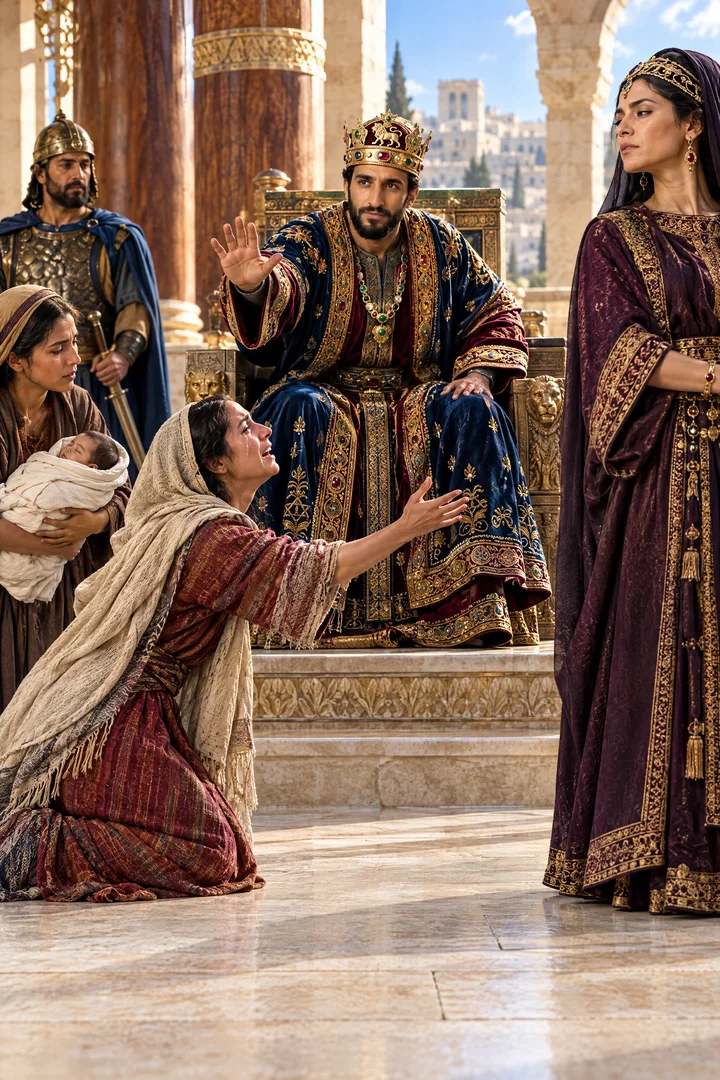
And she arose at midnight, and took my son from beside me, while thine handmaid slept, and laid it in her bosom, and laid her dead child in my bosom.
Translations
And she arose at midnight, and took my son from beside me, while your handmaid slept, and laid it in her bosom, and laid her dead child in my bosom.
King James Version, Revised Version
And she arose at midnight, and took my son from beside me, while thine handmaid slept, and laid it in her bosom, and laid her dead child in my bosom.
And she rose at midnight, and took my son from beside me, while thine handmaid slept, and laid it in her bosom, and laid her dead child in my bosom.
Webster Bible, American Standard Version
And she arose at midnight, and took my son from beside me, while thy handmaid slept, and laid it in her bosom, and laid her dead child in my bosom.
and she riseth in the middle of the night, and taketh my son from beside me — and thy handmaid is asleep — and layeth it in her bosom, and her dead son she hath laid in my bosom;
And she arose at midnight, and took my son from beside me, while thy handmaid slept, and laid it in her bosom, and laid her dead son in my bosom.
Then arose she, in the middle of the night, and took my son from beside me, while thy handmaid was sleeping, and laid it in her own besom,—but, her dead son, laid she in, my, bosom.
Berean Standard Bible, Majority Standard Bible
So she got up in the middle of the night and took my son from my side while I was asleep. She laid him in her bosom and put her dead son at my bosom.
She arose at midnight, and took my son from beside me while your servant slept, and laid it in her bosom, and laid her dead child in my bosom.
And she got up in the middle of the night and took my son from my side while your servant was sleeping; and she took it in her arms and put her dead child in my arms.
And she rose at midnight, and tooke my sonne from my side, while thine handmaide slept, and layde him in her bosome, and layde her dead sonne in my bosome.
Douay-Rheims (Challoner revision)
And rising in the dead time of the night, she took my child from my side, while I thy handmaid was asleep, and laid it in her bosom: and laid her dead child in my bosom.
Pictures

Commentary
Each commentary is drawn from primary sources: the writings of Ellen G. White and Adventist pioneers and periodicals. Each commentary is separate. Its own words are not a quotation; follow the references to read the source passages.
Ellen G. White
2 sources
The verse preserves one mother's accusation that the other woman got up at midnight and took the living son from beside her while she herself was asleep, holding him to her own bosom and putting her dead child in the place of the living one.RH Dec 21, 1905 The charge turns on a secret nighttime exchange of infants, with the living child removed from the sleeping claimant and the lifeless child left with her.RH Dec 21, 1905
This accusation belongs to the narrative of 1 Kings 3:16-27, which took place in Solomon's early reign and displayed his wisdom together with kindly sympathy in judging between the two women.PK 57.2RH Dec 21, 1905 By discerning who was the true mother of the helpless baby, he restored the child to her.PK 57.2RH Dec 21, 1905
Sources
Pioneers and periodicals
9 sources
The verse records one woman's accusation that while she slept the other woman took her living son from beside her into her own bosom and laid her own dead child in the accuser's bosom.RH Dec 21, 1905ST Dec 9, 1897ST Jan 6, 1888 It is part of the account of Solomon's wisdom in judging between the two women in dispute before him.ST Dec 9, 1897 It belongs to the history of the undivided kingdom under Solomon in 1 Kings 1 to 11, which relates the same events as 2 Chronicles 1 to 9 and falls in chronological order.RH May 11, 1916 The exchange claim is part of the difficult case between the two women that Solomon decides as proof of his wisdom in judgment.RH Dec 21, 1905ST Dec 9, 1897
The famous judgment is marked by rough, shrewd sense that shows the striking impression made when a king personally grants justice.ST Nov 5, 1885 The account shows Solomon facing uncertainty over which woman is the living child's mother, with the reported nighttime exchange illustrating grounds for doubting to whom the child rightly belongs.RH Nov 4, 1858 The judging between the two women displays Solomon's early wisdom and kindly sympathy in restoring a helpless baby to its mother.RH Dec 21, 1905
The two mothers both claiming the living child until the king's judgment reveals the true mother portray the moral law as the living child that must remain whole and the ceremonial law as the dead child rejected as dead and nailed to the cross.RH Jun 9, 1853 The true mother's anguish at the threat of the sword shows the moral law must not be divided or put to death.RH Jun 9, 1853 The real mother's plea for the contested child's life pictures the converted sinner's regard for God's law, pleading for it to remain in force rather than be abolished.RH Apr 16, 1867 The child's death occurring while the mother slept without her knowing until morning pictures spiritual life quietly dying while a Christian rests secure in church membership and profession.RH Feb 7, 1865
Sources