1 Kings 3:21
And when I rose in the morning to give my child suck, behold, it was dead: but when I had considered it in the morning, behold, it was not my son, which I did bear.
Translations
American King James Version, King James Version, KJV Cambridge Paragraph Bible, Revised Version
And when I rose in the morning to give my child suck, behold, it was dead: but when I had considered it in the morning, behold, it was not my son, which I did bear.
And when I rose in the morning to nurse my child, behold, it was dead: but when I had considered it in the morning, behold, it was not my son, which I bore.
And when I rose in the morning to give my child suck, behold, it was dead; but when I had looked at it in the morning, behold, it was not my son, whom I did bear.
and I rise in the morning to suckle my son, and lo, dead; and I consider concerning it in the morning, and lo, it was not my son whom I did bear.'
And when I rose in the morning to give my child suck, behold, it was dead; and I considered it in the morning, and behold, it was not my son, whom I bore.
And, when I arose in the morning, to give suck unto my child, lo! it was dead! but, when I looked at it narrowly in the morning, lo! it was not, my son that I had borne.
Berean Standard Bible, Majority Standard Bible
The next morning, when I got up to nurse my son, I discovered he was dead. But when I examined him, I realized that he was not the son I had borne.”
When I rose in the morning to nurse my child, behold, he was dead; but when I had looked at him in the morning, behold, it was not my son whom I bore.”
And when I got up to give my child the breast, I saw that it was dead; but in the morning, looking at it with care, I saw that it was not my son.
And when I rose in the morning to giue my sonne sucke, beholde, he was dead: and when I had well considered him in the morning, beholde, it was not my sonne, whom I had borne.
Douay-Rheims (Challoner revision)
And when I rose in the morning to give my child suck, behold it was dead: but considering him more diligently when it was clear day, I found that it was not mine which I bore.
Pictures


Cross-references
- 1 Kings 3:26-27
Then spake the woman whose the living child was unto the king, for her bowels yearned upon her son, and she said, O my lord, give her the living child, and in no wise slay it. But the other said, Let it be neither mine nor thine, but divide it.
The true mother pleads for the living child, and Solomon identifies her.
- 1 Kings 3:1-15
And Solomon made affinity with Pharaoh king of Egypt, and took Pharaoh’s daughter, and brought her into the city of David, until he had made an end of building his own house, and the house of the LORD, and the wall of Jerusalem round about.
Solomon asks God for wisdom before deciding the case.
Commentary
Each commentary is drawn from primary sources: the writings of Ellen G. White and Adventist pioneers and periodicals. Each commentary is separate. Its own words are not a quotation; follow the references to read the source passages.
Ellen G. White
2 sources
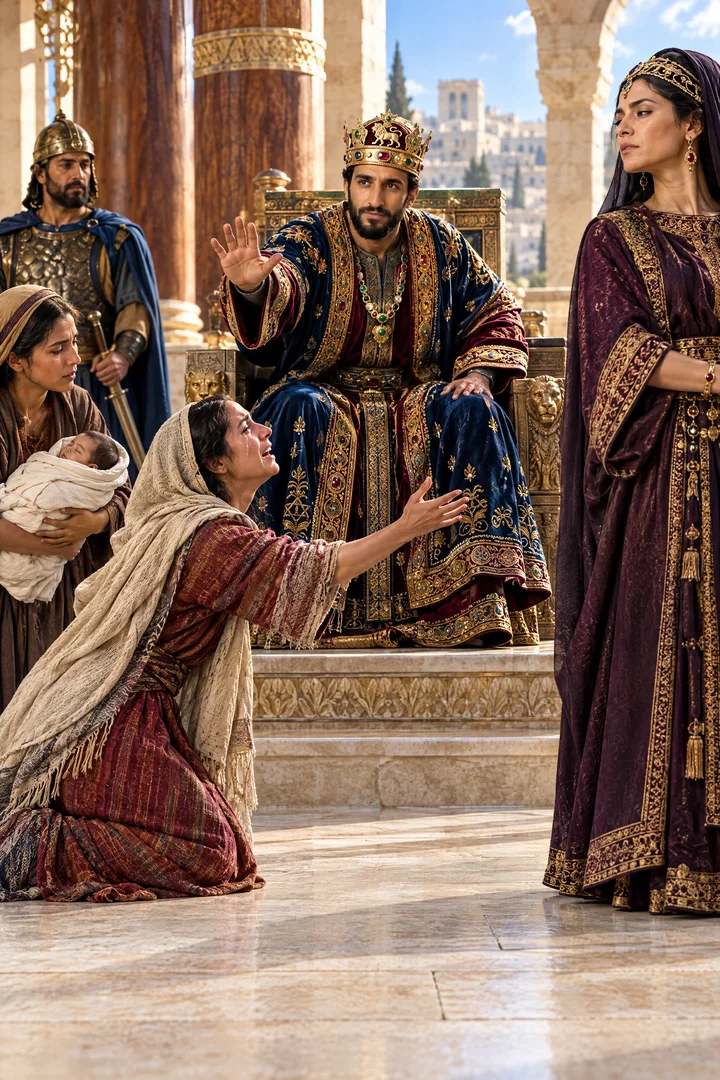
The verse belongs to the larger account in 1 Kings 3:16-28 in which a helpless infant is restored to its unfortunate mother.PK 57.2RH Dec 21, 1905 It records the mother rising in the morning to nurse her child, finding it dead, and on careful examination in the morning recognizing it was not the son she had borne.RH Dec 21, 1905 The surrounding episode displays Solomon's wisdom and sympathy in his early reign in resolving the case.PK 57.2RH Dec 21, 1905 His action in saving the living child proves his allegiance to God, his self-mastery, his moral efficiency, his fine sensibilities, and his unseared conscience.PK 57.2 The episode marks the height from which he later fell when communication with idolaters separated him from God and became his ruin, so that he who had saved a living child sank so low as to consent to erecting an idol to whom living children were offered as sacrifices.PK 57.2
Sources
Pioneers and periodicals
9 sources
1 Kings 3:21 is part of the account in 1 Kings 3:16-28 of Solomon deciding a difficult case, his wise and famous judgment between two women or mothers who each claimed the living child as her own.ST Jul 30, 1885ST Nov 5, 1885ST Oct 1, 1896 It belongs to the narrative presented as a proof of his wisdom.ST Dec 9, 1897ST Oct 1, 1896 In the verse the speaking woman rose in the morning to nurse or give suck to her child, found the child beside her dead, and when she examined or considered it in the morning recognized that it was not the son she had borne.RH Dec 21, 1905ST Jul 30, 1885ST Jan 6, 1888RH Apr 16, 1867 That morning discovery revealed the dispute over which woman was the living child's mother and exposed the other woman's claim to her living son.ST Nov 5, 1885ST Jan 6, 1888
The account in 1 Kings 3:16-28 belongs with the account of Solomon's wealth and wisdom in 1 Kings 4:25-34 and gives its background.ST Dec 9, 1897ST Oct 1, 1896 Solomon could at first be uncertain which woman was the child's rightful mother.RH Nov 4, 1858 His wisdom and sympathy enabled him to restore the helpless baby to its mother.RH Dec 21, 1905ST Nov 5, 1885 The judgment illustrates a rough, shrewd sense of justice.RH Dec 21, 1905ST Nov 5, 1885
The surrounding judgment turns on the king's proposed sword, which exposes the true mother because she pleads for the child's life and would rather surrender it than see it killed or destroyed.RH Jun 9, 1853RH Apr 16, 1867 The test applies to the moral and ceremonial laws: both disputing parties treat the ceremonial law as though dead, but disagree over whether the moral law should also be divided or allowed to remain whole and living.RH Jun 9, 1853RH Apr 16, 1867 The true mother's plea illustrates how a repentant sinner honors God's law and desires its continued life, not its abolition.RH Jun 9, 1853RH Apr 16, 1867
Sources