1 Kings 3:22
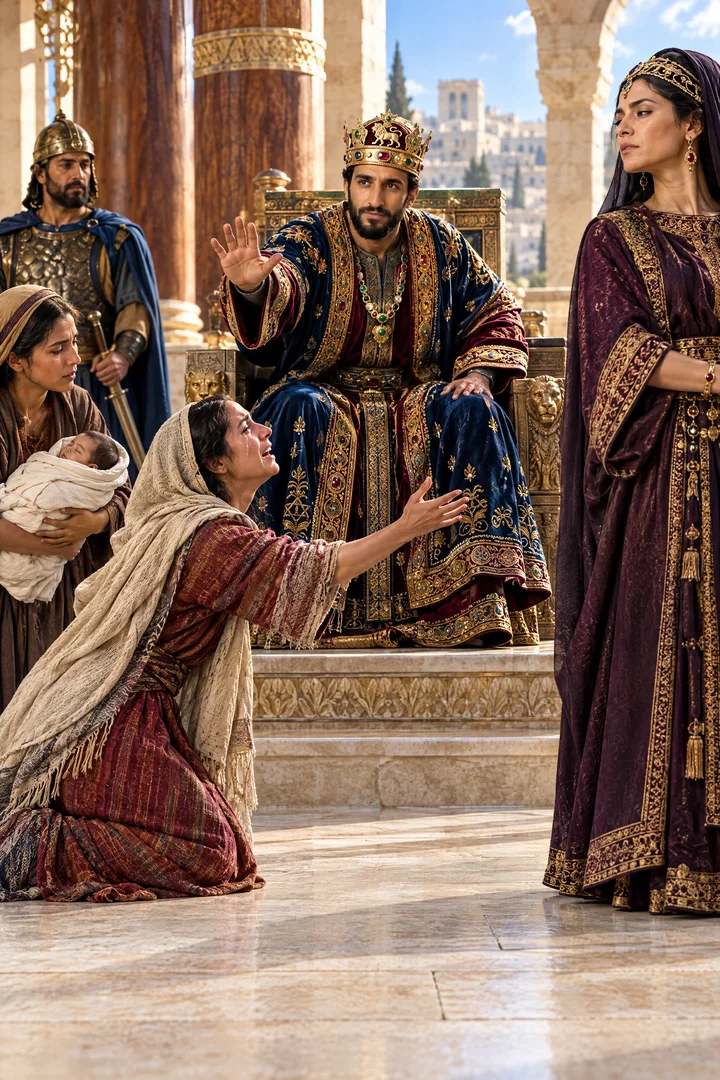
And the other woman said, Nay; but the living is my son, and the dead is thy son. And this said, No; but the dead is thy son, and the living is my son. Thus they spake before the king.
Translations
And the other woman said, No; but the living is my son, and the dead is your son. And this said, No; but the dead is your son, and the living is my son. Thus they spoke before the king.
King James Version, KJV Cambridge Paragraph Bible, Revised Version, American Standard Version
And the other woman said, Nay; but the living is my son, and the dead is thy son. And this said, No; but the dead is thy son, and the living is my son. Thus they spake before the king.
And the other woman said, No; but the living is my son, and the dead is thy son. And this said, No; but the dead is thy son, and the living is my son. Thus they spoke before the king.
And the other woman saith, 'Nay, but my son [is] the living, and thy son the dead;' and this [one] saith, 'Nay, but thy son [is] the dead, and my son the living.' And they speak before the king.
And the other woman said, No, for the living is my son, and the dead is thy son. And this one said, No, but the dead is thy son, and the living is my son. Thus they spoke before the king.
Then said the other woman—Nay! but, my son, is the, living, and, thy son, the, dead. But, this, one kept on saying—Nay, verily! but, thy son, is the, dead, and, my son, the, living. Thus spake they before the king.
Berean Standard Bible, Majority Standard Bible
“ No,” said the other woman, “ the living one is my son and the dead one is your son.”But the first woman insisted, “ No, the dead one is yours and the living one is mine.” So they argued before the king.
The other woman said, “ No! But the living one is my son, and the dead one is your son.”The first one said, “ No! But the dead one is your son, and the living one is my son.” They argued like this before the king.
And the other woman said, No; but the living child is my son and the dead one yours. But the first said, No; the dead child is your son and the living one mine. So they kept on talking before the king.
Then the other woman sayd, Nay, but my sonne liueth, and thy sonne is dead. Againe she sayde, No, but thy sonne is dead, and mine aliue: thus they spake before the King.
Douay-Rheims (Challoner revision)
And the other woman answered: It is not so as thou sayest, but thy child is dead, and mine is alive. On the contrary she said: Thou liest: for my child liveth, and thy child is dead. And in this manner they strove before the king.
Pictures



Cross-references
- 1 Kings 3:9-12
Give therefore thy servant an understanding heart to judge thy people, that I may discern between good and bad: for who is able to judge this thy so great a people?
Solomon asks for wisdom to judge his people and receives it.
Commentary
Each commentary is drawn from primary sources: the writings of Ellen G. White and Adventist pioneers and periodicals. Each commentary is separate. Its own words are not a quotation; follow the references to read the source passages.
Ellen G. White
2 sources
The dispute belongs to Solomon's early reign, when he restored a helpless babe to its unfortunate mother.PK 57.2RH Dec 21, 1905 In that act was displayed his early wisdom and sympathetic care.PK 57.2RH Dec 21, 1905 It revealed at that time moral efficiency, fine sensibility, and a clear conscience.PK 57.2 This compassionate wisdom stands in sharp contrast to his later ruin and approval of idolatry involving the sacrifice of children.PK 57.2RH Dec 21, 1905 That later fall came after separation from God through communication and association with idolaters, when he lost mastery of himself and sank so low as to consent to the erection of an idol to whom living children were offered as sacrifices.PK 57.2
Sources
Pioneers and periodicals
8 sources
The verse belongs to the history of the undivided kingdom under Solomon told in 1 Kings 1 to 11, which relates the same events as 2 Chronicles 1 to 9 and comes in chronological order.RH May 11, 1916 It belongs to the difficult case Solomon decides soon after asking God for wisdom, and the case provides a proof of his wisdom.ST Dec 9, 1897 It records the two women repeating their opposing claims before Solomon, each saying the living child is her own son and the dead child is the other woman's son.ST Nov 5, 1885ST Jan 6, 1888RH Nov 4, 1858
At that point Solomon faced conflicting claims about which woman was the living child's mother and could not yet determine who was right.RH Nov 4, 1858 The dispute is settled when Solomon proposes dividing the child: the true mother would rather give the child to the other woman than see it killed, while the false claimant accepts the division.ST Jan 6, 1888 The verse shows his wisdom, sympathy, and shrewd judgment in deciding the case and restoring the helpless babe to its mother, as an example of the justice a king could deliver through a personal appeal.RH Dec 21, 1905ST Nov 5, 1885
The episode shows his early wisdom and care, in sharp contrast with his later approval of idolatry and the sacrifice of children.RH Dec 21, 1905 The dispute illustrates that human beings may fail to recognize or remember what is true, but the Lord knows who belongs to him and nothing can hide them from his sight.RH Nov 4, 1858 The real mother's pleading for the infant's life illustrates how a truly repentant sinner regards God's law: he does not seek its abolition, but values and upholds it.RH Apr 16, 1867
The verse supplies an image of two women disputing over a living child and a dead child whose claims the king tests.RH Jun 9, 1853 Applied to the law, the ceremonial law is treated as dead while the continuing life of the moral law is disputed, with some wanting to divide or abolish it and others wanting to preserve it whole.RH Jun 9, 1853 The mother who trembled at the sword represents care for the living child, and the sword of truth and justice tests the competing claims, teaching that the moral law must not be slain or divided, even though the comparison has a stated flaw.RH Jun 9, 1853
Sources