1 Kings 3:23
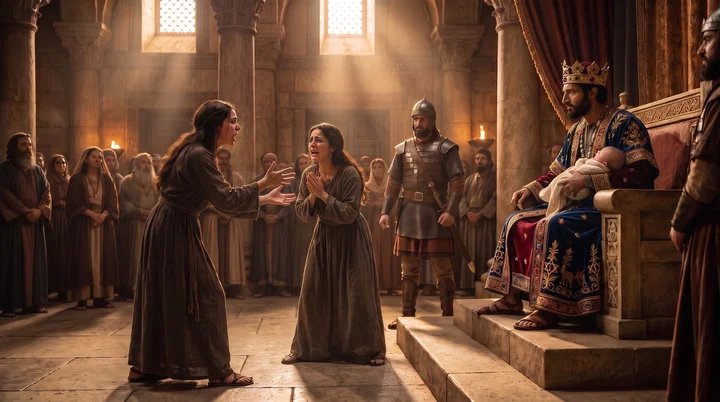
Then said the king, The one saith, This is my son that liveth, and thy son is the dead: and the other saith, Nay; but thy son is the dead, and my son is the living.
Translations
Then said the king, The one says, This is my son that lives, and your son is the dead: and the other says, No; but your son is the dead, and my son is the living.
King James Version, KJV Cambridge Paragraph Bible, Revised Version, American Standard Version
Then said the king, The one saith, This is my son that liveth, and thy son is the dead: and the other saith, Nay; but thy son is the dead, and my son is the living.
Then said the king, The one saith, This is my son that liveth, and thy son is the dead; and the other saith, No; but thy son is the dead, and my son is the living.
And the king saith, 'This [one] saith, This [is] my son, the living, and thy son [is] the dead; and that [one] saith, Nay, but thy son [is] the dead, and my son the living.'
Then said the king, The one says, This that is living is my son, and thy son is the dead; and the other says, No, for thy son is the dead, and my son is the living.
Then said the king, The one woman, is saying, This, is, my son, the one that liveth, and, thy son, is, the one that is dead,—and, the other, is saying, Nay! but, thy son, is, the dead one, and, my son, the, living.
Berean Standard Bible, Majority Standard Bible
Then the king replied, “ This woman says, ‘ My son is alive and yours is dead,’ but that woman says, ‘ No, your son is dead and mine is alive.’”
Then the king said, “ One says, ‘ This is my son who lives, and your son is the dead one;’ and the other says, ‘ No! But your son is the dead one, and my son is the living one.’”
Then the king said, One says, The living child is my son, and yours is the dead: and the other says, Not so; but your son is the dead one and mine is the living.
Then sayde the King, She sayth, This that liueth is my sonne, and the dead is thy sonne: and the other sayth, Nay, but the dead is thy sonne, and the liuing is my sonne.
Douay-Rheims (Challoner revision)
Then said the king: The one saith, My child is alive, and thy child is dead. And the other answereth: Nay, but thy child is dead, and mine liveth.

Commentary
Each commentary is drawn from primary sources: the writings of Ellen G. White and Adventist pioneers and periodicals. Each commentary is separate. Its own words are not a quotation; follow the references to read the source passages.
Ellen G. White
2 sources
The saying belongs to Solomon's early-reign judgment in which a helpless babe was restored to its unfortunate mother.PK 57.2RH Dec 21, 1905 In that judgment he showed wisdom and kindly sympathy.PK 57.2RH Dec 21, 1905 That wisdom and sympathy revealed his allegiance to God, his mastery of himself, and his moral efficiency.PK 57.2 They revealed also his fine sensibilities and an unseared conscience.PK 57.2
That wisdom and sympathy were afterward lost when through communication with idolaters he separated from God.PK 57.2 In separating he cast off his allegiance and lost his self-mastery.PK 57.2 He fell so low as to consent to the erection of an idol to whom living children were offered as sacrifices, and to countenance licentious rites.PK 57.2
Sources
Pioneers and periodicals
9 sources
The verse belongs to Solomon's reign when the kingdom was still undivided.ST Dec 9, 1897 It stands in the history of that undivided kingdom told in 1 Kings 1-11, which tells the same events as 2 Chronicles 1-9 and comes in chronological order.RH May 11, 1916
The verse is Solomon restating the two women's conflicting claims before him, each saying the living child is hers and the dead child belongs to the other.ST Dec 9, 1897ST Nov 5, 1885RH Jun 9, 1853RH Nov 4, 1858 The two women repeat opposite claims about which child is alive and which is dead.ST Jan 6, 1888 Their opposing testimony leaves no clear way to decide the case from their words alone, and Solomon is left uncertain which woman is the child's true mother.ST Jan 6, 1888RH Nov 4, 1858
The dispute is the test of Solomon's wisdom, his first proof of wisdom, which he must judge.ST Dec 9, 1897 It leads into his famous judgment in which he threatens to divide the living child.ST Nov 5, 1885ST Jan 6, 1888 That threat tests their responses and reveals the true mother through her willingness to give the child up rather than see it killed.ST Jan 6, 1888 With wisdom and kindly sympathy he restores the helpless babe to its unfortunate mother.RH Dec 21, 1905ST Nov 5, 1885
The shrewdness of that judgment illustrates justice obtained through a direct appeal to the king.ST Nov 5, 1885 The dispute over the children also serves as an analogy in which the dead child is the ceremonial law treated as dead and the living child whose fate is contested is the moral law.RH Jun 9, 1853 The sword that tests the women represents truth and justice testing those who dispute the moral law, and though the analogy is not exact in every detail, its general point is that the moral law should remain whole and alive.RH Jun 9, 1853
The real mother's plea that the contested child be kept alive pictures the repentant sinner's regard for God's law.RH Apr 16, 1867 He does not seek the law's abolition, but values and keeps it.RH Apr 16, 1867
Sources