1 Kings 3:24
And the king said, Bring me a sword. And they brought a sword before the king.
Translations
American King James Version, King James Version, KJV Cambridge Paragraph Bible, Webster Bible, Darby Translation
And the king said, Bring me a sword. And they brought a sword before the king.
Revised Version, American Standard Version
And the king said, Fetch me a sword. And they brought a sword before the king.
And the king saith, 'Take for me a sword;' and they bring the sword before the king,
And the king said—Bring me a sword! So they brought a sword before the king.
Berean Standard Bible, Majority Standard Bible
The king continued, “ Bring me a sword.” So they brought him a sword,
The king said, “ Get me a sword.” So they brought a sword before the king.
Then he said, Get me a sword. So they went and put a sword before the king.
Then the King said, Bring me a sworde: and they brought out a sworde before the King.
Douay-Rheims (Challoner revision)
The king therefore said: Bring me a sword. And when they had brought a sword before the king,
Pictures
Cross-references
- 1 Kings 3:5-14
In Gibeon the LORD appeared to Solomon in a dream by night: and God said, Ask what I shall give thee.
Solomon asks God for wisdom and receives it in the same chapter.
Commentary
Each commentary is drawn from primary sources: the writings of Ellen G. White and Adventist pioneers and periodicals. Each commentary is separate. Its own words are not a quotation; follow the references to read the source passages.
Ellen G. White
2 sources
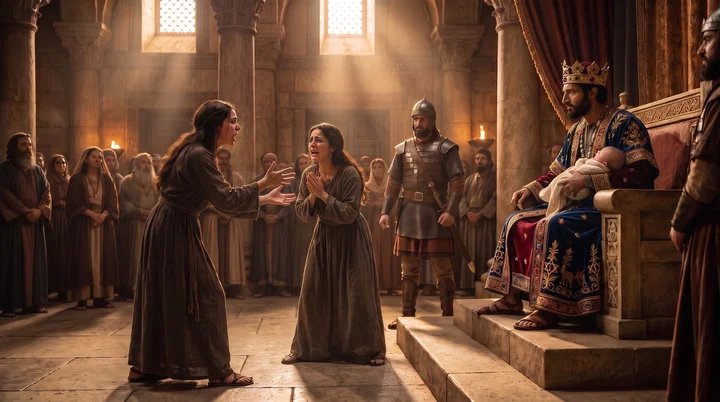
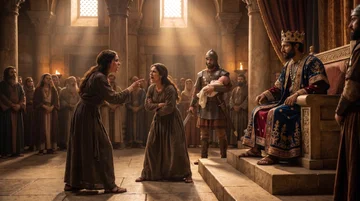
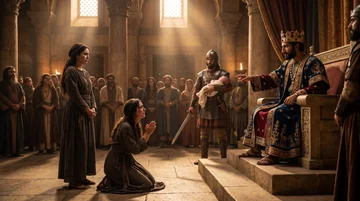
The order to bring a sword came early in Solomon's reign as a demonstration of both wisdom and kindly sympathy.PK 57.2RH Dec 21, 1905 It was given in the course of a dispute between two women over a child, where human testimony alone could not settle the claim.PK 57.2RH Dec 21, 1905 By calling for the sword Solomon exposed the true mother, distinguishing her by her self-sacrificing love from the false claimant.PK 57.2RH Dec 21, 1905 In this way the helpless child, even a tiny babe, was identified with its rightful parent and restored to her care.PK 57.2RH Dec 21, 1905
Sources
Pioneers and periodicals
10 sources
The verse belongs to the history of the undivided kingdom under Solomon in 1 Kings 1 to 11, which relates the same events as 2 Chronicles 1 to 9 and comes in chronological order.RH May 11, 1916 It belongs to the account in 1 Kings 3:16-28 of Solomon's difficult case and famous judgment between two women, or two mothers, who each claimed the same living child.ST Dec 9, 1897ST Dec 9, 1897ST Oct 1, 1896ST Jan 6, 1888 The king orders a sword to be brought before him as the means to test their claims, proposing that the living child be divided.ST Dec 9, 1897ST Jan 6, 1888RH Jun 9, 1853RH Apr 16, 1867 The test reveals the true mother through her response: in anguish and love she cannot bear the child's death, gives up her claim and pleads for the child's life rather than see him killed, thereby showing who genuinely loved the child.ST Dec 9, 1897ST Jan 6, 1888RH Jun 9, 1853RH Apr 16, 1867 The decision provides proof of and displays the wisdom and understanding God gave to Solomon, for which he was known, and belongs with the account of Solomon's peace, wealth, and wisdom.ST Dec 9, 1897ST Oct 1, 1896
The judgment exemplifies rough, shrewd justice and the king's personal authority to address a petitioner's case.ST Nov 5, 1885 It belongs to Solomon's use of wisdom and kindly sympathy to identify the child's true mother and restore the helpless babe to her.RH Dec 21, 1905 Solomon is initially uncertain which woman is the child's mother, illustrating that human judgment and recognition can fail.RH Nov 4, 1858
As the sword revealed who genuinely loved the child, the moral law is likewise to remain whole rather than be divided or slain.RH Jun 9, 1853 The verse illustrates the converted sinner's love for God's law: rather than asking that the law be abolished, the sinner pleads for its life, as the true mother pleaded for the infant's.RH Apr 16, 1867
Sources