1 Kings 3:25
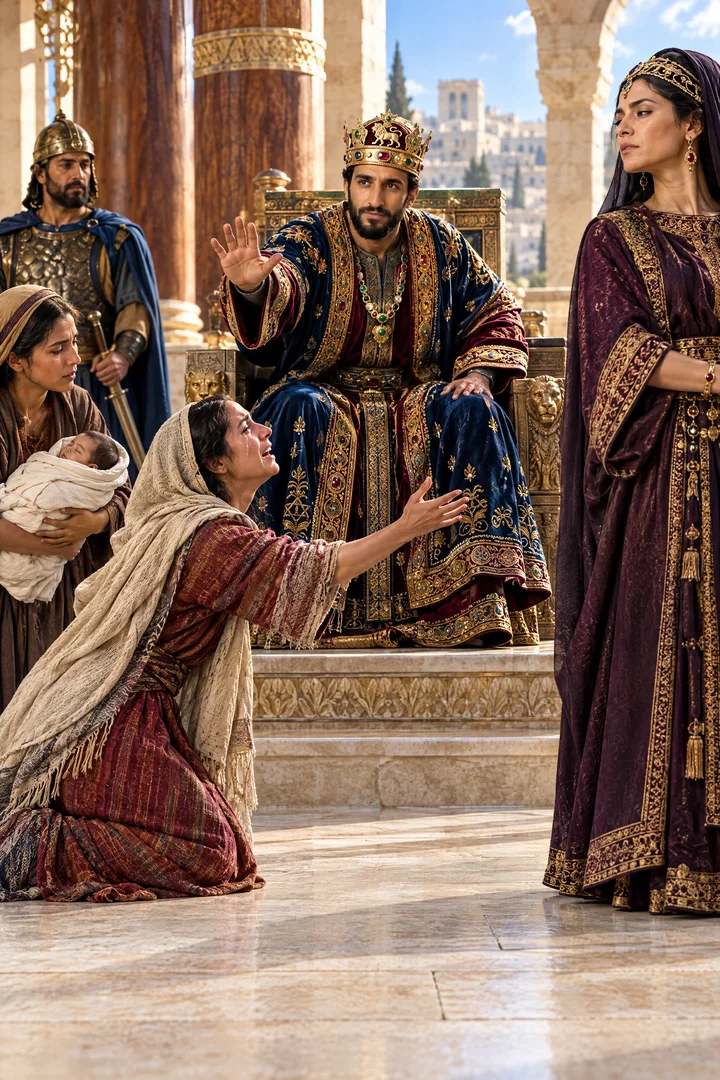
And the king said, Divide the living child in two, and give half to the one, and half to the other.
Translations
American King James Version, King James Version, KJV Cambridge Paragraph Bible, Webster Bible, Revised Version, American Standard Version, Darby Translation
And the king said, Divide the living child in two, and give half to the one, and half to the other.
and the king saith, 'Cut the living child into two, and give the half to the one, and the half to the other.'
Then said the king, Divide the living child, in twain,—and give half to the one, and half to the other.
Berean Standard Bible, Majority Standard Bible
and the king declared, “ Cut the living child in two and give half to one and half to the other.”
The king said, “ Divide the living child in two, and give half to the one, and half to the other.”
And the king said, Let the living child be cut in two and one half given to one woman and one to the other.
And the King sayde, Deuide ye the liuing child in twaine, and giue the one halfe to the one, and the other halfe to the other.
Douay-Rheims (Challoner revision)
Divide, said he, the living child in two, and give half to the one, and half to the other.
Pictures
Cross-references
- 1 Kings 3:9-12
Give therefore thy servant an understanding heart to judge thy people, that I may discern between good and bad: for who is able to judge this thy so great a people?
Solomon asks for wisdom before demonstrating it in the judgment.
Commentary
Each commentary is drawn from primary sources: the writings of Ellen G. White and Adventist pioneers and periodicals. Each commentary is separate. Its own words are not a quotation; follow the references to read the source passages.
Ellen G. White
2 sources
The command belongs to Solomon's early reign while he was loyal to God, and it displays his wisdom and kindly sympathy.PK 57.2RH Dec 21, 1905 The order to divide the living child was given in order to reveal who the true mother was.PK 57.2 By this judgment the helpless babe was restored to its unfortunate mother.PK 57.2RH Dec 21, 1905 The act proves his self-mastery, moral efficiency, fine sensibilities, and clear conscience at that time.PK 57.2
This early act stands in sharp contrast to his later ruin and participation in idolatrous worship in which living children were offered as sacrifices.PK 57.2RH Dec 21, 1905 That later fall came after separation from God through communication with idolaters, when he lost mastery of himself and fell so low as to consent to the erection of such an idol.PK 57.2
Sources
Pioneers and periodicals
11 sources
The verse belongs to the history of the undivided kingdom under Solomon in 1 Kings 1 to 11, which relates the same events as 2 Chronicles 1 to 9 and comes in chronological order.RH May 11, 1916 It belongs to Solomon's decision in a difficult case between the two women and shows in action the wisdom he had asked for as king and that God gave him, proving that wisdom.ST Dec 9, 1897ST Dec 9, 1897 The judgment in 1 Kings 3:16-28 belongs with the accounts of Solomon's wealth, dominion, and household provision in 1 Kings 4:20-34, 1 Kings 10:14-29, 2 Chronicles 1:13-17, and 2 Chronicles 9:13-28 as proof that God honors those who honor Him.ST Oct 1, 1896
Uncertain which woman was the child's rightful mother, Solomon proposed and ordered dividing the living child in two and giving half to each woman, using the threat to reveal which woman truly loved the child as its mother, since she would give him up rather than let him be killed.ST Nov 5, 1885ST Jan 6, 1888RH Nov 4, 1858 The judgment shows how a king's personal decision could deliver justice in a way that deeply impressed those who received it.ST Nov 5, 1885 The verse belongs to Solomon's early wisdom and kindly sympathy in restoring a helpless baby to its mother, which contrasts with his later participation in idolatrous worship in which children were sacrificed.RH Dec 21, 1905
As the threat to divide the living child exposed the true mother, the sword of truth and justice tests competing claims about the law.RH Jun 9, 1853 The ceremonial law is dead and the moral law is living, so dividing or abolishing any part of the moral law would damage the whole, which is to remain intact.RH Jun 9, 1853 The image of dividing the living child in two shows that the gospel message is fatally divided when it teaches faith without the good works faith should produce, since faith that bears no good works is dead.ST Jul 1, 1875 God's pardon is given on condition of repentance, and His goodness does not cancel His severity toward those who remain in sin, just as Christ's love does not cancel the Lamb's wrath toward persistent rebels, so that grace benefits those who heed its teaching of self-denial, obedience, zeal in good works, and godliness.ST Jul 1, 1875 As the true mother valued the contested child's life, a genuinely repentant sinner values the law's life and does not seek its abolition, so conversion leads a person to honor and keep God's law.RH Apr 16, 1867
Sources