1 Kings 6:18
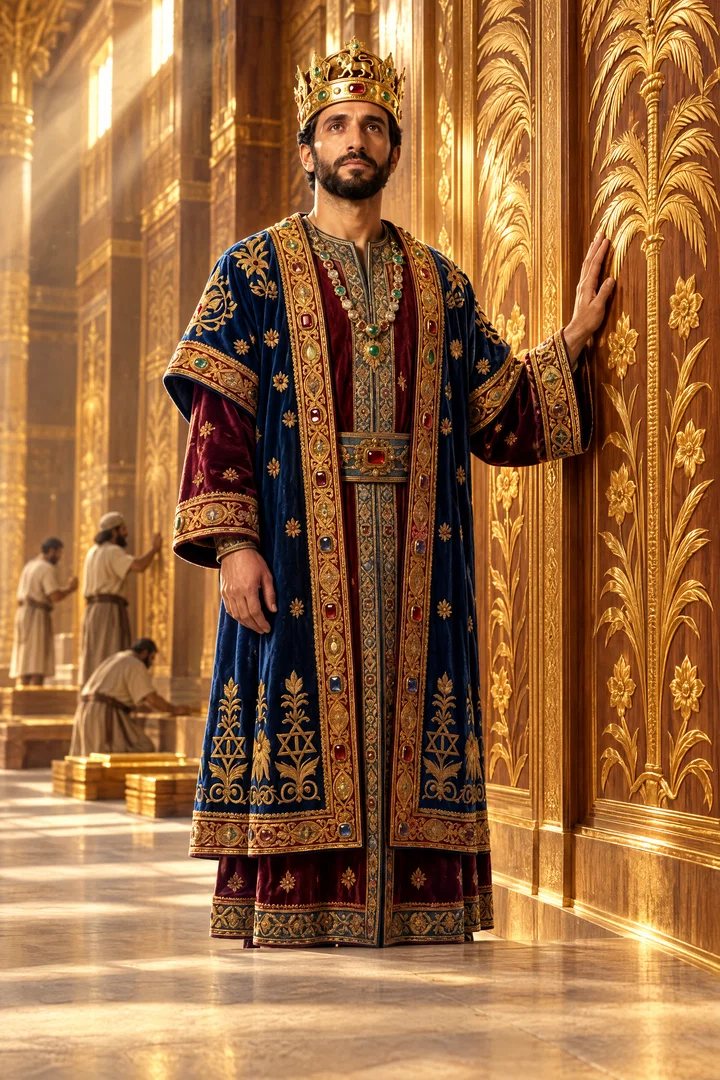
And the cedar of the house within was carved with knops and open flowers: all was cedar; there was no stone seen.
Translations
American King James Version, King James Version, KJV Cambridge Paragraph Bible
And the cedar of the house within was carved with knops and open flowers: all was cedar; there was no stone seen.
And the cedar of the house within was carved with knobs and open flowers: all was cedar; there was no stone seen.
Revised Version, American Standard Version
And there was cedar on the house within, carved with knops and open flowers: all was cedar; there was no stone seen.
And the cedar for the house within [is] carvings of knobs and openings of flowers; the whole [is] cedar, there is not a stone seen.
And the cedar of the house within was carved with colocynths and half-open flowers: all was cedar; there was no stone seen.
And, the cedar for the house within, was carved with colocynths, and with festoons of flowers,—the whole, was cedar, there was no stone to be seen.
Berean Standard Bible, Majority Standard Bible
The cedar paneling inside the temple was carved with gourds and open flowers. Everything was cedar; not a stone could be seen.
There was cedar on the house within, carved with buds and open flowers. All was cedar. No stone was visible.
( All the inside of the house was cedar-wood, ornamented with designs of buds and flowers; no stonework was to be seen inside.)
And the cedar of the house within was carued with knops, and grauen with floures: all was cedar, so that no stone was seene.
Douay-Rheims (Challoner revision)
And all the house was covered within with cedar, having the turnings, and the joints thereof artfully wrought and carvings projecting out: all was covered with boards of cedar: and no stone could be seen in the wall at all.
Pictures
Cross-references
- 2 Chronicles 3:5-7
And the greater house he cieled with fir tree, which he overlaid with fine gold, and set thereon palm trees and chains.
Both describe the temple’s cedar interior and carved decorations.
- 1 Chronicles 28:11-12
Then David gave to Solomon his son the pattern of the porch, and of the houses thereof, and of the treasuries thereof, and of the upper chambers thereof, and of the inner parlours thereof, and of the place of the mercy seat,
David gives Solomon the Spirit-guided pattern for the temple and its rooms.
- Hebrews 8:5
Who serve unto the example and shadow of heavenly things, as Moses was admonished of God when he was about to make the tabernacle: for, See, saith he, that thou make all things according to the pattern shewed to thee in the mount.
The earthly sanctuary was made according to the pattern shown to Moses.
- 2 Chronicles 4
Moreover he made an altar of brass, twenty cubits the length thereof, and twenty cubits the breadth thereof, and ten cubits the height thereof.
Gives a parallel account of the temple’s construction and dedication.
- 2 Chronicles 5
Thus all the work that Solomon made for the house of the LORD was finished: and Solomon brought in all the things that David his father had dedicated; and the silver, and the gold, and all the instruments, put he among the treasures of the house of God.
Gives a parallel account of the temple’s construction and dedication.
- Exodus 25:8-9
And let them make me a sanctuary; that I may dwell among them.
The tabernacle and its furnishings were made according to a divinely shown pattern.
- Hebrews 9:23-24
It was therefore necessary that the patterns of things in the heavens should be purified with these; but the heavenly things themselves with better sacrifices than these.
The earthly sanctuary patterns the heavenly holy places where Christ ministers.
- 1 Kings 7
But Solomon was building his own house thirteen years, and he finished all his house.
Continues the account of the temple and its furnishings.
Commentary
Each commentary is drawn from primary sources: the writings of Ellen G. White and Adventist pioneers and periodicals. Each commentary is separate. Its own words are not a quotation; follow the references to read the source passages.
Ellen G. White
3 sources
The inner walls were lined with cedar carved with buds and open flowers, so that the stone walls were entirely hidden and none remained visible.RH Nov 2, 1905GC88 411.1–412.3 The permanent temple followed the proportions and arrangement of the tabernacle, but was built on a larger scale.GC88 411.1–412.3
Its richness, beauty, and costly design could not be excelled, making it the most magnificent building the world ever saw.SG4 97.3 It was built in faithful obedience to God's directions, by the wise and understanding heart God had given, which had been chosen above earthly riches, honor, and long life.SG4 97.3 Faithful work in directing and managing its construction spread fame among all nations.SG4 97.3
Sources
Pioneers and periodicals
23 sources
The inner stone walls of Solomon's house for the Lord were lined with cedar carved with buds and open flowers, so that the wood wholly covered the masonry and no stone could be seen in a richly finished interior.ST Apr 26, 1910RH Jan 4, 1870RH Mar 26, 1857 Built on the same plan as the wilderness tabernacle but larger and grander with its two holy places and sacred vessels and ministry, it was a pattern and type of the heavenly temple, showing that the heavenly dwelling itself has two holy places.RH Jan 4, 1870ST May 16, 1878RH Mar 26, 1857RH Feb 3, 1853 In both tabernacle and temple the worship and service turned upon the holy of holies where the law of God rested beneath the mercy seat.ST Jun 19, 1907 Cedar was chosen for the most important and conspicuous parts for strength and beauty, for its fine grain and polish and fragrance and resistance to decay made it fitting for the house of God, and its soundness pictures the faithful Christian who is pure to the core and withstands the hidden corruption of sin.RH May 7, 1861 Its carved adornment was a rightful use of images not made for worship and therefore did not break the command against images, while the house itself foreshadows God gathering a people for His name to become at last a spiritual temple in the kingdom of heaven.RH Mar 9, 1916RH Dec 10, 1908
Temple Interior and History
The interior of Solomon's temple had its stone walls lined with cedar carved with knops or buds and knobs and open flowers, so that the cedar entirely covered the interior and concealed the stone beneath and no stone was seen, giving a richly finished interior.RH Nov 2, 1905ST Apr 26, 1910RH Jan 4, 1870RH Mar 26, 1857RH Mar 9, 1916 The temple in its earthly sanctuary form thus used materials different from those of the wilderness tabernacle, with its cedar construction overlaid with gold.RH Mar 26, 1857 The temple preserved the tabernacle's two apartments and proportions on a doubled scale, with the temple's dimensions twice those of the tabernacle so that the tabernacle inner sanctuary fifteen feet square was doubled in the temple.ST Nov 14, 1892ST May 20, 1880 The inner apartment, called the oracle or most holy place, was a cube twenty cubits on each side.ST May 8, 1901
The temple was a magnificent, permanent enlargement of the tabernacle plan, taking seven years and six months to build, with vessels greater in size and number than those of the tabernacle.RH Jan 6, 1853 It took the place of the movable and portable wilderness tabernacle erected at God's command after Israel entered the promised land and remained the earthly sanctuary and the building generally meant by the word sanctuary, along with the inner tabernacle.ST Dec 8, 1881ST Jun 19, 1907ST Aug 30, 1877 It continued in use apart from the period when it lay in ruins in Daniel's day, until its destruction by the Romans in A.D. 70.ST Dec 8, 1881RH Jul 19, 1870
The temple was built as a dwelling place and glorious house for the Lord to dwell in that had come into David's mind to build.RH Oct 27, 1863 Its building and dedication belonged to Solomon's period of single-hearted devotedness after he asked for wisdom, during the seven and one-half years when he subdued his enemies, organized the kingdom, and was greatly blessed by God.ST Dec 10, 1896 It stands as an example of the remarkable architecture of Solomon's age and of great skill and combined human strength.RH Oct 3, 1871RH May 22, 1900
Pattern of Heavenly Sanctuary
Like the tabernacle, the temple was built with two holy places on the same plan and with the same sacred vessels and ministry, but on a larger and grander scale.RH Jan 4, 1870ST May 16, 1878RH Feb 3, 1853RH Mar 8, 1870 Its interior of cedar carved with knops and open flowers covering the walls so that no stone was seen belonged to that two-apartment building, which was erected in every respect according to the pattern given to David by the Spirit as a resemblance of the holy tabernacle prepared from the beginning.RH Jan 4, 1870ST May 16, 1878RH Feb 3, 1853RH Mar 8, 1870 Like the tabernacle it served as a pattern and type of the heavenly temple, proving that the heavenly tabernacle itself contains two holy places.RH Jan 4, 1870ST May 16, 1878RH Mar 8, 1870 Its cedar construction overlaid with gold shows that the sanctuary in its temple form used materials different from those of the wilderness tabernacle while it remained a type of the heavenly sanctuary.RH Mar 26, 1857
In both the tabernacle and the temple, the sanctuary that took the place of the portable wilderness structure, earthly worship and service centered on and revolved around the holy of holies where the law of God rested with the mercy seat over it.ST Jun 19, 1907 The temple built as a dwelling place for God also serves as a type of the church of God and as an example of God gathering a people for his name who will ultimately become a spiritual temple in the kingdom of heaven.RH Dec 10, 1908 The carved cedar ornamentation of buds and open flowers inside, which completely covered the stone, was a legitimate use of images that did not violate the second commandment because it was not made for worship.RH Mar 9, 1916
Spiritual Lessons for Believers
Cedar gave both strength and ornament to the most important and conspicuous parts of the temple, including the interior where it lined the walls from roof to floor.RH May 7, 1861 Its fine grain that took a high polish, its fragrance, and its resistance to decay made it fitting material for the house of God.RH May 7, 1861 Its soundness pictures the faithful Christian, who is pure to the core and resists the hidden corruption of sin.RH May 7, 1861 Solomon's care in building the interior carefully with cedar carved with knops and open flowers is an example of selecting sound material for construction.RH Aug 3, 1911
Sources