Translations
American King James Version, King James Version, Webster Bible, Revised Version
And let them make me a sanctuary; that I may dwell among them.
And let them make me a sanctuary; that I may dwell amongst them.
And let them make me a sanctuary, that I may dwell among them.
'And they have made for Me a sanctuary, and I have tabernacled in their midst;
And they shall make me a sanctuary, that I may dwell among them.
So shall they make for me a sanctuary,—and I will make my habitation in their midst:
Berean Standard Bible, Majority Standard Bible
And they are to make a sanctuary for Me, so that I may dwell among them.
Let them make me a sanctuary, that I may dwell among them.
And let them make me a holy place, so that I may be ever present among them.
Also they shall make me a Sanctuarie, that I may dwell among them.
Douay-Rheims (Challoner revision)
And they shall make me a sanctuary, and I will dwell in the midst of them:
Pictures
Cross-references 20 of 159
- Hebrews 8:1-5
Now of the things which we have spoken this is the sum: We have such an high priest, who is set on the right hand of the throne of the Majesty in the heavens;
The earthly sanctuary was a pattern of the true heavenly tabernacle where Christ ministers.
- Hebrews 9:1-5
Then verily the first covenant had also ordinances of divine service, and a worldly sanctuary.
Describes the first covenant’s earthly sanctuary and its furnishings.
- Hebrews 9:24
For Christ is not entered into the holy places made with hands, which are the figures of the true; but into heaven itself, now to appear in the presence of God for us:
Earthly holy places are figures of the true sanctuary where Christ appears before God.
- Hebrews 8:5
Who serve unto the example and shadow of heavenly things, as Moses was admonished of God when he was about to make the tabernacle: for, See, saith he, that thou make all things according to the pattern shewed to thee in the mount.
The earthly sanctuary was made as a copy and shadow of the heavenly pattern.
- Exodus 25:40
And look that thou make them after their pattern, which was shewed thee in the mount.
Connects the sanctuary’s design with the pattern shown to Moses.
- Exodus 25:22
And there I will meet with thee, and I will commune with thee from above the mercy seat, from between the two cherubims which are upon the ark of the testimony, of all things which I will give thee in commandment unto the children of Israel.
God meets and speaks from above the mercy seat between the cherubim.
- Exodus 26:31-33
And thou shalt make a vail of blue, and purple, and scarlet, and fine twined linen of cunning work: with cherubims shall it be made:
Describes the veil separating the sanctuary’s holy and most holy places.
- Exodus 35:21
And they came, every one whose heart stirred him up, and every one whom his spirit made willing, and they brought the LORD’s offering to the work of the tabernacle of the congregation, and for all his service, and for the holy garments.
Willing-hearted people bring offerings for the sanctuary’s construction.
- Exodus 36:5-7
And they spake unto Moses, saying, The people bring much more than enough for the service of the work, which the LORD commanded to make.
The people give more than enough for the sanctuary’s construction, so Moses stops further offerings.
- Daniel 8:14
And he said unto me, Unto two thousand and three hundred days; then shall the sanctuary be cleansed.
Identifies the sanctuary to be cleansed at the end of the 2300 days.
- Exodus 40:34
Then a cloud covered the tent of the congregation, and the glory of the LORD filled the tabernacle.
God’s glory fills the completed tabernacle.
- Hebrews 9:9
Which was a figure for the time then present, in which were offered both gifts and sacrifices, that could not make him that did the service perfect, as pertaining to the conscience;
The first tabernacle is described as a figure for its time.
- Acts 7:44
Our fathers had the tabernacle of witness in the wilderness, as he had appointed, speaking unto Moses, that he should make it according to the fashion that he had seen.
Confirms the wilderness tabernacle was made according to the pattern shown to Moses.
- Exodus 29:43-45
And there I will meet with the children of Israel, and the tabernacle shall be sanctified by my glory.
God promises to meet Israel at the sanctuary and dwell among them.
- Leviticus 16:33
And he shall make an atonement for the holy sanctuary, and he shall make an atonement for the tabernacle of the congregation, and for the altar, and he shall make an atonement for the priests, and for all the people of the congregation.
Names the sanctuary in the instructions for its atonement.
- Revelation 11:19
And the temple of God was opened in heaven, and there was seen in his temple the ark of his testament: and there were lightnings, and voices, and thunderings, and an earthquake, and great hail.
The heavenly temple is opened, revealing the ark of God’s testament.
- John 1:14
And the Word was made flesh, and dwelt among us, ( and we beheld his glory, the glory as of the only begotten of the Father,) full of grace and truth.
Christ fulfills the tabernacle as God dwelling among humanity.
- Exodus 26:30
And thou shalt rear up the tabernacle according to the fashion thereof which was shewed thee in the mount.
The tabernacle is to be erected according to the pattern shown on the mountain.
- Exodus 15:17
Thou shalt bring them in, and plant them in the mountain of thine inheritance, in the place, O LORD, which thou hast made for thee to dwell in, in the Sanctuary, O Lord, which thy hands have established.
The promised land is described as the place where God would dwell, with a sanctuary established there.
- 1 Corinthians 3:16
Know ye not that ye are the temple of God, and that the Spirit of God dwelleth in you?
Believers are God’s temple, where his Spirit dwells.
Commentary part 1 of 2
Each commentary is drawn from primary sources: the writings of Ellen G. White and Adventist pioneers and periodicals. Each commentary is separate. Its own words are not a quotation; follow the references to read the source passages.
Ellen G. White
57 sources
God commanded Moses on the mount after the giving of the law at Sinai to make Him a portable sanctuary in the wilderness where His glory would rest and His presence be specially manifested among Israel.4SP 498.6Ms 144a, 1904, par. 5–6RH Nov 8, 1915STB 779.4–780.1 It was to be made in every detail according to the heavenly pattern shown to Moses, with God Himself devising the plan and qualifying chosen workers with skill, wisdom and ability to accomplish it.ST Nov 2, 1915Ms 14, 1899, par. 1–3SG4 5.1SG4 154.3ST Mar 4, 1903 The costly materials were to come only from freewill offerings given freely by willing hearts, and the people gave so cheerfully and abundantly that the supply exceeded the need and the offerings had to be stopped.PK 61.2SSP 4.4–5.1SG4 5.2–3RH Oct 13, 1874ST Sep 11, 1884 It was given in pity for their weakness after Egypt as a visible sign where God could meet with fallen humanity with veiled glory they could endure, foreshadowing Christ veiling His divinity in human form to dwell among men.ED 35.1–2DA 21.2–4ST Nov 2, 1915Ms 126, 1901, par. 4–6 The same command requires His people still to prepare sacred, orderly, reverent places where He can meet with and bless them, built and supported by willing, liberal, unselfish giving.RH Sep 22, 1904SG4 6.1–7.1Ms 23, 1889, par. 1–35T 495.21SP 271.1
Command and Historical Setting
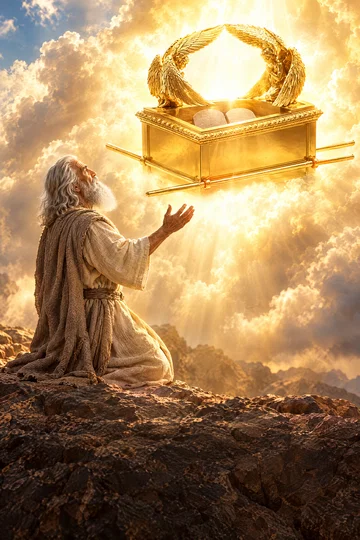
God commanded Moses on the mount to have Israel make Him a sanctuary so that He might dwell among them, the command coming after the law was given at Sinai and after the covenant was ratified.RH Nov 8, 1915STB 779.4–780.1RH Jan 4, 1906Ms 58, 1900, par. 23–25 Moses went up into the mount of God and spent forty days and nights there receiving the specifications for Israel's service and the details of its obligations.Ms 170, 1904, par. 4–6 There the Lord gave him the directions for building the sanctuary and showed him the pattern of the ark.Ms 58, 1900, par. 23–25
Those directions for the sanctuary were given before the special instructions about the Sabbath were given.1SP 242.2 Israel's apostasy cost them the blessing of God's presence and prevented the sanctuary from being built for a time.PP 343.1 When first commanded the sanctuary planned for His presence among Israel was not yet built, and Moses pitched a temporary worship tent outside the camp.SG3 286.1–287.1 When the people were again accepted, Moses carried out the command to build.PP 343.1
Christ gave Moses the specifications for building the tabernacle.Ms 97, 1899, par. 3–4RH Mar 6, 1900 Paul repeated those specifications chapter after chapter to his fellow workers while making tents with Aquila and Priscilla, for his own and their benefit.Ms 97, 1899, par. 3–4 He related them while working with his hands, making tents diligently and thoroughly.RH Mar 6, 1900
Structure of Earthly Dwelling
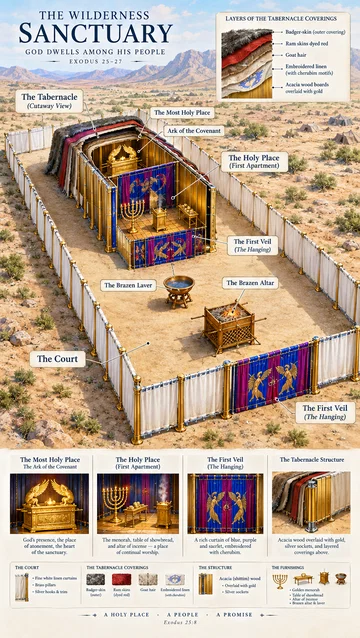
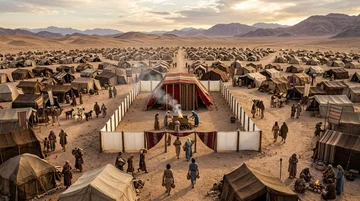
The command was to make a distinct earthly dwelling where God could dwell among Israel while they journeyed through the wilderness, a structure where His glory rested and His presence was specially manifested, not the earth itself nor the land of Canaan.4SP 498.6GC 411.2–412.3GC88 683.4–684.5GC88 411.1–412.3PP 313.3 It was the earthly dwelling place of the Most High given in the mount, with a court and two apartments, the holy place and the most holy place, where the divine presence was manifested in the most holy place between the cherubim.4SP 498.6GC 411.2–412.3GC88 411.1–412.3ST May 13, 1880 The sanctuary built in the wilderness was the movable tabernacle carried by Israel, later represented by the temple in Jerusalem.4SP 498.6GC88 683.4–684.5GC88 411.1–412.3
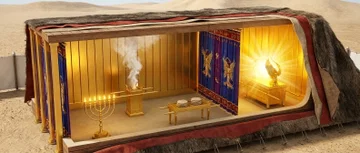
It was made portable so it could be taken down, carried, and set up again from place to place through all the travels of Israel, in order that the knowledge of God would be made known wherever they went.Ms 144a, 1904, par. 5–6Ms 38, 1904, par. 62–64RH Nov 8, 1915 Though movable, it was of great magnificence, with walls of upright boards heavily plated with gold set in sockets of silver.RH Nov 8, 1915 Its roof was of layered curtains or coverings, the outer of skins and the innermost of fine linen beautifully wrought with figures of cherubim.RH Nov 8, 1915 Outside was a court containing the altar of burnt offering, and the tabernacle itself held the two apartments called the holy and the most holy place, separated by a rich and beautiful curtain or veil, with a similar veil closing the entrance to the first apartment.GC 411.2–412.3GC88 411.1–412.3RH Nov 8, 1915
The holy place held the candlestick on the south with its seven lamps giving light day and night, the table of showbread on the north, and the golden altar of incense before the veil separating the holy from the most holy.RH Nov 8, 1915 From that altar a fragrant cloud with the prayers of Israel daily ascended before God.RH Nov 8, 1915 The most holy place held the ark, a chest of precious wood overlaid with gold containing the two tables of stone with the ten commandments.GC 411.2–412.3GC88 411.1–412.3RH Nov 8, 1915 It was covered by the mercy seat with two cherubim of solid gold, one at each end, where the divine presence appeared in the cloud of glory between the cherubim above the ark.GC 411.2–412.3GC88 411.1–412.3RH Nov 8, 1915
After Israel settled in Canaan the movable wilderness sanctuary was replaced by Solomon's temple in Jerusalem, which represented it and received the vessels from the movable sanctuary.4SP 498.6GC88 683.4–684.5GC88 411.1–412.3 That temple retained its proportions and furnishings, with holy and most holy places answering to those of the tabernacle.4SP 498.6GC88 411.1–412.3
Heavenly Pattern and Workmanship
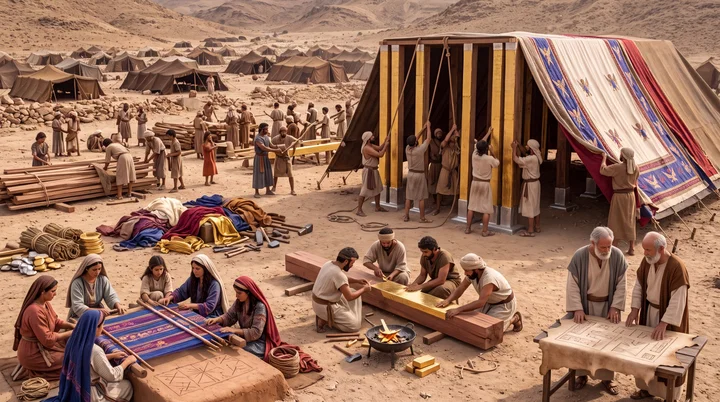
Neither Moses nor the workmen were left to plan the form and workmanship, for God Himself devised the plan and gave particular directions as to size, form, dimensions, materials, curtains, furniture, and every article pertaining to it.SG4 5.1ST Mar 4, 1903 He showed Moses a miniature model of the heavenly sanctuary and commanded that the tabernacle and all belonging to it be made in similitude of heavenly things according to the pattern shown in the mount.ST Nov 2, 1915SG4 5.1ST Mar 4, 1903 Moses wrote all the directions in a book and read them to the most influential of the people.SG4 5.1 As designer God educated the builders, choosing the workers Himself and raising up men and women and qualifying them with more than natural abilities.Ms 14, 1899, par. 1–3SG4 5.1SG4 154.3STE 94.1 He fitted them for their work by giving skill, wisdom, and genius, imparting embroidery and ingenious work including vessels of solid gold, and apportioning to each worker work according to ability to make up one divine design.Ms 14, 1899, par. 1–3SG4 5.1SG4 154.3
The work required hard labor with heart and soul and strength, the sturdy mechanic taxing muscle and sinew.STE 94.1 Industry, diligence, thoroughness, and quick, skillful work with the hands in God-appointed work is true religion, a manifestation of love to God and labor for His honor.Ms 97, 1899, par. 3–4Ms 14, 1899, par. 1–3RH Mar 6, 1900STE 94.1 Such diligent, thorough, intelligent manual labor preaches the gospel, keeps the worker in touch with the great Teacher, educates others in unity, and the skill, genius, and wisdom given by God are to be used to His glory with supreme honor to Him.Ms 97, 1899, par. 3–4RH Mar 6, 1900 The specifications Christ gave Moses for the tabernacle were repeated by Paul chapter after chapter to his fellow workers while making tents with Aquila and Priscilla, for his own and their benefit.Ms 97, 1899, par. 3–4RH Mar 6, 1900
Different workers received different work requiring unity in diversity, with each person assigned a task and each part in harmony with the other.Ms 14, 1899, par. 1–3Ms 21, 1903, par. 30–32 No one was to seize another's portion of the work or stand in a fellow laborer's way, but each was to do appointed work with strictest fidelity, for in the essential building no part is menial and every part means service.Ms 14, 1899, par. 1–3 Followed in this way the plan produced a complete tabernacle illustrating simplicity, beauty, harmony, perfect order, and coordinated labor without discord.Ms 14, 1899, par. 1–3Ms 21, 1903, par. 30–32 From the beginning God was particular as to both design and accomplishment, arranging every detail of construction so that the sanctuary, its order, harmony, exalted character, and workmanship represented His power, majesty, and holiness and honored His name.7T 93.4–94.1Ms 81, 1900, par. 18Ms 39, 1900, par. 3
He gives wisdom to all engaged in His service today to do His will and to carry His work forward on an elevated, refined, ennobling basis, with faithfulness, stability, and fitness seen in every line and with buildings corresponding to His providence.Ms 81, 1900, par. 18Ms 39, 1900, par. 3 His name must be honored by work done for Him today and His work must not move forward shabbily.Ms 39, 1900, par. 3 He is displeased with those who in their service do not carry out His design, and He will separate such men from His cause and prove others in their place, who if self-sufficient will in turn be replaced by still other laborers.Ms 81, 1900, par. 18 God gave Israel in the wilderness the privilege, honor, and great responsibility of making Him a sanctuary of surpassing splendor demanding the most costly material and the highest artistic skill, a stupendous task for a people just escaped from slavery.ST Nov 2, 1915 Yet He who gave the plan stood pledged to cooperate with the builders, with Christ and His angels as instructors in that industrial school, as all the people cooperated with labor of brain and hand and by that labor and giving learned to cooperate with God and with one another and to cooperate also in preparing the spiritual building, God's temple in the soul.ST Nov 2, 1915
Willing and Abundant Offerings
Preparing a dwelling for God required costly materials and great, expensive preparations with precious materials including gold, silver, brass and other materials, yet only freewill offerings given freely and willingly were accepted, from every one whose heart stirred him and whose spirit made him willing.PK 61.2Ms 144a, 1904, par. 5–6SSP 4.4–5.1Ms 38, 1904, par. 62–64SG4 5.2–3 Devotion to God and a spirit of sacrifice were the first requisites in preparing a place for Him, and unwilling and stinted offerings are not accepted.PK 61.2SSP 4.4–5.1SG4 5.2–3SG4 6.1–7.1 The construction was supported by such freewill offerings brought by people whose hearts and spirits made them willing, and the work went forward according to the word of the Lord.Ms 144a, 1904, par. 5–6Ms 38, 1904, par. 62–641SP 269.2
The command came just after leaving Egypt, when freedom was fragile and one step could turn them back to slavery, and Israel was to build from limited and scanty means while their own tents were small.ST Sep 11, 1884ST Aug 5, 1875 God's house was to be built first, before enlarging their own dwellings, according to the design God gave.ST Aug 5, 1875 Each soul was anxious to have a part and gave cheerfully without urging, even taking ornaments and jewelry from the person and giving gold, silver, brass and ornamental work gladly.ST Sep 11, 1884ST Aug 5, 1875 In such abundance was given that more than a million dollars was expended.ST Aug 5, 1875
The people gave so freely and abundantly for the sanctuary and its service, including precious materials and skilled work, that the supply exceeded what was needed until there was more than enough.SG4 5.2–3RH Oct 13, 1874ST Sep 11, 1884ST Mar 4, 1903 Moses had to proclaim that they had enough and that offerings and labor must cease, telling them to stop bringing offerings because enough had been brought.SG4 5.2–3ST Sep 11, 1884ST Aug 5, 1875
Those who prize the blessing of God's sacred presence and value heavenly blessings higher than earthly comforts manifest greater interest and zeal in proportion as they value divine things, willingly bringing acceptable offerings of the very best they have.SG4 6.1–7.1 They are blessed in proportion as they have estimated the value of divine things.SG4 6.1–7.1 Those who withhold what belongs to God and rob Him will be afflicted in their families and decreased in their possessions according to the measure of that withholding.SG4 6.1–7.11SP 271.1 A building prepared expressly for God to meet with His people should therefore be arranged with care, made comfortable, neat and convenient, dedicated and presented to Him with Him entreated to abide in that house and make it sacred by His holy presence, with enough willingly given to liberally accomplish the work so the workmen can say bring no more offerings, and a house built for God never should be left in debt, for God would be dishonored.SG4 6.1–7.11SP 271.1
Purpose of God's Dwelling
The sanctuary was commanded as a visible symbol of divine presence so that God might live among the people and meet with them.ED 35.1–2ST Nov 2, 1915Lt 44, 1903, par. 19 It was given in pity for their weakness, for after long years in Egypt amid material and degrading representations of deity they found it difficult to conceive the existence and character of the Unseen One.ED 35.1–2ST Nov 2, 1915Lt 44, 1903, par. 19 In that condition they needed a tangible sign to help them grasp that He is real and to learn what He is like.ED 35.1–2Lt 44, 1903, par. 19
After the fall the tabernacle became the appointed means by which God could approach humanity.Ms 126, 1901, par. 4–6 There He met with the people and His voice was often heard, and His presence was made visible in the glory of the cloud resting above the tabernacle, while the cloud veiled its brightness so that mortals could endure it.Ms 126, 1901, par. 4–6 As His glory was thus veiled in the sanctuary, so Christ's divinity was afterward veiled in human form, and the sanctuary foreshadowed Christ dwelling among humanity so that people could draw near to Him, behold His character, and live.DA 21.2–4 His presence in this veiled nearness remained with Israel through the wilderness journey.DA 21.2–4
The command looked beyond a building, for God's purpose was also to make Israel themselves His dwelling place by revealing to them His glorious ideal of character.ST Nov 2, 1915 That pattern was shown in the mount in the giving of the law from Sinai and in the proclamation of the Lord as merciful and gracious, long-suffering, and abundant in goodness and truth.ST Nov 2, 1915 To impress that majesty, holiness, and required purity, special directions were given for arranging the camp in perfect order and for everything connected with the tabernacle.GW92 308.2 That order and harmony and exalted character were not for Israel alone but to make an impression upon the surrounding nations, revealing to them the character of the true God and what He desires His people to be.GW92 308.2
Worship and Work Today
A place prepared for God to meet with and dwell among His people is sacred, set apart above ordinary temporal things, and dear to His loyal people, calling for reverence.Ms 23, 1889, par. 1–35T 495.26T 104.15T 491.2 Its divinely ordered service and directions show that worship and places dedicated to God are sacred and are to be treated as sacred.Ms 23, 1889, par. 1–35T 495.25T 491.2 They are to be kept pure, clean, and orderly, with His people giving their best in His service.Ms 23, 1889, par. 1–3 Such a house is to serve as a place where He meets with and blesses them, and personal sacrifice is willingly made so it can fulfill that purpose.6T 104.1
A house dedicated to worship should therefore be treated as sacred and not used for school, meals, business, or other common purposes.Ms 23, 1886, par. 15–16 Worshipers should enter it with reverence and leave worldly thoughts and sinful attitudes behind.Ms 23, 1886, par. 15–16 Those who value God's sacred presence and prize the blessing of His presence should prepare a place of worship with interest and zeal in keeping with the worth they place on heavenly blessings, manifesting greater interest and zeal in proportion as they value heavenly blessings higher than earthly comforts, realizing they are preparing a house for God.1SP 270.1SG4 6.1–7.1 Such a building prepared expressly for God to meet with His people should be arranged with care and made comfortable, neat, convenient, and tastefully finished.1SP 270.1SG4 6.1–7.11SP 271.1 It is to be dedicated and presented to Him, with Him entreated to abide in that house and make it sacred by His holy presence.SG4 6.1–7.11SP 271.1
Devotion to the work of God and sacrifice from the heart are first required in preparing a place for Him, with only free-will offering accepted and unwilling and stinted offerings not accepted.SG4 6.1–7.1 Enough should be willingly given to liberally accomplish the work so the workmen can say bring no more offerings.SG4 6.1–7.11SP 271.1 A house built for God never should be left in debt, for God would be dishonored.SG4 6.1–7.11SP 271.1 Those who willingly bring acceptable offerings of the very best they have will be blessed in proportion as they have estimated the value of divine things, while those who withhold what belongs to God and rob Him will be afflicted in their families and decreased in their possessions according to the measure of that withholding.SG4 6.1–7.11SP 271.1 As in building the wilderness tabernacle, God's people should exert their efforts in faith to provide room for His work and to prepare a place dedicated to Him, and He blesses those efforts according to their faith.Ms 49, 1886, par. 113MR 233.1–234.2
God's people are commanded to arise and build Him a house where He can meet with those who worship Him, and to build without delay even when voices on every side say it cannot be done and no help comes from the conference.Lt 63, 1899, par. 25–30 Obedience means advancing step by step on a sure basis in faith, while God provides means at the exact time of need, opens the way for experienced workers to labor for reduced wages or as donation, supervises the building, honors faith and prospers the work.Lt 63, 1899, par. 25–30 The result is a neatly and tastefully finished meetinghouse completed without debt, large enough to hold growing worshipers with room to enlarge, through which God's name is glorified.Lt 63, 1899, par. 25–30 The same principles apply now, for God gave Israel special directions for arranging their camp in perfect order and for everything connected with the tabernacle to impress them with His majesty and holiness and with the purity He requires of all who serve Him.GW92 308.2 That order and harmony and exalted character were not for Israel alone but to make an impression upon surrounding nations, revealing to them the character of the true God and what He desires His people to be, so those who labor for God must study the instructions given to ancient Israel and make all their arrangements such as rightly to represent Him, because the world judges by appearances.GW92 308.2
The directions for building the tabernacle mean He establishes His work where He has said it is to be, so the work in Washington will be established to show forth His praise.Ms 144a, 1904, par. 13Ms 38, 1904, par. 70–71 Where He directs the building, the Lord God of Israel is in the work, His name is glorified, His truth finds standing room, and the place shows forth His praise.Ms 38, 1904, par. 70–71 The same command now requires God's people in America to give willingly, liberally, and unselfishly without grudging or selfishness, with hearts stirred and made willing bringing the Lord's offering for the work so the work goes forward according to the word of the Lord.RH Sep 22, 1904Ms 38, 1904, par. 62–64 That giving is to erect memorials for God at Takoma Park and Washington, with a school and a sanitarium to be set in operation and a publishing house and a building for public work to be built.RH Sep 22, 1904Ms 38, 1904, par. 62–64 The work is to go forward without weariness and without slack, slipshod work, with all means sent in used in the most careful, economical way, with buildings put up and furnished without display or unnecessary expenditure, with extravagance in dress and other things restrained, with church officers counseling prompt action, with all churches showing unselfish interest to hasten it forward, with prayers ascending to heaven, and with wisdom given to builders and workers and blessing to those who aid the work.RH Sep 22, 1904Ms 38, 1904, par. 62–64
Sources