Hebrews 8:5
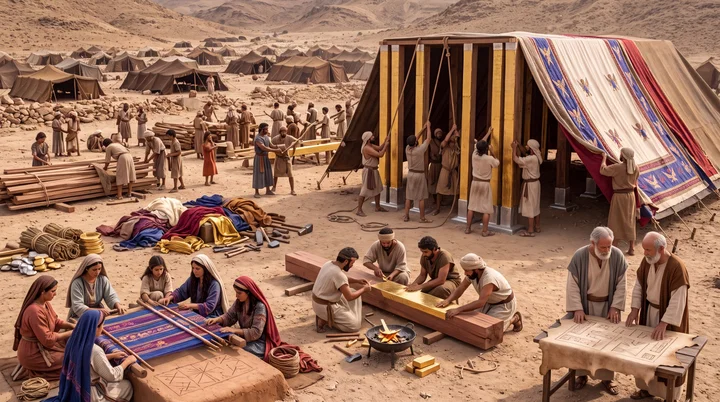
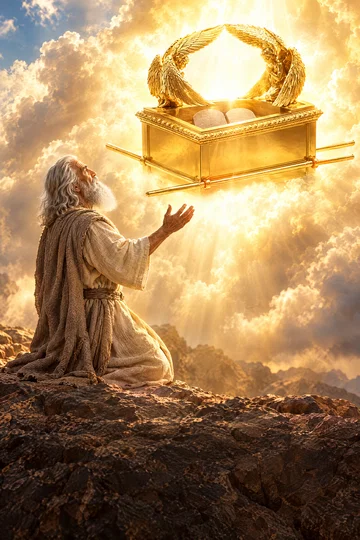
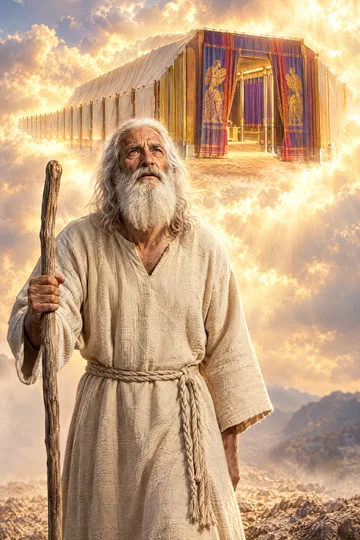
Who serve unto the example and shadow of heavenly things, as Moses was admonished of God when he was about to make the tabernacle: for, See, saith he, that thou make all things according to the pattern shewed to thee in the mount.
Translations
Who serve to the example and shadow of heavenly things, as Moses was admonished of God when he was about to make the tabernacle: for, See, says he, that you make all things according to the pattern showed to you in the mount.
Who serve unto the example and shadow of heavenly things, as Moses was admonished of God when he was about to make the tabernacle: for, See, saith he, that thou make all things according to the pattern shewed to thee in the mount.
who serve unto the example and shadow of heavenly things, as Moses was admonished of God when he was about to make the tabernacle: for, See, saith he, that thou make all things according to the pattern shewed to thee in the mount.
Who serve to the example and shadow of heavenly things, as Moses was admonished by God when he was about to make the tabernacle: for, See (saith he) that thou make all things according to the pattern shown to thee in the mount.
who serve that which is a copy and shadow of the heavenly things, even as Moses is warned of God when he is about to make the tabernacle: for, See, saith he, that thou make all things according to the pattern that was shewed thee in the mount.
who serve that which is a copy and shadow of the heavenly things, even as Moses is warned of God when he is about to make the tabernacle: for, See, saith he, that thou make all things according to the pattern that was showed thee in the mount.
who unto an example and shadow do serve of the heavenly things, as Moses hath been divinely warned, being about to construct the tabernacle, for 'See (saith He) thou mayest make all things according to the pattern that was shewn to thee in the mount;') —
( who serve the representation and shadow of heavenly things, according as Moses was oracularly told [ when] about to make the tabernacle; for See, saith He, that thou make all things according to the pattern which has been shewn to thee in the mountain.)
Who, indeed, are rendering divine service, with a glimpse and shadow, of the heavenly things; even as Moses hath received intimation, when about to complete the tent,—For see! saith he—Thou shalt make all things according to the model which hath been pointed out to thee in the mount.
Berean Standard Bible, Majority Standard Bible
The place where they serve is a copy and shadow of what is in heaven. This is why Moses was warned when he was about to build the tabernacle: “ See to it that you make everything according to the pattern shown you on the mountain.”
who serve a copy and shadow of the heavenly things, even as Moses was warned by God when he was about to make the tabernacle, for he said, “ See, you shall make everything according to the pattern that was shown to you on the mountain.”
Being servants of that which is a copy and an image of the things in heaven, as Moses, when he was about to make the Tent, had special orders from God: for, See, he said, that you make everything like the design which you saw in the mountain.
Who serue vnto the paterne and shadowe of heauenly things, as Moses was warned by God, whe he was about to finish the Tabernacle. See, saide hee, that thou make all thinges according to the paterne, shewed to thee in the mount.
Douay-Rheims (Challoner revision)
Who serve unto the example and shadow of heavenly things. As it was answered to Moses, when he was to finish the tabernacle: See (saith he) that thou make all things according to the pattern which was shewn thee on the mount.
Pictures
Cross-references 20 of 122
- Exodus 25:40
And look that thou make them after their pattern, which was shewed thee in the mount.
God tells Moses to make the sanctuary according to the pattern shown him.
- Hebrews 9:23-24
It was therefore necessary that the patterns of things in the heavens should be purified with these; but the heavenly things themselves with better sacrifices than these.
Earthly holy places are figures of the true heavenly sanctuary, where Christ appears for us.
- Revelation 11:19
And the temple of God was opened in heaven, and there was seen in his temple the ark of his testament: and there were lightnings, and voices, and thunderings, and an earthquake, and great hail.
The heavenly temple is opened, revealing the ark of God’s testament.
- Hebrews 9:11-12
But Christ being come an high priest of good things to come, by a greater and more perfect tabernacle, not made with hands, that is to say, not of this building;
Christ ministers in the greater, true tabernacle.
- Hebrews 10:1
For the law having a shadow of good things to come, and not the very image of the things, can never with those sacrifices which they offered year by year continually make the comers thereunto perfect.
The law’s services are a shadow of coming heavenly realities.
- Exodus 25:9
According to all that I shew thee, after the pattern of the tabernacle, and the pattern of all the instruments thereof, even so shall ye make it.
God directs Moses to make the sanctuary according to the pattern shown.
- Hebrews 9:23
It was therefore necessary that the patterns of things in the heavens should be purified with these; but the heavenly things themselves with better sacrifices than these.
Earthly holy places are patterns of heavenly things, and their cleansing points to Christ’s sacrifice.
- Hebrews 9:1-5
Then verily the first covenant had also ordinances of divine service, and a worldly sanctuary.
Describes the earthly sanctuary and its furnishings as a pattern of heavenly things.
- Leviticus 16
And the LORD spake unto Moses after the death of the two sons of Aaron, when they offered before the LORD, and died;
Describes the earthly sanctuary’s cleansing as a shadow of the work to come.
- Colossians 2:17
Which are a shadow of things to come; but the body is of Christ.
Ceremonial observances are shadows whose substance is Christ.
- Hebrews 9:6-7
Now when these things were thus ordained, the priests went always into the first tabernacle, accomplishing the service of God.
describes earthly service foreshadowing heavenly ministry
- Hebrews 9:8
The Holy Ghost this signifying, that the way into the holiest of all was not yet made manifest, while as the first tabernacle was yet standing:
Explains that the earthly tabernacle represented the true holy places.
- Revelation 8:3-4
And another angel came and stood at the altar, having a golden censer; and there was given unto him much incense, that he should offer it with the prayers of all saints upon the golden altar which was before the throne.
Incense accompanies the saints’ prayers at the golden altar in heaven.
- Exodus 26:30
And thou shalt rear up the tabernacle according to the fashion thereof which was shewed thee in the mount.
Moses is told to erect the tabernacle according to the pattern shown on the mountain.
- Exodus 25:8
And let them make me a sanctuary; that I may dwell among them.
God commands Israel to make a sanctuary so he may dwell among them.
- Exodus 25:21-22
And thou shalt put the mercy seat above upon the ark; and in the ark thou shalt put the testimony that I shall give thee.
God meets and speaks from above the mercy seat between the cherubim.
- Acts 7:44
Our fathers had the tabernacle of witness in the wilderness, as he had appointed, speaking unto Moses, that he should make it according to the fashion that he had seen.
The wilderness tabernacle was made according to the pattern God showed Moses.
- Hebrews 9:9
Which was a figure for the time then present, in which were offered both gifts and sacrifices, that could not make him that did the service perfect, as pertaining to the conscience;
Describes the earthly sanctuary and its services as figures.
- Hebrews 9:11
But Christ being come an high priest of good things to come, by a greater and more perfect tabernacle, not made with hands, that is to say, not of this building;
Christ serves as High Priest in the greater, more perfect tabernacle.
- Revelation 4:2-5
And immediately I was in the spirit: and, behold, a throne was set in heaven, and one sat on the throne.
The throne and seven lamps depict the heavenly sanctuary’s pattern.
Commentary part 1 of 2
Each commentary is drawn from primary sources: the writings of Ellen G. White and Adventist pioneers and periodicals. Each commentary is separate. Its own words are not a quotation; follow the references to read the source passages.
Ellen G. White
94 sources
The earthly priests and their sanctuary service were a copy, shadow and model of heavenly realities, covering both the building with its furnishings and the daily and yearly priestly work done in it.RH Nov 8, 1915LS 110.3–112.1GC88 412.4–413.2PP 352.2PP 351.4 God Himself devised that pattern and showed Moses on the mount a miniature view of the heavenly sanctuary, commanding him to make every detail exactly according to what was shown with no departure for human preference.CT 62.1DA 208.3–209.1ED 224.1SG4 5.11SP 272.1 The verse therefore proves there is a real sanctuary in heaven where Christ as mankind's great High Priest ministers since His ascension, presenting His blood and the prayers and faith of penitent believers before the Father.Lt 233, 1904, par. 7–814MR 216.3–217.1RH Nov 8, 1915GC88 420.2–3RH Nov 8, 1915 What was done in type in the two phases of the earthly service is done in reality in heaven, with Christ ministering in the holy place from His ascension until 1844 and then entering the most holy place for the closing atonement, cleansing of the sanctuary and investigative judgment.LS 110.3–112.1RH Nov 9, 1905GC 433.1–434.14SP 265.2–266.3 As the tabernacle had to match the heavenly pattern in every part, those accepted by heaven must form complete characters by that standard, and Christ's church and all God's work must be built in full obedience to heaven's design rather than human ideas.DA 208.3–209.1Ms 23, 1897, par. 12–13CT 60.2RH Jan 11, 1912Ms 29, 1908, par. 14
Shadow and Copy Explained
The priests and their service in the earthly sanctuary serve unto the example, shadow, pattern, copy and model of heavenly things.RH Nov 8, 1915LS 110.3–112.1GC88 412.4–413.2GC 417.2–3GC 413.3–414.2 Moses made the tabernacle and its furnishings according to the pattern shown to him on the mountain, so its design and its service reflected the heavenly sanctuary where Christ ministers as high priest.RH Nov 8, 1915GC88 412.4–413.2GC 413.3–414.2 The two holy places and the daily and yearly services of the earthly sanctuary correspond to a heavenly sanctuary where Christ ministers in two distinct phases, ministering in its holy place from His ascension until 1844 and then entering its most holy place to make a special atonement and cleanse the sanctuary.LS 110.3–112.1 That earthly pattern indicates the kind of work Christ would do, but it does not mean that He left the heavenly sanctuary when He entered the most holy place.LS 110.3–112.1
Not only the sanctuary building but also the work of the priests done in it is included in the example and shadow.PP 352.2PP 351.4 The shadow covers the daily service performed at the altar of burnt offering in the court and in the holy place, and the yearly service performed in the most holy place.PP 352.2PP 351.4 It includes the morning and evening burnt offering, the offering of sweet incense on the golden altar, the special offerings for individual sins, and the offerings for sabbaths, new moons and special feasts.PP 352.2PP 351.4 Because it pictured heavenly things, every detail of that symbolic service was of great importance, and definite and explicit instruction was given about each point.PP 351.4
Its symbolic service helps explain the service of the true sanctuary and how sin could be connected with the sanctuary.GC 417.2–3GC88 417.2–3RH Nov 8, 1915 It helps explain why its cleansing was necessary.GC88 417.2–3 It provides the way to learn why its cleansing required blood.RH Nov 8, 1915
The heavenly sanctuary and Christ's ministry there are the original reality that cast its shadow backward, while the sanctuary Moses built is its copy, figure, miniature representation and pattern of heavenly things.AA 246.2–247.1SG1 160.1RH Nov 8, 1915GC88 413.3–415.1 The earthly sanctuary built by Moses pointed to the true tabernacle in heaven, which is the sanctuary of the new covenant.RH Nov 8, 1915RH Nov 8, 1915 Its beauty faintly reflected the greater glory of God's heavenly dwelling, and its structure and services taught important truths about the heavenly sanctuary and the work of redemption carried forward there for humanity.RH Nov 8, 1915GC88 413.3–415.14SP 260.1–261.2 Its two apartments and their furniture corresponded to the heavenly sanctuary, and the pattern shown to Moses was the true sanctuary in heaven where Christ ministers on behalf of His people.SG1 160.1GC88 413.3–415.1 Through the earthly sacrifices and offerings Israel was to lay hold of the merits of the coming Saviour.SG1 160.1
In Christ the type met its antitype and the shadow its substance, for the Jewish sanctuary service and its ceremonies were types and shadows of the gospel with their meaning fulfilled in Him.ST Nov 7, 18922SP 10.3–11.1GC 430.2–34SP 269.1 The sacrifices had no power to save in themselves but represented Christ's death, while the priesthood represented His work as Mediator, keeping before the people the separation sin had made between God and humanity and the need for mediation.2SP 10.3–11.1 The symbolic system was to continue until Christ, the perfect Offering, took its place, and His work exceeds the earthly priesthood in dignity and glory.2SP 10.3–11.1 When He entered the heavenly sanctuary by His own blood as the true sacrifice and Mediator, the earthly types ceased as a way of access to God, so that continuing the Jewish sacrifices and offerings could no longer bring access to God or the benefits of His mediation.GC 430.2–34SP 269.1 This meeting of shadows with reality came when Jesus the true High Priest came into office while Caiaphas held the earthly priestly office.3MR 184.3–185.2
The Levitical service therefore is not to be despised, because it pointed to Christ and revealed His relation to the whole system.ST Nov 7, 1892 All the ceremonies of the Jewish law were prophetic, typical of mysteries in the plan of redemption, giving significance to the ceremonial law and shedding light upon the whole Jewish economy as the gospel of Christ reflects glory upon the Jewish age.ST Jul 29, 1886 The rites and ceremonies of the law were given by Christ Himself and are sacred and to be treated with great respect, glorious and worthy of their divine Originator, founded on Christ and a pattern for faith and obedience.ST Nov 7, 1892ST Jul 29, 1886 Even after the law was no longer to be observed, its true position and value remain, showing its place in the plan of redemption and its relation to the work of Christ.ST Jul 29, 1886 That which was to be done away was glorious, but it was not the law instituted by God for the government of His family in heaven and on earth, for as long as the heavens shall remain so long shall the law of the Lord endure.ST Jul 29, 1886
Pattern Shown on Mount
God Himself devised the plan for the tabernacle, and it was not left to Moses or to the workmen to invent.SG4 5.11SP 269.1ST Mar 4, 1903 On the mountain He showed Moses a model and miniature model and view of the heavenly sanctuary as the pattern for what was to be built.ED 224.1SG4 5.11SP 269.1ST Mar 4, 1903 He gave detailed directions for its size, form, dimensions, materials, furnishings and contents, specifying what the tabernacle and its vessels should be.SG4 5.11SP 269.1ST Mar 4, 1903 To carry out that plan He gave the workmen unusual skill.SG4 5.11SP 269.1
He admonished Moses to make all things exactly according to the pattern shown in the mount, with no freedom to depart from it by human preference.DA 208.3–209.1Lt 27, 1892, par. 5–9Lt 40, 1892, par. 20ST Nov 21, 1892CT 60.2 No zeal for the work and no skill or talent of men could justify making anything by human suggestion, scheme or contrivance.Lt 27, 1892, par. 5–9ST Nov 21, 1892 There was no exception even for the smallest thing, not a bell, a pomegranate, a tassel, a fringe, a curtain or any vessel of the sanctuary.Lt 27, 1892, par. 5–9Lt 40, 1892, par. 20ST Nov 21, 1892
Moses had to wait until God called him into the mount, where God opened His own mind and set His ideas clear and distinct before him.Lt 27, 1892, par. 5–9ST Nov 21, 1892 He covered Moses with glory so he could live and see heavenly things as they were in the mind of God.Lt 27, 1892, par. 5–9ST Nov 21, 1892 He kept him there forty days in direct communion, until his face shone with glory, and only then was Moses ready to give directions for making the sanctuary.Lt 27, 1892, par. 5–9ST Nov 21, 1892 When the work was completed he checked it against the pattern and blessed the people when it agreed with what had been shown him.1SP 272.1
Solomon's temple followed that same mountain pattern and was like the heavenly sanctuary.SG4 113.3 Its additional large cherubim represented heavenly angels guarding God's law.SG4 113.3
Heavenly Sanctuary Disclosed
Hebrews 8:5 proves there is a real sanctuary in heaven, the true tabernacle of the new covenant where God is all and in all.Lt 233, 1904, par. 7–814MR 216.3–217.1RH Nov 8, 19152MR 186.2–3 The earthly sanctuary built by Moses was its copy and pattern, and its ministry served as a shadow of heavenly things.Lt 233, 1904, par. 7–814MR 216.3–217.1RH Nov 8, 1915RH Nov 8, 1915 Its beauty faintly reflected the greater glory of God's heavenly dwelling.RH Nov 8, 1915
Its two holy places and their furniture correspond to the holy places and objects John saw in the heavenly temple.SG1 160.1GC 414.3–415.1 The holy places made with hands are figures of the true and patterns of things in the heavens, a miniature representation of the heavenly temple where Christ ministers in the sinner's behalf after offering His life as a sacrifice.GC 414.3–415.1RH Nov 8, 1915PP 343.2 God Himself gave the plan with particular directions as to size and form, materials, and every article of furniture, presenting before Moses in the mount a view of the heavenly sanctuary and commanding him to make all things according to it.PP 343.2
The design and services of that earthly copy taught important truths about the heavenly sanctuary and the work carried forward there for human redemption.GC 413.3–414.2RH Nov 8, 1915GC88 413.3–415.14SP 260.1–261.2 The pattern shown to Moses was the true sanctuary in heaven, where Christ ministers on behalf of His people as High Priest.GC88 413.3–415.14SP 260.1–261.2
The law kept in the earthly ark was an exact transcript and copy of the law in the heavenly ark, including the fourth commandment and its Sabbath obligation.GC 435.14SP 275.1 The opening of Christ's ministry in the heavenly sanctuary revealed this truth, and no one could overturn what God had established.GC 435.1 The heavenly sanctuary and Christ's ministry there show God's law remains binding as long as the heavens remain.4SP 275.1
God's people are therefore to become familiar with its pattern and to study and keep the heavenly sanctuary and its ministry in mind.Lt 233, 1904, par. 7–814MR 216.3–217.12MR 186.2–3
Christ's Heavenly Priesthood
The earthly priestly ministry was a model and shadow of heavenly things, prefiguring the real work of Christ as mankind's great High Priest in the heavenly sanctuary.RH Nov 8, 1915GC88 420.2–3GC 420.2–421.1 After His ascension He began ministering there on behalf of His people.RH Nov 8, 1915GC88 420.2–3GC 420.2–421.111MR 54.1–2 In that daily service in the first apartment He presents His blood before the Father for sinners and presents the prayers, repentance and faith of penitent believers with the fragrance of His righteousness.GC88 420.2–3GC 420.2–421.111MR 54.1–2
What the priests performed in type in the two phases of the earthly service is carried out in reality in two phases in heaven.LS 110.3–112.1GC 428.34SP 265.2–266.3 Christ ministered in the holy place from His ascension until 1844, then entered the most holy place to make a special atonement and cleanse the sanctuary.LS 110.3–112.1GC 428.34SP 265.2–266.3 His movement from the first apartment to the most holy place on the pattern of the Day of Atonement illustrates His transition from one part of His heavenly intercession to another after ending His ministration in the first apartment.GC 433.1–434.1GC 428.3GC88 433.1 This entering of the most holy place does not mean that He left the heavenly sanctuary.LS 110.3–112.1
The opening of God's temple in heaven and the appearance of the ark point to the opening of heaven's most holy place at the end of the 2,300 days in 1844.RH Nov 9, 1905GC 433.1–434.1GC88 433.1 Then Christ entered to perform the closing work of the atonement and plead His blood for repentant sinners.RH Nov 9, 1905GC 433.1–434.1GC 428.3GC88 433.1 As sin was transferred in figure to the earthly sanctuary through sacrificial blood, sins are transferred in fact to the heavenly sanctuary through Christ's blood, and its cleansing removes or blots out the recorded sins and involves an investigative judgment before Christ returns.4SP 265.2–266.3
Christ's sacrifice fulfilled the meaning of the sacrificial offerings, and as mankind's great High Priest He made atonement for sin once for all before beginning His ministry in the heavenly sanctuary.AA 246.2–247.1 The sacrifices had no power to save in themselves; they represented His death while the priesthood represented His work as Mediator.2SP 10.3–11.1 The ceremonial types pointed forward to His crucifixion, priesthood and ministry in the sanctuary and set forth the Lamb of God who takes away the sins of the world, to whom the gathering of the nations should be.SLP 103.2–104.1FE 97.2Ms 22, 1890, par. 1–3 These rites kept before the people the separation sin had made between God and humanity and the need for mediation through whom the way to God was opened, to continue until Christ the perfect Offering took the place of what they represented in dignity and glory exceeding the earthly priesthood.2SP 10.3–11.1
The morning and evening burning of a lamb a year old with its meat offering symbolized the daily consecration of the nation to Jehovah and constant dependence upon the atoning blood of Christ.PP 352.3 God's direction that every offering be without blemish, with priests examining and rejecting any defective animal, was a symbol of the perfect purity of Him who offered Himself as a lamb without blemish and without spot.PP 352.3 These sacrifices illustrate what followers of Christ are to become in presenting their bodies a living sacrifice, holy and acceptable to God, giving themselves to God's service as nearly perfect as possible with nothing less than the best they can offer, loving Him with all the heart and constantly bringing every power into harmony with the laws that promote ability to do His will.PP 352.3
In the yearly atonement service animal blood transferred sin to the sanctuary without fully releasing the sinner from the law's condemnation.PP 355.5 The high priest then presented blood before the law, bearing Israel's guilt as mediator, and confessed the sins over the scapegoat which carried them away as forever separated from the people.PP 355.5 These earthly rites taught truths about the atonement and the heavenly work they represented.PP 355.5
The work in the inner apartment reveals how sacred those heavenly things are.PP 352.1 No mortal eye but that of the high priest was to look upon it, and only once a year could he enter there after the most careful and solemn preparation.PP 352.1 With trembling he went in before God to make atonement for Israel before the mercy-seat, where God met with him in the cloud of glory, while the people waited in reverent silence with hearts uplifted in earnest prayer for the divine blessing.PP 352.1 His stay beyond the accustomed time filled them with fear lest because of their sins or his own he had been slain by the glory of the Lord.PP 352.1
Character Formed by Pattern
The earthly tabernacle had to match the heavenly pattern in every part and detail, and those finally accepted by heaven must likewise have complete characters conforming to heaven's standard.CT 60.2RH Jan 11, 1912Ms 29, 1908, par. 14 They must seek to carry out God's will in every particular and put heaven's impress on their work, for God demands uprightness in small and great matters.RH Jan 11, 1912Ms 29, 1908, par. 14CT 58.1–2 Agricultural and mechanical labor like every other kind of work is to be shaped by heaven's principles, and Christians honor God when they reveal the Spirit's leading in their earthly labors and dealings.CT 58.1–2
The pattern also illustrates how character is to be formed: God's law is the standard of righteousness, represents His character, and tests loyalty to His government.CT 62.1STE 77.3 Its beauty and excellence are revealed in Christ's life.CT 62.1STE 77.3 The revealed pattern showed Israel God's ideal of character through the law and His declaration of mercy, grace, patience, goodness, truth and forgiveness, but Israel chose its own ways instead of following it.DA 208.3–209.1
Christ is the true temple for God's indwelling, who shaped every part of His earthly life in harmony with God's ideal.DA 208.3–209.1 Believers are likewise to form their characters as a dwelling for God through the Spirit, following Christ as their pattern.DA 208.3–209.1 Moses on the mount beholding the pattern of the tabernacle as the abiding-place of God's glory points to the secret place of communion with God.RH Dec 31, 1908MYP 249.1–2ED 258.3–4GW 254.1ST Oct 19, 1904 That secret place is entered by surrender of the whole life, continual need and dependence, and prayer, especially secret prayer.RH Dec 31, 1908
There people contemplate God's glorious ideal for humanity and shape their character-building after it, so that God may dwell and walk in them as their God and they as His people.RH Dec 31, 1908MYP 249.1–2ED 258.3–4GW 254.1ST Oct 19, 1904 Through that communion with heaven God works out His purpose by gradually unfolding the doctrines of grace, and those who place themselves where He can enlighten them advance from partial understanding to fuller light.AA 564.2
Outward forms and ceremonies are valuable only when they follow the pattern God revealed, while forms that depart from it are valueless.Lt 76, 1895, par. 12–13 The pattern requires heavenly wisdom and grace and unselfish love, which produces righteousness, peace and joy in the Holy Spirit.Lt 76, 1895, par. 12–13 Carefully following the Pattern and building character according to it is the way to live as one should before God and to receive His approval.LJAHS 31.1–32.113MR 66.1–2 Safety is found only by following Jesus and drawing wisdom from what is pure and undefiled, since human ideas and wisdom cannot replace that pattern.13MR 66.1–2
Christ came to show the perfect character God accepts, and by His grace and the merits of His life salvation is made possible.RH Jan 11, 1912 Those who accept His virtues and rely on Him are precious to God and can develop Christlike character.RH Jan 11, 1912
God's Work by Pattern
No zeal for God's work and no skill or talent of men can justify making anything by human suggestion, scheme, contrivance, preference, custom or practice.DA 208.3–209.1Lt 27, 1892, par. 5–93MR 8.2–3 Human agents must constantly look heavenward, wait on the Lord, catch divine inspiration, and work out God's thoughts and plans in full and implicit obedience rather than their own ideas and imperfect judgment.Lt 27, 1892, par. 5–93MR 8.2–3 Moses was commanded to make all things of the tabernacle exactly according to the pattern shown to him in the mount, with no exception for even the smallest thing, a bell, a pomegranate, a tassel, a fringe, a curtain, or any vessel.Lt 27, 1892, par. 5–9 He had to wait until God called him into the mount, where God opened His own mind and set His ideas clear and distinct before him, covering him with glory so he could live and see the things to be made as they were in the mind of God, and after forty days of communication he came down ready to give the exact pattern.Lt 27, 1892, par. 5–9
Christ's church on earth is to resemble heaven as a temple built after the pattern of things shown in the holy mount.Ms 23, 1897, par. 12–1314MR 24.1–3Ms 23, 1897, par. 14–16 Men must give up their own ideas, plans, devices, calculations, inventions and worldly designs and let God as Architect work out His original intentions by His flawless pattern and golden measuring rod from heaven, without impeding the great Designer by human wisdom, counsel and control.Ms 23, 1897, par. 12–1314MR 24.1–3Ms 23, 1897, par. 14–16 Any work misshapen by human measures where men are placed where God should be He pronounces imperfect and misshapen.Ms 23, 1897, par. 12–13 Every worker serves only as he works under God's superintendence as a laborer together with Him, yoked with Christ in meekness and lowliness, and when all is made according to the pattern a temple of heavenly design is presented where the divine presence is manifested and God's seal affixed.Ms 23, 1897, par. 12–13
The same direction given to Moses governs God's work now to fulfill prophecy and carry truth in sanctifying power to the world.Lt 15, 1894, par. 11–12 Everything relating to God's worship must bear a striking resemblance to heavenly things, kept elevated, holy, sacred and dignified under God's own supervision with the cooperation of angels, never brought down to a low level or mingled with common temporal things.Lt 15, 1894, par. 11–12Ms 34, 1901, par. 6–7Ms 7, 1889, par. 3–4 It must represent purity, virtue and holiness and carry the work forward and upward to greater success, with every aspiration, motive, power and influence given its proper, dignified place.Lt 15, 1894, par. 11–12 This requires humbling self, purifying the soul through sanctification and belief of the truth, rejecting fanciful human theories while receiving God's message in its original power, and never perverting its principles by worldly plans.Ms 34, 1901, par. 6–7Ms 7, 1889, par. 3–421MR 177.4–5 God's purposes on earth are to be carried out according to the pattern of things in heaven.Lt 279, 1904, par. 21–2321MR 177.4–5 Divine directions carry obligation in actual work, so in whatever institution is established and whatever is done the work should be a fitting representation of the most elevated, ennobling principles ever given to man.Ms 111, 1899, par. 8
The order, method, perfection, cleanliness and energy specified for Israel encamped in the wilderness by Christ enshrouded in the cloudy pillar are patterns for religious service in the last days including camp meetings.Ms 46, 1893, par. 8 Their plans and detailed arrangements cannot be copied but their principles must be given to all, and neglecting order causes loss while doing everything in the most perfect manner pays.Ms 46, 1893, par. 8 God is as pleased with cleanliness, order and energy now as then and no lesson is to be given that He accepts disorder, careless work or untidy surroundings.Ms 46, 1893, par. 8 The first camp meeting in New Zealand was to serve as a model for future ones, with its arrangements made according to that pattern.LSEGW 341.5–6 Everything connected with the sanctuary was to be made with utmost care and perfection to honor the divine pattern and give no cheap, careless or false impression of heavenly realities.Lt 90, 1896, par. 4–8 Likewise buildings erected for God are to reflect the perfection He requires, made with care, sound materials and exactness in each part so as to withstand testing, though perfection does not require embellishment.Ms 127, 1901, par. 2–4Ms 111, 1899, par. 18 Leaders and managers of God's institutions should seek His guidance, follow the heavenly pattern and honor the sacred character of the work rather than manage by cheap or merely worldly standards.STPW91 37.216MR 137.1–3
The pattern shown in the mount guides each person in faithfully doing the work God has appointed, teaching the worker about heavenly things.Ms 5, 1899, par. 11 Christ as the tabernacle of witness for heavenly things and the great Medical Missionary gives daily lessons for that faithful service.15MR 259.3 For medical missionary work the definite pattern must be followed exactly.Ms 169, 1899, par. 11–12 Physicians are to do only their appointed work faithfully in close union with gospel missionaries so their work symbolizes the gospel ministry, with work enough without bringing in many added interests and large plans.20MR 252.2–46T 245.4–246.2Lt 205, 1899, par. 13–16Ms 169, 1899, par. 11–12 God gives every man his work and does not require impossibilities, so embracing too much, going into the worst dens of iniquity in large cities, or laying largeness of labor for a class that cannot be benefited or benefit others departs from the pattern and brings weakness instead of strength, a departure the enemy seeks to counterwork God's designs.Lt 205, 1899, par. 13–16Ms 169, 1899, par. 11–12
Copying exactly in all things the pattern God has given is a solemn responsibility requiring prompt implicit obedience at whatever cost without questioning or consulting inclination.Lt 52, 1892, par. 5–6 With casualties by sea and land, sudden death, contagious diseases, plagues and the withdrawal of God's Spirit allowing no moment to lose, earnest self-examination is required to make calling and election sure, united covenant with God by sacrifice, and making everything earthly subordinate to the eternal to have clear title to an immortal inheritance.Lt 52, 1892, par. 5–6 Agricultural and mechanical labor like every other kind of work, including social and business dealings, can be shaped by heaven's principles through Christ's grace.CT 58.1–2RH Jan 11, 1912 Teachers are to reveal the Spirit's leading and Christians are honored by God when they show those principles and put heaven's impress on their work.CT 58.1–2RH Jan 11, 1912
Sources
Pioneers and periodicals
228 sources
The earthly tabernacle with its priesthood, services and offerings was a copy, figure and shadow of the true heavenly sanctuary and Christ's ministry there as great High Priest, which is the substance and reality.LDT 179.2ST Jul 1, 1889ST Oct 25, 1905 The pattern God showed Moses on the mount and commanded him to follow exactly was that heavenly sanctuary itself seen in vision, proving a literal original pitched by the Lord exists in heaven where God dwells.RH Jul 31, 1900RH Jan 6, 1853RH Apr 6, 1869 As the earthly had two holy places for distinct ministries, so the heavenly has two corresponding apartments with the same articles in purpose, the seven lamps and altar of incense marking the first and the ark of the testament marking the second.ST Dec 30, 1889ST Feb 7, 1884ST Mar 20, 1879ST Jul 9, 1896RH Dec 30, 1873 Christ entered upon His priestly work in the first apartment at His ascension and then on October 22, 1844, at the end of the 2300 days of Daniel 8:14, He passed to the most holy place to begin the final cleansing and judgment before His coming.RH Mar 2, 1852RH Apr 5, 1864CO 91.1ST Mar 14, 1878RH Sep 2, 1851 As blood in the daily service transferred sins into the earthly sanctuary until removed on the Day of Atonement, so His blood carries sins into the heavenly in fact, and His final atonement there blots them out, acquits the repentant by the law in the ark, and bears the remitted sins away to destruction.ST Apr 20, 1904RH Dec 1, 1910ST Oct 2, 1879ST Apr 29, 1913ST Jul 30, 1902
Example Shadow and Pattern
The earthly tabernacle and sanctuary with its priesthood, priests, services, offerings and sacrifices serve unto the example and shadow, copy, pattern, figure and type of heavenly things.LDT 179.2ST Jul 1, 1889ST Oct 25, 1905ST Oct 23, 1884 The heavenly things are the true heavenly sanctuary or temple and Christ's ministry there as great High Priest, which is the substance and antitype of which the earthly was the illustration.LDT 179.2ST Jul 1, 1889ST Oct 23, 1884RH Jul 18, 1854 The earthly priests served in a sanctuary made according to the pattern God showed Moses on the mount, so its design and service represented the heavenly sanctuary and pointed beyond themselves to Christ's complete priesthood and mediatorial work in heaven.LDT 179.2ST Jul 1, 1889ST Oct 25, 1905 That priestly work began after His death, resurrection and ascension, when He entered beyond the veil with His own blood to intercede for His people and minister for the church on earth in the presence of God the Father.ST Jul 1, 1889ST Oct 23, 1884 The blood of bulls and goats offered in the worldly sanctuary took away no sin but only pointed forward to the future fact of Christ's blood, which alone cleanses from sin and heals the breach made in God's holy law.RH Jul 18, 1854 Because the figure cannot come after the fact and the thing signified cannot come after the sign, a revival of the types after Christ's priesthood closes is impossible, and when He comes out of the heavenly sanctuary His mediatorial work will be finished never to return to mediate.ST Oct 23, 1884RH Jul 18, 1854
The heavenly sanctuary is the true, greater, more perfect, real and literal original pitched by the Lord and not man.RH Jan 6, 1853RH Apr 6, 1869RH Mar 28, 1854RH Jan 1851RH Mar 10, 1874 It is established in heaven where God dwells as a personal being and where Christ now ministers, greater and more glorious than the earthly though correctly represented by it in miniature like a child's toy beside reality.RH Mar 28, 1854RH Jan 1851RH Mar 10, 1874 It was built in type primarily that the Lord might dwell among His people, and it was also used for the work of the priesthood in relation to sin.RH Jul 31, 1900 It contains two holy places as taught by its earthly copy, with the heavenly realities of the golden candlestick with its seven lamps, the golden altar of incense before the throne, and the ark of the testament in the most holy place.RH Mar 28, 1854
The pattern God showed Moses on the mount and warned and commanded him to follow exactly for the tabernacle, its furnishings, vessels, coverings, priesthood and all things in it was the heavenly sanctuary itself seen in vision.RH Jul 31, 1900RH Jan 6, 1853RH Apr 6, 1869RH Jan 1851RH Mar 10, 1874 That command proves there is a great original somewhere from which the earthly copy was made, and that the man-made tabernacle was not original.RH Mar 28, 1854 The earthly sanctuary with its apartments and furnishings therefore guides understanding of Christ's priesthood and ministry in the heavenly sanctuary, of which the earthly was a copy.RH Jan 1851RH Mar 10, 1874
Moses was to make all things strictly in every particular without swerving, with form, shape, dimensions, materials, methods, furniture and workmanship all prescribed and shown.ST Apr 4, 1900ST Nov 25, 1889ST Apr 17, 1901RH Mar 28, 1871 Nothing was left to chance or to human devising, judgment, fancy, skill or learning, and he was not to follow any whims or fancies of his own but to do strictly according to the rules and pattern shown in the mount.ST Apr 4, 1900ST Apr 17, 1901 The structure with all its belongings was constructed along the lines of a model prepared in heaven and exhibited to Moses, even to bell, pomegranate, tassel, fringe, curtain and vessel, and he obeyed.ST Apr 17, 1901RH Mar 28, 1871 When the sanctuary was completed and all things were found to be according to that pattern, the cloud covered the tent of the congregation and the glory of the Lord filled the tabernacle, revealing the majesty of heaven and assuring the people that the work of their hands was accepted and that God would abide with them.ST Apr 1, 1913 Exact obedience to the heavenly pattern was necessary so the sanctuary and its ministration could faithfully portray the real mediatorial work of Christ.ST Nov 25, 1889
The verse identifies the earthly tabernacle as a model of the true, heavenly sanctuary, not the earth itself nor the earth and heaven together as the two parts represented by its two apartments.RH Dec 15, 1868RH Jan 24, 1856RH Jan 9, 1855 It does not make Canaan, Palestine, any part of the earth, the Christian church on earth, the human body, or the Most Holy Place alone the antitype.RH Dec 15, 1868RH Jul 5, 1870RH Jan 24, 1856ST Nov 25, 1889RH Jan 9, 1855 Both the holy and Most Holy places correspond to places in the true sanctuary where Christ ministers, not merely the Most Holy Place representing heaven while the holy place typified the Christian church whose members are priests, though those who held that distinction taught it.RH Jul 5, 1870RH Apr 15, 1873 Solomon's temple as counterpart of the tabernacle in arrangement and purpose was likewise an example and shadow of heavenly things, not a type of the structure or details of the Christian church on earth, and the verse gives no basis for a new ritual or order for Sunday services.ST Nov 25, 1889
What is true of Moses' tabernacle made after the mount pattern is true of Solomon's temple and later temples, which followed the same general revealed plan, arrangement and purpose on a larger permanent scale.ST Nov 25, 1889RH Jan 26, 1860RH Jan 6, 1853ST Nov 28, 1895RH Dec 30, 1873 The tabernacle built by Moses in the wilderness, later replaced by the temple with its building, appointments, priesthood and service, was typical of Christ and His priesthood in the heavenly sanctuary, and all the articles typified in that earthly work have their antitypes in heaven before the throne of God, including the molten sea whose antitypical sea is the sea of glass before the throne.RH Jan 26, 1860ST Nov 28, 1895 The tabernacle erected by Moses and the temple built by Solomon which superseded it as its enlargement and continuation were temporary buildings made after the pattern of the temple of God in heaven, the great original, and the later temples built by Solomon and Zerubbabel continued the earthly pattern.RH Jan 6, 1853RH Dec 30, 1873 David likewise was shown a pattern by the Spirit to be followed exactly, so that the earthly and heavenly tabernacles are in an important sense only one sanctuary of the Bible, the centers of typical and antitypical worship where the typical and the real atonement is accomplished.RH Dec 30, 1873
The word sanctuary means a hallowed place where God dwells and is used in the Bible almost always for the tabernacle, the temple, or the heavenly temple.ST Apr 29, 1897 It can also describe a church truly dedicated to God or the Christian's body as God's temple.ST Apr 29, 1897
Moses Vision on Mount
After the ten precepts were proclaimed from Sinai, Moses went up into the mount to receive tables of stone and law and commandments to teach, and while there with the Lord he was permitted to behold the great original heavenly sanctuary of which the tabernacle he was about to make was only shadow, figure and emblem.ST Nov 23, 1904ST Apr 22, 1913ST Dec 24, 1894 He was covered so he could live and spent forty days in direct communion, beholding golden pavements and gleaming walls with ark, mercy-seat, cherubim, lamps and incense, which Christ Himself showed him with particulars of candlestick, boards, bars, altar, pans and shovels.ST Apr 22, 1913ST Sep 17, 1874 He was straitly commanded to make the tabernacle and all its parts, furnishings, vessels and priestly service in every particular according to the divine model shown him, and the ark of the covenant within it held the two stone tablets bearing the Ten Commandments.ST Apr 22, 1913RH Apr 9, 1901ST Jun 27, 1911ST Sep 17, 1874 Because every part of this typical service mattered, precise instructions were given for its details, and Israel's ordinances and history had typical meaning calling for spiritual application.ST Nov 23, 1904ST Dec 24, 1894ST Jun 27, 1911
The structure with all its belongings was not devised according to the notions of Moses or his associates or endowed workmen, but God Himself devised the plan and exhibited a model prepared in heaven, commanding Moses to make all things exactly according to that divine pattern without swerving in the least particular.ST Mar 21, 1911ST Apr 17, 1901RH Mar 28, 1871 God gave particular directions as to size and form, materials to be used, and every article of furniture it was to contain, presenting before Moses a miniature model of the heavenly sanctuary, and Moses wrote all the directions in a book and read them to the most influential of the people.ST Mar 21, 1911ST Apr 22, 1913ST Feb 17, 1890 Neither Moses nor the workmen were left to plan form and workmanship or to man's fancy in design or size, though men called of God were endowed with more than natural abilities for most ingenious work.ST Mar 21, 1911ST Apr 17, 1901ST Feb 17, 1890 After giving the plans in detail the Lord called Bezalel by name and filled him with the Spirit of God in wisdom and understanding and knowledge and all manner of workmanship, and put wisdom in the hearts of all the wise-hearted to make all that He had commanded.ST Mar 21, 1911ST Apr 22, 1913 When the tabernacle was finished Moses looked upon all the work and saw they had done it as the Lord had commanded and blessed them, and after solemn dedication a cloud covered the tent and the glory of the Lord filled the tabernacle, with explicit instructions sacred under penalty of death because it was a holy place where God would dwell among Israel.ST Apr 22, 1913ST Feb 17, 1890
The vision included ark and law, altar, lamps, bread, sacrifice, incense and high priest, with tacklings, cords, curtains, holy of holies, mercy-seat and cherubim where the sinner brought offering and the priest atoned with blood of guiltless victims, all pointing to the dear Redeemer to be slain for sinners and revealing how sins are forgiven through blood of Christ the Lamb.ST Jun 10, 1889RH Oct 4, 1864ST Jun 10, 1889 Their meaning is fulfilled in Christ as the Lamb who died on Calvary, the substitute and surety whose righteousness, merit and purity answer the law's claims, the bread of life, the light, the living source of life and truth, and the high priest who bears humanity before God and whose merit makes human prayer acceptable.ST Jun 10, 1889RH Oct 4, 1864ST Jun 10, 1889 The earthly ark held stone tablets as copy of the heavenly ark of the testament now really existing, for the law of God was in heaven before the earthly tabernacle was built and the earthly would not have been a true copy without the Ten Commandments in both places, seen by faith when the seventh trumpet opens the heavenly apartment containing the ark as the rule by which hearts and motives are measured.LDT 177.1–2ST Feb 13, 1901 By the pattern God showed He had pitched in wisdom a heavenly temple where His Son, when He had filled His mission, could stand to offer prayer and atone for sinners, keeping His holy law in His holy temple in heaven.LDT 177.1–2RH Oct 4, 1864
God provided this earthly copy because people could not go to heaven to see where Jesus ministers for them, yet needed to grasp that reality by faith.RH Nov 8, 1915ST Jun 20, 1911ST Nov 5, 1912 The sanctuary plan was simple yet comprehensive, its beauty faintly reflecting the greater glory of God's heavenly dwelling, and its structure and services taught important truths about the heavenly sanctuary and the work of redemption.RH Nov 8, 1915RH Aug 6, 1908ST Jun 10, 1908 God's visible presence in the tabernacle with curtains and cherubim helped Israel understand that He dwelt among them.ST Jun 20, 1911ST Nov 5, 1912 The earthly sanctuary with ark, golden mercy-seat, cherubim, golden lamps and incense shrine was made to copy that pattern yet is only a dim shadow like a child's tiny toy beside heavenly reality, given because He understood timid hearts to lead people who would have recoiled from the full heavenly vision step by step through increasing degrees of heavenly love until they worship Him with undivided hearts.RH Nov 8, 1915
The rites and ceremonies were given by Christ Himself while leading Israel in the cloud and fire, so the ceremonial law was sacred and to be treated with respect, distinct from the enduring moral law.ST Nov 7, 1892 The Jewish sanctuary service and its ceremonies were types and shadows of the gospel with meaning fulfilled in Christ, in whom type met antitype and shadow met substance, and therefore the Levitical service was not to be despised because it pointed to Christ and revealed His relation to the whole system.ST Nov 7, 1892ST Jan 16, 1907 The instructions to make everything according to the pattern shown on the mountain connect the Old Testament sanctuary with the heavenly sanctuary, and the New Testament presents this subject in condensed form without contradicting the Old Testament, frequently referring to its rites and services and building convincing proof of the truth of the gospel upon Mosaic references as firm foundation.ST Oct 21, 1930ST Jan 16, 1907RH Aug 6, 1908 Its design was given by God as an object lesson in the plan of salvation, shedding light on the Jewish economy.RH Aug 6, 1908
Two Holy Places
The earthly dwelling had two rooms with priests going always into the first tabernacle while into the second went the high priest alone once every year with blood which he offered for himself and for the errors of the people, and because that service was example and shadow made exactly according to the pattern shown on the mount, the heavenly true tabernacle where Christ ministers has two corresponding holy places and apartments for the same general purposes.ST Dec 30, 1889ST Feb 7, 1884ST Mar 20, 1879ST Dec 17, 1894RH Aug 28, 1853 The two apartments and their services indicate the order of His more excellent ministry as High Priest and Advocate, first in the holy place and then in the most holy place, with work in the most holy as the close of priestly service including final removal of sin and cleansing.ST Mar 20, 1879ST Dec 17, 1894RH Aug 28, 1853ST Aug 15, 1878RH Aug 23, 1864 It is a true likeness in arrangement and not a metaphor of dispensations.ST Feb 7, 1884ST Mar 20, 1879RH Aug 28, 1853
The likeness lies in two apartments each for a distinct ministry, not in outward size, appearance or same material, for God chose pleasing earthly articles and the heavenly is not covered with badger-skins, but only as a shadow can represent the reality.ST Jul 9, 1896ST Mar 17, 1898RH Nov 17, 1863 The earthly and heavenly have the same articles of furniture in purpose, with seven lamps and the golden altar of incense marking the first apartment and the ark of the testament marking the second.ST Jul 9, 1896RH Dec 30, 1873RH Apr 15, 1873RH Sep 1, 1904 The later temples followed the same general revealed plan with holy and most holy apartments.RH Sep 1, 1904ST Mar 17, 1898
Details reveal heavenly realities, for the command proves a great original somewhere from which the copy was made, pitched by the Lord and not man, containing the golden candlestick with seven lamps, the golden altar of incense before the throne, and the ark of the testament in the most holy place.RH Mar 28, 1854ST Sep 21, 1876 The seven lamps in John's vision identify the heavenly holy place where Christ served in continual intercession giving opportunity for reconciliation until the appointed cleansing and blotting out of sin, seen as seven lamps of fire before the throne answering to the earthly candlestick, with the Son of God before the throne and the golden altar of incense marking the beginning of ministration above traced in the New Testament.ST Sep 21, 1876RH Apr 15, 1873 In the earthly God's presence rested above the law between the cherubim, and so in heaven God's law is the basis of His throne with His presence on the mercy-seat related to the law in the same way, while ark, golden altar, entrance curtain with rainbow colors and cherubim, and sea of glass as antitype of the molten sea point to counterparts before God's throne, including the ark containing the Ten Commandments as original of the law shut up in the earthly ark.ST Jun 19, 1907ST Sep 11, 1884
The heavenly sanctuary has no table of showbread because Christ Himself is the bread from heaven, while candlestick, altar of incense, throne, lamps and ark with law are really there.ST Mar 21, 1911RH May 27, 1852ST Mar 6, 1884 The mercy-seat really exists in heaven with the ark to rest upon, and there is the same evidence that the ark of the ten commandments exists in heaven in this dispensation, containing the testimony of God's commandments including the fourth commandment which remains binding.ST Mar 6, 1884ST Oct 22, 1874RH Sep 24, 1914 The earthly mercy-seat and covering cherubim represent the heavenly where God's throne is above the mercy-seat between the covering cherubim, with the earthly ark as pattern of the true ark holding the law with mercy-seat beside which stand living angels.ST Mar 21, 1911RH May 27, 1852RH Jul 21, 1853 The two cherubim beaten out of one solid piece of gold with the mercy-seat, standing one on each end with faces toward each other looking reverently downward, with one wing of each stretched forth on high and the other covering their forms, represent all the heavenly angels looking with interest and reverence to the law deposited in the ark, where living angels stand in the same posture with one wing overshadowing the mercy-seat and stretched forth on high while the other wings are folded over their forms in token of reverence and humility.ST Mar 21, 1911
While the first tabernacle stood the way into the true holy places was not yet manifested and not opened, but after ascension Christ entered the temple of God by His own blood.ST Mar 20, 1879ST Dec 17, 1894 The verse does not teach He began work in both heavenly apartments at once, but that He ministers successively first in the holy place then in the most holy.ST Feb 7, 1884ST Mar 20, 1879ST Dec 17, 1894ST Aug 15, 1878RH Aug 23, 1864
Priests first anointed the whole earthly sanctuary including both holy and most holy apartments and its furnishings, but began their ministry in the first apartment, showing anointing the most holy did not mean ministry began there.RH Aug 18, 1863ST Jun 24, 1880RH Mar 15, 1870 So the new-covenant sanctuary was anointed at Christ's ascension preparatory to ministry beginning in the first apartment, with the anointing of the Most Holy in Daniel 9:24 referring to the heavenly sanctuary and preparing it for service.RH Aug 18, 1863ST Mar 26, 1912RH May 8, 1856 As antitypical Priest of the Aaronic priesthood He entered on His work as Priest in the then-anointed heavenly sanctuary to do what Moses and Aaron did in its pattern, including the anointing of the most holy preparatory to commencement of ministration, and having to enter within the veil to fulfill the type He did so after His ascension with the anointing of the Holy of Holies preceding presentation of the sin offering.RH Aug 18, 1863ST Mar 26, 1912RH May 8, 1856
Sources