1 Samuel 13:16
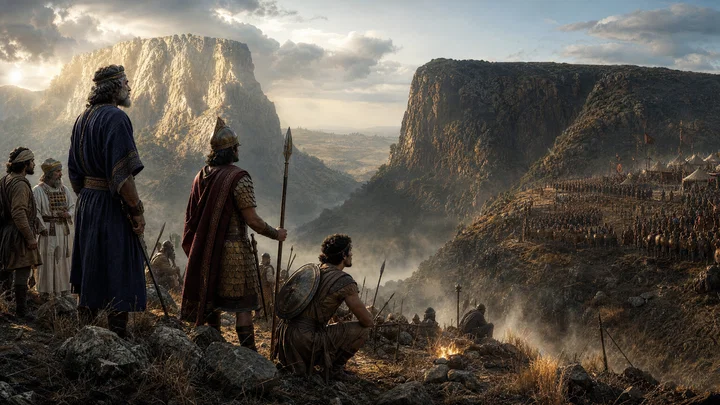
And Saul, and Jonathan his son, and the people that were present with them, abode in Gibeah of Benjamin: but the Philistines encamped in Michmash.
Translations
And Saul, and Jonathan his son, and the people that were present with them, stayed in Gibeah of Benjamin: but the Philistines encamped in Michmash.
King James Version, KJV Cambridge Paragraph Bible, Webster Bible
And Saul, and Jonathan his son, and the people that were present with them, abode in Gibeah of Benjamin: but the Philistines encamped in Michmash.
Revised Version, American Standard Version
And Saul, and Jonathan his son, and the people that were present with them, abode in Geba of Benjamin: but the Philistines encamped in Michmash.
and Saul, and Jonathan his son, and the people who are found with them, are abiding in Gibeah of Benjamin, and the Philistines have encamped in Michmash.
And Saul, and Jonathan his son, and the people that were found with them, abode in Geba of Benjamin; and the Philistines encamped in Michmash.
Now, Saul, and Jonathan his son, and the people that were found with him, were abiding in Geba of Benjamin,—but, the Philistines, had encamped in Michmash.
Berean Standard Bible, Majority Standard Bible
Now Saul and Jonathan his son and the troops with them were staying in Geba of Benjamin, while the Philistines camped at Michmash.
Saul, and Jonathan his son, and the people who were present with them, stayed in Geba of Benjamin; but the Philistines encamped in Michmash.
And Saul, with Jonathan his son and the people who were with them, was waiting in Geba in the land of Benjamin: but the tents of the Philistines were in Michmash.
And Saul and Ionathan his sonne, and the people that were found with them, had their abiding in Gibeah of Beniamin: but the Philistims pitched in Michmash.
Douay-Rheims (Challoner revision)
And Saul and Jonathan his son, and the people that were present with them, were in Gabaa of Benjamin: but the Philistines encamped in Machmas.
Pictures
Cross-references
- 1 Samuel 13:5
And the Philistines gathered themselves together to fight with Israel, thirty thousand chariots, and six thousand horsemen, and people as the sand which is on the sea shore in multitude: and they came up, and pitched in Michmash, eastward from Beth-aven.
Describes the Philistine force and its encampment at Michmash.
- 1 Samuel 13:2
Saul chose him three thousand men of Israel; whereof two thousand were with Saul in Michmash and in mount Beth-el, and a thousand were with Jonathan in Gibeah of Benjamin: and the rest of the people he sent every man to his tent.
Reports Saul’s force of six hundred men.
Commentary
Each commentary is drawn from primary sources: the writings of Ellen G. White and Adventist pioneers and periodicals. Each commentary is separate. Its own words are not a quotation; follow the references to read the source passages.
Ellen G. White
3 sources
Saul, Jonathan his son, and the Israelites who remained with them stayed at Gibeah of Benjamin, while the Philistines were encamped at Michmash.PP 618.2–621.2PP 622.3 The Israelite position is also identified as Geba, facing the Philistine encampment at Michmash across a deep, rugged valley.ST Aug 10, 1882 The two armies faced each other from opposite sides of that deep, rugged valley or gorge.ST Aug 10, 1882PP 622.3
Michmash lay to the north of the Israelite position, and Philistine detachments ranged out from their camp to plunder the country.PP 622.3 Israel was in crisis because of the opposing positions and the great difference in numbers and equipment between the small Israelite force and the Philistines.ST Aug 10, 1882 This military crisis was the setting for Saul's impatience and fear, leading him to blame his scattering troops and the Philistine gathering for his decision to offer sacrifice against God's command.PP 618.2–621.2 God used the crisis to rebuke Saul's perversity and to teach the people humility and faith.ST Aug 10, 1882
Sources
Pioneers and periodicals
3 sources
Saul and Jonathan his son and the people present with them abode in Gibeah, also called Geba, while the Philistines encamped in Michmash across a deep, rugged valley.ST Aug 10, 1882 The opposing positions placed Israel under severe military pressure, with a reduced force facing a far larger and better-equipped enemy, bringing the nation to a crisis.ST Aug 10, 1882
Amid those conditions occurred another rash act by Saul that exposed his rashness and weakness and perversity.ST Aug 10, 1882ST Mar 31, 1909 God used the crisis to rebuke Saul and to teach the people humility and faith.ST Aug 10, 1882
The verse belongs to the account of the beginning of Saul's reign after Israel asked for a king and stopped looking to God alone as King.ST Mar 31, 1909 It stands in the sequence leading to the rejection of Saul and his house and the anointing of David.ST Mar 31, 1909 It stands in 1 Samuel 7-18, which covers the choosing of Saul as king, the death of Samuel, the waning of the house of Saul, and the calling of David.ST Mar 31, 1909ST Apr 15, 1913 This is within the history running from Eli to the old age of David in which 1 Samuel stands as the last book of the Judges.ST Mar 31, 1909 The verse is assigned as Friday morning reading together with 1 Samuel 14.ST Mar 31, 1909
Sources