1 Samuel 17:44
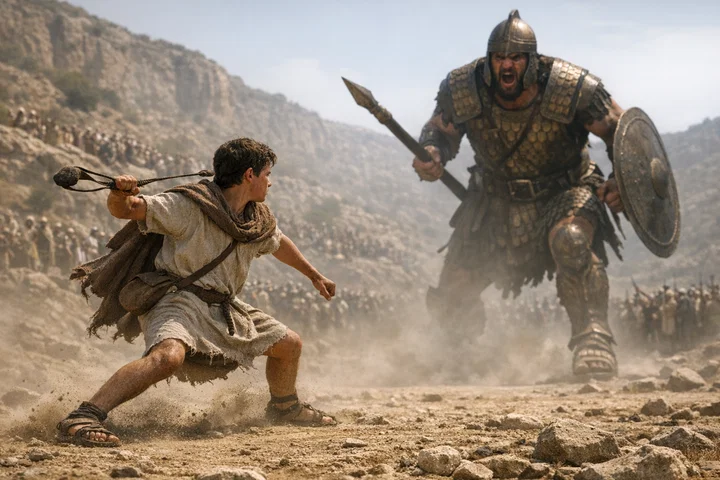
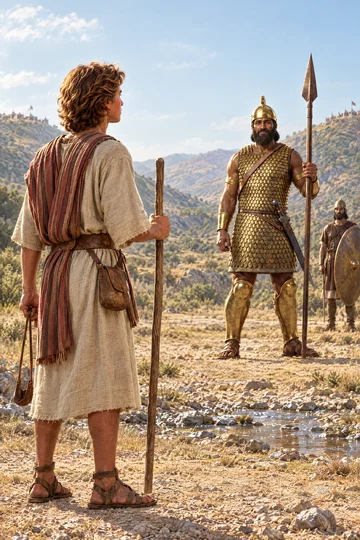
And the Philistine said to David, Come to me, and I will give thy flesh unto the fowls of the air, and to the beasts of the field.
Translations
And the Philistine said to David, Come to me, and I will give your flesh to the fowls of the air, and to the beasts of the field.
King James Version, KJV Cambridge Paragraph Bible, Revised Version
And the Philistine said to David, Come to me, and I will give thy flesh unto the fowls of the air, and to the beasts of the field.
And the Philistine said to David, Come to me, and I will give thy flesh to the fowls of the air, and to the beasts of the field.
And the Philistine said to David, Come to me, and I will give thy flesh unto the birds of the heavens, and to the beasts of the field.
and the Philistine saith unto David, 'Come unto me, and I give thy flesh to the fowl of the heavens, and to the beast of the field.'
And the Philistine said to David, Come to me, and I will give thy flesh to the fowls of the heavens and to the beasts of the field.
And the Philistine said unto David,—Come, unto me, that I may give thy flesh to the birds of heaven, and to the beasts of the field.
Berean Standard Bible, Majority Standard Bible
“ Come here,” he called to David, “ and I will give your flesh to the birds of the air and the beasts of the field!”
The Philistine said to David, “ Come to me, and I will give your flesh to the birds of the sky and to the animals of the field.”
And the Philistine said to David, Come here to me, and I will give your flesh to the birds of the air and the beasts of the field.
And the Philistim sayd to Dauid, Come to me, and I will giue thy flesh vnto the foules of the heauen, and to the beastes of the field.
Douay-Rheims (Challoner revision)
And he said to David: Come to me, and I will give thy flesh to the birds of the air, and to the beasts of the earth.
Pictures

Cross-references
- 1 Samuel 17:49-50
And David put his hand in his bag, and took thence a stone, and slang it, and smote the Philistine in his forehead, that the stone sunk into his forehead; and he fell upon his face to the earth.
David defeats Goliath despite his threat and superior arms.
- 1 Samuel 17:34-37
And David said unto Saul, Thy servant kept his father’s sheep, and there came a lion, and a bear, and took a lamb out of the flock:
David recalls God’s deliverance from the lion and bear as confidence to face Goliath.
- 1 Samuel 17:40
And he took his staff in his hand, and chose him five smooth stones out of the brook, and put them in a shepherd’s bag which he had, even in a scrip; and his sling was in his hand: and he drew near to the Philistine.
David approaches Goliath with a sling and stones instead of Saul’s armor.
- 1 Samuel 17:50
So David prevailed over the Philistine with a sling and with a stone, and smote the Philistine, and slew him; but there was no sword in the hand of David.
David’s victory fulfills the challenge to Goliath.
- 1 Samuel 17:38-39
And Saul armed David with his armour, and he put an helmet of brass upon his head; also he armed him with a coat of mail.
David rejects Saul’s armor, contrasting reliance on equipment with trust in God.
- 1 Samuel 18:5-17
And David went out whithersoever Saul sent him, and behaved himself wisely: and Saul set him over the men of war, and he was accepted in the sight of all the people, and also in the sight of Saul’s servants.
David’s victory brings him distinction, and Saul recognizes his calling.
Commentary
Each commentary is drawn from primary sources: the writings of Ellen G. White and Adventist pioneers and periodicals. Each commentary is separate. Its own words are not a quotation; follow the references to read the source passages.
Ellen G. White
13 sources
Goliath threatened to kill David and leave his body to be eaten by birds and wild animals.1SP 371.1–3PP 646.4–647.11SP 370.1–3 His boast was part of his repeated defiance of Israel and its God, meant to terrify the army with insults, contempt and proud confidence in his own size, strength and armor.PP 646.4–647.1PP 644.4–645.11SP 370.1–33T 219.23T 218.2–219.1 David answered not by trusting in weapons or superior skill and strength but in the Lord of hosts, showing that the battle belongs to God who can save without sword or spear.1SP 371.1–31SP 370.1–3SG4 80.3–82.1 God's workers must therefore not take Goliath's part by daring, defying and trusting in prepared arguments, but like humble David must make God their strength, carrying controversy without losing temper under the guidance of the Holy Spirit.3T 219.2GW92 187.1–188.2Lt 31d, 1895, par. 2–3
Goliath's Boastful Defiance
The verse records Goliath's threat to kill David and give his flesh to the birds of the air and to the beasts of the field.1SP 371.1–3PP 646.4–647.11SP 370.1–3SG4 80.3–82.1GW92 187.1–188.2 It is his boastful word of what he would do to the youth who came against him, spoken in pride and in contempt for Israel and its God.PP 646.4–647.11SP 370.1–33T 219.2SG4 80.3–82.1GW92 187.1–188.2
The threat belonged to his repeated defiance of Israel, in which he challenged the Israelites to send a man to fight him.PP 644.4–645.1 He dared and provoked David with insults and savage boasting meant to terrify Israel and fill them with fear.PP 644.4–645.13T 219.23T 218.2–219.1 That defiance continued until David was stirred to defend God's honor and his people.PP 644.4–645.1
His boast displayed pride and contempt, with confident expectation that his size, strength, and armor would ensure victory.PP 646.4–647.11SP 370.1–3SG4 80.3–82.13T 218.2–219.1 He went forth confident and boastful in his own strength, magnifying himself instead of hiding behind God.3T 219.2 His proud defiance stated falsehood as though it were truth with misrepresenting assertions.Lt 31d, 1895, par. 2–3
David's Trust and Victory
When the giant threatened to kill him and leave his body to birds and wild beasts, David answered not with reliance on weapons or superior skill and strength but with trust in the Lord of hosts.1SP 371.1–31SP 370.1–3SG4 80.3–82.1 That proud challenge displayed contempt for Israel and its God and confidence in his own power.1SP 370.1–3SG4 80.3–82.1 His defeat proved that the battle belongs to God and that God can save without sword or spear.1SP 371.1–3SG4 80.3–82.1
David met him as a young and seemingly insignificant opponent who could not wear Saul's armor, so he dropped it and laid it aside.Ms 116, 1898, par. 12–1418MR 4.1–4Lt 4a, 1878, par. 1–3 He took instead the sling and the stone with which he was familiar, and with them slew the Philistine who defied Israel.Ms 116, 1898, par. 12–1418MR 4.1–4 His small pebbles mean the truth, which brings the defeat of such a boaster and makes his weakness apparent.Lt 31d, 1895, par. 2–3
That slaying of the Philistine champion later put David in peril when he sought refuge at Gath among the Philistines.PP 656.2
Counsel for God's Workers
Ministers of the truth must not play the part of Goliath, who dared and defied and provoked David with a boastful threat of what he would do to him, going forth confident and boastful in his own strength and magnifying himself instead of hiding behind God.3T 219.2 To defy and provoke discussion and then trust in prepared arguments is to act his part, for defying belongs on the side of opposers of truth, while God's servants must like humble David trust in the God of Israel and make Him their strength, that truth may triumph.3T 219.2 Self-confident boasting brings injury both to their own souls and to the souls of others.3T 219.2
Goliath's defiance and railing against God's people, threatening David with death, illustrate the spirit of those who oppose the truth, stating falsehood as though it were truth with misrepresenting assertions.GW92 187.1–188.2Lt 31d, 1895, par. 2–3 His proud and boastful defiance of the armies of Israel is pictured in an opponent of the truth who debates the Sabbath question in the same proud, boastful spirit.Lt 31d, 1895, par. 2–3 Those sent to proclaim the truth must not answer with defiance or provoke debate, but present the truth humbly and with love for souls.GW92 187.1–188.2Lt 31d, 1895, par. 2–3 David's small pebbles mean the truth, which brings the defeat of such a boaster and makes his weakness apparent.Lt 31d, 1895, par. 2–3
Victory over such a boaster does not come by being sharp and severe in dealing with him.Lt 31d, 1895, par. 2–3 It comes by carrying the controversy through under the guidance of the Holy Spirit without once losing temper, with special prayer every night that the Lord will give victory to the truth, with brethren standing by, and with dignity, so that the Lord stands by His servant and the impression left causes many to favor the truth.Lt 31d, 1895, par. 2–3 The lesson is enforced by David's laying aside of Saul's armor, which he could not wear, and taking instead the sling and the stone with which he was familiar, and with them slaying the Philistine who defied Israel.Ms 116, 1898, par. 12–1418MR 4.1–4 God assigns each person his own part to act in harmonious diversity, with unity but not sameness of mold, so no worker can sink his individuality in another or succeed by patterning after another man's character, mind, or judgment, but each must work with his own God-given ability in the armor God has provided for him.Ms 116, 1898, par. 12–1418MR 4.1–4 No worker is to demerit or belittle God's workmanship for not bearing his likeness, for all characters are to be fashioned not after man's pattern but after the Lord's ideal under the molding of the Holy Spirit.Ms 116, 1898, par. 12–1418MR 4.1–4
Sources
Pioneers and periodicals
40 sources
Goliath's scornful boast that he would easily kill David and leave his body unburied as food for birds and beasts was meant to humiliate him in utter defeat.ST Mar 4, 1886RH Sep 16, 1902ST Nov 21, 1895 He uttered it when David had laid aside Saul's untried armor and came against him with only staff, sling and five smooth stones, while the giant advanced with his shield-bearer and disdained him as a mere ruddy youth.ST Nov 21, 1895ST Dec 12, 1895ST Oct 10, 1900 The giant stood glorying in his own strength as the champion of evil defying God, while David stood for the Lord and for right, trusting not in himself but in heaven's power.ST Mar 4, 1886RH Sep 16, 1902ST Jan 1, 1885 His victory with only sling and stone shows that God gives strength to the few and weak against the many and mighty, and works through plain and seemingly feeble means rather than human equipment or wisdom.ST Dec 12, 1895ST Jan 1, 1885ST Oct 4, 1883ST Jun 7, 1910RH Apr 2, 1861 That same proud contempt still meets those who keep God's commandments and defend His truth, yet when they forget self and honor Him He makes His strength perfect in their weakness and crowns their work with success.ST Mar 4, 1886ST Dec 20, 1910
Words and Setting
The verse records the Philistine champion's boastful, scornful threat that he would easily kill David and give his flesh to the birds of the air and the beasts of the field, leaving his body unburied as food for scavengers in a humiliating defeat.ST Mar 4, 1886ST Dec 20, 1910RH Sep 16, 1902ST Nov 21, 1895ST Dec 2, 1913 His loud contempt did not decide the outcome, for his size and angry bellowing could not prevail against David's sling, and the stone from the sling brought the giant down.ST Dec 2, 1913ST Aug 8, 1906
The threat belongs to the conflict in the vale of Elah after David put off Saul's untried helmet of brass, coat of mail, and sword because he had not proved them.ST Nov 21, 1895ST Dec 12, 1895 He drew near to the Philistine with staff in hand, sling in hand, and five smooth stones from the brook in his shepherd's bag, while Goliath came on with his shield-bearer before him, looked about, saw David, and disdained him as but a ruddy youth of fair countenance.ST Nov 21, 1895 David did not need to know Goliath's fighting tactics, because he knew how to use his stone and sling effectively.ST Oct 10, 1900
David was not a little boy but a strong young man. The encounter shows that true greatness is measured by spirit and bravery rather than physical size, in contrast to the physically imposing Saul who lacked David's courage.RH Mar 2, 1905
David's slaying of the champion became the signal for a united attack by Israel that put the Philistines to flight in confusion at the sight of their slain leader.ST Mar 14, 1906 Before the contest his supporters were perfectly jubilant and certain of victory, and afterward their jubilant, triumphant feelings gave place to wrathful ones when their champion had fallen and the absurdity of their position became apparent.RH Apr 9, 1872 The victory distinguished David and led Saul to recognize him as the man God had chosen to succeed him and to keep him at court, while the people's song exalting David over Saul stirred Saul's jealousy and began about a year of hatred and persecution until the meeting of David and Jonathan at the rock Ezel.ST Sep 20, 1883ST Nov 28, 1895 That checkered but ever-rising career of David set against Saul's rashness, weakness, failure, rejection, and ever downward course throws light on the habits and customs of the people and the influence of surrounding nations upon them, and shows God's providence shaping and molding national events while God still remembers the promised Seed.ST Apr 11, 1911
The account is invoked as a pattern for later unequal contests won by weak and unexpected means over overwhelming power, as when a shepherd's staff and sling prevailed against an armed giant.RH Dec 1, 1874 So powerful Germany confronting much smaller Samoa is as Goliath facing David.ST Feb 4, 1889 So also sluggish Spain, the last country that could have been expected to defy the universal conqueror, resisted with England's help, leading to the restoration of Europe, the taking of the monarch of monarchs prisoner, and the scattering of the French Atheistic Empire.RH Dec 1, 1874
Faith Against Boasting
Goliath's threat to give David's flesh to the birds and the beasts was the boast of a champion glorying in his own strength with proud contempt and confidence that he would easily overcome him and inflict a humiliating defeat.ST Mar 4, 1886ST Feb 19, 1894RH Sep 16, 1902 He stands as the leader of the powers of darkness and as giant evil defying Israel, while David stands for the cause of right, the Lord and His truth.ST Feb 19, 1894RH Sep 16, 1902 David was not intimidated by the scornful threat because his trust was in God rather than in his own strength, and he met the giant in the name of heaven armed only with sling and stones.ST Mar 4, 1886ST Feb 19, 1894 The faith-filled youth was thereby a stronger force against the Philistine army than its fearful soldiers with their weapons, showing that confidence in God can overcome a seemingly overwhelming enemy.ST Jan 1, 1885
Israel's fear in the vale of Elah arose from lack of the Lord's presence, while David's assurance arose from confidence in God's power.ST Dec 12, 1895 The young man of Bethlehem facing the giant of Gath is the example of how God gives strength to the few and weak against the many and powerful.ST Jan 1, 1885ST Jul 14, 1887 In that contrast the believing youth outweighs an armed host, because the issue turns not on human force but on whether God is present and trusted.ST Dec 12, 1895ST Jan 1, 1885ST Jul 14, 1887
Faith connects a person not to human power but to God's strength, so that even when the way God will act cannot be understood, believing God is enough and He can open a way of deliverance as He did for David.ST Aug 26, 1889 Living faith joins human weakness to God's power and enables believers to overcome obstacles on the way to the heavenly country, as David though weak by human measure met Goliath through faith in God.ST Sep 3, 1896 Doing deeds of valor through God requires venturing in faith, asking for great things and risking much, and David had to venture to slay Goliath before God wrought victory through him.ST Sep 17, 1896
David had been trained among the sheep, and people prepared in such humble work may be trained to meet greater challenges ahead.RH Mar 10, 1903 His obedience and trust in God practiced in protecting his father's sheep from a lion and a bear prepared him for this greater trial, so that past faithfulness became the ground of success against Goliath. Faithfulness in the lowly place is thus the schooling for the larger conflict.RH Mar 10, 1903
Those who trust in Israel's God and keep His holy precepts need not fear even intimidating giant human power such as Goliath's challenge displays.RH Sep 30, 1858 The Philistine giant glorying in his strength is the pattern of the enemies of God's truth, who may seem to prosper in their opposition but whose triumph will not last.ST Mar 4, 1886 They will fall into the trap they set for others.ST Mar 4, 1886RH Sep 30, 1858
Strength Through Weak Means
David laid aside the armor offered by the king and met the giant with only sling and stone, and that setting aside of Saul's armor shows that triumph comes not by impressive human strength, equipment, eloquence or wisdom but by God blessing plain and seemingly weak means.ST Oct 4, 1883ST Jun 7, 1910RH Apr 2, 1861RH Apr 28, 1874 The faith-filled act won a victory for Israel and planted courage that bore fruit in later years.ST Jun 7, 1910 Even so humble a part as the sling taken up against a formidable foe can help conquer the opposing force.ST Aug 27, 1896
Victory in God's work does not require wielding a sword as large as the giant's, for David's courage and ability to face the challenge came from God and his success with sling and pebble was possible because God directed him and God's Spirit was with him.RH Apr 2, 1861RH Sep 17, 1872RH Dec 20, 1870 This stands in contrast to unconsecrated and fearful Israelites who could accomplish nothing despite their apparent strength.RH Dec 20, 1870 Those who can work must therefore not stand gazing while perishing souls go down to ruin, must not let the adversary surround them and make them captive while the two-edged sword rusts in their hands, and must not refuse to work because their weapons seem small, since it is far better to lose some battles than never to appear on the field to offer life for the cause that cost Jesus His precious blood.RH Sep 17, 1872 If all keep humble, maintain a close walk with God, agonize with God for more strength to battle hostile hosts, and work in complete unity in giving the last loud call, this last struggle will end in joining the great choir in singing praise to the great Deliverer.RH Sep 17, 1872
The lions and bears slain in the pasture and the giant slain in the valley were the youthful deeds that ambitious young men desire, and that ancient victory shows that moral giants as formidable still surround modern youth.ST Mar 14, 1906 Bad companions, bad books, and intemperance can be met and conquered as David met and conquered the champion, and his slaying of the leader became the signal for a united attack by the army that put the enemy to flight in confusion at the sight of their slain leader.ST Mar 14, 1906 Though his later place as companion of the king, leader of the army, and king brought far greater trials and temptations that marred his record with mistakes and sins, he remained a man after God's own heart because his heart was perfect, so his example and especially his youthful achievements are worthy to follow to inspire higher ambitions and greater efforts.ST Mar 14, 1906
The giant's proud and boastful contempt in despising David as small and weak reveals the end of those who take the glory to themselves, for they become proud and self-sufficient and prosperity proves their ruin.ST Dec 20, 1910 When men like David forget self and seek to honor God and vindicate His name and His truth, the Lord makes His strength perfect in human weakness and works mightily with them and crowns their efforts with success.ST Dec 20, 1910 The compassionate Father in heaven pities human weakness and bears long with follies, as shown in giving His Son to a fallen world to bear the buffetings and temptations of Satan to show men how to overcome.ST Dec 20, 1910
Courage for Believers Today
Goliath's proud and boastful contempt in despising David as small and weak is the same spirit that meets those who are loyal to God and keep all His commandments.ST Mar 4, 1886ST Dec 20, 1910 Learned men, proud in supposed superiority, despise the little band who stand with the Bible in hand in defense of God's truth and to vindicate His Sabbath trodden beneath lawless feet, though many of them never graduated from college.ST Mar 4, 1886ST Dec 20, 1910
Scorn from powerful opposers does not decide the outcome, for the Lord makes His strength perfect in man's weakness.ST Mar 4, 1886ST Dec 20, 1910 When men like David forget self and seek to honor God and vindicate His name and His truth, He works mightily with them and crowns their efforts with success.ST Mar 4, 1886ST Dec 20, 1910 Those who take the glory to themselves become proud and self-sufficient and prosperity proves their ruin, while the compassionate Father pities human weakness and bears long with follies, as shown in giving His Son to a fallen world to bear the buffetings and temptations of Satan to show men how to overcome.ST Dec 20, 1910
Christian laborers are as Davids who, ever reliant on Jesus, are commissioned to slay even the mightiest Philistine giant.RH Nov 28, 1871 Young preachers facing powerful opponents rest their hope of victory on the truth they proclaim and on God's strength, as David's victory did.RH Jul 1, 1862 The enemy's mocking laughter and threatening scorn sweep over the valleys against God's workers, yet the call is to press on and work despite that laughter and scorn.RH Nov 28, 1871 More Davids are needed with sling and pebble in hand and God to direct, for victory in God's work does not require wielding a sword as large as Goliath's.RH Sep 17, 1872
Those who can work must not stand gazing while perishing souls go down to ruin, must not refuse to work because their weapons seem small, and must not let Satan surround them and make them captive with the two-edged sword rusting in their hands.RH Sep 17, 1872 If all keep humble, maintain a close walk with God, agonize with God for more strength to battle Satan's hosts, and work in complete unity in giving the last loud call, this last struggle will end in joining the great choir in singing praise to the great Deliverer.RH Sep 17, 1872 God's patient workers hereafter shall laugh when the enemies weep, and it is better by far to lose some battles than never to appear on the field to offer one's life for the cause which cost Jesus His precious blood.RH Nov 28, 1871RH Sep 17, 1872
David going alone to face Goliath encourages lonely Christians to stand faithfully when isolated, being patient and courageous because being alone does not mean being without God. David and his sling stand as an apparently insignificant opponent regarded as of little consequence by a confident adversary.RH Sep 4, 1860 A formidable lecturer who had seemed formidable was humbled before the congregation while the speaker trusted in God for protection.RH Jan 29, 1867 Goliath recalls a great enemy approaching the threshold that calls for courage, strength, and wit to protect one's family, in contrast to more subtle harms that can damage a home.RH Nov 16, 1916
Sources