1 Samuel 24:1
And it came to pass, when Saul was returned from following the Philistines, that it was told him, saying, Behold, David is in the wilderness of En-gedi.
Translations
And it came to pass, when Saul was returned from following the Philistines, that it was told him, saying, Behold, David is in the wilderness of Engedi.
King James Version, KJV Cambridge Paragraph Bible, Revised Version, American Standard Version
And it came to pass, when Saul was returned from following the Philistines, that it was told him, saying, Behold, David is in the wilderness of En-gedi.
And it came to pass, when Saul had returned from following the Philistines, that it was told to him, saying, Behold, David is in the wilderness of En-gedi.
And it cometh to pass when Saul hath turned back from after the Philistines, that they declare to him, saying, 'Lo, David [is] in the wilderness of En-gedi.'
And it came to pass when Saul had returned from following the Philistines, that it was told him, saying, Behold, David is in the wilderness of Engedi.
And it came to pass, when Saul had returned from following the Philistines, that it was told him, saying: Lo! David is in the wilderness of En-gedi.
Berean Standard Bible, Majority Standard Bible
After Saul had returned from pursuing the Philistines, he was told, “ David is in the wilderness of En-gedi.”
When Saul had returned from following the Philistines, he was told, “Behold, David is in the wilderness of En Gedi.”
Now when Saul came back from fighting the Philistines, news was given him that David was in the waste land of En-gedi.
And Dauid went thence, and dwelt in holdes at En-gedi.
Douay-Rheims (Challoner revision)
And when Saul was returned from following the Philistines, they told him, saying: Behold, David is in the desert of Engaddi.
Pictures

Cross-references
- 1 Samuel 26:9-11
And David said to Abishai, Destroy him not: for who can stretch forth his hand against the LORD’s anointed, and be guiltless?
David again refuses to kill Saul when he has the opportunity.
- 1 Samuel 24:6-7
And he said unto his men, The LORD forbid that I should do this thing unto my master, the LORD’s anointed, to stretch forth mine hand against him, seeing he is the anointed of the LORD.
David refuses to harm Saul when he has the opportunity.
- 1 Samuel 24:10-11
Behold, this day thine eyes have seen how that the LORD had delivered thee to day into mine hand in the cave: and some bade me kill thee: but mine eye spared thee; and I said, I will not put forth mine hand against my lord; for he is the LORD’s anointed.
David says he spared Saul and had done him no wrong.
- 1 Samuel 24:17
And he said to David, Thou art more righteous than I: for thou hast rewarded me good, whereas I have rewarded thee evil.
Saul weeps and calls David more righteous.
- 1 Samuel 23:14-15
And David abode in the wilderness in strong holds, and remained in a mountain in the wilderness of Ziph. And Saul sought him every day, but God delivered him not into his hand.
David hides in the wilderness while Saul seeks his life.
- 1 Samuel 26:21
Then said Saul, I have sinned: return, my son David: for I will no more do thee harm, because my soul was precious in thine eyes this day: behold, I have played the fool, and have erred exceedingly.
Saul admits his wrong after David spares him.
Commentary
Each commentary is drawn from primary sources: the writings of Ellen G. White and Adventist pioneers and periodicals. Each commentary is separate. Its own words are not a quotation; follow the references to read the source passages.
Ellen G. White
3 sources
When Saul had turned back from chasing the Philistines, word came to him that David was hiding in the wilderness of En-gedi.PP 661.2–3 This was during David's flight from Saul after the priests had been killed, when Abiathar had escaped to David and David had promised him protection.PP 660.1 Upon that report Saul took three thousand chosen men to hunt for David, who had only six hundred men with him.PP 661.2–3
Saul then went alone into the secluded cave where David and his men were concealed, placing himself within David's power to kill.PP 661.2–3 David would not lift his hand against him because he was the Lord's anointed, contenting himself with secretly cutting off a portion of Saul's robe, and afterward his conscience smote him even for that act.PP 661.2–3 The encounter thus set a young shepherd holding God's promise of the throne against an established monarch bent on holding his power, proving that one who trusts God's word can stand firm against overwhelming human strength.ED 254.2–3
Sources
Pioneers and periodicals
14 sources
After fighting the Philistines Saul is told David is in the wilderness of En-gedi and turns to pursue him there, opening the account of Saul's decline and David's rise in which Saul seeks to kill David.RH Mar 23, 1916ST Sep 20, 1883ST Apr 11, 1911ST Apr 9, 1912 Saul hunts David at En-gedi with three thousand chosen men while David hides among the rocks and strongholds, until by providence the weary Saul enters to rest in the very cave where David and his men are hidden.ST Jul 24, 1884ST Sep 9, 1889ST Jun 15, 1904 Though himself anointed as successor and urged by his men to kill his persecutor as promised deliverance, David guards Saul as the Lord's anointed and refuses to harm him, approaching the sleeping king only to cut off the skirt of his coat.ST Feb 17, 1904ST Jul 24, 1884ST Jun 15, 1904ST Apr 22, 1903 In refusing to take vengeance into his own hands David shows trust in God and that it is safe to commit one's cause into God's hands.ST Feb 17, 1904ST Apr 9, 1912ST Apr 7, 1909 Holding up the cut skirt as proof that there is no evil in his hand, his soft answer turns away wrath so that Saul weeps and confesses David is more righteous than he because he has returned good for evil, giving a lasting example of loving an enemy and patiently enduring persecution.RH Mar 23, 1916RH Sep 26, 1871ST Jul 24, 1884ST Jun 15, 1904
Wilderness Pursuit Setting
When Saul had returned from following the Philistines, word came to him that David was in the wilderness of En-gedi, and he turned aside from that war to pursue him there.ST Sep 20, 1883ST Apr 11, 1911 The moment belongs to the decline of Saul and the rise of David, opening the account found in 1 Samuel 23 to 25 and especially in chapter 24, in which Saul seeks David's life to kill him.RH Mar 23, 1916ST Apr 11, 1911ST Apr 9, 1912
At En-gedi Saul hunted David with three thousand chosen men, while David hid with his companions among the rocks of the wild goats and in the mountain strongholds.ST Jul 24, 1884ST Sep 9, 1889ST Jun 15, 1904RH Dec 6, 1906 Weary from the pursuit, Saul entered to rest in the very cave where David and his men lay hidden, so that their cruel pursuer fell asleep completely in their power.ST Jul 24, 1884ST Sep 9, 1889ST Jun 15, 1904 By providence he was thus brought into David's hand, which David's men took as the promised deliverance of Saul into his hands and urged as the occasion to slay the king.ST Jul 24, 1884ST Sep 9, 1889
Saul's Envious Pursuit
Saul's turning aside from fighting the Philistines to chase David into the wilderness of En-gedi was wicked and inexcusable.ST Sep 20, 1883 It was not an isolated act but part of a long career of seeking the life of his most faithful and innocent servant.ST Sep 20, 1883 The pursuit was driven by envy and by refusal to submit to God after God had announced that the kingdom would be given to another man.ST Sep 20, 1883 Saul saw that other man to be David, and from that time he never desisted from murderous hatred toward him.ST Sep 20, 1883 He persisted in that hatred even after the Spirit of God had departed from him.ST Sep 20, 1883
His life was stained by envy, jealousy, fierce rage, and crime, yet noble traits still remained in his character.ST Feb 19, 1885ST Sep 9, 1889 Those noble traits, if cultivated while the evil was eradicated, could have won him the favor of God and man.ST Feb 19, 1885 Instead he persisted in self-will, lack of faith in God, forgetfulness of God, neglect of his people, and effort to sustain his own kingly dignity and gratify his personal vanity.ST Feb 19, 1885 He pressed the pursuit with three thousand chosen men in fierce rage until ruin overtook him.ST Feb 19, 1885ST Sep 9, 1889
David's Merciful Restraint
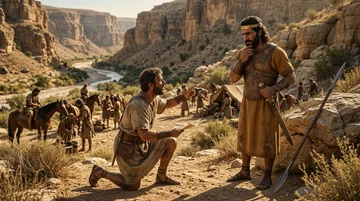
Though himself also anointed as successor, David guarded Saul as the Lord's anointed and refused to harm him even when he had the power and opportunity amid Saul's efforts to prevent him from becoming king.ST Jun 15, 1904ST Apr 22, 1903 Hidden with his companions in the same cave where his bitter, avowed enemy and persecutor had come to rest asleep, David refused vengeance when his cruel enemy was completely in his power despite being urged by his men to slay the king as the promised deliverance into his hands.ST Feb 17, 1904ST Jul 24, 1884ST Jun 15, 1904 Approaching the sleeping king with keen-edged sword, he only cut off the skirt of his coat or severed a fold from his mantle, and even for that his tender conscience smote him.ST Jul 24, 1884ST Jun 15, 1904
His course reveals noble character and wise opposition to evil, held with purpose and loyalty and acted with courage, self-control, tenderness, kindness and magnanimity.RH Dec 6, 1906ST Apr 22, 1903 That wise course with Saul stands with Noah at the flood, Abraham in Canaan, Moses in Egypt, John the Baptist, Paul before the Roman tribunal, and Elijah waiting before denouncing apostate Israel as the measure of wise opposition to evil.RH Dec 4, 1913 He refused to take vengeance into his own hands or seek personal revenge against his persecutor, and his loyal restraint shows trust in God and teaches that it is safe to commit one's cause into God's hands.ST Feb 17, 1904ST Apr 9, 1912ST Apr 7, 1909
David followed with a pacific argument and soft answer, calling out that some bade him kill Saul but his eye spared him, and holding up the cut skirt as proof that there is neither evil nor transgression in his hand and he has not sinned against Saul.ST Jul 24, 1884ST Jun 15, 1904 The act proved to Saul that David bore him no malice.ST Jul 24, 1884 The soft answer turned away wrath, for Saul lifted up his voice and wept and confessed that David was more righteous than he because David had returned good for evil whereas he had rewarded David evil.RH Mar 23, 1916RH Sep 26, 1871ST Jul 24, 1884ST Jun 15, 1904 It is a striking example of loving an enemy and patiently enduring persecution, an example of returning good for evil and of Christian conduct in practice that holds true today.RH Mar 23, 1916RH Sep 26, 1871ST Jul 24, 1884ST Jun 15, 1904
Sources