1 Samuel 26:9
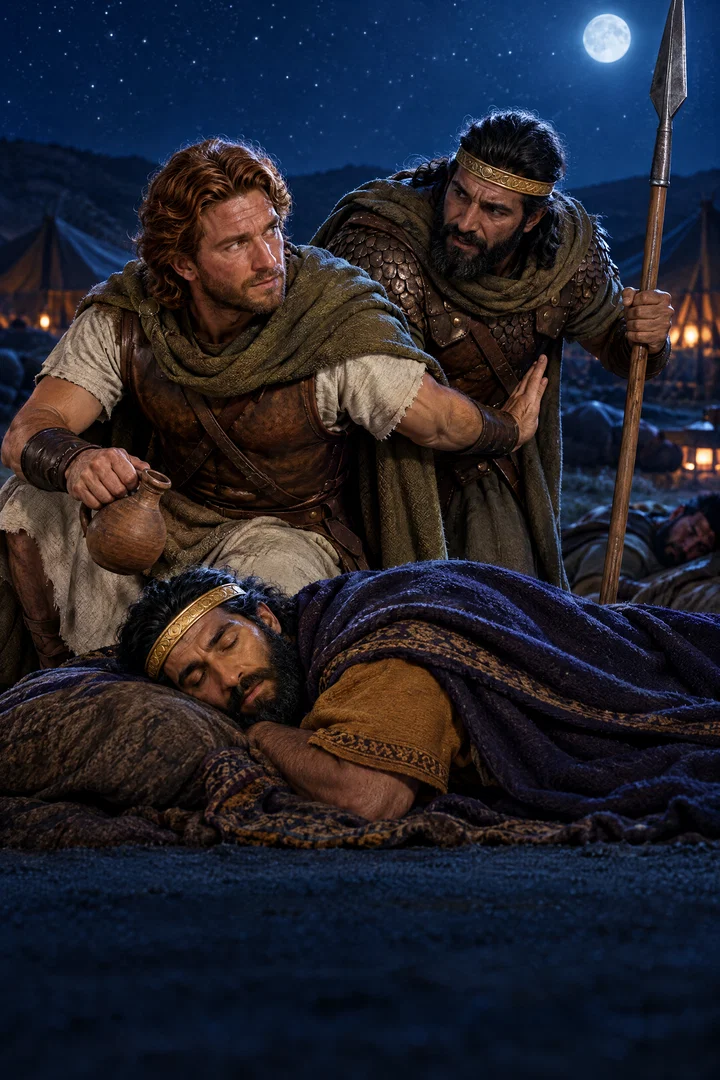
And David said to Abishai, Destroy him not: for who can stretch forth his hand against the LORD’s anointed, and be guiltless?
Translations
American King James Version, King James Version
And David said to Abishai, Destroy him not: for who can stretch forth his hand against the LORD’s anointed, and be guiltless?
And David said to Abishai, Destroy him not: for who can stretch forth his hand against the Lord’s anointed, and be guiltless?
And David said to Abishai, Destroy him not; for who can stretch forth his hand against the LORD'S anointed and be guiltless?
And David said to Abishai, Destroy him not: for who can put forth his hand against the LORD’S anointed, and be guiltless?
And David said to Abishai, Destroy him not; for who can put forth his hand against Jehovah’s anointed, and be guiltless?
And David saith unto Abishai, 'Destroy him not; for who hath put forth his hand against the anointed of Jehovah, and been acquitted?'
And David said to Abishai, Destroy him not; for who can stretch forth his hand against Jehovah's anointed, and be guiltless?
But David said unto Abishai, Do not destroy him,—for who that hath thrust forth his hand against the Anointed of Yahweh, shall be guiltless?
But David said to Abishai, “ Do not destroy him, for who can lift a hand against the LORD’s anointed and be guiltless?”
But David said to Abishai, “ Do not destroy him, for who can extend a hand against the LORD’s anointed and be guiltless?”
David said to Abishai, “Don’t destroy him, for who can stretch out his hand against the LORD’s anointed, and be guiltless?”
And David said to Abishai Do not put him to death; for who, without sin, may put out his hand against the man on whom the Lord has put the holy oil?
And Dauid sayde to Abishai, Destroy him not: for who can lay his hand on the Lordes anoynted, and be giltlesse?
Douay-Rheims (Challoner revision)
And David said to Abisai: Kill him not: for who shall put forth his hand against the Lord’s anointed, and shall be guiltless?
Pictures
Cross-references
- 1 Samuel 24:6
And he said unto his men, The LORD forbid that I should do this thing unto my master, the LORD’s anointed, to stretch forth mine hand against him, seeing he is the anointed of the LORD.
David refuses to harm Saul, the Lord’s anointed.
- 2 Samuel 1:14-16
And David said unto him, How wast thou not afraid to stretch forth thine hand to destroy the LORD’s anointed?
David condemns the killing of Saul, the LORD’s anointed.
- 1 Samuel 16:13
Then Samuel took the horn of oil, and anointed him in the midst of his brethren: and the Spirit of the LORD came upon David from that day forward. So Samuel rose up, and went to Ramah.
David was anointed king, yet would not harm Saul, the LORD’s anointed.
- Psalms 105:15
Saying, Touch not mine anointed, and do my prophets no harm.
God forbids harm to his anointed.
- Romans 12:19
Dearly beloved, avenge not yourselves, but rather give place unto wrath: for it is written, Vengeance is mine; I will repay, saith the Lord.
Vengeance belongs to the Lord, so David forbids taking it into his own hands.
- Matthew 26:51-53
And, behold, one of them which were with Jesus stretched out his hand, and drew his sword, and struck a servant of the high priest’s, and smote off his ear.
Jesus stopped the sword and said he could call for heavenly help.
- Romans 13:1-2
Let every soul be subject unto the higher powers. For there is no power but of God: the powers that be are ordained of God.
Saul’s position is established by God, so opposing him is opposing God’s appointment.
- 1 Samuel 26:20
Now therefore, let not my blood fall to the earth before the face of the LORD: for the king of Israel is come out to seek a flea, as when one doth hunt a partridge in the mountains.
David describes his hunted exile and entrusts his fate to God.
- Acts 13:22
And when he had removed him, he raised up unto them David to be their king; to whom also he gave testimony, and said, I have found David the son of Jesse, a man after mine own heart, which shall fulfil all my will.
God removed Saul and raised David as king.
- Numbers 16:1-3
Now Korah, the son of Izhar, the son of Kohath, the son of Levi, and Dathan and Abiram, the sons of Eliab, and On, the son of Peleth, sons of Reuben, took men:
Korah opposed God's appointed leadership.
- John 18:10-11
Then Simon Peter having a sword drew it, and smote the high priest’s servant, and cut off his right ear. The servant’s name was Malchus.
Jesus restrains Peter’s violence and accepts arrest despite having power to resist.
- 1 Peter 2:23
Who, when he was reviled, reviled not again; when he suffered, he threatened not; but committed himself to him that judgeth righteously:
Christ did not retaliate when reviled or suffering.
- 1 Samuel 26:24
And, behold, as thy life was much set by this day in mine eyes, so let my life be much set by in the eyes of the LORD, and let him deliver me out of all tribulation.
David asks God to spare him as he spared Saul.
- 2 Samuel 18:33
And the king was much moved, and went up to the chamber over the gate, and wept: and as he went, thus he said, O my son Absalom, my son, my son Absalom! would God I had died for thee, O Absalom, my son, my son!
David’s grief for Absalom illustrates his tenderness and forgiving spirit.
- Daniel 2:21
And he changeth the times and the seasons: he removeth kings, and setteth up kings: he giveth wisdom unto the wise, and knowledge to them that know understanding:
God removes and establishes kings; their removal belongs to him.
Commentary
Each commentary is drawn from primary sources: the writings of Ellen G. White and Adventist pioneers and periodicals. Each commentary is separate. Its own words are not a quotation; follow the references to read the source passages.
Ellen G. White
5 sources
The verse belongs to the time after Abiathar son of Ahimelech escaped Saul's slaughter of the Lord's priests and fled to David, when David knew Doeg the Edomite would tell Saul, acknowledged that he had occasioned the death of all of Abiathar's father's house, and promised Abiathar safety with him because Saul sought both their lives.PP 660.1 David speaks when Saul is asleep and defenseless in his power, with Abishai and his men urging him to kill Saul, a pressure he faced often when he had Saul in his power.PP 668.2–31SP 374.2SG4 83.2PP 669 He refuses to destroy Saul because Saul is the Lord's anointed ruler appointed by God, and to stretch forth the hand against him brings guilt.PP 668.2–31SP 374.2SG4 83.2PP 669
He leaves Saul's judgment to God, who might strike him directly, let him die a natural death, or let him perish in battle.PP 668.2–3 Instead of harming Saul, he takes Saul's spear and water and leaves him unharmed.PP 668.2–3 Though David knew God had chosen him to be ruler in Israel, he still refused to harm Saul.1SP 374.2
His humility and faithfulness kept him from taking the life of the ruler God had appointed, shown in his humble, irreproachable conduct in obedient service to Saul and in doing God's will, which was a constant rebuke to Saul's extravagant, rebellious course while Saul hunted him as a wild beast and made killing him the great object of his life.1SP 374.2SG4 83.2 Rather than strike Saul, he chose to seek asylum and refuge among the Philistines with a prudent, humble course, by which he made even his enemies to be at peace with him, and he remained there until Saul died.1SP 374.2SG4 83.2
Sources
Pioneers and periodicals
20 sources
David spared Saul a second time when he and Abishai entered Saul's sleeping camp at night and Abishai asked to kill him at once with his own spear, and David answered that he must not be destroyed.RH Sep 26, 1871ST Jul 24, 1884RH Jun 25, 1901 He refused because Saul was the Lord's anointed, so that to lift the hand against him would bring guilt, even though Saul was wicked and rejected and was relentlessly pursuing him to take his life while David himself had already been anointed king in his place.ST Sep 20, 1883ST Aug 13, 1896ST Apr 11, 1911STST Apr 22, 1903 He left vengeance and the timing and manner of Saul's removal to God, trusting that God would deal with Saul, strike him, or bring him to nothing in His own time and way without human aid.RH Sep 26, 1871ST Aug 13, 1896ST Apr 9, 1912STST Jan 17, 1906 His restraint in having his enemy twice in his power and refusing to harm him displays mercy, self-control and tender kindness, and leaves an example of patient endurance under persecution and returning good for evil.ST Apr 11, 1911ST Jul 24, 1884RH Jun 25, 1901RH Dec 6, 1906ST Nov 29, 1910 If leaders appointed by God depart from Him, He Himself will remove them in His own time and way, so others must respect His appointments, submit to the government that is, and not take judgment or force into their own hands.ST Aug 13, 1896STRH Apr 15, 1909RH Nov 4, 1873RH Nov 18, 1873
David's Refusal Explained
The verse records David's second sparing of Saul, when at night David and Abishai entered Saul's camp in the valley and found Saul asleep with his army around him.ST Jul 24, 1884RH Jun 25, 1901 When Abishai whispered to strike Saul at once to the earth with his own spear, so that none on earth but they two would ever know, David answered, Destroy him not, and would not permit it.ST Jul 24, 1884RH Jun 25, 1901 With the earlier sparing this makes twice he spared his bitter enemy.RH Sep 26, 1871ST Jul 24, 1884 That enemy was relentlessly pursuing him as he fled, in jealous anger trying to take his life and determinedly seeking it.RH Sep 26, 1871ST Jul 24, 1884
David refused because Saul was the LORD's anointed, and to stretch forth the hand against him would bring guilt.ST Sep 20, 1883ST Apr 11, 1911ST Apr 22, 1903 He honored the king even while Saul acted wickedly and sought his life, showing mercy and restraint toward his enemy.ST Sep 20, 1883ST Apr 11, 1911 His restraint held even when he had the power and opportunity, though Saul was wicked, rejected by God, apostate, hunting and hating him, and trying to kill him.ST Aug 13, 1896STST Apr 22, 1903 It held even though David himself had already been anointed to be king in Saul's place, yet he would not take Saul's life, consent to another doing so, or lift his hand against the one holding a position God had established.ST Aug 13, 1896STRH Nov 18, 1873
He treated vengeance and the timing of Saul's removal as God's to decide.ST Aug 13, 1896STST Jan 17, 1906 He trusted that God's prophetic choice of him as king would be fulfilled in God's own time and way, and would not take the king's life even when urged and able to do so because Saul was king.ST Aug 13, 1896ST Jan 17, 1906 Saul might be struck by the Lord, die naturally, or perish in battle.ST Aug 13, 1896 God in His own time would bring to nothing all who had conspired against David and kept him back from his own right.ST
The verse belongs to the closing part of 1 Samuel that ends with the sad account of Saul's death.ST Apr 22, 1913 That was a miserable end for one strong and noble in his youth, who followed the instruction of the spiritualist medium, the woman with a familiar spirit, and it brings regret.ST Apr 22, 1913
Leaving Vengeance to God
Vengeance belongs to the Lord, and the command to destroy him not teaches returning good for evil and leaving all avenging to God.ST Jul 24, 1884RH Jun 25, 1901ST Nov 11, 1880 David lost sight of Saul himself and desired only that the Lord would deal with him as he had dealt with Saul, asking that his own life might be much set by in the eyes of the Lord and that the Lord would deliver him out of all tribulation, even as Saul's life had been much set by in his eyes that day.RH Jun 25, 1901 Though he had the opportunity to kill Saul, he refused to take vengeance on him.ST Nov 11, 1880
He remained loyal and left his cause in God's hands, holding in hope and absolute trust in God and utterly refusing to take vengeance into his own hands.ST Apr 9, 1912ST Apr 7, 1909ST Nov 29, 1910 He would not take revenge though Saul had long persecuted him, but trusted God to bring about his deliverance, because God needed no human aid against the tyrannical and God-forsaken king.RH Apr 23, 1901ST Nov 29, 1910 Such returning of good for evil moved Saul to acknowledge his wrongdoing.RH Sep 26, 1871
His steadfast, holy purpose to harm no part of the Lord's anointed held him back even when more than once he had the power to turn the conflict in his own favor.ST Nov 29, 1910 That restraint displayed mercy and forbearance toward his enemy, with bravery and self-control joined to tenderness and kindness toward the king who lay within his power.ST Apr 11, 1911RH Dec 6, 1906ST Nov 29, 1910 This refusal shines as the clearest and brightest part of his life, revealing the Saviour living in him.RH Apr 23, 1901ST Nov 29, 1910 Up to this point it marks him as a man after God's own heart and as God's ideal of how humans should live, with clean, harmonious, consistently humble character and unfailing courage and unbroken spirit through the weariness, loneliness, homelessness and cold of exile as a hunted fugitive, waiting until the providence of God would prove the kingly heart within him.ST Nov 29, 1910 It leaves an example of patient endurance under persecution that all servants of God would do well to imitate by leaving vengeance to Him.ST Jul 24, 1884
Respecting Appointed Authority
David's word is refusal to use force against a ruler, submitting to the government that was and leaving all judgment with God.ST Aug 13, 1896ST Though Saul was wicked, had been rejected by God, and was hunting David to kill him out of hatred and despite, David would not kill him when he had the chance nor consent to another doing so.ST Aug 13, 1896ST Though David himself had already been anointed to be king in Saul's place, he would not lift his hand against the Lord's anointed to take the king's life.ST Aug 13, 1896ST He treated vengeance and the timing of Saul's removal as God's to decide, whether the Lord would strike him, let him die naturally, let him perish in battle, or in His own time bring to nothing all who had conspired against David and kept him back from his right.ST Aug 13, 1896ST Because Saul held a position God had established, restraint toward him teaches respect for God's appointments and not injuring those serving as His agents.RH Nov 18, 1873
If leaders chosen by God depart from God and should be removed, God will remove them in His own time and way, so others must not take it into their own hands to attack them.RH Nov 4, 1873 David left Saul's removal to God rather than killing him, even though Saul was seeking to kill him and had fallen into David's power.RH Nov 4, 1873 No one can stretch forth the hand against the Lord's anointed and be guiltless, but woe comes on him who does so or who seeks to bring in an order of things which God has not ordained.RH Apr 15, 1909 Even though the church has never been free from sin and its leaders are imperfect, for Moses spake unadvisedly with his lips and Paul made mistakes and Luther was not perfect, God still leads them as His own precious heritage.RH Apr 15, 1909
He rebukes kings for their sakes, goes before them as in the pillar of cloud by day and pillar of fire by night in the wilderness, and manifests His presence in their daily service.RH Apr 15, 1909 The verse therefore condemns offshoots who withdraw over claimed errors in leadership, unrecognized talents, or wrongs in the work and then attack God's people.RH Apr 15, 1909 In this sense the absolute monarch is the Lord's anointed, so that no one can assassinate him or forcibly set him aside and be guiltless.RH Nov 26, 1914 The Turkish sultans are the Lord's anointed in this sense, and Turkey's uncertain rule of succession with its many assassinations and forcible settings aside of sultans violates the verse and shows the lack of a definite and clearly organized government.RH Nov 26, 1914
Sources