1 Samuel 4:10
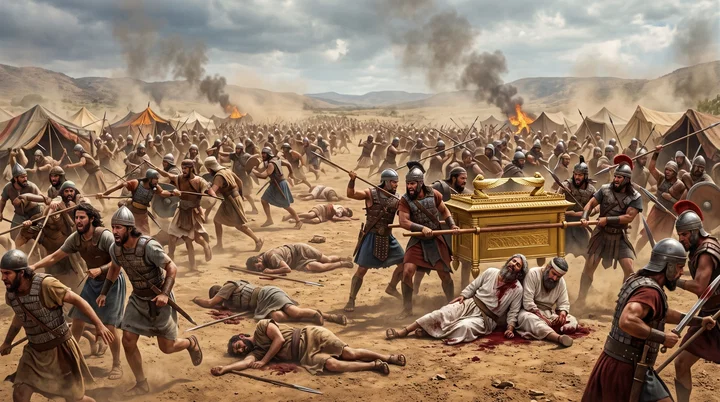
And the Philistines fought, and Israel was smitten, and they fled every man into his tent: and there was a very great slaughter; for there fell of Israel thirty thousand footmen.
Translations
American King James Version, King James Version, KJV Cambridge Paragraph Bible
And the Philistines fought, and Israel was smitten, and they fled every man into his tent: and there was a very great slaughter; for there fell of Israel thirty thousand footmen.
And the Philistines fought, and Israel was smitten, and they fled every man into his tent: and there was a very great slaughter, for there fell of Israel thirty thousand footmen.
Revised Version, American Standard Version
And the Philistines fought, and Israel was smitten, and they fled every man to his tent: and there was a very great slaughter; for there fell of Israel thirty thousand footmen.
And the Philistines fight, and Israel is smitten, and they flee each to his tents, and the blow is very great, and there fall of Israel thirty thousand footmen;
And the Philistines fought, and Israel was routed, and they fled every man to his tent; and there was a very great slaughter, and there fell of Israel thirty thousand footmen.
So the Philistines fought, and Israel was smitten, and they fled every man to his home; and the slaughter became exceeding great,—and there fell of Israel—thirty thousand footmen.
Berean Standard Bible, Majority Standard Bible
So the Philistines fought, and Israel was defeated, and each man fled to his tent. The slaughter was very great— thirty thousand foot soldiers of Israel fell.
The Philistines fought, and Israel was defeated, and each man fled to his tent. There was a very great slaughter; for thirty thousand footmen of Israel fell.
So the Philistines went to the fight, and Israel was overcome, and every man went in flight to his tent: and great was the destruction, for thirty thousand footmen of Israel were put to the sword.
And the Philistims fought, and Israel was smitten downe, and fled euery man into his tent: and there was an exceeding great slaughter: for there fell of Israel thirtie thousand footemen.
Douay-Rheims (Challoner revision)
So the Philistines fought, and Israel was overthrown, and every man fled to his own dwelling: and there was an exceeding great slaughter; for there fell of Israel thirty thousand footmen.
Pictures
Cross-references
- 1 Samuel 5
And the Philistines took the ark of God, and brought it from Eben-ezer unto Ashdod.
continues story of taken ark
- 1 Samuel 4:17-18
And the messenger answered and said, Israel is fled before the Philistines, and there hath been also a great slaughter among the people, and thy two sons also, Hophni and Phinehas, are dead, and the ark of God is taken.
The defeat and loss of the ark lead to Eli’s death.
- 1 Samuel 4:21-22
And she named the child I-chabod, saying, The glory is departed from Israel: because the ark of God was taken, and because of her father in law and her husband.
Ichabod’s name marks the ark’s capture as Israel’s loss of glory.
- 1 Samuel 6:1-12
And the ark of the LORD was in the country of the Philistines seven months.
The Philistines return the captured ark with a trespass offering.
- 1 Samuel 4:3-4
And when the people were come into the camp, the elders of Israel said, Wherefore hath the LORD smitten us to day before the Philistines? Let us fetch the ark of the covenant of the LORD out of Shiloh unto us, that, when it cometh among us, it may save us out of the hand of our enemies.
Israel brought the ark, trusting it for help.
- 1 Samuel 7:10
And as Samuel was offering up the burnt offering, the Philistines drew near to battle against Israel: but the LORD thundered with a great thunder on that day upon the Philistines, and discomfited them; and they were smitten before Israel.
The LORD thunders against the Philistines, turning Israel’s earlier defeat into victory.
- Psalms 78:61
And delivered his strength into captivity, and his glory into the enemy’s hand.
Describes the ark’s capture as delivering strength and glory into the enemy’s hand.
- 1 Samuel 5:6-12
But the hand of the LORD was heavy upon them of Ashdod, and he destroyed them, and smote them with emerods, even Ashdod and the coasts thereof.
Philistine cities were smitten while the ark was among them.
- 1 Samuel 3:11-14
And the LORD said to Samuel, Behold, I will do a thing in Israel, at which both the ears of every one that heareth it shall tingle.
The slaughter fulfills the LORD’s sworn judgment on Eli’s house and the tingling-ears warning.
- 1 Samuel 2:29-34
Wherefore kick ye at my sacrifice and at mine offering, which I have commanded in my habitation; and honourest thy sons above me, to make yourselves fat with the chiefest of all the offerings of Israel my people?
Eli’s sons’ deaths fulfilled the judgment pronounced before the battle.
- 1 Samuel 4:17
And the messenger answered and said, Israel is fled before the Philistines, and there hath been also a great slaughter among the people, and thy two sons also, Hophni and Phinehas, are dead, and the ark of God is taken.
Both report Israel’s flight and a great slaughter.
- Joshua 6:6-20
And Joshua the son of Nun called the priests, and said unto them, Take up the ark of the covenant, and let seven priests bear seven trumpets of rams’ horns before the ark of the LORD.
The ark’s role at Jericho encouraged Israel to bring it into battle.
- 1 Samuel 3:14
And therefore I have sworn unto the house of Eli, that the iniquity of Eli’s house shall not be purged with sacrifice nor offering for ever.
The defeat and deaths fulfill the oath of judgment against Eli’s household.
- 1 Kings 8:33-34
When thy people Israel be smitten down before the enemy, because they have sinned against thee, and shall turn again to thee, and confess thy name, and pray, and make supplication unto thee in this house:
Solomon prays for Israel’s forgiveness after defeat because of sin.
- Joshua 3:16-17
That the waters which came down from above stood and rose up upon an heap very far from the city Adam, that is beside Zaretan: and those that came down toward the sea of the plain, even the salt sea, failed, and were cut off: and the people passed over right against Jericho.
Israel’s safe crossing contrasts with its defeat after unfaithfulness.
- Jeremiah 7:12-14
But go ye now unto my place which was in Shiloh, where I set my name at the first, and see what I did to it for the wickedness of my people Israel.
Shiloh’s destruction warns Judah of divine judgment.
Commentary
Each commentary is drawn from primary sources: the writings of Ellen G. White and Adventist pioneers and periodicals. Each commentary is separate. Its own words are not a quotation; follow the references to read the source passages.
Ellen G. White
28 sources
The Philistines attacked fiercely after Israel's first loss of four thousand, Israel was smitten and fled every man to his tent, and thirty thousand footmen fell in a very great slaughter.1SP 402.3–403.1ST Feb 12, 18801SP 404.1–2 The elders had blamed the first defeat on the absence of the ark and had it brought from Shiloh by Hophni and Phinehas expecting certain triumph, yet in that same battle the ark was taken and Eli's two sons were slain defending it.ST Feb 12, 18801SP 404.1–2ST Dec 22, 1881SG4 105.1–2 Israel's strength lay in obedience to the law contained in the ark, and trusting in its mere presence while profaning its commandments was vain idolatrous worship that could not give victory apart from God.1SP 402.3–403.11SP 404.1–2ST Jan 12, 1882SG4 105.1–2 The immediate cause of the smiting was Eli treating his sons' vile corruption lightly and failing to reprove and restrain them, leaving Israel separated from God and given into the Philistines' hands until repentance.ST Feb 12, 1880ST Jan 12, 1882SG4 105.1–2PK 415.3–416.1PP 584.1–2 God permitted the defeat and the taking of the ark to humble Israel, expose presumption, and chastise his people, proving that sacred privileges cannot shield persistent sin from divine judgment.ST Feb 12, 18801SP 404.1–2ST Dec 22, 1881ST Jan 12, 1882PK 415.3–416.1
The Defeat in Battle
This was the second defeat, for four thousand had already fallen in the first battle.SG4 105.1–2 The elders blamed that first loss on the absence of the ark, remembered how the passage over Jordan and the conquest of Jericho had come when the ark was carried, and had the ark brought from Shiloh with Hophni and Phinehas, expecting triumph.SG4 105.1–2 Israel shouted with restored confidence when it came, and the Philistines were afraid that God had come into the camp and remembered the gods that smote the Egyptians.SG4 105.1–2 Yet they rallied and roused themselves to fight strongly like men rather than become servants to the Hebrews.SG4 105.1–2
The Philistines fought in a fierce attack, Israel was smitten, they fled every man to his tent, and there was a very great slaughter.1SP 402.3–403.1ST Dec 22, 1881SG4 105.1–2 In that slaughter thirty thousand Israelite footmen fell.1SP 402.3–403.11SP 404.1–2ST Dec 22, 1881ST Jan 12, 1882 The defeat was decisive despite the bringing of the ark into battle.1SP 402.3–403.1ST Jan 12, 1882
In the same battle the ark of God was taken by the Philistines.1SP 404.1–2ST Dec 22, 1881ST Jan 12, 1882SG4 105.1–2 Hophni and Phinehas were slain, Eli's two sons dying defending the ark they had brought into battle.ST Dec 22, 1881SG4 105.1–2 Their death with the loss of thirty thousand men and the capture of the ark made the calamity complete.ST Feb 12, 18801SP 404.1–2ST Jan 12, 1882
Eli was sitting by the wayside watching with a trembling heart for fear the ark would be taken and polluted.1SP 404.1–2SG4 106.2–3 When the messenger told him his sons were dead he bore it with calmness because he had reason to expect it, but when he heard the ark was taken he wavered in anguish.4T 516.1–2SG4 106.2–3 He recognized his neglect had deprived Israel of strength and glory, fell backward from his seat and died.4T 516.1–21T 118.2–119.2 The dying wife of Phinehas named her child Ichabod to declare that the glory is departed from Israel because the ark is taken.SG4 106.2–3
Why Israel Was Smitten
Israel's strength lay not in the ark itself but in obedience to the law contained in the ark, which represented God himself.1SP 402.3–403.1SG4 105.1–2 The ark was only the symbol of God's presence, and it had no power apart from God to guarantee victory.1SP 404.1–2SG4 106.2–3PP 584.1–2 That is why bringing it into battle did not prevent Israel from fleeing and losing thirty thousand footmen to the Philistines.1SP 402.3–403.1SG4 105.1–2
The people trusted in the mere presence of the ark as their boasted strength and confidence, with reverence mixed with pride in past victories at the passage over Jordan and at Jericho.ST Jan 12, 1882SG4 105.1–2SG4 106.2–3 To treat the ark as a source of power while despising and profaning the commandments it contained was vain, empty, idolatrous worship, worshiping the ark instead of the God it represented.1SP 404.1–2SG4 106.2–3PP 584.1–2 Unlike earlier victories when Israel obeyed and the ark was carried as God commanded, this time the people followed their own plans and the ark was carried by the wicked, polluted priests Hophni and Phinehas who were transgressing that law.SG4 105.1–2ST Dec 22, 1881 The law beneath the mercy seat stood against their disobedience, and God's blessings could not be secured through the symbol while the people disobeyed Him.PP 584.1–2ST Dec 22, 1881
Their disobedience and unfaithfulness had separated them from God and left them vulnerable to punishment.ST Jan 12, 1882PP 584.1–2 God did not give them victory but withdrew from them in anger and gave them into the Philistines' hands until they repented and forsook sin.PP 584.1–2ST Jul 24, 1884Ms 1, 1854, par. 10–15 Mere knowledge of the law could not save them without obedience that transformed their lives, and military strength could not save them.ST Jan 12, 1882Ms 3, 1884, par. 5
The immediate cause was Eli treating his sons' sin lightly and failing to reprove, restrain, correct and govern them.ST Feb 12, 1880ST Jun 1, 18764T 166.1–2 His sons held sacred offices yet were wicked, vile, corrupt and ungodly, transgressing the law they were to guard, leading Israel astray, exerting a corrupting influence and bringing reproach on God's cause until their corruption became a proverb of reproach.SG4 105.1–2PK 415.3–416.11T 118.2–119.2 Because sin was treated lightly and allowed to remain, calamity followed in the defeat, the deaths of Eli's sons, and the capture of the ark.PK 415.3–416.1ST Jun 1, 18764T 166.1–2
God permitted the defeat and the taking of the ark to show how vain it was to trust in the ark while profaning its commandments, and to humble Israel by removing its confidence and strength.1SP 404.1–2SG4 106.2–3 It was His chastisement to expose hypocrisy and rebuke presumption.ST Dec 22, 1881 He used the Philistines to punish Israel and then used the ark to bring judgment on the Philistines, and He had not wholly rejected Israel.ST Jan 12, 1882PP 585.5 The defeat testifies that God's professed people do not escape punishment for iniquity, that wherever sin is cherished divine judgment follows, and that greater knowledge of God's will brings greater guilt when it is disregarded.ST Dec 22, 1881PP 583.3PP 585.5
Warning for Church and Home
The thirty thousand slain show what follows when sin is treated lightly and allowed to remain among God's people, ending in defeat, death, and the loss of the ark.ST Feb 12, 1880PK 415.3–416.1ST Jun 1, 1876 No sacred object, religious privilege, reverence for the law, or outward observance can shield from divine judgment while wickedness is cherished and repentance, obedience, and turning from evil are refused.PK 415.3–416.14T 166.3–4ST Feb 12, 1880 Confidence that the mere presence of the ark would secure victory, without forsaking sin, proved vain.PK 415.3–416.14T 166.3–4ST Feb 12, 1880 The calamity came because Eli failed to reprove and restrain his sons though they held sacred offices, and the evils spreading through the land were left unchecked.ST Feb 12, 1880PK 415.3–416.1ST Jun 1, 18764T 166.1–2
Those in responsible positions must therefore faithfully deal with and remove wrongs that dishonor the cause of truth.ST Feb 12, 1880ST Jun 1, 18764T 166.1–2 The judgment fell under the frown of God because Eli did not rule well his own house and restrain his corrupt, wicked, and ungodly sons, whose corruption became a proverb of reproach, exerted a corrupting influence, disgusted unbelievers, and brought reproach upon God's cause.SG4 164.1–21T 234.2–235.2 Servants of God must govern their own families and have them in good subjection, for they are not prepared to judge or decide in matters of the church unless they can rule well their own house.SG4 164.1–21T 234.2–235.2
The national disaster, with thousands dead, the ark taken, and the deaths of Eli's sons and of Eli himself, resulted from Eli's indulgence and criminal neglect in not restraining his sons.4T 516.1–21T 118.2–119.2SG4 164.1–2ST Nov 24, 1881RH Jan 29, 1901 His sons were wicked and vile and led Israel astray, and because he restrained them not their sins would not be purged with sacrifice nor offering forever.SG4 164.1–2 Parents must not be led by their children but must lead them, govern them, correct their passions and subdue them.SG4 164.1–2 God was particular to notice parental neglect anciently and is no less particular in the last days, and unrestraining parents will not be blameless when God destroys the children in the day of His fierce anger.SG4 164.1–21T 234.2–235.2 The loss of the ark made Eli recognize that his neglect had deprived Israel of its strength and glory, and when he heard the ark was taken he fell backward and died.4T 516.1–2SG4 164.1–2
This calamity is the historical warning behind the threat that Jerusalem would become like Shiloh, showing the consequences of allowing sin to remain and disregarding warnings.ST Feb 12, 1880 It was a warning Saul knew but failed to heed when he later relied on the ark to strengthen his army.ST Aug 10, 1882 The same principle holds where desecrating God's house and violating the Sabbath bring God's displeasure, so that enemies of the faith triumph and spiritual power is lacking.Ms 1, 1854, par. 10–15 The later victory over the Philistines on that same field stands in contrast to this disaster, proving that obedience leads to safety and happiness while transgression and unfaithfulness, with pride in past victories and trust in military strength, leave the people vulnerable to punishment and bring terror and despair.ST Jan 12, 1882PP 591.1
Sources
Pioneers and periodicals
60 sources
The Philistines fought and Israel was smitten with humiliating defeat, every man fleeing to his tent in a very great slaughter in which thirty thousand footmen fell.ST Jan 23, 1907ST Apr 8, 1913ST Jul 8, 1889 In the same overthrow the ark of God was taken by the enemy, with Hophni and Phinehas slain defending it.ST Feb 22, 1910ST Apr 8, 1913ST Jun 26, 1884 Israel had brought the ark into camp and onto the battlefield in hope its presence would insure victory, while failing to keep God's law and living in unrighteousness.ST Aug 13, 1902RH Apr 21, 1851ST Jun 26, 1884 The ark was only a symbol of God's presence and strength while Israel was faithful, cherishing His law within and His mercy above, and it could not protect the people when they had forfeited that presence through disobedience.ST Dec 22, 1881ST Jul 4, 1906 God withdrew His protection, which is given only on moral and spiritual conditions, fulfilling the judgment sworn against Eli's house because his sons made themselves vile and he restrained them not.ST Jan 12, 1882ST Aug 13, 1902RH Mar 19, 1872RH Jul 22, 1873
Battle and Slaughter
The Philistines fought, and Israel was smitten, every man fleeing into his tent in humiliating defeat and confusion with great loss of life.ST Aug 13, 1902ST Jan 23, 1907ST Apr 8, 1913ST Apr 8, 1913 The flight was the nation brought low in battle, left without strength after falling low through transgression and departure from God.ST Apr 8, 1913ST Apr 8, 1913ST Apr 2, 1912RH Jul 8, 1852 The defeat was a very great slaughter, for there fell of Israel thirty thousand footmen, thirty thousand foot soldiers killed in that one overthrow.ST Feb 12, 1880ST Jan 23, 1907ST Apr 8, 1913ST Nov 12, 1912ST Apr 2, 1912 Thousands of the people died besides Eli's sons, for the effects of sin among God's people fall on the whole community.ST Feb 12, 1880ST Jan 23, 1907ST Apr 8, 1913ST Jul 8, 1889
The Philistines had rallied themselves to fight fiercely because they feared becoming Israel's servants.ST Mar 11, 1897 They saw they were fighting not only Israel but Israel's God, and roused themselves with redoubled valor to crush Israel and seize the supernatural secret of its power.ST Mar 11, 1897 In presumptuous despair Israel had brought the ark of God to the front of the army while politically under Philistine power and morally corrupted, and the Philistine resolve met it with crushing force.ST Mar 11, 1897
In the same overthrow the ark of God was taken by the enemy and carried away, captured while surrounded by Israel's earthly defenders.ST Feb 22, 1910ST Apr 8, 1913ST Jun 26, 1884ST Mar 31, 1909ST Dec 3, 1902 Hophni and Phinehas were slain, dying as they defended it in the fierce attack.ST Dec 22, 1881ST Dec 3, 1902 Possessing the tables of the law and the ark could not protect Israel while trampling God's law, and the sacred objects were no substitute for God dwelling in the heart.ST Aug 13, 1902ST Jun 26, 1884RH Jul 8, 1852
Setting and Aftermath
The battle falls in the interval between the judges and the kings, when Israel had fallen low through widespread spiritual corruption, unfaithfulness, transgression and departure from God and was left without strength.ST Apr 2, 1912RH Aug 28, 1856ST Apr 2, 1912ST Dec 3, 1894 Politically under Philistine power and morally corrupted by Hophni and Phinehas and the helplessness of Eli, corrupt Israel collapsed by its own weight and came to the end of its own strength.ST Mar 11, 1897 In presumptuous despair Israel brought the ark of God to the front of the army, but carrying it into battle could not protect a people trampling on God's law or hide transgression, because God had departed from them.RH Aug 28, 1856ST Apr 2, 1912ST Dec 3, 1894
The encounter was at Eben-ezer, and its capture of the ark brought the lament that the glory had departed from Israel.RH Aug 28, 1856 It was fought on the same geographically unchanged field between Mizpeh and Shen where twenty years later God gave Israel a signal victory, yet in that first encounter thirty-four thousand of the flower of the nation were slain and the ark of God was taken. The defeat happened because the message was in the ark but not in the men, and Israel looked to the ark itself for rescue instead of taking God into account, while twenty years later through Samuel's prayers and earnest labors a mighty change had taken place in the hearts of God's people, the message was in the men, God was taken into account, and He wrought for them, so that the ground of the stone Ebenezer witnessed both crushing defeat and great victory.
Israel did not recover from this overthrow for many years, for possessing the tables of the law and the ark could not protect the people while they trampled on God's law, since sacred objects were no substitute for God dwelling in their hearts.ST Jun 26, 1884 The bondage to Philistia and the capture of the ark were bitter, but Israel's backsliding from God was still sadder, and the people did not appreciate it. It was the deepest, darkest hour of national woe, the darkness just before the dawn of reformation under Samuel.ST Mar 11, 1897
In this defeat God forsook His habitation at Shiloh, giving His glory, the ark of His testament, into the hands of the enemy in the fighting, smiting, flight and very great slaughter.RH Jan 6, 1853 That sanctuary was the curtained tabernacle called the house of the Lord pitched at Shiloh, and its being forsaken meant His strength was delivered into captivity and His glory into the enemy's hand.RH Sep 2, 1852 Shiloh was where the tabernacle was set up when Israel entered Canaan under Joshua and where the land was divided by lot after the conquest, where Eli officiated as high priest and the youthful Samuel served in the tabernacle, and where the prophet Ahijah afterward dwelt when the wife of Jeroboam came to him in disguise.ST Sep 29, 1898 After the ark was taken from the tabernacle at Shiloh, God's glory, the ark of His covenant, never returned to that building, and of Shiloh nothing is left but a wilderness of rocks and stones.RH Jan 6, 1853ST Sep 29, 1898
The same captivity of the country by the Philistines, with very great slaughter of Israel, brought to an end the irregular priesthood set up at Laish in Dan by Jonathan the son of Gershom, the grandson of Moses, which had continued through his posterity until that time.RH Dec 22, 1910
The calamity fulfilled the astounding judgment God warned would make ears tingle, exposing the presumption of Hophni and Phinehas in carrying the ark of the covenant into battle as if it were an irresistible mascot that would win the victory.ST Dec 3, 1902 In that same overthrow the ark was carried off by the enemy, Hophni and Phinehas were slain, Eli expired on receipt of the news, and the house of Eli was blotted out as a ruling family, showing that the name of the Lord is a strong tower but the disobedient and presumptuous find no security in it.ST Feb 12, 1880ST Apr 6, 1888ST Dec 3, 1902RH Jul 16, 1857RH Jun 22, 1916 The fearful slaughter of thirty thousand people followed when Eli treated his sons' sin lightly and failed to reprove, restrain and govern them, teaching that sin allowed to remain among God's people brings grave consequences and that those in responsible positions must faithfully remove wrongs that dishonor the cause of truth.ST Feb 12, 1880RH Jul 16, 1857RH Jun 22, 1916 God's delayed sentence against Eli's family was then carried out in Israel's defeat and great loss and the death of Eli and his sons, marking the family's loss of the priesthood after they failed to honor God and did not repent.ST Apr 6, 1888ST Mar 11, 1897 The death of blind ninety-eight-year-old Eli when he heard the tidings, the death of his daughter-in-law, and the naming of Ichabod, the glory is departed, belong to this same disaster.ST Mar 11, 1897
False Confidence in Ark
Israel brought the ark into the camp and onto the battlefield in hope of victory, trusting its presence to insure success while failing to keep God's law and living in unrighteousness, and the result was defeat and great loss of life with thirty thousand footmen fallen.ST Aug 13, 1902RH Apr 21, 1851ST Jun 26, 1884ST Jun 30, 1898 The ark itself could not secure victory while Israel had violated God's covenant, and possessing the tables of the law and the ark could not protect a people trampling on that law.RH Apr 21, 1851ST Jun 26, 1884 Relying on the ark rather than on obedience to God's whole will could not secure victory, for claiming to belong to God or relying on past experience is no safety; safety lies in following the light of truth and taking God's word as counsel.ST Jul 8, 1889 Carried into battle presumptuously, the ark did not protect a people sinning against God.ST Jul 15, 1889
The ark was only a symbol of God's presence and strength while Israel was faithful, cherishing His holy law on the tables inside and His rich mercy on its mercy-seat cover.ST Jul 4, 1906 It could not protect the people when they had forfeited that presence through disobedience, and God's blessings could not be secured through it while the people disobeyed Him.ST Dec 22, 1881 Unlike earlier victories when Israel obeyed and the ark was carried as God commanded, this time the people followed their own plans, the law beneath the mercy seat stood against their disobedience, and confidence in the ark brought defeat, disaster and death.ST Dec 22, 1881
The people depended on the material symbol instead of having the sacred principles of God's law as part of their lives and God dwelling in their hearts.ST Jun 26, 1884 The message was in the ark but not in the men, and they looked to the ark itself for rescue instead of taking God into account. Form and external machinery do no good when iniquity is regarded in the heart, since God's cooperation is given only on moral and spiritual conditions. The ark was borne by unconverted, unrighteous and wicked priests, Hophni and Phinehas, and carried by unrighteous priests without God Himself.ST Jun 30, 1898 It was carried presumptuously and rashly against God's commands concerning it, and carrying it into battle could not protect Israel or hide transgression, because God had departed and left them without strength.ST Jul 24, 1884ST Dec 22, 1881RH Aug 28, 1856 This defeat after bringing the ark with Hophni and Phinehas was a warning Saul knew but failed to heed when he later relied on the ark to strengthen his army.ST Aug 10, 1882
Israel worshiped the ark itself as a charm, fetish, irresistible mascot and magical power to secure victory, exalting it while backslidden.ST Dec 3, 1902ST Jul 4, 1906ST Jul 26, 1905 They had forgotten the law of God and lost the living principles and spiritual truth the ark stood for, worshiping the form while losing the fact.ST Jul 17, 1907ST Sep 12, 1900 Outward religious forms and external machinery without that truth were powerless.ST Sep 12, 1900 God withdrew His protection and cooperation, which is given only on moral and spiritual conditions, and the sacred ark and law were no guarantee of safety for a sinful people.ST Aug 13, 1902 Military strength could not save them, the army could not secure victory even with the ark taken into battle, for God was no longer fighting for Israel because of sin but had given them over to their enemies until they learned He would not claim them as His special people unless they lived according to His will.ST Jan 12, 1882ST Nov 15, 1905ST Jul 15, 1889
Eli's House and Corporate Sin
The slaughter is the fulfillment of the judgment sworn against the house of Eli for the iniquity which he knew, because his sons made themselves vile and he restrained them not, a sin that would not be purged with sacrifice nor offering forever.RH Mar 19, 1872RH Jul 22, 1873 It is God judging Eli's house for parental failure to restrain vile sons, holding parents accountable for the character and training of their children.RH Mar 19, 1872 Because the Lord is the same yesterday, today, and forever, He will judge the negligent Elis of this nation, even negligent priests whose sons have made themselves vile and are not restrained, as He judged Eli of old.RH Mar 19, 1872RH Jul 22, 1873
Eli treated his sons' deliberate sins lightly, indulging them and passing over them with only weak reproof instead of decidedly restraining and governing them.ST Feb 12, 1880ST Jun 1, 1876RH Jul 22, 1873 He said, Why do ye so wickedly, but did not take hold to restrain them, though they brought the worship of the sanctuary into contempt with an influence to ruin souls eternally.RH Jul 22, 1873 That indulgence of wrongdoing brought national disaster, with Israel defeated, thousands dying, thirty thousand killed, Eli's sons and Eli dying, and the ark taken.ST Feb 12, 1880ST Jun 1, 1876ST Nov 24, 1881 Sin allowed to remain among God's people brings grave consequences, and those in responsible positions in the church must faithfully remove wrongs that dishonor the cause of truth.ST Feb 12, 1880ST Jun 1, 1876
The priests wrongly presumed that their office and presence with the ark, and reliance on tabernacle ritual, made them safe.RH Aug 3, 1869ST Aug 14, 1884RH Aug 3, 1869 Their sin against God's law and carelessness of sin brought judgment on them and destruction on Israel, with themselves killed, Israel defeated, many slain, and the ark captured by the Philistines.RH Aug 3, 1869ST Aug 14, 1884RH Aug 3, 1869 God breaks forms treated as objects of trust instead of signs of His grace, and the defeat exposed the failure of priests and people to live spiritually faithful lives.ST Aug 14, 1884
What came when parents or children turn from following God and do not keep His commandments and statutes, so that Israel is cut off, is the same judgment that came on Eli's house because his sons were not restrained.RH Mar 19, 1872RH Jun 23, 1853 The disastrous outcome of Eli's failure to restrain, govern, and enforce religious discipline was that Hophni and Phinehas were killed in battle, Israel suffered a great slaughter of thirty thousand men, the ark of God was captured, and afterward Eli, blind at ninety-eight, and his daughter-in-law died.ST Nov 24, 1881ST Jun 22, 1882RH Jun 22, 1916RH May 8, 1856 The destruction of father and sons was an act of divine justice for corruption and indulgence, and negligent Elis today in family and church, who pass over sin as easily, will have to give account in the day of judgment.ST Jun 22, 1882RH Jul 22, 1873
The effects of sin among God's people fall on the whole community, for the defeat brought death to thousands besides Eli's sons, with thirty thousand footmen slain and Israel fleeing from enemies.ST Feb 12, 1880ST Jul 8, 1889RH Jul 22, 1873 Those who excuse or cover up others' wrongdoing share in its consequences, and the calamity with the ark taken warns that Jerusalem would become like Shiloh if sin is allowed to remain and warnings are disregarded.ST Feb 12, 1880ST Jul 8, 1889 The defeat was God's chastisement exposing hypocrisy and rebuking presumption, showing that sins of professed servants of God do not go unpunished and that greater knowledge of God's will brings greater guilt when disregarded.ST Dec 22, 1881ST Jan 12, 1882 Religious privileges and respect for God's law cannot shield the unrepentant and wicked from divine judgment when they refuse to repent and obey, and the sons of Eli miserably perishing at the hands of the Philistines as the harvest of sowing to the flesh proves youth is no excuse for sin.ST Dec 22, 1881ST Feb 12, 1880RH May 27, 1873
Holiness and Earthly Power
The ark was never taken until it was surrounded by the arms of earthly defenders, when Israel ringed it with an army and sought to guard it with carnal weapons.ST Jan 23, 1907ST Jan 24, 1906ST Oct 24, 1895 That surrounding ended in Israel smitten, every man fleeing to his tent, thirty thousand footmen fallen, and the ark carried away by the Philistines.ST Jan 23, 1907ST Aug 26, 1897ST Oct 24, 1895 Earthly force gives no protection to holy things and brings no addition of dignity or strength to them.ST Jan 23, 1907ST Jan 24, 1906 Divine truth is not protected but endangered by union with earthly power.
Its real security lies in its own holiness and moral power. That security is its benevolent morality, its exquisite adaptation to the human heart, its accommodation to every human intellect, its consolation to the house of mourning, and its light on the mystery of the grave, not in being made part and parcel of the common law.ST Jan 23, 1907ST Jan 24, 1906 True religion therefore gains no added dignity or strength from being made part of civil law, and is in far greater danger of being corrupted by alliance with civil power than of being crushed by its opposition.ST Jan 21, 1897 Only secular institutions need secular defense by human law and the human sword, while truly sacred things are defended by God Himself, so that once the holy law and its sanctified receptacle were out of the hands of those who would defend them with carnal weapons they were vindicated and rescued by an unseen hand, even laying the hostile god prostrate on the threshold of his own temple.ST Aug 26, 1897ST Jan 21, 1897
The ark of the Lord can have no connection with carnal warfare.ST Nov 18, 1903 Carrying it onto the battlefield with the sons of Eli did not give victory but settled the matter in defeat.ST Aug 26, 1897ST Nov 18, 1903 The house to be built for the Lord was to be the resting-place of the ark of the covenant and the dwelling-place of the God of peace, not a monument to carnal victories.ST Nov 18, 1903 For that reason David, as a man of war with the odor of human blood on his garments, had fulfilled a necessary but bloody mission that did not qualify him to take a leading part in that peaceable work of building.ST Nov 18, 1903 To guard a so-called sacred day with drawn swords and enforce it by secular power is a tacit admission of no practical faith in its sanctity, and any temporary success by such enforcement is evidence that the institution so defended is nothing but a secular day.ST Aug 26, 1897
Sanctuary Glory and Warning
The fighting and smiting, the flight of every man and the very great slaughter with thirty thousand footmen fallen, is God giving His glory, the ark of His testament and covenant, into the hands of the enemy after forsaking His habitation at Shiloh for gross wickedness.RH Jan 6, 1853ST Jun 30, 1898 The slaughter means the glory or character of God had departed from Israel, summed up in the word Ichabod, the glory is departed, because the people depended on the material symbol instead of having the sacred principles of God's law as part of their lives.ST Jun 30, 1898ST Jul 4, 1906 The ark was borne by unconverted, unrighteous priests and carried in hope of victory to insure success while living in unrighteousness without God Himself, and form and external machinery could do no good when iniquity was regarded in the heart, since God's cooperation is given only on moral and spiritual conditions.ST Jun 30, 1898ST Jul 8, 1889 It was a symbol of God's presence and strength only while Israel was faithful, cherishing His holy law on the tables inside and His rich mercy on its mercy-seat cover, but Israel had forgotten God and His presence had departed from their lives and worshiped the ark itself as a charm, fetish or irresistible mascot to secure victory, so they met defeat and the ark met captivity and never returned to that building.RH Jan 6, 1853ST Jul 4, 1906ST Jul 17, 1907
The event proves God did not immovably fix Himself to the position between the cherubim on the ark and did not meet or commune with His people only from there, even when the sons of Eli rashly took it out to battle and it fell into Philistine hands.RH Jul 27, 1876 God used the Philistines to punish Israel for unfaithfulness, whose reverence for the ark was mixed with pride in past victories and whose military strength could not save them from terror and despair, then used the ark in captivity to bring judgment on the Philistines.ST Jan 12, 1882ST Jan 21, 1897 In captivity its own sanctity was sufficient to vindicate it from insult and to lay the hostile god prostrate on the threshold of his own temple.ST Jan 12, 1882ST Jan 21, 1897 The slaughter belongs to the church in the wilderness, the Israel of God, in backsliding apostasy in the days of Samuel, meaning backsliding from which recovery is possible through Samuel's prayers and earnest labors, not utter apostasy from which there is no recovery.
In that first encounter thirty-four thousand of the flower of the nation were slain and the ark was taken on the same geographically unchanged field between Mizpeh and Shen where twenty years later God gave a signal victory, because the message was in the ark but not in the men and Israel looked to the ark itself for rescue instead of taking God into account.ST Oct 17, 1895 Twenty years later a mighty change had taken place in the hearts of God's people, the message was in the men, God was taken into account, and He wrought for them.ST Oct 17, 1895 This calamity is the historical warning behind the threat that Jerusalem would become like Shiloh, showing the consequences of allowing sin to remain among God's people and of disregarding His warnings.ST Aug 10, 1882ST Feb 12, 1880 It was also a warning Saul knew but failed to heed when, after this defeat which followed bringing the ark into battle with Hophni and Phinehas, he later relied on the ark to strengthen his army.ST Aug 10, 1882ST Feb 12, 1880
When a church or country departs from its high ideals it forgets the law of God and worships the form while it loses the fact, worshiping the ark itself as a mere symbol while losing the living principles it stood for.RH Jul 8, 1852ST Jul 17, 1907 So God wrote Ichabod upon that history in letters of death and the people went into captivity.ST Jun 30, 1898ST Jul 17, 1907 The taking of the ark containing God's constitution in consequence of sin illustrates what enemies of God's unabolished law, now shut up and guarded in heaven, would do if they were able to take it, and how anxious they would be to get rid of it just as the Philistines were.RH Jul 8, 1852 Safety lies not in claiming to belong to God or relying on past experience, for the ark itself was not their strength, but the law of God, the Ten Commandments kept in it, called them to obey God's whole will.ST Jul 8, 1889ST Oct 17, 1895 Safety is in following the light of truth and taking God's word as counsel, for the defeat came not because the Lord's strength was less at one time than another but because of lack of faith and obedience, and when in right relation to Him the Lord brings victory in the same place where defeat was suffered before, until victory is achieved a person being led over the same field of any given sin again and again.ST Jul 8, 1889ST Oct 17, 1895
Sources