1 Samuel 4:17
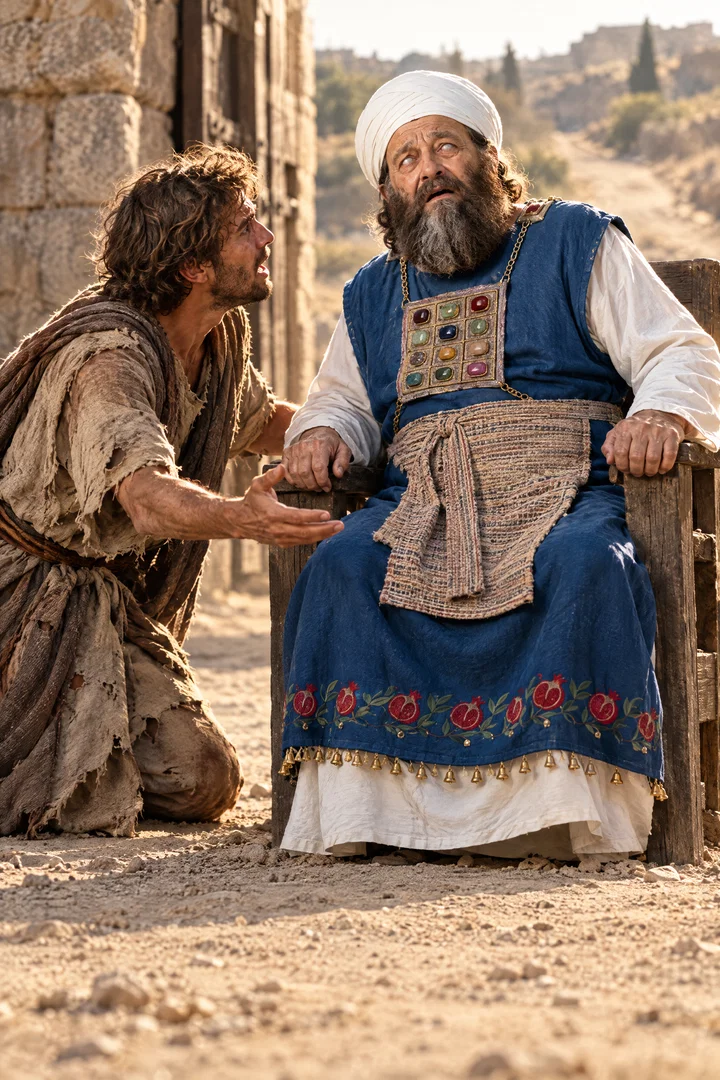
And the messenger answered and said, Israel is fled before the Philistines, and there hath been also a great slaughter among the people, and thy two sons also, Hophni and Phinehas, are dead, and the ark of God is taken.
Translations
And the messenger answered and said, Israel is fled before the Philistines, and there has been also a great slaughter among the people, and your two sons also, Hophni and Phinehas, are dead, and the ark of God is taken.
King James Version, KJV Cambridge Paragraph Bible
And the messenger answered and said, Israel is fled before the Philistines, and there hath been also a great slaughter among the people, and thy two sons also, Hophni and Phinehas, are dead, and the ark of God is taken.
And the messenger answered and said, Israel hath fled before the Philistines, and there hath been also a great slaughter among the people, and thy two sons also, Hophni and Phinehas, are dead, and the ark of God is taken.
Revised Version, American Standard Version
And he that brought the tidings answered and said, Israel is fled before the Philistines, and there hath been also a great slaughter among the people, and thy two sons also, Hophni and Phinehas, are dead, and the ark of God is taken.
And he who is bearing tidings answereth and saith, 'Israel hath fled before the Philistines, and also a great slaughter hath been among the people, and also thy two sons have died — Hophni and Phinehas — and the ark of God hath been captured.'
And the messenger answered and said, Israel has fled before the Philistines, and there has been also a great slaughter among the people, and thy two sons also, Hophni and Phinehas, are dead, and the ark of God is taken.
And the bearer of tidings answered, and said—Israel hath fled before the Philistines, Moreover also, a great smiting, hath taken place among the people,—Moreover also, thy two sons, are slain, Hophni and Phinehas, And, the ark of God, is taken.
Berean Standard Bible, Majority Standard Bible
The messenger answered, “ Israel has fled before the Philistines, and there has been a great slaughter among the people. Your two sons, Hophni and Phinehas, are both dead, and the ark of God has been captured.”
He who brought the news answered, “ Israel has fled before the Philistines, and there has been also a great slaughter among the people. Your two sons also, Hophni and Phinehas, are dead, and God’s ark has been captured.”
And the man said, Israel went in flight from the Philistines, and there has been great destruction among the people, and your two sons, Hophni and Phinehas, are dead, and the ark of God has been taken.
Then the messenger answered and sayd, Israel is fled before the Philistims, and there hath bene also a great slaughter among the people: and moreouer thy two sonnes, Hophni and Phinehas are dead, and the Arke of God is taken.
Douay-Rheims (Challoner revision)
And he that brought the news answered, and said: Israel has fled before the Philistines, and there has been a great slaughter of the people: moreover thy two sons, Ophni and Phinees, are dead: and the ark of God is taken.
Pictures
Cross-references 20 of 25
- 1 Samuel 3:13
For I have told him that I will judge his house for ever for the iniquity which he knoweth; because his sons made themselves vile, and he restrained them not.
Eli’s failure to restrain his sons brings judgment on his house, fulfilled in their deaths.
- 1 Samuel 5
And the Philistines took the ark of God, and brought it from Eben-ezer unto Ashdod.
The captured ark brought Dagon down and brought plagues on the Philistines.
- 1 Samuel 2:12-17
Now the sons of Eli were sons of Belial; they knew not the LORD.
Describes Hophni and Phinehas’s misconduct and Eli’s failure to restrain them.
- 1 Samuel 4:11
And the ark of God was taken; and the two sons of Eli, Hophni and Phinehas, were slain.
Reports the deaths of Eli’s sons and the capture of the ark.
- 1 Samuel 4:22
And she said, The glory is departed from Israel: for the ark of God is taken.
The ark’s capture is named as the departure of Israel’s glory.
- Jeremiah 26:6
Then will I make this house like Shiloh, and will make this city a curse to all the nations of the earth.
Shiloh’s defeat is held up as a warning of judgment against Jerusalem.
- 1 Samuel 2:34
And this shall be a sign unto thee, that shall come upon thy two sons, on Hophni and Phinehas; in one day they shall die both of them.
The foretold death of Eli’s two sons occurs in one day.
- 1 Samuel 6:19
And he smote the men of Beth-shemesh, because they had looked into the ark of the LORD, even he smote of the people fifty thousand and threescore and ten men: and the people lamented, because the LORD had smitten many of the people with a great slaughter.
Beth-shemesh suffers a great slaughter after people look into the ark.
- 1 Samuel 2:22-25
Now Eli was very old, and heard all that his sons did unto all Israel; and how they lay with the women that assembled at the door of the tabernacle of the congregation.
The sons’ sins and Eli’s weak rebuke precede their deaths.
- 1 Samuel 4:10
And the Philistines fought, and Israel was smitten, and they fled every man into his tent: and there was a very great slaughter; for there fell of Israel thirty thousand footmen.
Both describe Israel’s defeat and the great slaughter.
- Jeremiah 7:14
Therefore will I do unto this house, which is called by my name, wherein ye trust, and unto the place which I gave to you and to your fathers, as I have done to Shiloh.
God says he will treat the temple as he treated Shiloh.
- Joshua 3:14-17
And it came to pass, when the people removed from their tents, to pass over Jordan, and the priests bearing the ark of the covenant before the people;
The ark accompanies Israel’s passage through the Jordan, contrasting with its capture in defeat.
- 1 Samuel 5:6-12
But the hand of the LORD was heavy upon them of Ashdod, and he destroyed them, and smote them with emerods, even Ashdod and the coasts thereof.
Philistine cities suffer disaster while holding the captured ark.
- Psalms 78:60-62
So that he forsook the tabernacle of Shiloh, the tent which he placed among men;
Both describe God forsaking Shiloh and giving the ark to the enemy.
- 1 Samuel 4:13
And when he came, lo, Eli sat upon a seat by the wayside watching: for his heart trembled for the ark of God. And when the man came into the city, and told it, all the city cried out.
Eli waited trembling for news of the ark
- 1 Samuel 7:1
And the men of Kirjath-jearim came, and fetched up the ark of the LORD, and brought it into the house of Abinadab in the hill, and sanctified Eleazar his son to keep the ark of the LORD.
The ark is taken to Kirjath-jearim and kept in Abinadab’s house.
- 1 Samuel 3:14
And therefore I have sworn unto the house of Eli, that the iniquity of Eli’s house shall not be purged with sacrifice nor offering for ever.
Eli’s house faces judgment that sacrifice cannot purge.
- 1 Samuel 4:2
And the Philistines put themselves in array against Israel: and when they joined battle, Israel was smitten before the Philistines: and they slew of the army in the field about four thousand men.
The first slaughter of four thousand preceded the ark being fetched.
- Revelation 11:19
And the temple of God was opened in heaven, and there was seen in his temple the ark of his testament: and there were lightnings, and voices, and thunderings, and an earthquake, and great hail.
Both texts refer to the ark of God’s covenant.
- 2 Samuel 6:7
And the anger of the LORD was kindled against Uzzah; and God smote him there for his error; and there he died by the ark of God.
Uzzah dies after touching the ark, as the ark’s presence brings judgment.
Commentary
Each commentary is drawn from primary sources: the writings of Ellen G. White and Adventist pioneers and periodicals. Each commentary is separate. Its own words are not a quotation; follow the references to read the source passages.
Ellen G. White
14 sources
The messenger brought Eli word that Israel had fled before the Philistines with thirty thousand slain, that his two sons Hophni and Phinehas were dead in battle, and that the ark of God had been taken by the enemy.ST Dec 22, 18811SP 404.1–2 The capture of the ark was the greatest calamity that could befall Israel, for the ark was the symbol of God's presence and boasted strength, so its loss meant His presence had withdrawn and the glory had departed from Israel.ST Dec 22, 18811SP 404.1–2 Eli bore the death of his sons with a degree of calmness as what he had reason to expect, but the tidings of the ark filled him with anguish until he wavered, fell backward, and died.PP 585.1–3SG4 106.2–34T 516.1–2 The disaster came because Eli failed to restrain his wicked sons but indulged them and excused their sin, thus sharing their guilt, while Israel vainly trusted the presence of the ark to secure victory while profaning the commandments contained in it.1SP 404.1–2SG4 106.2–3ST Feb 12, 18804T 516.1–2PK 415.3–416.1 The overthrow therefore warns parents and those in responsible positions that God condemns negligence that dallies with sin, holds them accountable for the faults of those under their charge, and will visit retribution for indulgence that leaves evil uncorrected.ST Feb 12, 18804T 383.14T 199.3–200.1ST Nov 24, 18811T 234.2–235.2
The Ark Taken
A runner from the army came to Shiloh to Eli, who was sitting by the wayside watching with a trembling heart because he feared the ark of God would be taken and polluted by the Philistines.SG4 106.2–3
His report was that Israel had fled before the Philistines, that there had been a great slaughter among the people with thirty thousand slain, that his two sons Hophni and Phinehas were dead in battle, and that the ark of God had been taken by the enemy.ST Dec 22, 18811SP 404.1–2SG4 106.2–3ST Feb 12, 1880
The defeat, the loss of life, the deaths of Hophni and Phinehas, and the capture of the ark together made up the calamity that fell that day.ST Dec 22, 18811SP 404.1–2PP 585.1–34T 166.1–2
The taking of the ark was the greatest calamity that could befall Israel and the most grievous news to Eli.ST Dec 22, 18811SP 404.1–2PP 585.1–3SG4 106.2–3
The ark was the symbol of God's presence and their boasted strength and confidence, so its capture meant that God's presence had withdrawn from Israel.ST Dec 22, 18811SP 404.1–2PP 585.1–3SG4 106.2–3
For that reason the dying wife of Phinehas named her child Ichabod, on the ground that the glory had departed from Israel.SG4 106.2–3
Eli knew that his neglect to restrain wrongdoing had deprived Israel of its strength and glory.4T 516.1–2
News that Hophni and Phinehas were slain Eli could bear with a degree of calmness, because he had reason to expect it.SG4 106.2–3
But the final words, that the ark of God was taken, filled him with anguish.PP 585.1–3SG4 106.2–34T 516.1–2
At that word he wavered upon his seat, fell backward, and died.PP 585.1–3SG4 106.2–3ST Nov 24, 1881Ms 187, 1907, par. 17–19
So the loss of the ark was the word he could not bear, and with it came the death of his sons, his own death, and the slaying of thirty thousand.4T 516.1–24T 166.1–2ST Nov 24, 1881
Sin That Invited Defeat
The disaster fell because Eli failed to rule his own house and restrain his children, passing lightly over the iniquity of his sons while they occupied sacred offices and neglecting in a loose and slack manner to reprove and restrain them.SG4 106.2–3ST Feb 12, 18804T 166.1–24T 199.3–200.11T 234.2–235.2 He only remonstrated with them and answered the divine warning with submission instead of taking prompt measures himself to put their evil away from Israel, and had he been aroused to the full guilt of his neglect and acted at once, Israel might have been saved from the humiliation of defeat and the ark would not have fallen into the enemy's hands.4T 516.1–24T 199.3–200.1 His neglect to restrain wrongdoing deprived Israel of its strength and glory, and the fleeing of Israel, the great slaughter with thirty thousand slain, the death of Hophni and Phinehas, the taking of the ark of God, and the loss of Eli's own life all came for that reason.ST Feb 12, 18804T 516.1–24T 166.1–2ST Nov 24, 1881 That indulgence of wickedness brought ruin on his family and grave disaster on Israel.4T 383.1ST Nov 24, 1881
It sprang from blind and foolish fondness and undue affection by which he indulged and petted his sons and let them hold the reins and rule before they were able to walk.4T 383.1ST Nov 24, 1881 He treated the sins of his own sons as less offensive than the sins of others, being quick to see and rebuke the sins of the people, even reproving Hannah unjustly, yet ever ready to find excuses for the perverse course of Hophni and Phinehas.ST Nov 24, 1881 That partiality which passes over in one's own children what would be severely censured in others is unjust and unchristian, leaving faults uncorrected to grow and strengthen until they become second nature.ST Nov 24, 1881
Hophni and Phinehas were wicked, ungodly and corrupt, a proverb of reproach whose corrupting influence disgusted unbelievers and brought reproach upon God's cause.SG4 106.2–31T 234.2–235.2 Their evil and sin were greatly heightened because as sons of the high priest they were connected with the work of God.ST Nov 24, 1881 To just the extent Eli permitted or excused sin in his children he became a partaker in their guilt and shared the wrath that came upon his sons, being guilty in great measure of their transgressions by criminally neglecting to restrain them.SG4 106.2–3ST Nov 24, 1881
Eli himself understood the capture of the ark as the result of his sin, which had dishonored God and deprived Israel of its strength and glory and marked God's withdrawal of His presence from Israel.ST Dec 22, 1881PP 585.1–34T 516.1–2 The capture meant that God had withdrawn His presence from Israel.ST Dec 22, 1881 Israel had wrongly trusted that the presence of the ark would secure victory despite sinful practices, but trusting in the ark while profaning the commandments contained in it was vain.1SP 404.1–2SG4 106.2–3PK 415.3–416.1 God permitted His ark to be taken to humble Israel and to show that the ark, the symbol of His presence and their boasted strength and confidence, was not a guarantee of safety apart from obedience, and that sacred objects and outward religious observance could not shield them from the consequences of uncorrected sin and evils flourishing throughout Israel.1SP 404.1–2SG4 106.2–3PK 415.3–416.1 Sin lightly regarded and allowed to remain in their midst brings fearful retribution, and the fleeing of Israel, the great slaughter, the death of Hophni and Phinehas, the taking of the ark, and the loss of Eli's own life all came for that reason.ST Feb 12, 18804T 166.1–2
Warning to Parents and Leaders
The calamity that fell because sin was lightly regarded and allowed to remain in the midst adjures men holding responsible positions in the church of God faithfully to remove the wrongs that dishonor the cause of truth.ST Feb 12, 18804T 166.1–2 The fleeing of Israel before the Philistines, the great slaughter with thirty thousand slain, the death of Hophni and Phinehas, the taking of the ark of God, and the loss of Eli's own life all came because Eli passed lightly over the iniquity of his sons while they occupied sacred offices and neglected to reprove and restrain them.ST Feb 12, 18804T 166.1–2 That overthrow connected with Shiloh was well understood by the people in Jeremiah's day when they were warned that their house would be made like Shiloh.4T 166.1–2
The slaughter, the death of Hophni and Phinehas, and the loss of the ark show that God condemns negligence that dallies with sin and crime and holds parents accountable in great degree for the faults and follies of their offspring.4T 199.3–200.1 He visited His curse not only on the sons of Eli but on Eli himself as a warning to parents, for Eli only remonstrated with his sons and answered God's warning with submission instead of taking prompt measures himself to put their evil away from Israel.4T 199.3–200.11T 234.2–235.2 If he had been aroused to the full guilt of his neglect and acted at once, Israel might have been saved from the humiliation of defeat and the ark would not have fallen into the enemy's hands.4T 199.3–200.1 His failure to rule well his own house and restrain his children in a loose and slack manner brought the judgment of defeat before the Philistines, great slaughter among the people, the death of both sons, and the taking of the ark of God.ST Nov 24, 18811T 234.2–235.2 Hophni and Phinehas were wicked, ungodly and corrupt, a proverb of reproach whose corrupting influence disgusted unbelievers and brought reproach upon God's cause, and Eli's indulgence of their wickedness brought ruin on his family and grave disaster on Israel.ST Nov 24, 18811T 234.2–235.2
The retribution that fell on Eli for blind and foolish fondness falls on parents who follow his pernicious example.4T 383.1 He surrendered to his children, indulged and petted them, and let them hold the reins and rule before they were able to walk.4T 383.1 Such indulgence teaches men and women who accept indulgent parents as teachers from God to indulge their own children, and will be shown at the Judgment to have resulted in the loss of scores of children.4T 383.1 It closes the gates of heaven before the indulged child so that with present habits and disposition she will never see the kingdom of God, and it puts the parents' own salvation in danger, for they will reap what they sow.4T 383.1 The defeat of Israel, the death of Hophni and Phinehas, the capture of the ark, and Eli's falling backward and dying when he heard the news therefore warn parents to carry out their responsibility to educate, restrain and guide their children.ST Nov 24, 1881Ms 187, 1907, par. 17–19
The account exposes natural parental partiality that passes over in one's own children what would be severely censured in others as unjust and unchristian.ST Nov 24, 1881 Eli treated the sins of his own sons as less offensive than the sins of others, for he was quick to see and rebuke the sins of the people, even reproving Hannah unjustly, but from undue affection was ever ready to find excuses for the perverse course of Hophni and Phinehas.ST Nov 24, 1881 That indulgence dishonored God and misled the people, and to just the extent he permitted or excused sin in his children he became a partaker in their guilt.ST Nov 24, 1881 Leaving faults uncorrected lets them grow and strengthen until they become second nature.ST Nov 24, 1881 Their evil and sin were greatly heightened because as sons of the high priest they were connected with the work of God, and the evil is tenfold greater when those who stand in Christ's stead to instruct the people fail to control their own households and by wrong example sanction the growth of evil instead of repressing it.ST Nov 24, 1881
Sources
Pioneers and periodicals
35 sources
The messenger brought four crushing facts from the battlefield, that Israel had fled before the Philistines, that a great slaughter had fallen on the people, that Hophni and Phinehas were dead, and that the ark of God was taken.ST Dec 22, 1881ST Jul 8, 1889ST Apr 8, 1913 To aged Eli waiting trembling for its safety, the taking of the ark was the heaviest tidings of all, nearer his heart than the defeat or even his sons' fate, and at its mention he fell backward from his seat and died broken-hearted.ST Dec 22, 1881ST Apr 8, 1913RH Apr 21, 1851ST Apr 8, 1889 Israel had fetched the ark into battle by unrighteous priests and shouted as if its physical presence guaranteed victory, while breaking the law shut up within it and forgetting pure righteousness.ST Aug 13, 1902RH Apr 21, 1851ST Jun 30, 1898RH Aug 3, 1869ST Dec 3, 1902 An outward holy symbol gives no strength when the heart has left God, so the ark had become a mere charm and idol, and God withdrew His presence and gave His people over to their enemies because their sins cut them off from His strength.ST Dec 22, 1881ST Aug 13, 1902ST Jun 26, 1884ST Jun 30, 1898RH Apr 20, 1876 In this the sworn judgment on Eli's house was fulfilled forever, because he knew his sons made themselves vile in greed and corruption and from undue affection restrained them not, becoming a partaker in their guilt.ST Feb 12, 1880ST Nov 24, 1881ST Nov 24, 1881RH Mar 19, 1872RH Jul 16, 1857 It was the first time the ark was ever taken, taken only when surrounded by earthly arms, yet once captive its own sanctity vindicated it and laid Dagon prostrate, showing sacred truth gains nothing from human power and warning parents and leaders today that excused sin will bring the same retribution.ST Jul 8, 1889ST Apr 8, 1913ST Jan 23, 1907ST Feb 22, 1910
The Messenger's Report
The messenger's report summed the disaster in four facts: Israel had fled before the Philistines, a great slaughter had fallen among the people, Hophni and Phinehas were dead, and the ark of God was taken.ST Dec 22, 1881ST Jul 8, 1889ST Apr 8, 1913RH Apr 21, 1851 The defeat was a humiliating rout in which many Israelites were killed, the two sons of Eli perished, and the sacred ark was captured by the enemy.ST Dec 22, 1881ST Jul 8, 1889ST Apr 8, 1913ST Apr 8, 1913 The wrongdoing of a few had thus brought suffering on the whole community, with thousands slain and Eli's household cut off.ST Jul 8, 1889 The capture exposed Israel's low spiritual condition and the corruption of its priests, whose greed and heathen practices had made the people abhor God's service.ST Apr 8, 1913
The report was brought hastily from the battle to aged Eli as he sat waiting with a heart trembling for the ark of God.RH Aug 28, 1856 It came in four brief sentences: Israel fled before the Philistines, a great slaughter fell on the people, his two sons Hophni and Phinehas died, and the ark of God was taken.RH Aug 28, 1856 The vessel is called the Ark of God, a name showing it was the most important vessel of the sanctuary and pointing to its exalted place.ST It was a chest in which God's constitution, the ten commandments, was shut up and guarded with the utmost care.RH Jul 8, 1852 That ark was God's testament and His glory given into the Philistines' hands when He forsook His habitation at Shiloh.RH Jan 6, 1853
The taking of the ark was the most grievous and heaviest tidings to Eli.ST Dec 22, 1881RH Apr 21, 1851ST Apr 8, 1889RH Aug 28, 1856RH Apr 20, 1876 Though dulled to his sons' sins, he bore the first three losses with comparative composure, because his deepest care was for the ark.ST Apr 8, 1889RH Aug 28, 1856RH Apr 20, 1876 It lay nearer his heart than even the welfare of Israel or the fate of his sons, so that anxiety for it made him overlook the other calamities.RH Aug 28, 1856 He saw its capture as a sign that his own sin had dishonored God and caused God to withdraw His presence from Israel, and he knew the glory had departed from Israel.ST Dec 22, 1881RH Apr 21, 1851RH Apr 20, 1876 The final word about the ark was the bitter dregs of the tale that blasted his hope, realized his worst fear, and broke his strength under the accumulated weight.RH Aug 28, 1856
At the mention of the ark being taken he fell backward from his seat by the gate, broke his neck, and died.ST Apr 8, 1913ST Apr 8, 1889ST Dec 3, 1902RH Aug 28, 1856 His reign ended with that defeat and slaughter, and these events hastened his death and cut off his house from its place as a ruling family.ST Dec 3, 1902 He died broken-hearted, finding his own grave in his country's general calamity.RH Aug 28, 1856ST Aug 24, 1904
Historical Setting and Aftermath
The disaster was the battle of Eben-ezer, where Israel fled before the Philistines with great slaughter and thirty thousand footmen fell and thirty thousand were slain.ST Feb 12, 1880RH Apr 21, 1851RH Aug 28, 1856 God forsook His habitation at Shiloh because of the gross wickedness of priests and people, giving His glory, the ark of His testament, into the hands of the Philistines.RH Jan 6, 1853 After the ark was taken from the tabernacle at Shiloh, His glory never returned to that building.RH Jan 6, 1853
Eli's reign ended with this defeat by the Philistines, and the slaughter, the deaths of his two sons, and the capture of the ark hastened his own death.ST Dec 3, 1902 The disaster was the foretold judgment against Eli's house, for after his sons presumptuously bore the ark into battle as a guarantee of victory the Lord permitted the Philistines to take it, Eli died at the news, and his house lost its place as a ruling family.ST Apr 6, 1888ST Dec 3, 1902 After God had long given time to repent, failure to do so brought death in one day and loss of the priesthood, making the fallen house contemptible before the people it had oppressed.ST Apr 6, 1888
The capture meant the glory had departed from Israel, lamented because the ark was taken.RH Apr 21, 1851RH Aug 28, 1856 That true condition is written in the word Ichabod, meaning the glory is departed.ST Jun 30, 1898ST Mar 11, 1897 Ichabod was the name given to Phinehas's orphaned son to memorialize the nation's shame and the departure of its glory.ST Mar 11, 1897
The defeat and the ark's capture revealed the collapse of Israel's corrupt religious and civic leadership.ST Mar 11, 1897 This darkest hour came just before deliverance.ST Mar 11, 1897 The account belongs to Israel's apostasy in Samuel's day, and Israel was later restored through the ministry of Samuel the prophet.ST Mar 11, 1897
Hophni and Phinehas were corrupt priests who did not know the Lord. Their greed and heathen practices helped make the people abhor God's service, marking Israel's profound humiliation and revealing the consequences of its low spiritual condition and the corruption of its priests.ST Apr 8, 1913 Their fall also shows how the Levitical priesthood had become a strong warrior caste, for the daily work of slaughtering sacrificial victims with steady aim and strong arm to give the fatal stroke and standing in blood made priest and butcher almost identical and hardened priests until they were nerved to shed the blood of a human enemy, so that priestly work was regarded as a coarse and altogether human occupation.RH Dec 29, 1910
Why Israel Was Defeated
Israel had the tables of the law and the ark in its possession, yet failed to keep the law it carried, violating the seventh commandment and thus one of the ten immutable precepts shut up within it, so that the ark was not its strength at that time.ST Aug 13, 1902RH Apr 21, 1851ST Jun 26, 1884 When Israel obeyed the ten commandments it was victorious, but when it violated them it was smitten, for possessing the sacred law cannot protect a people who are breaking that law.RH Apr 21, 1851ST Jun 26, 1884 God withdrew His protection because He does not serve with sin.ST Aug 13, 1902
The elders fetched the ark from Shiloh and carried it into battle by unrighteous priests, trusting its mere physical presence and raising a shout as if it guaranteed victory, even though Israel had forgotten pure righteousness and God's presence in the life.ST Jun 30, 1898ST Dec 3, 1902ST Aug 21, 1884 Hophni and Phinehas presumptuously brought it forward and may have trusted their priestly office and its presence for safety, treating it irreverently as a means to secure victory.RH Aug 3, 1869ST Dec 3, 1902ST Aug 21, 1884 Possessing the sacred law therefore did not shield deliberate sin against God's law from judgment.RH Aug 3, 1869ST Aug 21, 1884
An outward holy symbol gives no strength or benefit when the heart has left God and God is not enshrined within.ST Jun 26, 1884ST Jun 30, 1898 The ark had thus become a charm, an idol and a fetish instead of a symbol of God's presence and power to withstand foes, and formalism was proved a failure.ST Jun 30, 1898 Sacred things brought no benefit while sin had cut the people off from God's strength.ST Jun 26, 1884RH Apr 20, 1876
God departed from Israel because of the wickedness of priests and people, withdrew His presence, gave His glory, the ark of His testament, into the Philistines' hands, and gave Israel over to its enemies.RH Jan 6, 1853RH Apr 20, 1876 He would no longer fight for a people who would not live according to His will, until they learned they could not remain His chosen people without doing so. After the ark was taken from the tabernacle at Shiloh His glory never returned to that building.RH Jan 6, 1853 Eli felt the capture as the most grievous tidings, a sign that his own sin had dishonored God and caused Him to withdraw His presence from Israel.ST Dec 22, 1881
The disaster shows that the wrongdoing of a few among God's people can bring suffering on the whole community, for Eli's sons perished, thousands of Israelites were slain, and Eli and his household were cut off.ST Jul 8, 1889 Sin must therefore not be excused or covered up even when the transgressors are friends, lest sharing in their wrongdoing bring its retribution.ST Jul 8, 1889 The humiliation of defeat, slaughter, the death of Hophni and Phinehas, and the capture of the ark revealed Israel's low spiritual condition and the corruption of its priests, and marked the consequence of gross wickedness that caused God to forsake His habitation at Shiloh.ST Apr 8, 1913RH Jan 6, 1853
Judgment on Eli's House
The rout, the slaughter, the death of Hophni and Phinehas in battle, and the taking of the ark fulfilled the sworn word to judge Eli's house forever for the iniquity he knew, because his sons made themselves vile and he restrained them not.ST Nov 24, 1881RH Mar 19, 1872RH Jul 16, 1857 The parent is held accountable in great measure for the character and training of children, and the ruin of the family with grave disaster upon Israel shows what follows indulgence of wickedness and neglect of religious instruction and household discipline.ST Nov 24, 1881RH Mar 19, 1872RH May 8, 1856 Since the Lord is the same yesterday, today, and forever, the same judgment awaits the Elis of this nation and priests of the present time whose sons make themselves vile without restraint.RH Mar 19, 1872
Eli passed lightly over the iniquity of sons who occupied sacred offices, neglecting to reprove and restrain them, so that lightly regarded sin allowed to remain brought retribution in Israel's flight, great slaughter with thirty thousand slain, the death of Hophni and Phinehas, the capture of the ark, and the loss of his own life.ST Feb 12, 1880 From undue affection and natural parental partiality he was quick to see and rebuke the sins of others, even reproving Hannah unjustly, yet ever ready to find excuses for the perverse course of his own sons.ST Nov 24, 1881 He only asked why they acted wickedly and pleaded with them, without taking hold to restrain them decidedly lest there be trouble and feelings hurt, while they brought the worship of the sanctuary into contempt and cast an influence to ruin souls eternally.RH Jul 22, 1873 Men holding responsible positions in the church of God are thereby adjured faithfully to remove the wrongs that dishonor the cause of truth, for God holds to account those who are weak in dealing with sin in family and church and will require it in the day of Judgment.ST Feb 12, 1880RH Jul 22, 1873
To just the extent he permitted or excused sin in his children he became a partaker in their guilt, and sharing in wrongdoing brings its consequences even when the transgressors are friends or children.ST Nov 24, 1881ST Jul 8, 1889 Their evil was greatly heightened because as sons of the high priest they were connected with the work of God, dishonoring Him and misleading the people, and the evil is tenfold greater when those who stand in Christ's stead to instruct the people fail to control their own households and by wrong example sanction the growth of evil instead of repressing it.ST Nov 24, 1881 Faults passed over in one's own children that would be severely censured in others are unjust and unchristian, left uncorrected to grow and strengthen until they become second nature.ST Nov 24, 1881 The wrongdoing of a few among God's people can thus bring suffering on the whole community, with thousands slain and Eli and his household cut off, warning against excusing or covering up sin.ST Jul 8, 1889
Hophni and Phinehas may have trusted their priestly office and the ark's presence for safety, but deliberate sins against God's law did not shield them from judgment.RH Aug 3, 1869 Their deaths were an act of divine justice, for their crimes polluted the Lord's worship and corrupted the people.ST Jun 22, 1882 Their wicked conduct also led others into discouragement and sin, and Eli died heartbroken over their fate.ST Aug 24, 1904
God had long given Eli and his sons time to repent and sent repeated warnings and reproof about failure to restrain them, but persistence in wickedness and refusal to heed brought the sentence into execution in their deaths in one day and the loss of the priesthood by Eli's family.ST Apr 6, 1888ST Jul 8, 1889 Their downfall made them contemptible before the people they had oppressed.ST Apr 6, 1888 Continued willful sin can bring a point at which mercy is withdrawn and the threatened punishment cannot be escaped.ST Jul 8, 1889
The capture of the ark was the most grievous tidings to Eli, for he saw in it the sign that his own sin had dishonored God and caused God to withdraw His presence from Israel.ST Dec 22, 1881
The Ark Without Earthly Defense
It was the first time the ark of God was ever taken.ST Jan 23, 1907 It was taken only when surrounded by the arms of earthly defenders, because Israel trusted human military power to protect what was holy.ST Jan 23, 1907ST Feb 22, 1910 The capture after Israel's defeat by the Philistines illustrates that sacred things do not gain true security from worldly force.ST Jan 23, 1907ST Feb 22, 1910
Once taken into captivity its own sanctity and holiness were sufficient to vindicate it from insult.ST Jan 23, 1907ST Feb 22, 1910 God preserved the ark's sacredness even while it was held by Israel's enemies in their severe humiliation of Israel's flight, great slaughter, and death of Hophni and Phinehas.ST Apr 8, 1913ST Jan 23, 1907ST Feb 22, 1910 Its own holiness was enough to protect it from insult and to lay Dagon prostrate on the threshold of his own temple, overthrowing its enemies' idol.ST Jan 23, 1907ST Feb 22, 1910
Sacred truth gains no added dignity or strength from being joined to earthly power and made part and parcel of the common law.ST Jan 23, 1907ST Feb 22, 1910 Its real security lies in its own sanctity, in its benevolent morality, its adaptation to the human heart and to every intellect, its consolation to the house of mourning, and its light on the mystery of the grave.ST Jan 23, 1907 No dignity or strength is added to Christianity by earthly power or by being part of the common law, but its security is found in that benevolent morality, adaptation to heart and intellect, consolation in mourning, and light on the grave.ST Jan 23, 1907ST Feb 22, 1910
The ark was a kind of chest in which God's constitution, the ten commandments, was shut up and guarded with the utmost care, taken by the Philistines in consequence of the sin of God's people.RH Jul 8, 1852 As the Philistines took the earthly ark and then became anxious to get rid of it, so enemies of God's unabolished constitution now shut up and guarded in the heaven of heavens would take it if they were able and would be as anxious to get rid of it.RH Jul 8, 1852 The ark is an essential part of the sanctuary, so its history must be followed even while separated from the tabernacle after its capture at the battle of Eben-ezer, when Israel lamented that the glory had departed from Israel because the ark was taken.RH Aug 28, 1856
Warning for Home and Church
The messenger's report of flight, slaughter, the death of Hophni and Phinehas, and the taking of the ark is the fulfillment of God's sworn word to judge Eli's house forever for iniquity he knew, when his sons made themselves vile and he restrained them not.RH Mar 19, 1872 The parent is held accountable in great measure for the character and training of children, and must restrain and religiously instruct them in youth.RH Mar 19, 1872RH May 8, 1856 That instruction requires effective parental discipline and household worship and parental authority, for neglect of religious discipline leaves sons unrestrained to rebellion and ruin.ST Nov 12, 1912RH May 8, 1856 Their wrongdoing began when they were young and was allowed to grow without effective correction, until habits formed in childhood could not be undone by later protests.ST Nov 12, 1912 Eli's indulgence of wickedness brought ruin on his family and grave disaster on Israel, with defeat, many dead, the two sons killed, the ark captured, and Eli himself dead.ST Nov 24, 1881 When God's commandments are not kept by parents and children, the threatened cutting off comes to pass in defeat before enemies, death of sons, and loss of the ark.RH Jun 23, 1853
The Lord is the same yesterday, today, and forever, and He will judge the Elis of this nation as He judged Eli of old, even among priests of the present time whose sons make themselves vile without restraint.RH Mar 19, 1872 The ruin came because Eli was weak in dealing with sin in the family, only asking his sons why they acted wickedly and pleading with them instead of taking hold and decidedly restraining them, lest there be trouble and feelings hurt.RH Jul 22, 1873 While he so spared them, he let them bring the worship of the sanctuary into contempt and cast an influence that would ruin souls eternally, and God held him to account for not doing more.RH Jul 22, 1873 Sin in the family relation is just as hateful today, and those who like Eli pass over sin in churches and households will have to give account in the day of Judgment.RH Jul 22, 1873
Sin must not be excused or covered up even when the transgressors are friends or children, for sharing in wrongdoing brings its consequences upon the whole community.ST Jul 8, 1889 The fleeing of Israel, the great slaughter with thirty thousand slain, the death of Hophni and Phinehas, the taking of the ark, and the loss of Eli's own life all came because sin was lightly regarded and allowed to remain in the midst.ST Feb 12, 1880 Eli passed lightly over the iniquity of sons who occupied sacred offices and neglected to reprove and restrain them, and that lightly regarded sin brought fearful calamity and retribution.ST Feb 12, 1880 Men holding responsible positions in the church of God must therefore faithfully remove the wrongs that dishonor the cause of truth, lest by sharing in wrongdoing they share its retribution and ruin.ST Feb 12, 1880ST Jul 8, 1889 The disaster shows that the wrongdoing of a few among God's people can bring suffering on all, with sons perishing, thousands slain, and Eli and his household cut off.ST Jul 8, 1889
Failure to keep God's commandments by parents and children brings the threatened cutting off to pass, with ruin on the family and grave disaster on the people.ST Nov 24, 1881RH Jun 23, 1853 Eli failed to restrain Hophni and Phinehas, and Israel was defeated before the Philistines, the two sons died, and the ark of God was taken.RH Jun 23, 1853 That indulgence brought ruin on his family and grave disaster on Israel in defeat, death, capture, and his own death.ST Nov 24, 1881 The fate of Hophni and Phinehas dying in battle, the ark taken, and Eli dying broken-hearted after hearing the news illustrates the danger of neglecting parental authority and household religious discipline.RH May 8, 1856
The evil is tenfold greater when those who stand in Christ's stead to instruct the people fail to control their own households and by wrong example sanction the growth of evil instead of repressing it.ST Nov 24, 1881 Eli treated the sins of his own sons as less offensive than the sins of others, being quick to see and rebuke the sins of the people, even reproving Hannah unjustly, while from undue affection ever ready to find excuses for the perverse course of Hophni and Phinehas.ST Nov 24, 1881 That indulgence dishonored God and misled the people, and to just the extent he permitted or excused sin in his children he became a partaker in their guilt.ST Nov 24, 1881 Their evil and sin were greatly heightened because as sons of the high priest they were connected with the work of God.ST Nov 24, 1881 Such natural parental partiality, passing over in one's own children what would be severely censured in others, is unjust and unchristian, leaving faults uncorrected to grow and strengthen until they become second nature.ST Nov 24, 1881
Sources