1 Samuel 4:11
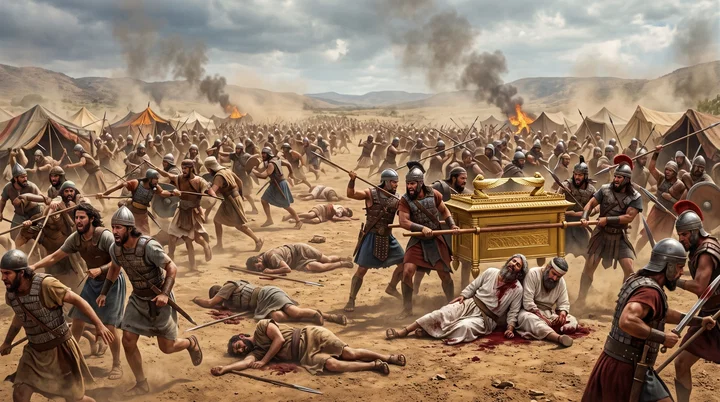
And the ark of God was taken; and the two sons of Eli, Hophni and Phinehas, were slain.
Translations
American King James Version, King James Version, KJV Cambridge Paragraph Bible, Webster Bible, Revised Version, American Standard Version
And the ark of God was taken; and the two sons of Eli, Hophni and Phinehas, were slain.
and the ark of God hath been taken, and the two sons of Eli have died, Hophni and Phinehas.
And the ark of God was taken; and the two sons of Eli, Hophni and Phinehas, died.
And, the ark of God, was taken,—and, the two sons of Eli, were slain, Hophni and Phinehas.
Berean Standard Bible, Majority Standard Bible
The ark of God was captured, and Eli’s two sons, Hophni and Phinehas, died.
God’s ark was taken; and the two sons of Eli, Hophni and Phinehas, were slain.
And the ark of God was taken; and Hophni and Phinehas, the sons of Eli, were put to the sword.
And the Arke of God was taken, and the two sonnes of Eli, Hophni and Phinehas died.
Douay-Rheims (Challoner revision)
And the ark of God was taken: and the two sons of Heli, Ophni and Phinees, were slain.
Pictures
Cross-references 20 of 44
- 1 Samuel 5:3-4
And when they of Ashdod arose early on the morrow, behold, Dagon was fallen upon his face to the earth before the ark of the LORD. And they took Dagon, and set him in his place again.
Dagon falls before the captured ark, displaying God’s power over idols.
- 1 Samuel 3:13
For I have told him that I will judge his house for ever for the iniquity which he knoweth; because his sons made themselves vile, and he restrained them not.
Eli’s failure to restrain his sons brings judgment on his house.
- 1 Samuel 4:18
And it came to pass, when he made mention of the ark of God, that he fell from off the seat backward by the side of the gate, and his neck brake, and he died: for he was an old man, and heavy. And he had judged Israel forty years.
Eli dies after hearing that the ark was captured and his sons were dead.
- 1 Samuel 2:12-17
Now the sons of Eli were sons of Belial; they knew not the LORD.
Eli’s sons corrupt their priestly service and offerings, bringing judgment.
- 1 Samuel 4:21-22
And she named the child I-chabod, saying, The glory is departed from Israel: because the ark of God was taken, and because of her father in law and her husband.
Ichabod names the ark’s capture as the departure of Israel’s glory.
- 1 Samuel 2:34
And this shall be a sign unto thee, that shall come upon thy two sons, on Hophni and Phinehas; in one day they shall die both of them.
The deaths of Hophni and Phinehas fulfill the sign of judgment on Eli’s household.
- Jeremiah 26:6
Then will I make this house like Shiloh, and will make this city a curse to all the nations of the earth.
Shiloh’s defeat warns that disobedience will bring judgment on the temple.
- 1 Samuel 6:7-12
Now therefore make a new cart, and take two milch kine, on which there hath come no yoke, and tie the kine to the cart, and bring their calves home from them:
The Philistines send the captured ark back to Israel on a new cart.
- Exodus 25:16
And thou shalt put into the ark the testimony which I shall give thee.
The ark contained the testimony of God's law.
- Joshua 3:14-17
And it came to pass, when the people removed from their tents, to pass over Jordan, and the priests bearing the ark of the covenant before the people;
The ark led Israel across the Jordan, contrasting with its capture.
- 1 Samuel 2:22-25
Now Eli was very old, and heard all that his sons did unto all Israel; and how they lay with the women that assembled at the door of the tabernacle of the congregation.
Eli’s sons persist in priestly sin despite his reproof, and the LORD judges them.
- Psalms 78:60-61
So that he forsook the tabernacle of Shiloh, the tent which he placed among men;
God forsook Shiloh and delivered his glory into the enemy’s hand.
- Jeremiah 7:14
Therefore will I do unto this house, which is called by my name, wherein ye trust, and unto the place which I gave to you and to your fathers, as I have done to Shiloh.
Shiloh’s destruction warns that Jerusalem’s temple cannot protect the wicked.
- Joshua 6:6-20
And Joshua the son of Nun called the priests, and said unto them, Take up the ark of the covenant, and let seven priests bear seven trumpets of rams’ horns before the ark of the LORD.
Priests carried the ark around Jericho before its conquest.
- 1 Samuel 4:3-4
And when the people were come into the camp, the elders of Israel said, Wherefore hath the LORD smitten us to day before the Philistines? Let us fetch the ark of the covenant of the LORD out of Shiloh unto us, that, when it cometh among us, it may save us out of the hand of our enemies.
Israel brings the ark to battle, trusting it to secure victory.
- 2 Samuel 6:6-7
And when they came to Nachon’s threshingfloor, Uzzah put forth his hand to the ark of God, and took hold of it; for the oxen shook it.
Uzzah is struck after touching the ark during its transport.
- Numbers 14:44-45
But they presumed to go up unto the hill top: nevertheless the ark of the covenant of the LORD, and Moses, departed not out of the camp.
Israel’s earlier defeat without the ark contrasts with false trust in the ark.
- 1 Samuel 4:17
And the messenger answered and said, Israel is fled before the Philistines, and there hath been also a great slaughter among the people, and thy two sons also, Hophni and Phinehas, are dead, and the ark of God is taken.
The messenger reports Israel’s flight and slaughter.
- 1 Samuel 7:1-2
And the men of Kirjath-jearim came, and fetched up the ark of the LORD, and brought it into the house of Abinadab in the hill, and sanctified Eleazar his son to keep the ark of the LORD.
The ark is taken to Kirjath-jearim after its return.
- 1 Samuel 2:30
Wherefore the LORD God of Israel saith, I said indeed that thy house, and the house of thy father, should walk before me for ever: but now the LORD saith, Be it far from me; for them that honour me I will honour, and they that despise me shall be lightly esteemed.
God’s warning of judgment on Eli’s house is fulfilled in his sons’ deaths.
Commentary
Each commentary is drawn from primary sources: the writings of Ellen G. White and Adventist pioneers and periodicals. Each commentary is separate. Its own words are not a quotation; follow the references to read the source passages.
Ellen G. White
33 sources
Israel brought the ark into battle expecting its mere presence to give victory, but was routed with thirty thousand fallen, the ark captured, and Hophni and Phinehas slain while carrying and defending it.1SP 402.3–403.1ST Dec 22, 1881SG4 105.1–2 Eli bore the death of his sons with calmness, but when he heard the ark was taken anguish came upon him and he fell backward and died, and the capture was the greatest calamity that could befall Israel because it removed the symbol of God's presence.1SP 404.1–2ST Jan 12, 18824T 516.1–2GW92 82.3–83.1SG4 106.2–3 The ark had no power to protect apart from God, for Israel revered the emblem itself as a source of salvation and strength while despising the law it contained, and that trust turned worship into formalism and idolatry that gives no protection while sin is cherished.1SP 402.3–403.1ST Jan 12, 1882SG4 105.1–2PP 584.1–2ST Jul 24, 1884 The calamity came because vile priests profaned sacred office and Eli, though loving purity, was too indulgent to reprove or remove his sons, so God took in hand the evil he failed to restrain.PP 581.2–3ST Feb 12, 1880ST Dec 22, 18814T 516.1–2PP 583.3 As Israel thought the ark would save them without repentance, so all who profess to keep God's law while cherishing iniquity flatter themselves that outward regard for sacred things will preserve them from justice, until God withdraws His presence and leaves defeat.4T 166.1–2PK 415.3–416.1ST Jun 1, 18764T 166.3–4Ms 1, 1854, par. 10–15
Battle Loss and Aftermath
After losing four thousand men the elders sent to Shiloh for the ark of the covenant, remembering the crossing of Jordan and the easy conquest of Jericho when the ark was borne before them and expecting its mere presence to give triumph over the Philistines.1SP 402.3–403.1SG4 105.1–2 It was conducted into the camp by the polluted priests Hophni and Phinehas, and its arrival restored Israel's confidence with a great shout.1SP 402.3–403.1ST Dec 22, 1881SG4 105.1–2 The Philistines were frightened, thinking God had come into the camp and remembering how the gods smote the Egyptians with plagues in the wilderness, and they resolved to fight as men rather than become servants to the Hebrews.SG4 105.1–2 Israel was smitten and fled home with thirty thousand footmen fallen, the ark of God was captured, and Eli's two sons were slain while carrying and defending it.1SP 402.3–403.1ST Dec 22, 1881SG4 105.1–2ST Aug 10, 1882
Eli sat by the wayside watching with a trembling heart, afraid the ark would be taken and polluted by the Philistines.SG4 106.2–3 When the messenger told him his two sons were slain he bore it with calmness because he had reason to expect it.4T 516.1–2GW92 82.3–83.1SG4 106.2–3 When he heard the ark of God was taken anguish came upon him and the pallor of death upon his face, and he wavered, fell backward and died.1SP 404.1–24T 516.1–2GW92 82.3–83.1SG4 106.2–3SG4 164.1–2 He knew his sin of neglect in failing to stand for the right and restrain wrong had at last deprived Israel of her strength and glory, and he shared the judgment and wrath of God that came upon his sons.1SP 404.1–24T 516.1–2GW92 82.3–83.1SG4 106.2–3
The capture of the ark was the greatest calamity that could befall Israel, removing the symbol of God's presence and power.1SP 404.1–2SG4 106.2–3PP 584.1–2Ms 122, 1897, par. 16–21 The people had revered it as a sacred sign of God's presence with awe and pride in past victories, and its loss brought terror and despair which military strength could not make up.1SP 404.1–2ST Jan 12, 1882 Phinehas's wife as she was about to die named her child Ichabod, saying the glory is departed from Israel for the ark of God is taken.1SP 404.1–2SG4 106.2–3
The disaster ruined Shiloh and ended the ark's long stay there.RH Nov 9, 1905 Through God's providence the ark was later returned uninjured, kept at Kirjath-jearim for many years, and brought by David to Jerusalem.RH Nov 9, 1905 That defeat occurred on the same field where Israel later won a decisive victory, showing the reversal from disaster to deliverance.PP 591.1
God permitted his ark to be taken to show Israel how vain it was to trust in the ark, their boasted strength and confidence, while profaning the commandments it contained, and he would humble them by removing that sacred ark from them.1SP 404.1–2SG4 106.2–3 The Philistines were instruments to punish Israel's unfaithfulness.ST Jan 12, 1882PP 585.5 Though the capture seemed a triumph for Israel's enemies, God's presence still attended the ark, and he used it to bring terror and judgment on the Philistines for their own transgressions, as his presence had once made it a source of strength, salvation, and glory for his obedient people and now brought terror and destruction to those who broke his holy law.ST Jan 12, 1882PP 585.5
Why Israel Was Defeated
The ark had no power to protect Israel apart from God Himself, for the law kept in the ark and beneath the mercy seat represented God and revealed His presence and will.1SP 402.3–403.1PP 584.1–2ST Dec 22, 1881 That law stood against disobedience and testified to the defeat and death that followed when it was despised.1SP 402.3–403.1ST Dec 22, 1881 Israel showed contempt for its commandments while profaning what the ark contained, and carried the sacred ark into battle by the hands of Hophni and Phinehas while violating that law.1SP 402.3–403.1PP 584.1–2ST Dec 22, 1881 Their sin separated them from God, so He gave them into the hands of the Philistines and would not give victory until they repented and turned from iniquity.1SP 402.3–403.1PP 584.1–2ST Jul 24, 1884 When sin brought His anger the ark was taken and Israel suffered defeat, and its absence explains their spiritual stupor.1SP 402.3–403.1ST Jul 24, 1884Ms 1, 1854, par. 10–15
Israel revered the ark as a sacred sign of God's presence, with awe and pride in past victories such as the crossing of Jordan and the conquest of Jericho, and after losing four thousand men the elders sent to Shiloh for it expecting its mere presence to give triumph.ST Jan 12, 1882SG4 105.1–2PP 584.1–2 They trusted, worshipped, and rashly used the emblem itself as though it were a source of salvation, strength, and glory that could give blessings only God could give.ST Jan 12, 1882SG4 105.1–2PP 584.1–2ST Dec 22, 1881 That reliance reduced worship to formalism, hypocrisy, and idolatry, for Israel's earlier deliverance had come while the people obeyed God and the ark was carried as He commanded, but now they acted against His counsel.PP 584.1–2ST Dec 22, 1881 Outward regard for sacred things gives no protection while sin is cherished, and regard for the ark or the commandments did not prevent the losses that were consequences of refusing to repent of wickedness.PK 415.3–416.14T 166.3–4ST Feb 12, 1880 The ark was a symbol of God's presence, not a guarantee of it, and God's presence had once made it a source of strength, salvation, and glory for His obedient people but now brought no victory to those who broke His holy law.ST Jan 12, 1882ST Dec 22, 1881
The calamity came because sin was lightly regarded and allowed to remain in their midst.ST Feb 12, 18804T 166.1–2ST Jun 1, 1876 Hophni and Phinehas were vile, polluted priests who profaned the house of God while occupying sacred offices and transgressing His law.ST Feb 12, 1880SG4 105.1–24T 516.1–2GW92 82.3–83.1 Professed service to God does not protect from punishment for wrongdoing, and greater knowledge of His will brings greater guilt when it is disregarded.ST Dec 22, 1881PP 583.3 Eli, though pure in morals and loving purity and righteousness, was too indulgent for love of peace and harmony and lacked moral courage to reprove, restrain, rebuke, or remove his sons from trust when they profaned the house of God and became more and more insensible to impurity and crime.ST Feb 12, 18804T 516.1–2GW92 82.3–83.1 By passing lightly over their iniquity, neglecting as a father to reprove and restrain them, and excusing wrongdoing, he shared in great measure in their guilt.ST Feb 12, 18804T 166.1–2PK 415.3–416.1ST Jun 1, 1876 God Himself took in hand the evil he failed to restrain, fulfilling the judgment pronounced on his house in the deaths of his guilty sons in battle, his own death, the taking of the ark, and the slaying of thirty thousand Israelites.PP 581.2–3ST Feb 12, 18804T 516.1–2GW92 82.3–83.14T 166.1–2
Knowing the law or possessing it does not save or transform without full obedience.Ms 3, 1884, par. 5 Eli and the people trusted the ark more than God, and the ark could not save people who were disobeying the law it contained.Ms 3, 1884, par. 5
Warning to Church Today
Jeremiah's warning that God would make His house like Shiloh pointed to this calamity when the Philistines overcame Israel and the ark of God was taken and Hophni and Phinehas were slain.4T 166.1–2ST Jun 1, 1876ST Feb 12, 1880 It came because sin was lightly regarded and allowed to remain among Israel, because Eli passed lightly over the iniquity of his sons who occupied sacred offices and neglected as a father to reprove and restrain them, and with it came the death of Eli himself and the slaying of thirty thousand of the people.ST Feb 12, 18804T 166.1–2ST Jun 1, 1876 Israel in the days of Samuel thought the presence of the ark containing the commandments of God would gain them victory over the Philistines whether or not they repented of their wicked works, expecting its mere presence to gain them victory.ST Jun 1, 18764T 166.3–4 Just so the Jews in Jeremiah's time believed strictly observed and divinely appointed temple services would preserve them from just punishment of their evil course, and outward regard for sacred things gives no protection while sin is cherished.ST Jun 1, 18764T 166.3–4 The same danger rests today on those who profess to be the repository and depositaries of God's law, who flatter themselves that the regard in which they hold the commandments will preserve them from divine justice, and neglect to repent and obey His word will bring as serious consequences now as upon ancient Israel.ST Jun 1, 18764T 166.3–4 There is a limit beyond which He will no longer delay His judgments, correction through His chosen instruments cannot be disregarded with impunity, and the desolation of Jerusalem stands as a solemn warning before modern Israel of what falls on God's house and people when they will not hearken to His law and His prophets.4T 166.1–2ST Jun 1, 18764T 166.3–4
The verse is a lesson and adjuration to men holding responsible positions in the church of God to faithfully remove the wrongs that dishonor the cause of truth.ST Feb 12, 18804T 166.1–2ST Jun 1, 1876 Prompt action by Eli to remove their evil and put away evil could have prevented this humiliation and fearful calamity in which his sons were slain, he himself lost his life, the ark of God was taken from Israel, and thirty thousand Israelites were slain.ST Feb 12, 1880ST Jun 1, 18764T 199.3–200.1 The judgment that followed Eli's failure to restrain his sons, when Hophni and Phinehas were killed and the ark of God was taken by Israel's enemies and fell into enemy hands and was captured, is presented as the consequence of his neglect of parental responsibility to restrain and correct them.1T 118.2–119.24T 199.3–200.1ST Nov 24, 1881 Because they served as the high priest's sons their sins against God's work were especially grave, and by excusing their wrongdoing and passing lightly over their iniquity Eli shared in great measure in their guilt and brought disaster upon himself and Israel and the nation.4T 166.1–2ST Nov 24, 1881 It warns parents who neglect restraint, correction, and responsibility, whose failure brings God's frown, makes corruption a proverb of reproach that disgusts unbelievers and corrupts others, and leaves children allowed to grow in wrongdoing to face punishment in the plagues to come, making their fate a warning to parents.4T 166.1–2ST Jun 1, 18764T 199.3–200.1
The removal of the ark warns that worldliness, idolatry, and false principles taking hold among God's people, and bringing in false principles and disregard of the truths entrusted to them, can cause God to withdraw His prospering hand, presence, and favor.Ms 29a, 1890, par. 2–10Ms 29, 1890, par. 7–10 When Israel's sin brought God's anger the ark was taken and Israel suffered defeat, the capture meant God had removed the symbol of His presence and power and the outward display of His presence, a sign of the loss of God's presence and favor that explains the people's spiritual stupor and their defeat.Ms 1, 1854, par. 10–15Ms 122, 1897, par. 16–21Ms 29, 1890, par. 7–10 Israel had trusted and worshipped the ark instead of the God it represented, and the verse means outward regard for sacred things gives no protection while sin is cherished.4T 166.3–4Ms 122, 1897, par. 16–21 A sin-hating God calls upon all who profess to keep His law and flatter themselves that regard for the commandments will preserve them from justice to depart from all iniquity, to repent and obey, not to refuse to be reproved of evil or charge His servants with being too zealous in putting sin out of the camp.ST Jun 1, 18764T 166.3–4 Corrections given through His chosen instruments cannot be disregarded with impunity, yet faithful people could still approach Him through prayer and communion even in captivity.ST Jun 1, 18764T 166.3–4Ms 122, 1897, par. 16–21
Sources
Pioneers and periodicals
70 sources
The defeat left about thirty thousand footmen dead as Israel fled, the ark was seized by the Philistines, and Hophni and Phinehas were killed while fighting to defend it.ST Jul 8, 1889ST Apr 8, 1913RH Apr 21, 1851ST Apr 8, 1913 By that stroke God forsook His habitation at Shiloh and gave His glory and strength into captivity because of the wickedness of priests and people.RH Jan 6, 1853RH Feb 24, 1910RH Apr 20, 1876RH Aug 28, 1856RH Apr 20, 1876 Possession of the ark could not protect an unfaithful people who broke the covenant it contained, for God withdraws His protection and does not compromise with sin.ST Aug 13, 1902RH Apr 21, 1851ST Jun 26, 1884ST Jun 30, 1898ST Jul 4, 1906 The ark had never been taken until it was surrounded by arms and defended with carnal weapons, showing that reliance on human force to secure what belongs to God brings defeat, while in captivity out of carnal hands its own holiness vindicated it and laid the hostile god prostrate.ST Jan 23, 1907ST Feb 22, 1910 The deaths fulfilled God's word against Eli's house, for he knew his sons made themselves vile and restrained them not, and his weak indulgence shared their guilt and brought disaster on himself and Israel.ST Apr 6, 1888ST Nov 24, 1881RH Mar 19, 1872RH Jul 16, 1857RH May 8, 1856
Battle and Aftermath
The verse records Israel smitten by the Philistines, fleeing every man to his tent, with thirty thousand footmen fallen in that battle, making about thirty-four thousand with the earlier slaughter of the flower of the nation.RH Apr 21, 1851 The defeat followed violation of the covenant the ark contained, for the ark itself could not protect Israel while that law was being broken, and its capture marked the departure of Israel's glory.RH Apr 21, 1851ST Jun 26, 1884 Sin lightly regarded and allowed to remain in the midst brought the fearful calamity, with the sons of Eli slain, the ark taken, Eli himself dead, and thirty thousand Israelites slain.ST Feb 12, 1880ST Jun 1, 1876 Israel thought the presence of the ark containing the commandments would gain victory without repentance, looking to the ark but not to God for rescue, because the message was in the ark and not in the men.ST Jun 1, 1876
In that defeat the ark of God was captured by the Philistines and Eli's two sons, Hophni and Phinehas, were slain while fighting to defend it.ST Dec 22, 1881ST Jul 8, 1889ST Apr 8, 1913 Their deaths with the loss of the sacred object reveal Israel's humiliation and low spiritual condition and the corruption of its priests.ST Apr 8, 1913ST Apr 8, 1913 The suffering spread beyond the direct transgressors, with thousands of Israelites killed and Eli and his household cut off, showing that covering wrongdoing even by friends shares its consequences.ST Jul 8, 1889 Professed service with greater knowledge of God's will brings greater guilt when disregarded, and does not protect deliberate wrongdoers from punishment.ST Dec 22, 1881 The capture signified to Eli that God would no longer fight for Israel and had given them over to enemies until they learned He would not claim them as His special people unless they lived according to His will.
A swift runner carried the news to Shiloh, where ninety-eight-year-old blind Eli fell backward from his seat by the side of the gate when mention was made of the ark of God, broke his neck and died.ST Mar 11, 1897 His heart broke at the taking of the ark with the death of Hophni and Phinehas after Israel had fled with great slaughter, and his house was blotted out as a ruling family.RH Feb 24, 1910ST Dec 3, 1902ST Mar 11, 1897 The Lord permitted the enemy to carry off the ark of the covenant because Hophni and Phinehas presumptuously carried it into battle supposing it would prove an irresistible mascot to win the victory, and the disobedient and presumptuous find no security in the name of the Lord.ST Dec 3, 1902 By this God forsook the tabernacle, delivering His strength into captivity and His glory into the enemy's hand.RH Feb 24, 1910 Their father Eli died heartbroken over what had happened, and the news of defeat, capture, and the killing of his two sons caused his death.ST Aug 21, 1884ST Aug 24, 1904
Phinehas's wife, though she did not survive the shock, divined the true cause of the disaster in saying the glory, or character of God, is departed from Israel. Their true condition was written in the word Ichabod, the glory is departed, a lasting reminder that Israel's glory had departed and of the loss of God's presence.ST Jun 30, 1898ST Jul 4, 1906 Israel had forgotten God and His presence had departed from their lives, forgetting pure righteousness while worshiping the ark as a charm, idol and fetish and holding to the form while losing the fact.ST Jun 30, 1898ST Jul 4, 1906ST Jul 17, 1907 The ark containing the tables of the law under the mercy-seat was a symbol of God's presence and strength to withstand all foes only as long as Israel was faithful, cherishing His law and mercy in their hearts, as when Jordan was stayed and the walls of Jericho fell.ST Jun 30, 1898ST Jul 4, 1906 Its capture marked the loss of that presence, for the ark was only a symbol of God's presence, not a source of salvation apart from the presence it represented.
The defeat happened on the same ground between Mizpeh and Shen where the Ebenezer stone was later set, about twenty years before Israel won a victory over the Philistines on that same field when the people trusted God.ST Jan 26, 1882ST Jul 15, 1889 In that first encounter thirty-four thousand of the flower of the nation were slain and the ark was captured, marking Israel's defeat at Mizpeh when the ark was taken and Eli's sons were killed.ST Jul 15, 1889 The earlier defeat illustrates that transgression leads to disaster and defeat, coming not from any change in the Lord's strength, which is the same at one time as another, but from failure in faith and obedience.ST Jan 26, 1882ST Oct 17, 1895 The contrast shows that relying on human strength leads to defeat, while God can bring victory and deliverance when in right relation to Him, leading people over the same field again until victory is achieved through change of heart when the message was in the men and God was taken into account and wrought for them.ST Jul 15, 1889ST Oct 17, 1895
The captured ark remained in the land of the Philistines seven months, during which at Ashdod their god Dagon fell twice before it, and as it was moved to Gath and then to Ekron both cities were sorely smitten because of its presence, until the lords of the Philistines agreed to send the ark of the God of Israel back to its place lest it slay them and their people.RH Aug 28, 1856 The loss came because of the sins of Eli's household, Shiloh was ruined, and the ark's capture ended its long stay there.RH Nov 9, 1905 The ark was later returned uninjured through God's providence, kept at Kirjath-jearim for many years, and brought by David to Jerusalem.RH Nov 9, 1905
Sanctuary Forsaken at Shiloh
The verse closes more than three hundred years during which the sanctuary rested undisturbed at Shiloh.RH Feb 24, 1910 That stay is reckoned as 303 years, from B.C. 1444 to B.C. 1141, within the longer period of about 450 years of the judges until Samuel the prophet.RH Apr 20, 1876 The ark was not removed from its resting-place until after the call of Samuel the prophet, when backslidden and infatuated Israel carried it out into a disastrous campaign meant to redeem defeat and it fell into Philistine hands.RH Apr 20, 1876 In the days of Eli the high priest it was thus taken from the tabernacle to the battlefield, where the two priests with it, Hophni and Phinehas, were killed, and Eli on hearing the news fell down and died.RH Feb 24, 1910
By this taking God forsook His habitation at Shiloh and forsook the tabernacle, delivering His strength into captivity and His glory into the enemy's hand.RH Feb 24, 1910RH Sep 2, 1852 That glory was the ark of His testament and covenant, the ark of His covenant, given into the hands of the Philistine enemy.RH Jan 6, 1853RH Aug 28, 1856 The cause was the gross wickedness of priests and people and long apostasy, for Israel had sunk toward heathen worship and its priests were adulterous.RH Jan 6, 1853RH Apr 20, 1876RH Aug 28, 1856 Israel's own sins had shorn them of strength so that they were smitten before the Philistines, and then, vainly supposing the ark alone would preserve them when the God of that ark had departed from their midst, they carried the ark of the covenant of the Lord of hosts into battle accompanied by its adulterous priests into a sinful and God-forsaken army.RH Aug 28, 1856 Remembering past victories with it at Jericho and past defeat without it against the Canaanites, they trusted the ark alone to save them, but the ark of itself was no safeguard against enemies when transgression had cut them off from divine strength, and its presence would not hide transgression from the eyes of the Lord nor avert punishment.RH Apr 20, 1876RH Aug 28, 1856
The sanctuary thus forsaken was not the land of Palestine but the curtained tabernacle pitched at Shiloh at the dividing of the land under Joshua, called the house of the Lord and the tabernacle of Shiloh.RH Sep 2, 1852 It was set up there when Israel entered Canaan under Joshua and the land was divided by lot, where Eli officiated as high priest and the youthful Samuel served in the tabernacle.ST Sep 29, 1898 After the ark was taken from the tabernacle at Shiloh, that glory never returned to that building.RH Jan 6, 1853 Carried out from Shiloh to the battle and captured by the Philistines, it was never returned again to Shiloh.ST Sep 29, 1898
What was torn from the tabernacle was the ark with its mercy-seat and cherubim, disarranging Israel's affairs and interrupting the service of the sanctuary for a time, so that the ark and the sanctuary must thereafter be traced separately.RH Aug 28, 1856 The other sacred vessels remained with the tabernacle that afterward stood at Nob and then at Gibeon.RH Jan 6, 1853 Shiloh was ruined by the sins of Eli's household, and there is no evidence that the ark was ever returned to the tabernacle at Shiloh or that God's presence was visibly manifested there again.RH Nov 9, 1905ST Dec 3, 1894 The rash removal of the ark to battle by the sons of Eli and its fall into the hands of the Philistines proves God was not then dwelling between the cherubim of the ark and was not immovably fixed to that position between the cherubim on the ark.RH Jul 27, 1876
Sacred Symbols Cannot Save
Israel's possession of the law and the ark could not protect them while they were unfaithful and breaking the covenant it contained, for God withdrew His protection and gave the people into the Philistines' hands, and He does not compromise with sin so that holy things give no protection to those who disregard their trust.ST Jul 24, 1884ST Feb 12, 1880ST Aug 13, 1902RH Apr 21, 1851ST Jun 26, 1884 In that defeat thirty thousand Israelite footmen fell, the sinful priests Hophni and Phinehas were slain, and the ark of God was taken, marking the departure of Israel's glory.ST Aug 13, 1902RH Apr 21, 1851ST Jun 26, 1884 The rash use of the ark as an emblem of God's presence did not secure God's help when the people refused to repent of wickedness, and when Hophni and Phinehas brought it into the camp possessing the sacred ark did not keep Israel from defeat.ST Jul 24, 1884ST Feb 12, 1880ST Aug 10, 1882 Possessing a sacred object was useless unless God was enthroned in their hearts.ST Jun 26, 1884
The ark containing the tables of the law under the mercy-seat, whose cover was the mercy-seat and which held the Ten Commandments reflecting God's unchangeable will and character, was a symbol of God's presence and strength to withstand all foes only as long as Israel was faithful to God, cherishing His law and mercy in their hearts.ST Jun 30, 1898ST Jul 4, 1906ST Jul 15, 1889 Before that ark Jordan's rolling flood was stayed, and in its presence the strong walls of Jericho were thrown down by God's invisible army while victory was shouted by faith, and Israel's earlier deliverance came while the people obeyed God and the ark was carried as He commanded.ST Dec 22, 1881ST Jun 30, 1898ST Jul 4, 1906 God did not display His power when Israel presumptuously brought the ark into battle while sinning against Him and acting against His counsel, carried by Eli's wicked sons who were doomed to die, but after the Philistines captured it His power was clearly shown against them.ST Dec 22, 1881ST Jul 15, 1889 The law kept beneath the mercy-seat stood against their disobedience and testified to the defeat and death that followed, for obedience to God's will is safe while disobedience brings death and destruction, and the defeat of Dagon before the ark showed that the God whose law it held is the only true God.ST Dec 22, 1881ST Jul 15, 1889
When Israel forgot the principles of pure righteousness and God's presence in the life, the people worshiped the ark itself as a charm, idol, fetish, mascot and source of magical power, holding to the form while losing the fact and looking to the ark but not to God, with the message in the ark and not in the men.ST Jun 30, 1898ST Dec 3, 1902ST Jul 4, 1906ST Jul 17, 1907ST Sep 12, 1900 They trusted that the physical presence of the ark borne by unrighteous priests would insure success and hoped it would get them victory in itself, supposing it would prove irresistible to win the victory, rather than receiving the spiritual truth of God's revelation.ST Jun 30, 1898ST Dec 3, 1902ST Jul 4, 1906ST Sep 12, 1900 The ark was only a symbol of God's presence, not a source of salvation apart from the presence it represented nor a guarantee of it, and religion become merely formal was exposed as powerless by the Philistines' capture.ST Dec 22, 1881ST Sep 12, 1900 Therefore Israel was defeated and the ark was taken and went into captivity, and their true condition was written in the word Ichabod, the glory is departed from Israel.ST Jun 30, 1898ST Jul 4, 1906 Departure from high ideals makes a church or country more devoted to mere symbols, and living principle, not worship of symbols, saves men and nations.ST Jul 17, 1907 The name of the Lord is a strong tower, but the disobedient and presumptuous find no security in it, and at the same time the two sons were slain Eli himself expired on receipt of the news and the house of Eli was blotted out as a ruling family.ST Dec 3, 1902
Priestly office and service near the ark did not protect deliberate wrongdoers from the consequences of their deliberate wrongdoing who dishonored what they handled, and the law and ark they had dishonored were given into enemy hands.RH Aug 3, 1869RH Aug 3, 1869 Professed service to God does not protect people from punishment for wrongdoing, and greater knowledge of God's will brings greater guilt when it is disregarded, with hypocrisy and presumption exposed by chastisement.ST Dec 22, 1881 The event warns against relying on past experience or merely claiming to be God's people, and against trusting in the ark, the symbol of God's presence, and in religious profession while breaking and disobeying the holy law kept in it beneath the mercy-seat, for sins separated them from God and He permitted the ark to fall into enemy hands.ST Jun 26, 1884ST Oct 26, 1904ST Dec 3, 1902ST Jul 8, 1889 Israel's strength lay not in possessing the ark but in obeying the Ten Commandments it contained, and safety and victory depend on faithfully following God's will and the light of truth.ST Jul 8, 1889
Sacred forms and tabernacle ritual cannot replace spiritual religion, holiness and obedience, for when priests and people relied on ritual while neglecting righteous conduct God allowed the Philistines to plunder the sanctuary and take the ark into a foreign land, with Hophni and Phinehas slain as part of this judgment.ST Jul 8, 1889ST Aug 14, 1884ST Jul 15, 1889 The loss brought terror and despair that military strength could not make up, for the people revered the ark as a sacred sign of God's presence with awe and pride in past victories at Jericho and past defeat without it against the Canaanites.ST Jan 12, 1882RH Apr 20, 1876 Its capture dishonored Israel before the heathen, showed the Lord would be blasphemed, and signaled coming national destruction and ruin of religion, proving God had departed and forsaken His habitation at Shiloh because of long apostasy in which Israel had sunk toward heathen worship with adulterous priests yet trusted the ark alone to save them.ST Jan 12, 1882RH Apr 20, 1876 God had used the Philistines to punish Israel and then used the ark to bring punishment on the Philistines, for God's presence had once made the ark a source of strength, salvation and glory for His obedient people, and now brought terror and destruction to those who broke His holy law.ST Jan 12, 1882 The death of Eli's two sons punished a weak father who failed to restrain them and let the ark go to battle, and Eli's greater grief over the ark than over Israel's flight, the great slaughter and his own sons' death, ending in his own death, proves the ark was enshrined deepest in his affections.RH Apr 20, 1876
Even the loss of so sacred a material thing holding the original copy of the decalogue written with the finger of God did not retard the work of God.RH Sep 6, 1906 God's work does not consist of material things that can be seen, though it uses material things in its work it depends on none of them to accomplish its work, and what seems like disaster God can use to advance His cause.RH Sep 6, 1906 Israel suffered after disregarding God's instructions about the ark's holiness and treating it as an ordinary object, for it was not to be treated as common or shown to the people as common.ST Apr 2, 1912 The ark of the Lord has no connection with carnal warfare and bloodshed where it has no part, for the ark of the covenant belongs in a resting-place of peace as God's earthly dwelling-place, not in human military campaigns, so that truth was settled when the sons of Eli carried it onto the battlefield and a man of war could take no leading part in building its house.ST Nov 18, 1903
Earthly Defenders Bring Defeat
The ark was never taken until it was surrounded by the arms of earthly defenders, for Israel carried it into battle and tried to defend it with carnal weapons and earthly force.ST Jan 23, 1907ST Jan 24, 1906ST Aug 26, 1897 That reliance on worldly power and human force to secure what belongs to God brought sore defeat instead of protection, so the ark was captured and carried away by the Philistines and Hophni and Phinehas were killed while defending it.ST Jan 23, 1907ST Feb 22, 1910ST Aug 26, 1897 Its loss shows that trust in earthly power does not secure sacred things but brings capture and loss.ST Jan 23, 1907ST Oct 24, 1895
Its capture did not diminish its holiness, overcome its sanctity, or mean it lacked power and needed human protection.ST Feb 22, 1910ST Nov 15, 1905ST Jan 24, 1906ST Jan 25, 1905 Once taken into captivity and out of the hands of carnal defenders, its own sanctity was sufficient to vindicate it from insult and disgrace, to preserve it among its enemies, and to lay the hostile god prostrate on the threshold of his own temple.ST Jan 23, 1907ST Nov 15, 1905ST Jan 24, 1906ST Jan 25, 1905 Dagon could not even remain standing before it, nor could the Philistines' god withstand its sacred presence.ST Feb 22, 1910ST Nov 15, 1905
Left to itself, true religion is secure in itself and gains no added dignity or strength from human force or from being made part of human law and preserved by legislature.ST Jan 23, 1907ST Jan 24, 1906ST Jan 21, 1897 Christianity finds its real security in its benevolent morality, its adaptation to the human heart, its fitness to the capacity of every intellect, its consolation to the house of mourning, its light on the mystery of the grave, and its evidences and beauty.ST Jan 23, 1907ST Jan 24, 1906ST Oct 24, 1895ST Jan 21, 1897 True holiness has an intrinsic character that no act of man can change and no act of man can desecrate, so the church was never aided by the state, state aid always proved a curse, nor was the state ever helped by union with the church.ST Oct 24, 1895ST Jan 21, 1897 Christianity is in far greater danger of being corrupted by alliance with state power than of being crushed by its opposition.ST Jan 21, 1897
Sacred things need no secular defense, and calling for human law and the human sword to defend them proves no practical faith in their sanctity.ST Aug 26, 1897 When the holy law of God and its sanctified receptacle were out of the hands of those who would defend them with carnal weapons, God defended and rescued them by an unseen hand.ST Aug 26, 1897 God's cause is brought into weakness and reproach when a spiritually weak, backslidden people rely on human power to defend or enforce it, while the fact that Sunday can be upheld with temporary success by secular power is evidence that it is a secular institution and not sacred.ST Aug 26, 1897ST Jan 25, 1905
Sin and Failed Restraint
The verse belongs to a backsliding of the church in the days of Samuel, when Israel had turned from God into apostasy and would afterward be restored through Samuel's ministrations.RH Apr 20, 1876 In that time Israel sank toward heathen worship with strange gods and Ashtaroth, forgot God until His presence departed from their lives, and trusted the ark alone to save them in battle after remembering past victories with it at Jericho and past defeat without it against the Canaanites.RH Apr 20, 1876ST Jul 4, 1906 The capture of the ark signified that God would no longer fight for Israel, but had given His people over to their enemies until they learned He would not claim them as His special people unless they lived according to His will, and its loss dishonored Israel before the heathen, showed the Lord would be blasphemed, and signaled coming national destruction and ruin of religion.RH Apr 20, 1876ST Jul 4, 1906 Their deaths and the capture of the ark amid this spiritual corruption reveal the grave consequences of Israel's low spiritual condition, exposed in the one word Ichabod, the glory is departed.ST Apr 8, 1913ST Jul 4, 1906
Eli's sons Hophni and Phinehas were corrupt, unconverted priests who did not know the Lord, whose greedy extortions made the people despise God's service and whose adulterous crimes and licentious license polluted the sanctuary's ordinances and corrupted the people.ST Jun 22, 1882RH Apr 20, 1876RH Aug 28, 1856 They turned the sanctuary at Shiloh and Jehovah's worship into license, so that the very fountains of justice and religion were corrupted and a corrupt religious and civil order had to fail completely before deliverance could come.RH Apr 20, 1876ST Mar 11, 1897RH Aug 28, 1856 Israel vainly supposed the ark alone would preserve them when the God of that ark had departed from their midst, and so carried the ark of the covenant of the Lord of hosts into battle accompanied by its adulterous priests into a sinful and God-forsaken army.RH Apr 20, 1876ST Mar 11, 1897RH Aug 28, 1856 The ark of itself was no safeguard against enemies when transgression had cut Israel off from divine strength, and its presence would not hide transgression from the eyes of the Lord nor avert punishment.RH Apr 20, 1876RH Aug 28, 1856ST Jul 4, 1906
Eli though honest in purpose was a helpless tool in their hands and a weak father who failed to restrain them and let the ark go to battle.RH Apr 20, 1876ST Mar 11, 1897 His greater grief over the ark than over Israel's flight, the great slaughter, and his own sons' death, ending in his own death when ninety-eight-year-old blind Eli broke his heart at the news and fell and broke his neck, proves the ark was enshrined deepest in his affections.RH Apr 20, 1876ST Mar 11, 1897 In presumptuous despair Israel's leaders had brought the ark of God to the front of the army, and the Philistines, knowing they now fought Israel's God, roused themselves with redoubled valor to crush Israel and secure its supernatural power.ST Mar 11, 1897
The taking of the ark with the deaths of the priests meant Israel had fled with great slaughter in its deepest darkest hour, falling by its own weight, with the dying anguish of Phinehas's wife who named her newborn Ichabod because the glory had departed.ST Mar 11, 1897 Yet it was the darkness just before dawn and near deliverance through Samuel, proving Israel's utter inability to lift itself so that God Himself could interpose.ST Mar 11, 1897 Their sin brought suffering beyond the direct transgressors, with thousands of Israelites killed and Eli and his household cut off, for the sin of passing lightly over iniquity while occupying sacred offices brought the slaying of thirty thousand Israelites together with the deaths of Hophni and Phinehas, the taking of the ark, and the death of Eli himself.ST Feb 12, 1880ST Jun 1, 1876ST Jul 8, 1889 The verse is a lesson to men holding responsible positions in the church of God to faithfully remove the wrongs that dishonor the cause of truth, warning God's people not to excuse or conceal wrongdoing even by friends lest they share its consequences, since sin lightly regarded and allowed to remain in their midst brings fearful calamity.ST Feb 12, 1880ST Jun 1, 1876ST Jul 8, 1889
The slaying of Hophni and Phinehas shows God's sure retributive justice upon men who while wearing the outward livery of Heaven as priests used it to allure souls to death, for men may be deceived by outward appearance but the Lord looks on the heart and repays.ST Dec 8, 1881RH May 27, 1873 Their fate warns that youth is no excuse for wrongdoing and that people reap the consequences of the course they choose, proving the law of sowing and reaping in which every man sows seed that produces a harvest he must reap.ST Dec 8, 1881RH May 27, 1873 It fulfills the rule that those who honor God He will honor and those who despise Him shall be lightly esteemed, with every act of injustice, cruelty, or licentiousness passing up to Heaven to be registered in the book of God's remembrance for accumulating, deepening, darkening vengeance, the righteous laying up eternal riches and the wicked treasuring up wrath against the day of wrath that grows greater each day and with every soul led astray.ST Dec 8, 1881
Warning to Parents and Church
The calamity carries out God's sworn word against Eli's house, that He would judge his house forever and that its iniquity would never be purged by sacrifice or offering.RH Mar 19, 1872RH Jul 16, 1857RH Jul 22, 1873 The priesthood was taken from Eli's family and his house was blotted out as a ruling family, with Eli and his sons dying in one day.ST Apr 6, 1888RH Mar 19, 1872RH Jul 16, 1857 The slaying of Hophni and Phinehas with the taking of the ark, after they had handled it in their corruption, followed Eli's failure to restrain their wrongdoing.ST Apr 6, 1888ST Jun 22, 1882RH Jul 16, 1857 Their crimes dishonored the Lord, polluted the sanctuary's ordinances and corrupted the people, and their deaths together with Eli's ended that corrupt leadership.ST Apr 6, 1888ST Jun 22, 1882RH Jul 22, 1873
Eli knew his sons made themselves vile and he restrained them not.RH Mar 19, 1872RH May 8, 1856RH Jul 22, 1873 He only pleaded and expostulated, saying why do ye so wickedly, without decidedly restraining them, lest there be trouble, hurt feelings, and a family scene.RH Jul 22, 1873 Though himself pious, he did not faithfully teach his sons his devotion to God nor enforce religious discipline and household instruction.ST Nov 24, 1881RH May 8, 1856 By excusing their wrongdoing he shared in their guilt and brought disaster upon himself and Israel.ST Nov 24, 1881
The verse proves how the Lord regards parental responsibility, holding a father accountable for the character of his children when he fails to restrain their vileness.RH Mar 19, 1872RH May 8, 1856 Neglect to defend what was right helped deprive Israel of its strength and glory, and parents and guardians are warned that they must reprove and restrain wrongdoing, using firm measures when gentler correction fails.RH Jun 22, 1916RH Jun 29, 1916RH May 8, 1856 The terrible calamity came upon the nation because Eli neglected to discipline his sons, whose wickedness made Israel sin, so that Israel was defeated by the Philistines and the ark was taken.RH Jan 29, 1901RH Jun 22, 1916RH Jun 29, 1916 Their deaths were the sad end of sons who forsook the Lord and committed wicked acts that led others into discouragement and sin, perishing without hope, while their father Eli died heartbroken over what had happened.ST Jun 22, 1882RH Jan 29, 1901ST Aug 24, 1904
The same judgment will fall on the Elis of this nation, even among priests in the present time, whose sons make themselves vile and are not restrained.RH Mar 19, 1872 God is the same today, sin in the family relation is just as hateful, and the many Elis in the churches who pass over sin in the family as easily will have to give account in the day of judgment.RH Mar 19, 1872RH Jul 22, 1873 The same danger exists today among that people who profess to be the repository of God's law, who flatter themselves that the regard in which they hold the commandments will preserve them from divine justice, who refuse to be reproved of evil and blame God's servants for putting sin out of the camp.ST Jun 1, 1876 Sin lightly regarded and allowed to remain in their midst, especially Eli's passing lightly over the iniquity of his sons who occupied sacred offices and neglecting as a father to reprove and restrain them, brought the fearful calamity in which the sons of Eli were slain, Eli himself lost his life, the ark of God was taken from Israel, and thirty thousand of the people were slain.ST Jun 1, 1876 It is a lesson to men holding responsible positions in the church of God to faithfully remove the wrongs that dishonor the cause of truth, for as Israel in Samuel's days thought the presence of the ark containing the commandments would gain victory whether or not they repented, so the Jews in Jeremiah's time believed strictly observed temple services would preserve them from just punishment.ST Jun 1, 1876 A sin-hating God calls upon those who profess to keep His law to depart from all iniquity, and neglect to repent and obey His word will bring as serious consequences as upon ancient Israel, for there is a limit beyond which He will no longer delay His judgments, correction through His chosen instruments cannot be disregarded with impunity, and the desolation of Jerusalem stands as a solemn warning before modern Israel.ST Jun 1, 1876
Links to Other Scriptures
The calamity lives on in Jeremiah's warning that the Lord's house would become like Shiloh, for the Philistines defeated Israel and took the ark of God.ST Jun 1, 1876ST Feb 12, 1880 Israel in Samuel's day thought the presence of the ark containing the commandments of God would gain them victory over the Philistines whether or not they repented of their wicked works, just as the Jews in Jeremiah's time believed strictly observed temple services would preserve them from just punishment of their evil course.ST Jun 1, 1876 That presumption grew from sin lightly regarded and allowed to remain in their midst, especially Eli's passing lightly over the iniquity of his sons in sacred office and his neglect as a father to reprove and restrain them, which brought the slaying of his sons, his own death, the taking of the ark, and the slaying of thirty thousand.ST Jun 1, 1876 The same danger exists among those who profess to be the repository of God's law and flatter themselves that regard for the commandments will preserve them from divine justice while they refuse reproof for evil, for a sin-hating God calls those who profess to keep His law to depart from all iniquity, there is a limit beyond which He will no longer delay judgments, and the desolation of Jerusalem stands as solemn warning.ST Jun 1, 1876
The ark held God's constitution, and its taking in consequence of the sin of His people illustrates what enemies of God's law would do with the unabolished constitution now shut up in the ark guarded in heaven if they could take it.RH Jul 8, 1852 The Philistines' anxiety to get rid of the ark pictures how anxious those enemies would be to be rid of it.RH Jul 8, 1852 God did not display His power when Israel presumptuously brought the ark into battle while sinning against Him, but after its capture His power was clearly shown against the Philistines.ST Jul 15, 1889 The ark contained the Ten Commandments which reflect God's will and character and remain unchangeable, in that sense representing God's presence, and the defeat of Dagon before the ark showed that the God whose law it held is the only true God, so that obedience to His will is safe while disobedience brings death and destruction.ST Jul 15, 1889 The taking of the ark and the slaying of Hophni and Phinehas is given as an example of the Lord's warning to Solomon that if he or his children turned from following Him and would not keep His commandments and statutes, He would cut off Israel out of the land He had given them.RH Jun 23, 1853
Sources