1 Samuel 9:2
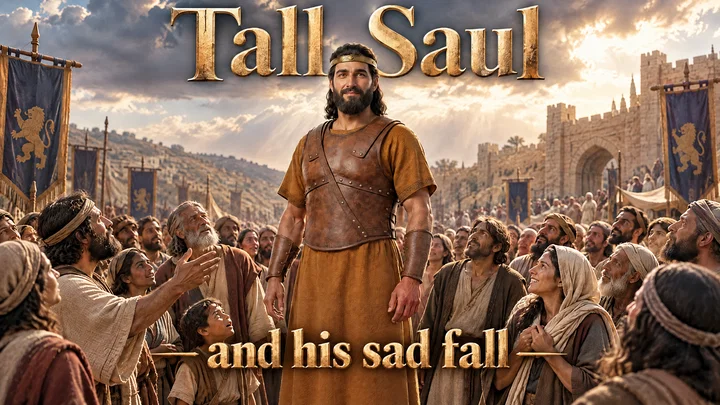
And he had a son, whose name was Saul, a choice young man, and a goodly: and there was not among the children of Israel a goodlier person than he: from his shoulders and upward he was higher than any of the people.
Translations
American King James Version, King James Version, KJV Cambridge Paragraph Bible
And he had a son, whose name was Saul, a choice young man, and a goodly: and there was not among the children of Israel a goodlier person than he: from his shoulders and upward he was higher than any of the people.
And he had a son, whose name was Saul, a choice young man, and a goodly: and there was not among the children of Israel a more handsome person than he: from his shoulders and upward he was higher than any of the people.
Revised Version, American Standard Version
And he had a son, whose name was Saul, a young man and a goodly: and there was not among the children of Israel a goodlier person than he: from his shoulders and upward he was higher than any of the people.
and he hath a son, and his name [is] Saul, a choice youth and goodly, and there is not a man among the sons of Israel goodlier than he — from his shoulder and upward, higher than any of the people.
And he had a son whose name was Saul, choice and comely; and there was not among the children of Israel a comelier person than he; from his shoulders and upward he was higher than any of the people.
and, he, had a son, whose name, was Saul, a choice young man and of noble appearance, and there was not a man of the sons of Israel, more noble than he,—from his shoulders and upwards, was he taller than any of the people.
Berean Standard Bible, Majority Standard Bible
And he had a son named Saul, choice and handsome, without equal among the Israelites— a head taller than any of the people.
He had a son whose name was Saul, an impressive young man; and there was not among the children of Israel a more handsome person than he. From his shoulders and upward he was taller than any of the people.
He had a son named Saul, a specially good-looking young man; there was no one better-looking among the children of Israel: he was taller by a head than any other of the people.
And he had a sonne called Saul, a goodly yong man and a faire: so that among the children of Israel there was none goodlier then he: from the shoulders vpwarde he was hier then any of the people.
Douay-Rheims (Challoner revision)
And he had a son whose name was Saul, a choice and goodly man, and there was not among the children of Israel a goodlier person than he: from his shoulders and upward he appeared above all the people.
Pictures
Cross-references
- 1 Samuel 10:1
Then Samuel took a vial of oil, and poured it upon his head, and kissed him, and said, Is it not because the LORD hath anointed thee to be captain over his inheritance?
Samuel anoints Saul and appoints him captain over Israel.
- 1 Samuel 8:5
And said unto him, Behold, thou art old, and thy sons walk not in thy ways: now make us a king to judge us like all the nations.
Israel asks for a visible king to lead them like other nations.
- 1 Samuel 10:22
Therefore they enquired of the LORD further, if the man should yet come thither. And the LORD answered, Behold, he hath hid himself among the stuff.
Saul hides among the baggage when summoned to accept the kingship.
- 1 Samuel 31:4-5
Then said Saul unto his armourbearer, Draw thy sword, and thrust me through therewith; lest these uncircumcised come and thrust me through, and abuse me. But his armourbearer would not; for he was sore afraid. Therefore Saul took a sword, and fell upon it.
Saul died by suicide.
- Acts 9:1-6
And Saul, yet breathing out threatenings and slaughter against the disciples of the Lord, went unto the high priest,
Contrasts Saul of Kish’s course with Saul of Tarsus’s obedience after meeting Christ.
- 1 Samuel 11:7
And he took a yoke of oxen, and hewed them in pieces, and sent them throughout all the coasts of Israel by the hands of messengers, saying, Whosoever cometh not forth after Saul and after Samuel, so shall it be done unto his oxen. And the fear of the LORD fell on the people, and they came out with one consent.
The passage points to Saul’s threat in chapter 11 as part of the account of his early rule.
- 1 Samuel 28:7
Then said Saul unto his servants, Seek me a woman that hath a familiar spirit, that I may go to her, and enquire of her. And his servants said to him, Behold, there is a woman that hath a familiar spirit at Endor.
Saul sought a spiritist medium.
- 1 Samuel 17:49-50
And David put his hand in his bag, and took thence a stone, and slang it, and smote the Philistine in his forehead, that the stone sunk into his forehead; and he fell upon his face to the earth.
David defeats the giant with a stone, showing that size is not the measure of strength.
- 1 Samuel 13:8-14
And he tarried seven days, according to the set time that Samuel had appointed: but Samuel came not to Gilgal; and the people were scattered from him.
Saul’s failure is linked to acting on his own judgment.
- Philippians 3:5
Circumcised the eighth day, of the stock of Israel, of the tribe of Benjamin, an Hebrew of the Hebrews; as touching the law, a Pharisee;
both Sauls were Benjamites
Commentary
Each commentary is drawn from primary sources: the writings of Ellen G. White and Adventist pioneers and periodicals. Each commentary is separate. Its own words are not a quotation; follow the references to read the source passages.
Ellen G. White
7 sources
The verse stands in the time when all the elders of Israel gathered to Samuel at Ramah and asked for a king to judge them like all the nations, because Samuel was old and his sons did not walk in his ways.PP 604.2 The injustice of those judges caused dissatisfaction and furnished a pretext for urging a change long secretly desired, while the real motive of the demand was discontent and pride and a deliberate and determined purpose.PP 604.2
It describes Saul as a choice young man of noble, dignified appearance, the most handsome and comely in Israel and taller than any of the people from his shoulders upward.PP 608.1–2ST Jul 20, 1882Lt 10, 1897, par. 10–1219MR 21.3–22.2 His outward distinction made him seem fit for command and for rule, and suited the people's pride and desire for a king to rule them.PP 608.1–2ST Jul 20, 1882 Yet those outward qualities did not amount to true wisdom or inner worth or spiritual character.PP 608.1–2ST Jul 20, 1882
His physical impressiveness did not mean he was ready to lead, for he lacked the experience and character needed for the work of a king.Lt 10, 1897, par. 10–1219MR 21.3–22.2 The Lord changed his heart through the Spirit, and that change gave him influence, yet he failed when he presumptuously relied on his own judgment.Lt 10, 1897, par. 10–12 The verse's measure of exceptional height is echoed in Jesus standing head and shoulders above the saints and angels gathered around him, so that his majestic form and lovely face are visible to everyone.EW 246.2SG1 208.1 Outward appearance alone is therefore not a sound basis for choosing someone for ministry or leadership.19MR 21.3–22.2
Sources
Pioneers and periodicals
15 sources
Saul was Kish's son, a Benjamite, and the first man chosen to be king over Israel, a choice young man exceptionally handsome and taller than anyone else, standing head and shoulders above all the people.RH Jan 28, 1902ST Apr 24, 1901ST Feb 19, 1885ST May 31, 1905ST Apr 28, 1914 His choosing came when Israel demanded a king like other nations, contrary to God's purpose, though God had specially prepared him, and his noble appearance and great height made him seem fit to rule by outward human standards.RH Jan 28, 1902ST Apr 24, 1901ST Feb 19, 1885ST Mar 31, 1909RH Sep 3, 1914 He began plain, meek and humble, accepting the kingship with unusual diffidence, and God gave him another heart, giving promise that his rule would be all Israel hoped for.ST May 31, 1905 His commanding build and outward distinction did not mean he possessed true wisdom or spiritual character, so bodily greatness did not make him truly great.ST Jul 20, 1882ST Feb 3, 1887RH Mar 2, 1905RH Sep 3, 1901 He afterward became disobedient and self-exalted, rebelled against God and was rejected as king, so his outward advantages that seemed good proved a curse in the end and show that physical size alone does not make a true giant.ST Feb 3, 1887ST May 31, 1905
Saul's Stature and Choosing
Saul was Kish's son, a Benjamite from Gibeah who lived in the tenth century B.C.ST May 31, 1905ST Apr 28, 1914RH Sep 3, 1901 He was the first man chosen to be king over Israel.ST May 31, 1905ST Apr 28, 1914 The Lord had specially prepared him for that work, and he possessed qualities suited to what God gave him to do.ST Apr 28, 1914
He was a choice young man, exceptionally handsome and comely, large and strong and physically imposing.ST Apr 24, 1901ST Feb 19, 1885ST Mar 31, 1909ST May 31, 1905 There was no goodlier person among the children of Israel, for his noble appearance and great height set him apart.ST Jul 20, 1882RH Jan 28, 1902ST Apr 24, 1901ST Mar 31, 1909 From his shoulders and upward he was higher than any of the people, standing head and shoulders above them all.RH Jan 28, 1902ST Apr 24, 1901ST Feb 19, 1885ST Mar 31, 1909
The account of his accession to the kingship begins in chapter 9.ST Feb 19, 1885 He was called to be king while making a tedious journey.RH Sep 3, 1914 His choosing belongs to Israel's request and demand for a king like those of other nations, which was contrary to God's purpose.RH Jan 28, 1902ST Mar 31, 1909 His noble appearance, comeliness, and great height made him seem fit to rule by outward, human standards, explaining why he appeared well suited to the people's desire.ST Jul 20, 1882ST Apr 24, 1901ST Oct 13, 1881 His comeliness made him stand out when the prophet chose him.ST Jan 23, 1893
His height became a familiar way to describe a tall man as a Saul among the people.ST Feb 18, 1886 His towering stature is used as an image for a leader who stands above rivals and draws a nation to rally around him.RH Sep 11, 1856
Promise, Failure, and Warning
Saul is introduced as plain, meek, bashful and humble, accepting the kingship with unusual diffidence, and that lowly beginning awakens sympathy and desire for his complete success.ST May 31, 1905 God gave him another heart, giving promise that his rule would be all Israel hoped for and that he would become strong in God. His noble appearance, comeliness and great height made him seem fit to rule, yet that outward distinction did not mean he possessed true wisdom or spiritual character.ST Jul 20, 1882 His commanding build did not make him truly great.ST Jul 20, 1882ST Feb 3, 1887
He later turned inconsistent, self-exalted, self-confident, jealous, cowardly and irresolute.ST Feb 3, 1887ST May 31, 1905 He disobeyed and rebelled against God, and though the Lord had specially prepared him he soon displeased God and was rejected as king.ST May 31, 1905ST Apr 28, 1914 He sought a spiritist medium and died by suicide after God's Spirit had departed from him.ST May 31, 1905 One who began with such promise proved utterly weak, and his repeated failure brings sadness.
His outward advantages seemed good but proved a curse in the end. Though he had qualities suited to the work God gave him, his disobedience could thwart God's plan for his own welfare. Physical size alone does not make a true giant, for he lacked the bravery that made the youthful David great in spirit.ST Feb 3, 1887RH Mar 2, 1905 His bodily greatness stands in contrast to the moral greatness of Saul of Tarsus, leaving him kingly only in bodily stature and not in character.ST Feb 3, 1887RH Sep 3, 1901
Sources