2 Chronicles 24:8
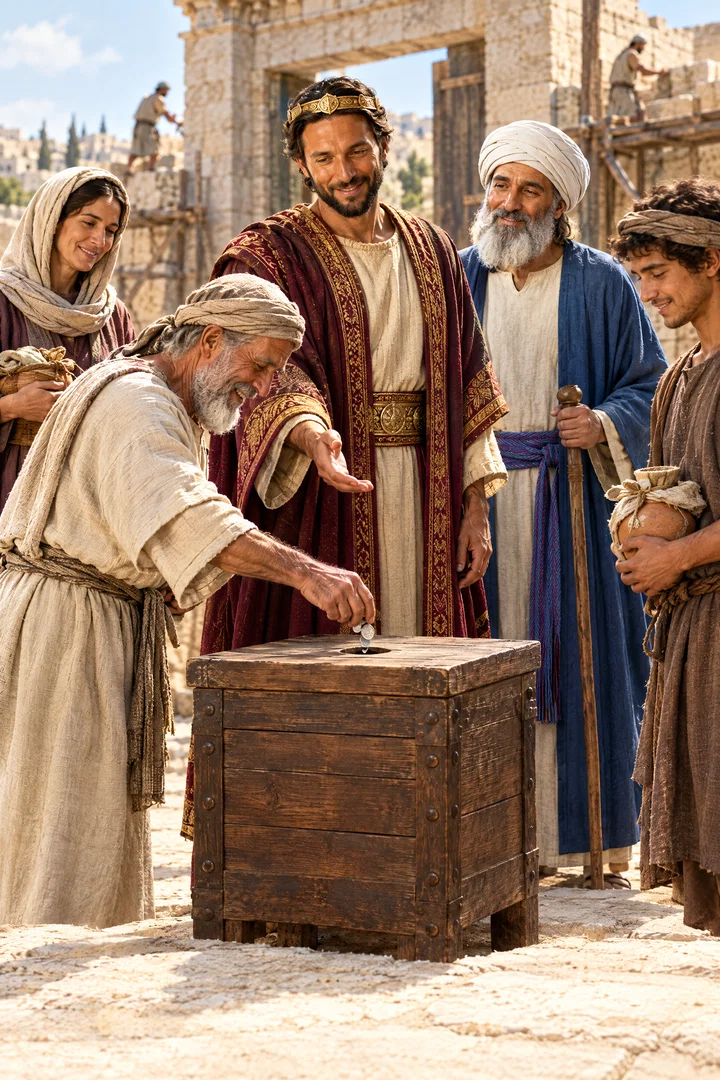
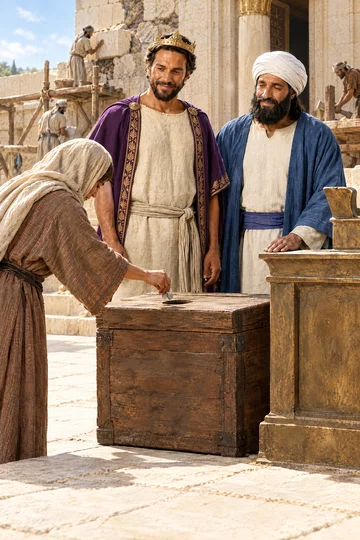
And at the king’s commandment they made a chest, and set it without at the gate of the house of the LORD.
Translations
American King James Version, King James Version
And at the king’s commandment they made a chest, and set it without at the gate of the house of the LORD.
And at the king’s commandment they made a chest, and set it without at the gate of the house of the Lord.
And at the king's commandment they made a chest, and set it without at the gate of the house of the LORD.
So the king commanded, and they made a chest, and set it without at the gate of the house of the LORD.
So the king commanded, and they made a chest, and set it without at the gate of the house of Jehovah.
And the king speaketh, and they make one chest, and put it at the gate of the house of Jehovah without,
And the king commanded, and they made a chest, and set it at the gate of the house of Jehovah without,
So the king bade [them], and they made a certain chest,—and set it in the gate of the house of Yahweh, outside.
Berean Standard Bible, Majority Standard Bible
At the king’s command a chest was made and placed outside, at the gate of the house of the LORD.
So the king commanded, and they made a chest, and set it outside at the gate of the LORD’s house.
So at the king's order they made a chest and put it outside the doorway of the house of the Lord.
Therefore the King commanded, and they made a chest, and set it at the gate of the house of the Lord without.
Douay-Rheims (Challoner revision)
And the king commanded, and they made a chest: and set it by the gate of the house of the Lord on the outside.
Pictures
Cross-references
- 2 Kings 12:9
But Jehoiada the priest took a chest, and bored a hole in the lid of it, and set it beside the altar, on the right side as one cometh into the house of the LORD: and the priests that kept the door put therein all the money that was brought into the house of the LORD.
Describes the collection chest used for temple repairs.
- Exodus 30:16
And thou shalt take the atonement money of the children of Israel, and shalt appoint it for the service of the tabernacle of the congregation; that it may be a memorial unto the children of Israel before the LORD, to make an atonement for your souls.
The atonement money was appointed for sanctuary service.
- Nehemiah 10:32-33
Also we made ordinances for us, to charge ourselves yearly with the third part of a shekel for the service of the house of our God;
joint examples of offerings for temple expenses
Commentary
Each commentary is drawn from primary sources: the writings of Ellen G. White and Adventist pioneers and periodicals. Each commentary is separate. Its own words are not a quotation; follow the references to read the source passages.
Ellen G. White
1 source
The chest made by royal order and placed outside at the entrance to the house of the Lord proves that the tithe set apart exclusively for the Levites was never intended as the limit of giving for religious purposes.PP 526.1 Both the tabernacle in the wilderness and afterward the temple itself were built entirely by freewill offerings given apart from the tithe.PP 526.1 In the same way, necessary repairs and other costs connected with the service of the sanctuary were met by additional contributions collected for that specific purpose, of which the chest collection is the illustration.PP 526.1
Sources
Pioneers and periodicals
9 sources
Joash was the son of Ahaziah and the grandson of Jehoram and Athaliah, and after Ahaziah died Athaliah seized the throne and sought to kill all her son's children, but the infant Joash and his nurse were hidden in the temple by his aunt, the wife of Jehoiada the high priest, and when Joash was seven Athaliah's corrupt reign provoked revolt so that Joash was brought out and proclaimed king and Athaliah was slain.ST Dec 8, 1898 The repair of the house of the Lord was undertaken under King Jehoash at Jehoiada's instigation and while the young king remained under Jehoiada's influence, and the worship of the true God was established once more.ST Dec 8, 1898ST Nov 5, 1912 His reign was faithful to the Lord while Jehoiada was alive and turned away from the Lord after Jehoiada's death.RH Dec 16, 1915
The good done in his reign while he was guided by the faithful priest Jehoiada, including the command to make the chest, belongs in human credit to Jehoiada rather than to Joash, since Joash was strong to do right only when led by that strong, good man. Though some of his ancestors' teachings had taken root in his heart, as soon as Jehoiada died his own heart yielded to evil and he went into the way of the house of Ahab. Joash, who began his reign young and fell into wickedness as soon as his instructor's strong hand was removed, stands in contrast to Josiah, who also began young but developed strength of character to stand for God and put forth every effort to reform the people by himself alone. After Josiah's devoted reign the course of Judah was rapidly downward, with transgression heaped upon transgression and message after message rejected, until at last Jerusalem was burned and the people were carried away to Babylon.
After the Levites failed to hasten the gathering of money to repair the house of God, the king commanded the chest to be made as the arrangement for receiving the collection for its restoration.ST Sep 29, 1898 At the king's command a chest was made and set outside at the gate or entrance of the house of the Lord to receive and gather the people's money and contributions for repairing the temple.ST Sep 29, 1898ST Sep 29, 1898ST Mar 4, 1886RH Mar 31, 1859 The collection was the neglected annual half-shekel tax commanded through Moses for the service of the tabernacle and later the temple.ST Sep 29, 1898
The collection was funded by the people's generous gifts, not by the tithe. The people gave willingly as worshipers, each according to personal devotion and ability, and the gifts supplied what was needed without public display of donors or amounts, treating giving to God's work as part of worship.ST Mar 4, 1886RH Mar 31, 1859 The example of bringing offerings to the chest at the temple gate supports gathering gifts together in a treasury for God's work rather than having each person keep them separately, and applies to raising funds for the gospel.RH Mar 31, 1859
When the priests set about their duty in earnest to gather the money, there was a great revival of interest among the people and soon enough money was on hand to repair the house and carry on other necessary work.ST Sep 29, 1898 The same principle holds today that where pastors and other church officers are faithful in all their own duties and keep before the people the requirements the Lord has laid upon the flock, there will be a working church and a house of worship in creditable condition.ST Sep 29, 1898 Much depends upon the faithfulness of the ministers of the Lord.ST Sep 29, 1898
Sources