2 Chronicles 24:9
And they made a proclamation through Judah and Jerusalem, to bring in to the LORD the collection that Moses the servant of God laid upon Israel in the wilderness.
Translations
And they made a proclamation through Judah and Jerusalem, to bring in to the LORD the collection that Moses the servant of God laid on Israel in the wilderness.
King James Version, Webster Bible
And they made a proclamation through Judah and Jerusalem, to bring in to the LORD the collection that Moses the servant of God laid upon Israel in the wilderness.
And they made a proclamation through Judah and Jerusalem, to bring in to the Lord the collection that Moses the servant of God laid upon Israel in the wilderness.
And they made a proclamation through Judah and Jerusalem, to bring in for the LORD the tax that Moses the servant of God laid upon Israel in the wilderness.
And they made a proclamation through Judah and Jerusalem, to bring in for Jehovah the tax that Moses the servant of God laid upon Israel in the wilderness.
and give an intimation in Judah and in Jerusalem to bring in to Jehovah the tribute of Moses, servant of God, [laid] on Israel in the wilderness.
and they made a proclamation through Judah and Jerusalem, to bring to Jehovah the tribute of Moses the servant of God [ laid upon] Israel in the wilderness.
And they made a proclamation, throughout Judah and Jerusalem, to bring in unto Yahweh the tribute of Moses the servant of God, laid upon Israel in the desert.
Berean Standard Bible, Majority Standard Bible
And a proclamation was issued in Judah and Jerusalem that they were to bring to the LORD the tax imposed by Moses the servant of God on Israel in the wilderness.
They made a proclamation through Judah and Jerusalem, to bring in for the LORD the tax that Moses the servant of God laid on Israel in the wilderness.
And an order was sent out through all Judah and Jerusalem that payment was to be made to the Lord of the tax which Moses, the servant of God, had put on Israel in the waste land.
And they made proclamation thorow Iudah and Ierusalem, to bring vnto the Lord the taxe of Moses the seruant of God, layde vpon Israel in the wildernesse.
Douay-Rheims (Challoner revision)
And they made a proclamation in Juda and Jerusalem, that every man should bring to the Lord the money which Moses the servant of God appointed for all Israel, in the desert.
Pictures
Cross-references
- 2 Kings 12:4-9
And Jehoash said to the priests, All the money of the dedicated things that is brought into the house of the LORD, even the money of every one that passeth the account, the money that every man is set at, and all the money that cometh into any man’s heart to bring into the house of the LORD,
Both describe collecting offerings for the temple repairs.
- Exodus 30:12-16
When thou takest the sum of the children of Israel after their number, then shall they give every man a ransom for his soul unto the LORD, when thou numberest them; that there be no plague among them, when thou numberest them.
Moses directs Israel’s half-shekel collection for the Lord’s service.
- Nehemiah 10:32-33
Also we made ordinances for us, to charge ourselves yearly with the third part of a shekel for the service of the house of our God;
same yearly contribution for sanctuary service
Commentary
Each commentary is drawn from primary sources: the writings of Ellen G. White and Adventist pioneers and periodicals. Each commentary is separate. Its own words are not a quotation; follow the references to read the source passages.
Ellen G. White
1 source
A proclamation was sent throughout Judah and Jerusalem calling the people to bring in to the Lord the collection that Moses the servant of God had laid upon Israel in the wilderness, and its purpose was to provide for necessary repairs and other expenses of the sanctuary.PP 526.1 That Mosaic collection was the direction that as often as the people were numbered, each person should contribute a half shekel for the service of the tabernacle.PP 526.1 The tithe devoted exclusively to the Levites was therefore not the limit of religious contributions.PP 526.1 The tabernacle and afterward the temple were erected wholly by freewill offerings, while repairs were met by this appointed per-person contribution.PP 526.1
Sources
Pioneers and periodicals
9 sources
The verse belongs to the history in 2 Chronicles 23 to 32 covering Athaliah, Joash, Amaziah, Ahaz, Jehoiada, Uzziah, Jotham and Hezekiah.ST May 7, 1912 That history shows that doing duty brought blessing and departing from God brought strife, captivity and great loss.ST May 7, 1912 It also shows that God was willing to turn to help His people when they sought Him with all the heart and wrought mightily for them.ST May 7, 1912
Joash was the grandson of Jehoram and Athaliah, hidden as an infant with his nurse in the temple by his aunt, the wife of Jehoiada, when Athaliah usurped the throne and sought to put all her son's children to death.ST Dec 8, 1898 He was brought out from hiding and proclaimed king at seven years old when the people revolted against his grandmother's corrupt reign and Athaliah was slain.ST Dec 8, 1898 The repair of the house of God and the proclamation through Judah and Jerusalem to bring in the collection for that work took place while Joash was under the influence and guidance of Jehoiada the high priest.ST Dec 8, 1898ST Nov 5, 1912 The human credit for the proclamation belongs to Jehoiada rather than Joash.
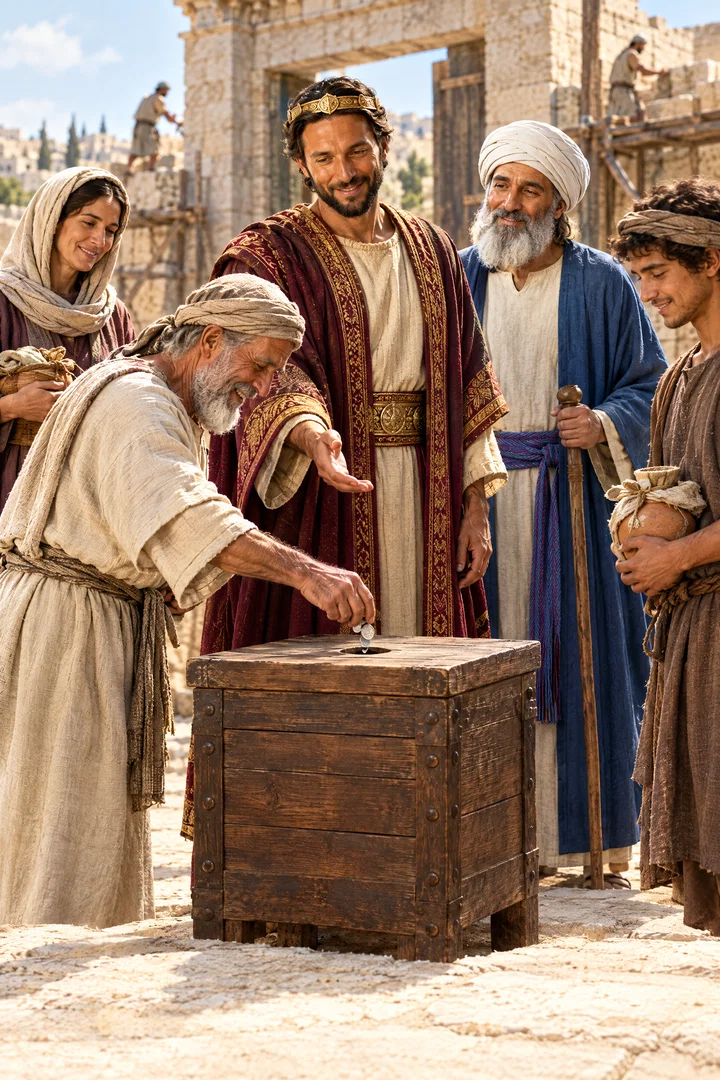
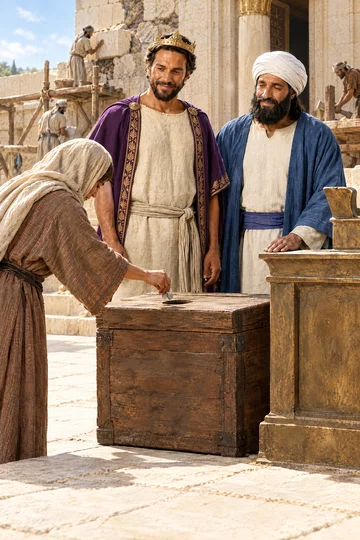
Joash was faithful to the Lord while Jehoiada was alive and strong to do right only when guided by that strong, good man.RH Dec 16, 1915 But as soon as Jehoiada died his heart yielded to evil and he turned away from the Lord into the way of the house of Ahab, though some of his ancestors' teachings had taken root in him.RH Dec 16, 1915 After Joash told the priests and Levites to go out to the cities of Judah and gather money year by year to repair the house of God and they did not hasten the matter, a chest was made and set outside at the gate of the house of the Lord, at the temple entrance.ST Sep 29, 1898 Then the proclamation was made through Judah and Jerusalem to bring in for the Lord the tax Moses the servant of God laid upon Israel in the wilderness to pay for restoring the house.ST Sep 29, 1898ST Nov 5, 1912
The collection Moses laid upon Israel was the half shekel the Lord commanded through Moses to be collected annually from every man twenty years old and upward for the service of the tabernacle and later for the temple.ST Sep 29, 1898 Its collection had been neglected, so that because of the backslidden condition of the people it was a difficult and disagreeable task to get them to pay it.ST Sep 29, 1898 On another account, the collection Moses had laid upon Israel was not used for the temple repair, and that work was instead supported by voluntary liberality, including gifts of precious stones. The money for the neglected temple was gathered through the chest placed at the temple entrance as worshipers gave without public display, each according to personal devotion and ability.ST Dec 8, 1898ST Mar 4, 1886
When the priests set about their duty in earnest a great revival of interest followed that soon brought in enough money to repair the house of God and to carry on other necessary work.ST Sep 29, 1898 By this the worship of the true God was well established once more.ST Dec 8, 1898 Joash began his reign when young and went into wickedness as soon as the strong hand of his instructor was removed, in contrast to Josiah who also began young but developed strength of character to stand for God and reform the people by himself alone. The reign of Joash stands before the reign of Amon the son of Manasseh and the blessed reign of Josiah, after which Judah went rapidly downward with transgression heaped upon transgression and message after message rejected until Jerusalem was burned and the people were carried away to Babylon.
The collection for repairing the temple provides an example of bringing offerings together for God's work, supporting an organized system of giving to fund the gospel.RH Mar 31, 1859 It shows the same principle holds today that where pastors and other church officers are faithful in all their own duties and keep before the people the requirements the Lord has laid upon the flock, there will be a working church with the house of worship in creditable condition.ST Sep 29, 1898 For much depends on the faithfulness of the priests and Levites, the ministers of the Lord.ST Sep 29, 1898
Sources