2 Chronicles 26:21
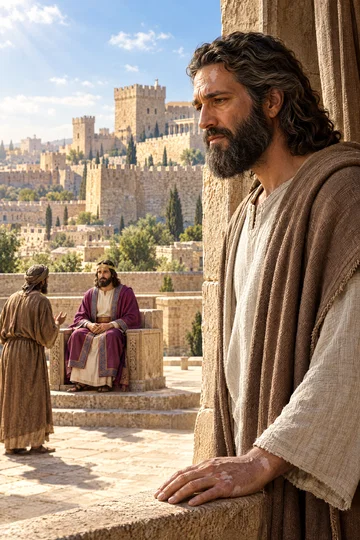
And Uzziah the king was a leper unto the day of his death, and dwelt in a several house, being a leper; for he was cut off from the house of the LORD: and Jotham his son was over the king’s house, judging the people of the land.
Translations
And Uzziah the king was a leper to the day of his death, and dwelled in a several house, being a leper; for he was cut off from the house of the LORD: and Jotham his son was over the king’s house, judging the people of the land.
King James Version, Revised Version
And Uzziah the king was a leper unto the day of his death, and dwelt in a several house, being a leper; for he was cut off from the house of the LORD: and Jotham his son was over the king’s house, judging the people of the land.
And Uzziah the king was a leper unto the day of his death, and dwelt in a several house, being a leper; for he was cut off from the house of the Lord: and Jotham his son was over the king’s house, judging the people of the land.
And Uzziah the king was a leper to the day of his death, and dwelt in a separate house, being a leper; for he was cut off from the house of the LORD: and Jotham his son was over the king's house, judging the people of the land.
And Uzziah the king was a leper unto the day of his death, and dwelt in a separate house, being a leper; for he was cut off from the house of Jehovah: and Jotham his son was over the king’s house, judging the people of the land.
And Uzziah the king is a leper unto the day of his death, and inhabiteth a separate house — a leper, for he hath been cut off from the house of Jehovah, and Jotham his son [is] over the house of the king, judging the people of the land.
And Uzziah the king was a leper to the day of his death, and dwelt in a separate house, being a leper; for he was cut off from the house of Jehovah. And Jotham his son was over the king's house, judging the people of the land.
And it came to pass that, Uzziah the king, was a leper until the day of his death, and dwelt in a house apart—a leper, for he was cut off from the house of Yahweh,—and, Jotham his son, was over the house of the king, judging the people of the land.
So King Uzziah was a leper until the day of his death. He lived in isolation, leprous and cut off from the house of the LORD, while his son Jotham had charge of the royal palace to govern the people of the land.
So King Uzziah was a leper until the day of his death. He lived in isolation, leprous and cut off from the house of the LORD, while his son Jotham had charge of the royal palace and governed the people of the land.
Uzziah the king was a leper to the day of his death, and lived in a separate house, being a leper; for he was cut off from the LORD’s house. Jotham his son was over the king’s house, judging the people of the land.
So King Uzziah was a leper till the day of his death, living separately in his private house; for he was cut off from the house of God; and Jotham his son was ruling over his house, judging the people of the land.
And Vzziah the king was a leper vnto the day of his death, and dwelt as a leper in an house apart, because he was cut off from the house of ye Lord: and Iotham his sonne ruled ouer the Kings house, and iudged the people of the land.
Douay-Rheims (Challoner revision)
And Ozias the king was a leper unto the day of his death, and he dwelt in a house apart being full of the leprosy, for which he had been cast out of the house of the Lord. And Joatham his son governed the king’s house, and judged the people of the land.
Pictures
Cross-references
- 2 Chronicles 26:16
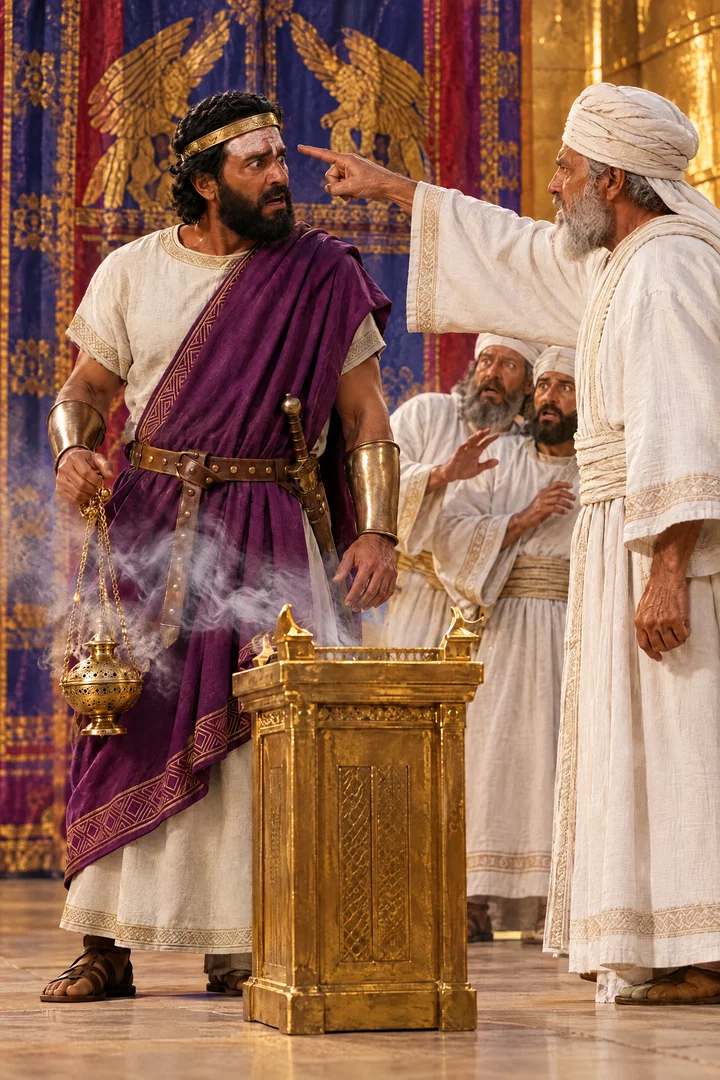
But when he was strong, his heart was lifted up to his destruction: for he transgressed against the LORD his God, and went into the temple of the LORD to burn incense upon the altar of incense.
Uzziah’s pride led him to transgress in the temple and incur judgment.
- Leviticus 13:46
All the days wherein the plague shall be in him he shall be defiled; he is unclean: he shall dwell alone; without the camp shall his habitation be.
Both describe the required isolation of a person with leprosy.
- 2 Chronicles 26:5
And he sought God in the days of Zechariah, who had understanding in the visions of God: and as long as he sought the LORD, God made him to prosper.
Uzziah prospered as long as he sought the Lord.
- Zechariah 14:5
And ye shall flee to the valley of the mountains; for the valley of the mountains shall reach unto Azal: yea, ye shall flee, like as ye fled from before the earthquake in the days of Uzziah king of Judah: and the LORD my God shall come, and all the saints with thee.
The people’s flight recalls the earthquake in Uzziah’s days.
- Isaiah 6:1
In the year that king Uzziah died I saw also the Lord sitting upon a throne, high and lifted up, and his train filled the temple.
Isaiah’s vision came near the end of Uzziah’s reign.
- 2 Kings 15:34-35
And he did that which was right in the sight of the LORD: he did according to all that his father Uzziah had done.
Describes Jotham’s conduct and rule while Uzziah remained in isolation.
- 2 Chronicles 27:6
So Jotham became mighty, because he prepared his ways before the LORD his God.
Jotham became strong because he ordered his ways before God.
- Amos 1:1
The words of Amos, who was among the herdmen of Tekoa, which he saw concerning Israel in the days of Uzziah king of Judah, and in the days of Jeroboam the son of Joash king of Israel, two years before the earthquake.
Dates Amos’s prophecy during Uzziah’s reign, two years before the earthquake.
- Numbers 3:10
And thou shalt appoint Aaron and his sons, and they shall wait on their priest’s office: and the stranger that cometh nigh shall be put to death.
gives the priesthood law Uzziah violated
- Numbers 15:30
But the soul that doeth ought presumptuously, whether he be born in the land, or a stranger, the same reproacheth the LORD; and that soul shall be cut off from among his people.
Uzziah’s presumptuous sin brought judgment and separation from the people.
Commentary
Each commentary is drawn from primary sources: the writings of Ellen G. White and Adventist pioneers and periodicals. Each commentary is separate. Its own words are not a quotation; follow the references to read the source passages.
Ellen G. White
5 sources
The verse records the outcome of Uzziah presumptuously entering the temple sanctuary to burn incense upon the altar, in violation of the plain divine command that none but the descendants of Aaron should officiate as priests.RH Aug 14, 1900RH Mar 4, 1915PK 304.1–3 When Azariah the high priest and his fellow priests unitedly warned him, protested together, and urged him to turn back, he answered with pride and wrathful rebellion in defiance of their warning.RH Aug 14, 1900PK 304.1–3 He then fled the temple in dismay after presumptuously attempting to profane the sanctuary.RH Mar 4, 1915PK 304.1–3 He was smitten at once with divine judgment, with leprosy rising upon his forehead.PK 304.1–3 He remained a leper unto the day of his death some years later, cut off from the house of the Lord and never again entering the temple courts.RH Aug 14, 1900RH Mar 4, 1915PK 304.1–3
As a leper declared unclean under the ritual law, he was forced to give up his rule, leave society, and dwell in a separate house apart, isolated from family and from the congregation of Israel and permitted to associate only with other lepers, showing that the law's demands applied to rulers as well as to ordinary people.MH 67.1–2DA 262.1–3 During the rest of his father's reign Jotham his son was over the king's house, judging the people of the land and bearing the responsibilities of rule.RH Mar 4, 1915 Among the Jews leprosy was regarded as a judgment for sin and as a symbol of sin, and Uzziah's lifelong affliction illustrates that understanding, removing even a king from public life and from the temple community.MH 67.1–2 His punishment stands as a living example of the folly of departing from a plain Thus saith the Lord and a plain command of God.RH Mar 4, 1915PK 304.1–3 His case proves that God is no respecter of persons, for neither success, royal position, nor exalted station, nor a long life of service authorizes anyone to take up work for which God has not appointed and fitted him, nor excuses presumptuous sin, which mars the closing years of a reign and brings the judgment of Heaven.RH Aug 14, 1900RH Mar 4, 1915PK 304.1–3
Sources
Pioneers and periodicals
20 sources
Uzziah became proud when he was strong and entered the temple to burn incense, a service reserved for the priests descended from Aaron, and persisted despite their protest and warning until the Lord struck him with leprosy in the temple, so that he remained a leper until his death, lived apart in a separate house cut off from the house of the Lord, while his son Jotham ruled over the king's house judging the people.RH Apr 9, 1914ST May 7, 1912ST Jan 8, 1885RH Jul 14, 1903ST Sep 3, 1896
It shows the binding law that gave the priestly service exclusively to Aaron and his sons, so that neither royal descent from David nor kingly position exempted anyone from God's command or gave right to its duties.ST Apr 15, 1886RH Aug 9, 1870ST
While that law remained Jesus, who came from Judah, could not serve as priest, so the change of priesthood to Christ required of necessity a change also of that law.RH Aug 9, 1870RH Feb 4, 1873
Leprosy was incurable and contagious and could force even a king to leave public life and yield authority, and among the Jews it was regarded as a judgment for sin, the stroke of God marking Uzziah's removal from sacred service.ST Jul 28, 1914ST Jan 31, 1911
It warns that strength, success, long service and royal position never authorize taking up work God has not appointed or departing from a plain command, for Uzziah's otherwise great reign ended in judgment through presumptuous irreverence.RH Aug 14, 1900RH Mar 4, 1915RH Apr 9, 1914
Uzziah's Sin and Punishment
Uzziah was king of Judah and a descendant of David, and when he was strong his heart became proud unto transgression.RH Jul 14, 1903ST Apr 15, 1886 In that pride he presumed to enter the temple to burn incense, a priestly religious duty reserved to the priests, the descendants of Aaron.ST Sep 3, 1896ST Apr 15, 1886ST Apr 22, 1889 That entering and offering was a rash, forbidden and unlawful usurpation of a sacred office, defying God's arrangement and command with an unholy heart.RH Mar 4, 1915ST Jan 8, 1885ST Apr 22, 1889 He persisted in the act despite the protest, warning and reproof of the priests, rejecting their stand against him.ST Jan 8, 1885RH Jul 14, 1903
For this presumption the Lord struck him with leprosy in the temple itself.ST Apr 15, 1886RH Nov 9, 1869 He fled from the sanctuary and was expelled from it, cut off from its courts and service.RH Mar 4, 1915RH Apr 9, 1914 He remained a leper unto the day of his death, dwelling apart in a several or separate house because he was a leper.ST May 7, 1912ST Jan 8, 1885RH Jul 14, 1903ST Sep 3, 1896ST Apr 11, 1911 He was thus separated and excluded from the house of the Lord for the remainder of his life, his strength and success giving him no exemption from judgment.RH Apr 9, 1914ST May 7, 1912ST Jan 8, 1885
While Uzziah was incapacitated as a leper, his son Jotham was over the king's house.RH Jul 14, 1903ST Sep 3, 1896ST Apr 15, 1886 Jotham managed the royal household and judged the people of the land.ST May 7, 1912RH Jul 14, 1903ST Sep 3, 1896ST Apr 15, 1886 He governed the people and ruled in his father's stead during the rest of his father's reign.RH Mar 4, 1915ST May 7, 1912ST Apr 11, 1911
This smiting with incurable leprosy until death belongs to the setting of the earthquake in Uzziah's reign, as part of the divine record of God's response to his wrongdoing in proudly entering to offer incense.RH Nov 9, 1869 Zechariah uses Uzziah's reign as the time-mark of an earthquake whose effects the people fled.RH Sep 11, 1856 That earthquake itself is not mentioned in Chronicles, which recounts the leprosy in 2 Chronicles 26:16-21.RH Sep 11, 1856
Priesthood Law and Lessons
The verse shows the binding force of the law that gave the service of the priesthood exclusively to Aaron and his sons, for a king was smitten with leprosy for disregarding it and presuming to perform priestly duties reserved for them.ST Apr 15, 1886RH Aug 9, 1870RH Feb 4, 1873 Royal descent did not confer the priestly office or the right to perform priestly duties, since Uzziah, king of Judah and a descendant of David, tried to act as priest by entering the temple to burn incense and was struck by the Lord for this presumption.ST Apr 15, 1886RH Aug 9, 1870 Even a king could not take the priest's place or treat holy service as common, and neither position and status nor consecrated standing exempted anyone from God's law or made disobedience with unholy heart and hands acceptable.STST Aug 13, 1896 Uzziah remained a leper until his death, lived apart because he was a leper, and was excluded, separated and cut off from the house of the Lord, while his son Jotham managed the royal household and judged the people.ST Apr 15, 1886
While that law remained, Jesus, who came from Judah, could not be recognized or serve as priest, for the rule restricting priestly service to Aaron's descendants would have prevented Him if it remained in force.RH Aug 9, 1870RH Feb 4, 1873 Therefore the change of priesthood from Aaron to Christ required of necessity a change also of that law, as proved by the binding character shown in the punishment of a king of Israel.RH Feb 4, 1873
Leprosy was incurable and contagious, and among the Jews it was regarded as a judgment for sin, called the stroke or the finger of God.ST Jul 28, 1914 It could force even a king to give up rule, leave public life, withdraw from society, live apart and yield authority, as Uzziah's leprosy cut him off from the house of the Lord.ST Jul 28, 1914 His generally great and good reign ended in leprosy because of his presumptuous sin, and his remaining a leper until his death with removal from the temple service marked the judgment that followed his transgression.ST Jan 31, 1911
Though he had been strong and successful, Uzziah became a leper and was expelled from the house of the Lord, living separated from it until his death because of presumption and transgression.RH Aug 14, 1900RH Apr 9, 1914 Success does not authorize anyone to take up work for which God has not appointed or fitted them, and neither royal position nor long service could excuse his sin in presumptuously trying to profane the sanctuary and defying the priests who warned him.RH Aug 14, 1900RH Mar 4, 1915 His punishment stands as an example of the folly of departing from a plain command of God, of choosing sin, of treating God's requirements and what is sacred carelessly, and of supposing sin can be committed with impunity, for his presumptuous irreverence in approaching the sacred work of worship brought leprosy from which he never recovered.RH Mar 4, 1915ST Jan 31, 1911RH Oct 9, 1900ST Jul 30, 1902
Sources