2 Chronicles 26:16
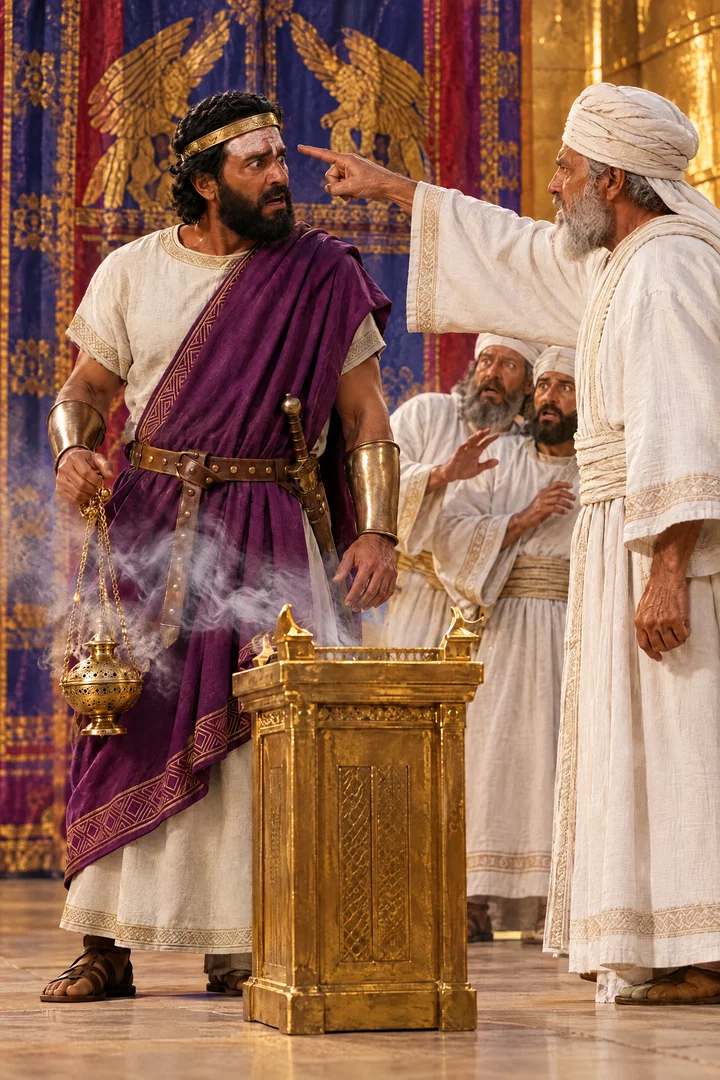
But when he was strong, his heart was lifted up to his destruction: for he transgressed against the LORD his God, and went into the temple of the LORD to burn incense upon the altar of incense.
Translations
But when he was strong, his heart was lifted up to his destruction: for he transgressed against the LORD his God, and went into the temple of the LORD to burn incense on the altar of incense.
King James Version, Webster Bible
But when he was strong, his heart was lifted up to his destruction: for he transgressed against the LORD his God, and went into the temple of the LORD to burn incense upon the altar of incense.
But when he was strong, his heart was lifted up to his destruction: for he transgressed against the Lord his God, and went into the temple of the Lord to burn incense upon the altar of incense.
But when he was strong, his heart was lifted up so that he did corruptly, and he trespassed against the LORD his God; for he went into the temple of the LORD to burn incense upon the altar of incense.
But when he was strong, his heart was lifted up, so that he did corruptly, and he trespassed against Jehovah his God; for he went into the temple of Jehovah to burn incense upon the altar of incense.
And at his being strong his heart hath been high unto destruction, and he trespasseth against Jehovah his God, and goeth in unto the temple of Jehovah to make perfume upon the altar of perfume.
But when he became strong his heart was lifted up to [ his] downfall; and he transgressed against Jehovah his God, and went into the temple of Jehovah to burn incense upon the altar of incense.
But, when he became strong, uplifted was his heart, unto ruin, for he acted unfaithfully against Yahweh his God,—and entered into the temple of Yahweh, to burn incense upon the altar of incense.
But when Uzziah grew powerful, his arrogance led to his own destruction. He was unfaithful to the LORD his God, for he entered the temple of the LORD to burn incense on the altar of incense.
But when Uzziah became powerful, his arrogance led to his own destruction. He was unfaithful to the LORD his God, for he entered the temple of the LORD to burn incense on the altar of incense.
But when he was strong, his heart was lifted up, so that he did corruptly and he trespassed against the LORD his God, for he went into the LORD’s temple to burn incense on the altar of incense.
But when he had become strong, his heart was lifted up in pride, causing his destruction; and he did evil against the Lord his God; for he went into the Temple of the Lord for the purpose of burning perfumes on the altar of perfumes.
But when he was strong, his heart was lift vp to his destruction: for he transgressed against the Lord his God, and went into the Temple of the Lord to burne incense vpon the altar of incense.
Douay-Rheims (Challoner revision)
But when he was made strong, his heart was lifted up to his destruction, and he neglected the Lord his God: and going into the temple of the Lord, he had a mind to burn incense upon the altar of incense.
Pictures
Cross-references 20 of 24
- Numbers 3:10
And thou shalt appoint Aaron and his sons, and they shall wait on their priest’s office: and the stranger that cometh nigh shall be put to death.
Priestly service belonged to Aaron’s family; unauthorized approach brought death.
- Leviticus 10:1-2
And Nadab and Abihu, the sons of Aaron, took either of them his censer, and put fire therein, and put incense thereon, and offered strange fire before the LORD, which he commanded them not.
Both accounts show judgment for unauthorized incense offered in the sanctuary.
- Numbers 16:40
To be a memorial unto the children of Israel, that no stranger, which is not of the seed of Aaron, come near to offer incense before the LORD; that he be not as Korah, and as his company: as the LORD said to him by the hand of Moses.
Forbids those outside Aaron’s line from offering incense.
- 2 Chronicles 26:5
And he sought God in the days of Zechariah, who had understanding in the visions of God: and as long as he sought the LORD, God made him to prosper.
Uzziah prospered while seeking the Lord, before pride followed his success.
- Numbers 16:35
And there came out a fire from the LORD, and consumed the two hundred and fifty men that offered incense.
Both accounts show deadly judgment for presuming to offer incense beyond priestly limits.
- Numbers 15:30
But the soul that doeth ought presumptuously, whether he be born in the land, or a stranger, the same reproacheth the LORD; and that soul shall be cut off from among his people.
Condemns presumptuous sin against the Lord.
- Numbers 18:1-5
And the LORD said unto Aaron, Thou and thy sons and thy father’s house with thee shall bear the iniquity of the sanctuary: and thou and thy sons with thee shall bear the iniquity of your priesthood.
Priests and Levites are assigned sanctuary duties, which Uzziah unlawfully undertook.
- Exodus 30:9
Ye shall offer no strange incense thereon, nor burnt sacrifice, nor meat offering; neither shall ye pour drink offering thereon.
Forbids unauthorized offerings on the incense altar.
- 2 Chronicles 26:21
And Uzziah the king was a leper unto the day of his death, and dwelt in a several house, being a leper; for he was cut off from the house of the LORD: and Jotham his son was over the king’s house, judging the people of the land.
Uzziah’s transgression led to lifelong leprosy.
- Exodus 30:7
And Aaron shall burn thereon sweet incense every morning: when he dresseth the lamps, he shall burn incense upon it.
Incense burning is reserved to Aaron.
- Numbers 18:7
Therefore thou and thy sons with thee shall keep your priest’s office for every thing of the altar, and within the vail; and ye shall serve: I have given your priest’s office unto you as a service of gift: and the stranger that cometh nigh shall be put to death.
Altar service is assigned to Aaron and his sons.
- Daniel 5:20
But when his heart was lifted up, and his mind hardened in pride, he was deposed from his kingly throne, and they took his glory from him:
Nebuchadnezzar is cited as another example of a lifted-up heart.
- Leviticus 16:2-19
And the LORD said unto Moses, Speak unto Aaron thy brother, that he come not at all times into the holy place within the vail before the mercy seat, which is upon the ark; that he die not: for I will appear in the cloud upon the mercy seat.
Describes the high priest’s sanctuary ministry.
- Zechariah 14:5
And ye shall flee to the valley of the mountains; for the valley of the mountains shall reach unto Azal: yea, ye shall flee, like as ye fled from before the earthquake in the days of Uzziah king of Judah: and the LORD my God shall come, and all the saints with thee.
Recalls the earthquake in Uzziah’s days.
- 2 Kings 14:10
Thou hast indeed smitten Edom, and thine heart hath lifted thee up: glory of this, and tarry at home: for why shouldest thou meddle to thy hurt, that thou shouldest fall, even thou, and Judah with thee?
Amaziah’s heart is also described as lifted up.
- Exodus 40:15
And thou shalt anoint them, as thou didst anoint their father, that they may minister unto me in the priest’s office: for their anointing shall surely be an everlasting priesthood throughout their generations.
The priesthood was established in Aaron’s line.
- Isaiah 6:1
In the year that king Uzziah died I saw also the Lord sitting upon a throne, high and lifted up, and his train filled the temple.
Isaiah’s vision is placed in the closing days of Uzziah’s reign.
- Luke 1:8-9
And it came to pass, that while he executed the priest’s office before God in the order of his course,
Describes a priest serving in the sanctuary.
- 1 John 3:4
Whosoever committeth sin transgresseth also the law: for sin is the transgression of the law.
Sin is defined as transgression of the law.
- 1 Corinthians 10:12
Wherefore let him that thinketh he standeth take heed lest he fall.
Warns those who think they stand to take heed lest they fall.
Commentary
Each commentary is drawn from primary sources: the writings of Ellen G. White and Adventist pioneers and periodicals. Each commentary is separate. Its own words are not a quotation; follow the references to read the source passages.
Ellen G. White
6 sources
When he became strong, his strength and prosperity lifted up his heart in pride, and that pride led through unfaithfulness and disobedience to his ruin and destruction.RH Mar 4, 1915PK 303.2PK 304.1–3RH Aug 14, 1900RH Mar 4, 1915 His growing strength turned him to pride that brought his ruin through unfaithfulness, with success and exalted position fostering the pride that led to his destruction.PK 303.2PK 304.1–3RH Aug 14, 1900RH Mar 4, 1915 His transgression was presumption in violating God's plain command and order by entering the temple sanctuary to burn incense upon the altar.RH Mar 4, 1915PK 303.2PK 304.1–3RH Aug 14, 1900 That was a priestly office reserved for the descendants of Aaron alone to officiate as priests, which he was not authorized to perform.RH Mar 4, 1915PK 303.2PK 304.1–3RH Aug 14, 1900
His reign had outward prosperity without matching spiritual growth, with temple worship continuing and crowds still gathering while pride and formality replaced humility and sincerity.RH Mar 4, 1915 He could have used his instruction and example to lead his people to reverence God and honor the sacred temple services, but instead his power lifted his heart into disobedience.RH Mar 4, 1915 Azariah the high priest and his associates withstood him, remonstrated with him and pleaded with him to turn from his purpose, telling him he had trespassed and that it would not be for his honor.RH Mar 4, 1915
His refusal to turn back when rebuked brought God's punishment and divine judgment, and he became a leper.PK 304.1–3RH Aug 14, 1900 As a leper he had to give up the throne and withdraw from society, showing that royal rank did not exempt him from the consequences of the disease.DA 262.1–3 Neither high position nor a long record of service excuses violating a plain command of God.PK 304.1–3 Success does not qualify people to take up work God has not assigned them.RH Aug 14, 1900
Sources
Pioneers and periodicals
32 sources
When he became strong his heart was lifted up in pride and self-confidence to his destruction, showing how prosperity and power lead to self-exaltation and ruin when dependence on God is forgotten.ST Jan 8, 1885RH Jul 14, 1903RH Apr 9, 1914 His transgression was to enter the temple to burn incense upon the altar of incense, taking up priestly work that belonged to Aaron's consecrated sons and not to him.RH Mar 4, 1915ST Jan 8, 1885RH Jul 14, 1903RH Apr 9, 1914ST Sep 3, 1896 Azariah the high priest and his associates withstood him and ordered him to leave, but he persisted in anger and was struck with leprosy on his forehead and driven out and excluded from the house of the Lord.ST Jan 8, 1885RH Jul 14, 1903RH Apr 9, 1914 His royal rank and power did not give him the priesthood or permit him to disregard God's command, illustrating the boundary of his office and the distinction between kingship and priesthood.ST Sep 3, 1896ST Apr 11, 1911ST Apr 22, 1889 His example teaches that spiritual strength and blessing call for watchfulness against pride and self-reliance, and that success does not qualify anyone to take up work God has not assigned.RH Aug 14, 1900ST Jan 8, 1885ST May 7, 1912ST Jan 1, 1894ST
Uzziah's Pride and Downfall
When he became strong, his heart was lifted up in pride and self-confidence to his destruction, and his success, strength, prosperity and power gave rise to self-exaltation and rebellion against God that brought his ruin.ST Jan 8, 1885RH Jul 14, 1903RH Apr 9, 1914ST Apr 11, 1911RH Dec 3, 1857 Prosperity can lead to self-reliance and disobedience when a person forgets dependence on God and rejects His guidance, and strength and success do not protect a person from destruction when pride turns him against God.ST Jan 8, 1885RH Apr 9, 1914ST May 7, 1912ST Apr 11, 1911RH Dec 3, 1857 Turning from God brings loss, while remembering and seeking God brings blessing.ST May 7, 1912
He prospered as long as he sought the Lord and gave heed to the word of the Lord by His prophets through Zechariah, who had understanding in the visions of God.PGGC 9.1 When he became strong he stopped heeding prophetic instruction, and this disobedience left him a leper until the day of his death.PGGC 9.1 His reign had outward prosperity without matching spiritual growth, with temple worship continuing and crowds still gathering while pride and formality replaced humility and sincerity.RH Mar 4, 1915 He could have used his instruction and example to lead his people to reverence God and honor the sacred temple services, but instead his growing strength turned him to pride that brought his ruin through unfaithfulness to God.RH Mar 4, 1915
His transgression against the Lord his God was to enter the temple or sanctuary to burn incense upon the altar of incense, violating the plain command that only the descendants of Aaron should officiate as priests.RH Mar 4, 1915ST Jan 8, 1885RH Jul 14, 1903RH Apr 9, 1914PGGC 9.1 It was a presumptuous sin that brought disaster, taking the priests' role and performing priestly work that was not his to perform, a duty reserved for the priests and for Aaron's consecrated sons.RH Mar 4, 1915RH Jul 14, 1903PGGC 9.1ST May 7, 1912ST Apr 11, 1911 His presumption included defying the boundary of his royal office and brought serious consequences.ST May 7, 1912ST Apr 11, 1911
Azariah the high priest and his associates withstood him, protested, ordered him to leave, remonstrated with him and pleaded with him to turn from his purpose.RH Mar 4, 1915ST Jan 8, 1885RH Jul 14, 1903RH Jan 20, 1853 They told him he had trespassed and that it would not be for his honor.RH Mar 4, 1915 He persisted despite the priests' protest and reproof, resisted them in anger, and was struck in the temple.ST Jan 8, 1885RH Jul 14, 1903RH Apr 9, 1914
For his presumption he was struck with leprosy, appearing on his forehead, and was driven out, removed, and excluded from the house of the Lord, ending his reign in disgrace as a leper.ST Jan 8, 1885RH Jul 14, 1903RH Apr 9, 1914PGGC 9.1ST Sep 3, 1896 His presumption was a trespass against the Lord and brought punishment by leprosy, cutting him off from the temple.ST Sep 3, 1896ST Jan 12, 1882 His act also brought divine displeasure shown in a great earthquake that shook the ground and damaged the temple, presented as a sign of God's displeasure at wickedness.RH Nov 9, 1869 His days are connected with the earthquake in the days of Uzziah and with people fleeing as they did then, although the earthquake itself is not mentioned in the Chronicles passage.RH Sep 11, 1856
His fifty-year reign was recorded by Isaiah, and his life supplied important lessons for students studying the lives of the kings of Judah in sacred history.RH Apr 8, 1915 He was blessed and prospered, but in his prosperity his heart was lifted up in pride to his destruction and ruin.RH Apr 8, 1915
Priesthood, Kingship, and Law
The burning of incense was a sacred duty reserved for Aaron and his sons and descendants, his consecrated priests, by plain command, so that during the Aaronic priesthood it was sinful and a trespass for someone from another tribe to serve as priest.RH Mar 4, 1915ST Sep 3, 1896ST Jan 12, 1882ST Apr 22, 1889RH Aug 9, 1870 Uzziah transgressed against the Lord his God by violating that order and entering the sanctuary or temple to offer incense, although the priesthood was not his office.RH Mar 4, 1915ST Jan 12, 1882ST Apr 22, 1889ST Dec 9, 1889 His punishment by leprosy appearing on his forehead, followed by his being driven out and cut off from the temple, shows his presumption and defiance of God's appointed order.ST Sep 3, 1896ST Jan 12, 1882ST Dec 9, 1889RH Aug 9, 1870
Kingship did not give him the priesthood, and the episode illustrates the distinction between the two offices and the boundary of his royal office.ST Sep 3, 1896ST Apr 11, 1911ST Apr 15, 1886 His royal status, rank, power and prosperity did not permit him to disregard God's command, excuse his violation, or take the priests' role and perform priestly work he had no right to perform.ST Apr 11, 1911ST Apr 22, 1889ST Apr 15, 1886STST Aug 13, 1896 Neither human rank nor consecration authorizes disobedience or makes a forbidden act right, and even a king may not take the priest's place at the altar.STST Aug 13, 1896
His being struck with leprosy for breaking the law that gave the service of the priesthood only to Aaron and his sons proves that the priesthood law was binding and enforced and barred others from serving as priests, including men of Judah.RH Aug 9, 1870RH Feb 4, 1873 This is the law that had to be changed so that Christ, who came from the tribe of Judah, could be recognized as priest.RH Aug 9, 1870RH Feb 4, 1873 His going into the temple to burn incense on the altar of incense was profanation, and God made him a once-for-all example of an offender in profanation, alongside Cain in murder, Lot's wife in loitering, Achan in coveting, Korah in presumption, and Saul in disobedience, to stand as a warning against such sin, just as Ananias and Sapphira were made an example for lying to the Holy Ghost.RH Mar 6, 1913 His attempt as king to take religious authority and take up the sacred censer brought God's displeasure and ended in the loss of his scepter and freedom, being struck with leprosy and cut off from the temple, warning that joining civil power with religious authority can bring a similarly destructive outcome for a people.ST Sep 3, 1896ST Mar 24, 1909
Warnings for God's People
Uzziah's strength and success lifted his heart in pride to rebellion and destruction, for when he became strong through God's help he forgot his dependence on God, rejected His guidance, and transgressed by entering the temple to burn incense, a duty not his to perform.ST Jan 8, 1885ST May 7, 1912ST Jan 1, 1894 He persisted in his self-exalting purpose despite the priests' protest and was struck with leprosy and excluded from the house of the Lord.ST Jan 8, 1885 His fall shows that prosperity can lead to self-reliance and disobedience, that turning from God brings loss while remembering and seeking Him brings blessing, and that strength did not protect him once pride took hold.ST Jan 8, 1885ST May 7, 1912ST Jan 1, 1894 He had been greatly helped until he became strong, which proves that spiritual strength, blessing, and help do not remove the danger of temptation but call for watchfulness against pride and a fall.ST Oct 15, 1896
Success does not qualify a person to take up work God has not assigned, for Uzziah violated God's appointed order by entering the temple to burn incense, a priestly duty reserved for Aaron's descendants.RH Aug 14, 1900 Even a king may not take the priest's place at the altar, and neither royal status and rank nor consecration excuses violation or authorizes disobedience.STST Aug 13, 1896 A good aim did not make his forbidden act right.RH Oct 11, 1864 Serving holy work with an unholy heart and hands brought leprosy, teaching that God's holy institutions cannot be treated carelessly, replaced, or treated as interchangeable, and that all people high and low are accountable to His righteous laws.STST Aug 13, 1896
His presumption in intruding into the temple to perform a priestly act God had not assigned him brought judgment and ended his reign as a leper, illustrating that God's judgments follow transgression.ST Jan 31, 1911RH Oct 9, 1900 His strength gave way to pride that defied God in an act he had no right to perform, showing that sin springs from a will set against God's commands.ST Nov 10, 1881 He went out of the temple a leper, showing the destructive consequence of choosing sin and disregarding God's holiness, and warning against treating sacred things and altar service carelessly.RH Oct 9, 1900ST Jul 30, 1902
Sources