2 Kings 20:12
At that time Berodach-baladan, the son of Baladan, king of Babylon, sent letters and a present unto Hezekiah: for he had heard that Hezekiah had been sick.
Translations
At that time Berodachbaladan, the son of Baladan, king of Babylon, sent letters and a present to Hezekiah: for he had heard that Hezekiah had been sick.
King James Version, KJV Cambridge Paragraph Bible
At that time Berodach-baladan, the son of Baladan, king of Babylon, sent letters and a present unto Hezekiah: for he had heard that Hezekiah had been sick.
At that time Berodach-baladan, the son of Baladan, king of Babylon, sent letters and a present to Hezekiah: for he had heard that Hezekiah had been sick.
At that time Berodach-baladan the son of Baladan, king of Babylon, sent letters and a present unto Hezekiah: for he had heard that Hezekiah had been sick.
At that time Berodach-baladan the son of Baladan, king of Babylon, sent letters and a present unto Hezekiah; for he had heard that Hezekiah had been sick.
At that time hath Berodach-Baladan son of Baladan king of Babylon sent letters and a present unto Hezekiah, for he heard that Hezekiah had been sick;
At that time Berodach-Baladan, the son of Baladan, king of Babylon, sent a letter and a present to Hezekiah, for he had heard that Hezekiah had been sick.
At that time, Berodach-baladan son of Baladan, king of Babylon, sent letters and a present, unto Hezekiah,—for he had heard that Hezekiah had been sick.
Berean Standard Bible, Majority Standard Bible
At that time Merodach-baladan son of Baladan king of Babylon sent letters and a gift to Hezekiah, for he had heard about Hezekiah’s illness.
At that time Berodach Baladan the son of Baladan, king of Babylon, sent letters and a present to Hezekiah, for he had heard that Hezekiah had been sick.
At that time, Merodach-baladan, the son of Baladan, king of Babylon, sent letters with an offering to Hezekiah, because he had news that Hezekiah had been ill.
The same season Berodach Baladan the sonne of Baladan King of Babel, sent letters and a present to Hezekiah: for he had heard howe that Hezekiah was sicke.
Douay-Rheims (Challoner revision)
At that time Berodach Baladan, the son of Baladan, king of the Babylonians, sent letters and presents to Ezechias: for he had heard that Ezechias had been sick.
Pictures
Cross-references
- Isaiah 39:1-2
At that time Merodach-baladan, the son of Baladan, king of Babylon, sent letters and a present to Hezekiah: for he had heard that he had been sick, and was recovered.
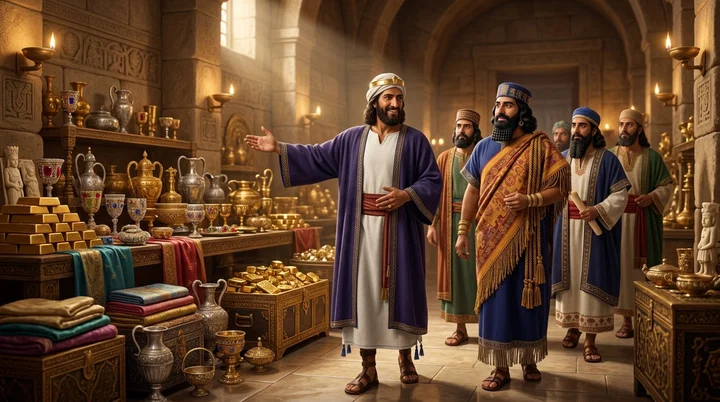
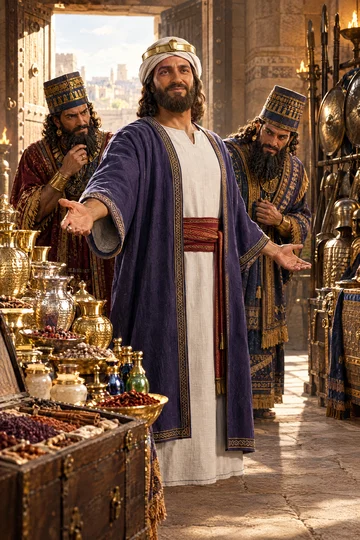
Babylonian envoys visit Hezekiah, who shows them his treasures.
- 2 Chronicles 32:31
Howbeit in the business of the ambassadors of the princes of Babylon, who sent unto him to enquire of the wonder that was done in the land, God left him, to try him, that he might know all that was in his heart.
Babylonian envoys inquire about the wonder, and their visit tests Hezekiah’s heart.
- Isaiah 38:1-8
In those days was Hezekiah sick unto death. And Isaiah the prophet the son of Amoz came unto him, and said unto him, Thus saith the LORD, Set thine house in order: for thou shalt die, and not live.
Recounts Hezekiah’s illness and the sign of the sundial’s turned-back shadow.
- Isaiah 39:6-7
Behold, the days come, that all that is in thine house, and that which thy fathers have laid up in store until this day, shall be carried to Babylon: nothing shall be left, saith the LORD.
Foretells treasures and Hezekiah’s descendants being taken to Babylon.
- 2 Kings 20:6
And I will add unto thy days fifteen years; and I will deliver thee and this city out of the hand of the king of Assyria; and I will defend this city for mine own sake, and for my servant David’s sake.
The fifteen-year extension prompts the Babylonian embassy.
Commentary
Each commentary is drawn from primary sources: the writings of Ellen G. White and Adventist pioneers and periodicals. Each commentary is separate. Its own words are not a quotation; follow the references to read the source passages.
Ellen G. White
10 sources
At that time the king of Babylon sent letters and a present to Hezekiah by messengers, for he had heard that Hezekiah had been sick.Ms 199, 1899, par. 1–4PK 344.1 The visit came after God had healed Hezekiah and had given the miraculous sign of the shadow turning back on the sundial, a wonder done in the land showing that the God of heaven had granted him a new lease of life.Ms 199, 1899, par. 1–4PK 344.1 The Babylonian visitors came to congratulate him and to learn about the God who had performed the wonder.PK 344.1
The visit became a test in which God left Hezekiah to reveal what was in his heart.Ms 199, 1899, par. 1–4Ms 199, 1899, par. 5–6 Wisdom was withdrawn and he was left to act according to his own will.Ms 199, 1899, par. 5–6
Hezekiah welcomed the envoys and showed them his treasures, riches, prosperity and advantages.10MR 248.1–252.1Ms 199, 1899, par. 5–6Ms 173, 1902, par. 24Ms 196, 1898, par. 6Ms 197, 1899, par. 5–6 What he displayed included the treasures in God's house, the sacred things of the temple including its gold vessels, exposing what should have remained secret.4MR 146.2Ms 123, 1902, par. 9Ms 1, 1853, par. 26–27
He did this from pride and self-exaltation, believing that displaying his advantages would gain him influence.10MR 248.1–252.1Ms 199, 1899, par. 5–6Ms 173, 1902, par. 24 His welcome and display was a mistake and sin — a heinous sin, a failure of trust in God and betrayal of sacred responsibility that amounted to giving himself to the enemy.4MR 146.2Ms 199, 1899, par. 5–6Ms 196, 1898, par. 6Ms 1, 1853, par. 26–27Ms 197, 1899, par. 5–6
The display tempted Babylon to come and plunder, for the envoys left planning how to take those advantages for themselves, and God pronounced a heavy curse because of it.10MR 248.1–252.1Ms 173, 1902, par. 24Ms 1, 1853, par. 26–27Ms 197, 1899, par. 5–6 The account warns against placing alliances and confidence in unbelievers and opening an institution's private affairs to outsiders, as in exposing books to gain a small promised donation, since this brings spiritual weakness and harm to others far outweighing any gain.4MR 146.2Ms 123, 1902, par. 9Ms 197, 1899, par. 5–6
Sources
Pioneers and periodicals
15 sources
Berodach-baladan king of Babylon sent letters and a present to Hezekiah after hearing that he had been sick and had recovered, to congratulate him and to inquire concerning the healing miracle and the wonder of the shadow turned back in the land.ST Jan 21, 1886RH Aug 8, 1907ST Hezekiah welcomed the envoys and showed them all his treasures and possessions, including the riches of his house and the vessels of the house of the Lord.ST Jan 21, 1886RH Aug 4, 1868 The display came from pride and self-exaltation, vaunting his strength to appear formidable among the nations and leaning on the arm of flesh for alliance against Assyria instead of honoring God.ST Nov 21, 1911RH Aug 4, 1868 It awakened Babylonian cupidity for Judah's wealth and brought Isaiah's word that all stored up by his fathers would be carried to Babylon and his sons would serve in the palace of the king of Babylon.ST Jan 21, 1886ST Nov 21, 1911ST Apr 15, 1903 The healing had given him opportunity to be a blessing by telling the glories of the living God who gives life and health and saves from death, but the messengers left without that witness, so his seed had to give it in captivity.ST May 3, 1910RH Aug 8, 1907ST Nov 21, 1911
Text and Historical Setting
The verse stands in the final section of the books of Kings, the history of Judah's remaining kingdom after the ten tribes had been swept away.ST Dec 9, 1897 The sender is named as the son of Baladan, at first king of the Babylonian coast territory, who later extended his authority over the upper country and became king of Babylon in fact. This corresponds to his being in command at Babylon after Sennacherib's campaign in Judea.ST Jul 30, 1885
The letters and present were sent because he had heard that Hezekiah had been sick, and had now recovered from his illness.RH Aug 8, 1907RH Aug 4, 1868ST Nov 19, 1885 They came to congratulate him on his restoration to health.ST Jan 21, 1886STST Apr 15, 1903 They came also to inquire about the healing miracle, the wonder that had occurred in the land, even the shadow moving backward on the sundial of Ahaz.ST Jan 21, 1886STST Nov 19, 1885
The embassy came when Babylon was rebelling against the king of Assyria at Nineveh.ST Nov 27, 1884 It fell in Merodach-baladan's second reign in Babylon, between Sennacherib's first and second invasions of Judea.ST Nov 19, 1885 It probably came after Sennacherib's defeat, when spoil taken from the Assyrians had replenished Hezekiah's treasuries.RH Aug 4, 1868
Hezekiah's Mistake and Judgment
Hezekiah welcomed the envoys from Babylon and showed them all his treasures and possessions, holding back nothing of what he owned.ST Jan 21, 1886RH Aug 4, 1868 He displayed his choicest treasures together with his weapons and preparations for war, apparently hoping to secure an alliance against Assyria.RH Aug 4, 1868 Among what he showed the strangers were his own greatness and wealth, including the valuable gold and silver vessels in the house of the Lord.ST Apr 15, 1903 The display arose from pride and ostentation, exalting man and self in place of God.RH Aug 4, 1868RH Aug 5, 1902 It was proud conceit in what he commanded and vain confidence in his own strength, vaunting himself to appear formidable among the nations and leaning upon the arm of flesh instead of God, the same pride of heart as David's sin in numbering Israel.RH Aug 4, 1868RH Sep 11, 1860
That showing of the kingdom's wealth aroused Babylonian cupidity and awakened Babylon's desire for Judah's wealth.ST Nov 21, 1911ST It naturally excited the covetousness of the Babylonians, so that Jerusalem's treasures became a dazzling temptation until Nebuchadnezzar took the city and robbed its treasure-houses, bringing great evil upon Jerusalem.ST Nov 21, 1911ST Apr 15, 1903RH Aug 5, 1902 The visit led directly to Isaiah's prophecy that all that was in Hezekiah's house and stored by his fathers would be carried to Babylon with nothing left.ST Nov 21, 1911ST Apr 15, 1903 Some of his descendants would be taken away to serve as eunuchs in the palace of the king of Babylon, fulfilled later when Daniel was present in Babylon.ST Jan 21, 1886ST Nov 21, 1911
Doctrinal and Practical Lessons
The embassy from Babylon was the very purpose for which the healing had been granted, that Hezekiah might be a blessing by recounting the riches of God's grace instead of the riches of his kingdom.ST May 3, 1910ST Nov 21, 1911ST The king of Babylon had sent with letters and a gift to congratulate him on restoration to health and to inquire about the healing miracle, and Hezekiah should have told them of the greatness and goodness of the God of heaven who had healed him and wrought the wonderful miracle for him.ST May 3, 1910STST Apr 15, 1903RH Aug 5, 1902 His opportunity was to point the ambassadors to God as healer of the soul, to reveal the gospel that God bestows life and health and dwells with flesh to save from death by the gift of indwelling life.ST May 3, 1910RH Aug 8, 1907RH Aug 5, 1902 Instead he exalted himself in the place of God and showed them his material treasures, his own greatness and wealth, and they left without the gospel.RH Aug 8, 1907ST Apr 15, 1903RH Aug 5, 1902 Because he missed the wonderful opportunity to give the gospel to Babylon, his seed had to give that same message in captivity.ST May 3, 1910
The account to which the sending of the letters and present belongs stands as an example of asking for one's own will and urging the petition until granted, a prayer without submission to God's will recorded as an admonition for future generations.RH Dec 29, 1868 The healing was from a sickness unto death in the middle of the reign, when fifteen years were added to life after the miraculous recovery.ST Nov 21, 1911ST Jul 13, 1904 That lengthened life was not used altogether as it should have been, for his son Manasseh, who was born three years after the recovery, became one of the most wicked kings the nation ever had.ST Nov 21, 1911ST Jul 13, 1904
Hezekiah's sin when his heart was lifted up and he displayed his choicest treasures to the nobility of Babylon, followed by a woeful message by the mouth of the prophet, proves it is a fearful thing to sin against God. It proves that God is still the same holy being as when He gave the law on Sinai, that truth is unbending and uncorrupted, and that He has never stooped to parley with evil nor will tolerate it in His people.
Sources