Isaiah 39:6
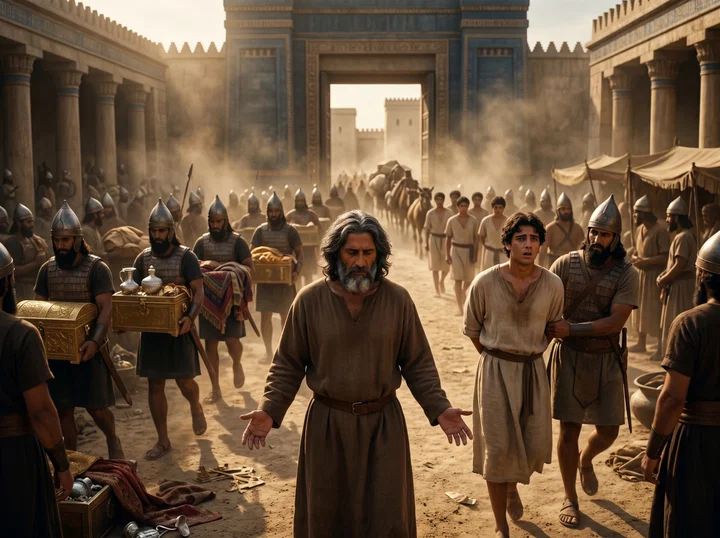
Behold, the days come, that all that is in thine house, and that which thy fathers have laid up in store until this day, shall be carried to Babylon: nothing shall be left, saith the LORD.
Translations
Behold, the days come, that all that is in your house, and that which your fathers have laid up in store until this day, shall be carried to Babylon: nothing shall be left, says the LORD.
King James Version, Revised Version
Behold, the days come, that all that is in thine house, and that which thy fathers have laid up in store until this day, shall be carried to Babylon: nothing shall be left, saith the LORD.
Behold, the days come, that all that is in thine house, and that which thy fathers have laid up in store until this day, shall be carried to Babylon: nothing shall be left, saith the Lord.
Behold, the days come, that all that is in thy house, and that which thy fathers have laid up in store until this day, shall be carried to Babylon: nothing shall be left, saith the LORD.
Behold, the days are coming, when all that is in thy house, and that which thy fathers have laid up in store until this day, shall be carried to Babylon: nothing shall be left, saith Jehovah.
Lo, days are coming, and borne hath been all that [is] in thy house, and that thy fathers have treasured up till this day, to Babylon; there is not left a thing, said Jehovah;
Behold, days come when all that is in thy house, and that which thy fathers have laid up until this day, shall be carried to Babylon: nothing shall be left, saith Jehovah.
Lo! days are coming, when all that is in thy house, and that which thy fathers have treasured up until this day, shall be carried away unto Babylon,—nothing, shall be left, Saith Yahweh.
Berean Standard Bible, Majority Standard Bible
The time will surely come when everything in your palace and all that your fathers have stored up until this day will be carried off to Babylon. Nothing will be left, says the LORD.
‘ Behold, the days are coming when all that is in your house, and that which your fathers have stored up until today, will be carried to Babylon. Nothing will be left,’ says the LORD.
Truly, the days are coming when everything in your house, and whatever your fathers have put in store till this day, will be taken away to Babylon: all will be gone.
Beholde, the dayes come, that all that is in thine house, and which thy fathers haue layed vp in store vntill this day, shall be caried to Babel: nothing shall be left, sayeth the Lord.
Douay-Rheims (Challoner revision)
Behold the days shall come, that all that is in thy house, and that thy fathers have laid up in store until this day, shall be carried away into Babylon: there shall not any thing be left, saith the Lord.
Pictures
Cross-references 20 of 21
- 2 Kings 20:12-18
At that time Berodach-baladan, the son of Baladan, king of Babylon, sent letters and a present unto Hezekiah: for he had heard that Hezekiah had been sick.
Hezekiah shows Babylon’s envoys his treasures, and Isaiah foretells their removal to Babylon.
- 2 Chronicles 32:31
Howbeit in the business of the ambassadors of the princes of Babylon, who sent unto him to enquire of the wonder that was done in the land, God left him, to try him, that he might know all that was in his heart.
Babylon’s envoys visit as God tests Hezekiah and reveals his heart.
- 2 Chronicles 32:25-26
But Hezekiah rendered not again according to the benefit done unto him; for his heart was lifted up: therefore there was wrath upon him, and upon Judah and Jerusalem.
Hezekiah’s pride brought wrath, then his humbling delayed judgment upon Judah.
- Daniel 1:1-6
In the third year of the reign of Jehoiakim king of Judah came Nebuchadnezzar king of Babylon unto Jerusalem, and besieged it.
Daniel and other royal youths were taken to Babylon after Jerusalem's capture.
- Isaiah 38:8
Behold, I will bring again the shadow of the degrees, which is gone down in the sun dial of Ahaz, ten degrees backward. So the sun returned ten degrees, by which degrees it was gone down.
The backward-moving shadow was the sign accompanying Hezekiah’s recovery.
- Jeremiah 25:11
And this whole land shall be a desolation, and an astonishment; and these nations shall serve the king of Babylon seventy years.
Jeremiah foretells Judah’s desolation and captivity under Babylon for seventy years.
- 2 Kings 24:13
And he carried out thence all the treasures of the house of the LORD, and the treasures of the king’s house, and cut in pieces all the vessels of gold which Solomon king of Israel had made in the temple of the LORD, as the LORD had said.
Describes Nebuchadnezzar carrying away Jerusalem’s treasures in fulfillment.
- Isaiah 39:2
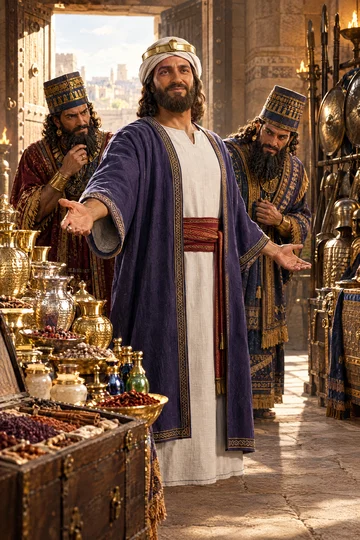
And Hezekiah was glad of them, and shewed them the house of his precious things, the silver, and the gold, and the spices, and the precious ointment, and all the house of his armour, and all that was found in his treasures: there was nothing in his house, nor in all his dominion, that Hezekiah shewed them not.
Hezekiah displays his treasures to Babylon, foreshadowing their later removal.
- Ezra 1:1-4
Now in the first year of Cyrus king of Persia, that the word of the LORD by the mouth of Jeremiah might be fulfilled, the LORD stirred up the spirit of Cyrus king of Persia, that he made a proclamation throughout all his kingdom, and put it also in writing, saying,
Cyrus’s proclamation permits the exiles to return from Babylon and rebuild the temple.
- 2 Chronicles 32:26
Notwithstanding Hezekiah humbled himself for the pride of his heart, both he and the inhabitants of Jerusalem, so that the wrath of the LORD came not upon them in the days of Hezekiah.
Hezekiah humbled himself, delaying the foretold judgment beyond his lifetime.
- 2 Chronicles 33:9-11
So Manasseh made Judah and the inhabitants of Jerusalem to err, and to do worse than the heathen, whom the LORD had destroyed before the children of Israel.
Manasseh’s wickedness brought judgment and capture in Babylon.
- Isaiah 44:28
That saith of Cyrus, He is my shepherd, and shall perform all my pleasure: even saying to Jerusalem, Thou shalt be built; and to the temple, Thy foundation shall be laid.
Names Cyrus, the ruler who would bring the people back from exile.
- 2 Kings 24:1-2
In his days Nebuchadnezzar king of Babylon came up, and Jehoiakim became his servant three years: then he turned and rebelled against him.
Nebuchadnezzar’s conquest began the removal of Jerusalem’s wealth and people.
- 2 Chronicles 36:22-23
Now in the first year of Cyrus king of Persia, that the word of the LORD spoken by the mouth of Jeremiah might be accomplished, the LORD stirred up the spirit of Cyrus king of Persia, that he made a proclamation throughout all his kingdom, and put it also in writing, saying,
Cyrus’s proclamation allows the Jews to return from Babylonian exile.
- 2 Kings 20:8-11
And Hezekiah said unto Isaiah, What shall be the sign that the LORD will heal me, and that I shall go up into the house of the LORD the third day?
Records the solar sign that prompted Babylon’s inquiry.
- Isaiah 45:1
Thus saith the LORD to his anointed, to Cyrus, whose right hand I have holden, to subdue nations before him; and I will loose the loins of kings, to open before him the two leaved gates; and the gates shall not be shut;
Names Cyrus as the ruler who would free the captives.
- Daniel 1:3-6
And the king spake unto Ashpenaz the master of his eunuchs, that he should bring certain of the children of Israel, and of the king’s seed, and of the princes;
Royal descendants are taken from Judah to Babylon.
- 2 Kings 18:5-6
He trusted in the LORD God of Israel; so that after him was none like him among all the kings of Judah, nor any that were before him.
Describes Hezekiah’s trust and obedience before his failure.
- 2 Kings 23:26-27
Notwithstanding the LORD turned not from the fierceness of his great wrath, wherewith his anger was kindled against Judah, because of all the provocations that Manasseh had provoked him withal.
Josiah’s reform did not avert the Lord’s judgment and removal of Judah.
- Isaiah 45:13
I have raised him up in righteousness, and I will direct all his ways: he shall build my city, and he shall let go my captives, not for price nor reward, saith the LORD of hosts.
Foretells the release of captives and rebuilding of the city.
Commentary
Each commentary is drawn from primary sources: the writings of Ellen G. White and Adventist pioneers and periodicals. Each commentary is separate. Its own words are not a quotation; follow the references to read the source passages.
Ellen G. White
14 sources
The days were coming when everything in the royal house at Jerusalem, including all Hezekiah had displayed and all former generations had stored, would be carried away to Babylon with nothing left behind, yet not until after Hezekiah's own lifetime.RH May 13, 1915PK 346.3–347.2ST Oct 1, 1902Ms 199, 1899, par. 5–610MR 248.1–252.1
The loss would follow Hezekiah's prideful display of his treasures to Babylon's ambassadors and his failure to use their visit to honor God, in a moment when God left him to test him and reveal what was in his heart.RH May 13, 1915PK 346.3–347.2ST Oct 1, 1902Ms 199, 1899, par. 1–4Ms 199, 1899, par. 5–6
Their report of what they had seen exposed Jerusalem's wealth to covetous eyes, so Babylon's rulers learned of its riches and planned to seek and seize them for themselves.PK 346.3–347.2ST Oct 1, 1902PK 346.2
The verse therefore warns of the danger of opening one's prosperity and advantages to an enemy of God and to outside strangers, for Hezekiah showed his treasures hoping to gain influence, but his visitors left planning to take what they had seen.Ms 196, 1898, par. 610MR 248.1–252.1Ms 123, 1902, par. 9Ms 173, 1902, par. 24Ms 1, 1853, par. 26–27
So institutions must not expose their affairs, resources, books, and plans to outsiders and unbelievers for inspection or support, as in showing strangers the riches of a health institution or opening its books for a promised contribution whose harm outweighs the gain, since betraying sacred trust by joining with unbelievers and revealing sacred things and the weakness of God's people dishonors God and brings weakness and ruin.Ms 199, 1899, par. 1–44MR 146.210MR 248.1–252.1Ms 123, 1902, par. 9Ms 197, 1899, par. 5–6
Hezekiah's Failure and Foretold Loss
The days were coming when everything in the royal house at Jerusalem would be carried to Babylon, both what Hezekiah had shown and what his fathers had laid up in store until that day, with nothing left behind.RH May 13, 1915PK 346.3–347.2ST Oct 1, 1902PK 346.2RH May 13, 1915 That removal was the future consequence of his revealing Judah's wealth, and the judgment would not fall in his own lifetime but afterward.RH May 13, 1915Ms 199, 1899, par. 5–610MR 248.1–252.1 What had been displayed and stored would eventually be taken away to Babylon.ST Oct 1, 1902RH May 13, 1915Ms 199, 1899, par. 5–6
The loss followed Hezekiah's prideful display of all his treasures to Babylon's ambassadors and his failure to use their visit to honor God.RH May 13, 1915PK 346.3–347.2ST Oct 1, 1902PK 346.2RH May 13, 1915 Instead of magnifying God before them, he opened his house and its riches to their eyes.PK 346.3–347.2ST Oct 1, 1902RH May 13, 1915 His pride in showing Judah's treasures thus connected personal unfaithfulness with coming national disaster.RH May 13, 1915ST Oct 1, 1902RH May 13, 1915
What the envoys saw they reported, and that report exposed the wealth to covetous eyes.PK 346.3–347.2PK 346.2RH May 13, 1915 Babylon's king and counselors learned of Jerusalem's riches from what the ambassadors had seen.PK 346.3–347.2ST Oct 1, 1902PK 346.2 Having seen his possessions and advantages, the visitors left planning to take them for themselves, to seek and seize that wealth.PK 346.3–347.2ST Oct 1, 1902RH May 13, 191510MR 248.1–252.1Ms 173, 1902, par. 24 In this setting God left Hezekiah to test him, that what was in his heart might be revealed.Ms 199, 1899, par. 1–4Ms 199, 1899, par. 5–6
Warning Against Exposing Resources
The verse stands as a warning against opening one's prosperity and advantages to an enemy of God and to outside strangers.Ms 196, 1898, par. 6Ms 173, 1902, par. 24 What Hezekiah exposed to the Babylonian envoys, including what his fathers had laid up in store, would be carried to Babylon with nothing left behind.Ms 196, 1898, par. 6Ms 123, 1902, par. 9Ms 1, 1853, par. 26–27 Applied to institutions, the same lesson warns against unwisely exposing their resources and affairs to outsiders, and against exposing sacred or confidential things to the wicked, since revealing the weakness of God's people dishonors God and can bring serious consequences.Ms 123, 1902, par. 9Ms 1, 1853, par. 26–27
Hezekiah displayed his treasures believing the display would gain him influence, but the visitors left planning to take for themselves the possessions and advantages they had seen.10MR 248.1–252.1Ms 173, 1902, par. 24 The warning therefore extends to foreign visitors who may use what they learn to plan how to acquire what has been shown to them.10MR 248.1–252.1Ms 173, 1902, par. 24 In the same way institutions are warned not to expose their affairs, resources, books, and plans to outsiders and unbelievers for inspection or support, and not to rely on such support without recognizing the danger of that association.4MR 146.210MR 248.1–252.1Ms 123, 1902, par. 9
Showing strangers the riches of a health institution, the Sanitarium, is the same as Hezekiah's display of the riches of the Lord's house and his own possessions.Ms 199, 1899, par. 1–44MR 146.2Ms 199, 1899, par. 5–6 That includes opening its books for public inspection for a promised financial contribution, an unwise course whose harm outweighed the gain, illustrated in Dr. Kellogg's display of the Sanitarium's riches.Ms 199, 1899, par. 1–44MR 146.2Ms 199, 1899, par. 5–6 The episode also teaches that God left Hezekiah to test him and reveal what was in his heart.Ms 199, 1899, par. 1–4Ms 199, 1899, par. 5–6 Those who betray sacred trust by joining with unbelievers and relying on them instead of God bring weakness and ruin upon themselves and those in their care.Ms 197, 1899, par. 5–6Ms 1, 1853, par. 26–27
Sources
Pioneers and periodicals
35 sources
The verse foretells that everything in the king's house, including the treasures laid up by former generations, would be carried away to Babylon with nothing left behind.RH May 13, 1915ST Jul 7, 1914ST Jan 13, 1888 It was spoken to Hezekiah after he displayed his wealth and the vessels of the house of the Lord to visitors from Babylon.RH May 13, 1915ST Oct 1, 1902ST Jan 13, 1888 The judgment came because in pride and self-exaltation he failed to give God glory for his healing, showing earthly riches instead of God's grace and saving power.RH May 13, 1915ST Oct 1, 1902RH Aug 4, 1904ST Nov 21, 1911ST Jun 18, 1902 By exposing his treasures to covetous eyes he stirred Babylonian greed, and the warning was literally fulfilled more than a century later when Nebuchadnezzar plundered Jerusalem.ST Oct 1, 1902ST Nov 21, 1911STST Jan 13, 1888 His royal descendants were also carried to Babylon to serve in the palace, fulfilled in Daniel taken from the royal line with Hananiah, Mishael, and Azariah.ST Oct 6, 1909ST Nov 28, 1911
Wording and Historical Setting
The prediction is that everything in the king's house, including the treasures of Jerusalem and all that earlier generations had laid up in store, would be carried away to Babylon with nothing left behind.RH May 13, 1915ST Oct 1, 1902ST Jul 7, 1914ST Jan 13, 1888RH Aug 4, 1904 What Hezekiah had shown to the Babylonian ambassadors was the very wealth that would be removed, so the display and the loss are bound together as showing and then forfeiting.RH May 13, 1915ST Oct 1, 1902ST Jan 13, 1888RH Aug 4, 1904ST Nov 21, 1911
The word was spoken to Hezekiah after he displayed his wealth, his house, and the gold and silver vessels of the Temple to visitors from Babylon.RH May 13, 1915ST Oct 1, 1902ST Jan 13, 1888RH Aug 4, 1904ST Nov 21, 1911 Instead of revealing heaven's treasure he set before the messengers his earthly riches, making the riches a temptation to covetous eyes.ST Oct 1, 1902RH Aug 4, 1904ST Nov 21, 1911ST The visit involved an embassy sent with presents to Merodach-baladan, the rebel king of Babylon, a serious political blunder that was rightly rebuked.ST Nov 27, 1884 The threatened carrying away was announced as a future consequence that would fall after Hezekiah's own lifetime.RH May 13, 1915
Cause of the Judgment
The judgment came because of Hezekiah's pride and self-exaltation, his backsliding, and his failure to honor God and give Him glory for his healing and the fifteen-year extension of his life.RH May 13, 1915ST Oct 1, 1902ST Jun 7, 1910 His proud display of Judah's wealth to Babylon made the coming loss the future consequence of that act, a judgment that would fall after his own lifetime.RH May 13, 1915ST Oct 1, 1902ST Nov 21, 1911 That failure to honor God when the Babylonians came led directly to the foretold captivity, in which his children went to Babylon and Jerusalem was plundered.ST Nov 21, 1911STST Oct 6, 1909 His backsliding thus brought consequences upon the people about a hundred years later, when trouble came to Judah from Babylon.ST Nov 21, 1911STST Jun 28, 1905
Instead of revealing heaven's treasure he showed earthly riches and material possessions, failing to make known God's gracious works, His grace, His saving power, and Christ.RH Aug 4, 1904ST Sep 4, 1901RH Feb 2, 1905RH May 21, 1908 He had opportunity to show the envoys God's grace and to share knowledge of God with the Babylonian visitors, but he failed to do so, and his communion with Babylon became a curse that led to the prophecy of captivity.RH Aug 4, 1904ST Jun 18, 1902ST Sep 4, 1901 Because he displayed material wealth instead of the spiritual treasure of God's saving power, the treasures of his house and those stored by his ancestors would be carried to Babylon with nothing remaining.RH Feb 2, 1905RH May 21, 1908 Without revealing Christ and trusting instead in possessions and outward signs of favor, he failed to show the principles of God's kingdom, and God's people in like manner can fall under the enemy's power.RH Aug 4, 1904
By exposing Judah's wealth to covetous eyes he stirred Babylonian greed and temptation, dishonoring God by displaying his wealth and the Temple's gold and silver vessels.ST Oct 1, 1902ST Nov 21, 1911STST Apr 15, 1903 Babylon learned of Jerusalem's wealth through what was shown, the ambassadors' greed was stirred by the display of earthly riches, and Babylon's rulers planned to seize what they heard reported.ST Oct 1, 1902ST Nov 21, 1911STST Jun 7, 1910 His exalting of himself before the envoys made the riches a temptation and stirred Babylon's desire for them, so that the stored treasures and even his descendants would be carried to Babylon and his action brought captivity upon his own seed.ST Nov 21, 1911ST The chapter records the outcome of Hezekiah insisting on his own request rather than submitting to God's will, a lasting warning about asking God to yield to human preference.RH Dec 29, 1868
Prophecy and Fulfillment
The warning was given about a hundred years before the events it predicted, more than a century before the loss it threatened.ST Nov 21, 1911STST Aug 16, 1905ST Jun 28, 1905ST Jul 13, 1904 It is dated about 712 B.C. and was fulfilled roughly 106 to 114 years later.ST Jan 13, 1888ST Jan 13, 1888 It foretold that all the treasures Hezekiah showed the Babylonian envoys, all that was in the king's house and what earlier generations had laid up in store, would eventually be carried off to Babylon with nothing left in the royal storehouses.ST Nov 21, 1911STST Jan 13, 1888ST Aug 16, 1905
It was literally fulfilled when Nebuchadnezzar captured Jerusalem and plundered its treasures, taking the treasures of the Lord's house and the king's house.ST Nov 21, 1911ST Jan 13, 1888ST Sep 4, 1901ST Jan 13, 1888 The fulfillment began with the taking of some of the temple vessels to Babylon under Nebuchadnezzar, which leads into the Babylonian captivity.RH Aug 11, 1904 That deportation began at the first capture in 605 B.C., when the city was plundered and youths of the royal family were taken to serve in Babylon.STST Nov 21, 1911ST Sep 4, 1901
Manasseh's later captivity in Babylon was the first step in the fulfillment and the beginning of a prolonged Babylonian hold on Jerusalem that was never permanently broken.RH May 21, 1908RH Aug 4, 1904 The disaster was delayed because Hezekiah and his people humbled themselves, but the prophecy was fulfilled in due time.RH May 21, 1908 The warning had called for reformation, but the people's change was temporary and incomplete, and Judah later relapsed into persistent rebellion.ST Jul 13, 1904 As Judah continued to depart from God it lost protection from surrounding nations, and Nebuchadnezzar later brought his army against Jerusalem, with the failure connected to the later trouble brought upon the kingdom by Hezekiah's son Manasseh.ST Sep 13, 1905RH May 21, 1908
The context also foretells that Hezekiah's descendants of the royal family would be carried to Babylon to serve in the king's palace.ST Sep 4, 1901 Daniel was among those taken as a young man from the royal line, with Hananiah, Mishael, and Azariah, fulfilling this prophecy.ST Nov 28, 1911ST Sep 4, 1901 His failure to honor God when the Babylonians came thus led to the foretold captivity in which his children went to Babylon and Jerusalem was plundered, his action bringing captivity upon his own seed.ST Oct 6, 1909ST Oct 6, 1909
Links to Other Scriptures
The carrying of all that was stored up to Babylon belongs to the approaching Babylonian captivity.RH Jul 6, 1916 That captivity is followed by the promised return from exile, a deliverance that also points toward deliverance from sin through the Messiah.RH Jul 6, 1916 The taking captive to Babylon meant a captivity lasting seventy years, though the foretelling does not state how long it would last and Jeremiah supplied the period of seventy years.ST Jan 13, 1888ST Feb 11, 1886 The prophecy of release naming Cyrus as the one who would free the Jews was made 176 years before its fulfillment and 113 years before Cyrus was born.ST Jan 13, 1888 At the time of that prophecy Persia did not yet exist as a country, and his ancestors were wandering tribes.ST Jan 13, 1888
Warning and Present Application
The chapter stands as a lasting warning drawn from a good king's mistake, showing the outcome of insisting on a personal request rather than submitting to God's will and of asking God to yield to human preference.RH Dec 29, 1868ST Jun 18, 1912 The warning that all stored treasure would be carried away with nothing left shows that God's holiness and justice do not excuse sin even in His own people, after prideful display of treasures to Babylon's nobility. It illustrates how God's people can fall under the enemy's power when they fail to show the principles of God's kingdom, displaying earthly wealth instead of revealing heaven's treasure.RH Aug 4, 1904 Hezekiah's failure to honor God before the Babylonian messengers helped seal Jerusalem's fate, because he displayed material wealth instead of the spiritual treasure of God's saving power and gracious works and glory.RH Feb 2, 1905RH May 21, 1908 God had intended the message of life and health to reach Babylon willingly, but when Hezekiah failed to give it under favorable circumstances the captives later declared it there.RH Aug 4, 1904 The coming captivity thus forced the people to go as messengers to Babylon after refusing to carry the gospel there willingly.RH May 21, 1908
The verse warns the church not to repeat that sin when rivalry and competition divert it from its mission.RH Feb 2, 1905 The judgment that followed showing off material possessions warns against trusting in possessions and outward signs of favor. What matters is whether visitors see Jesus rather than merely buildings and appliances, and whether Christ is revealed instead of earthly riches alone. Hezekiah's failure to be true to his trust warns that God's people must faithfully share the reformatory truths the world needs, or God will raise up others, like Daniel, to do that work.RH Nov 12, 1901
Sources