2 Kings 20:15
And he said, What have they seen in thine house? And Hezekiah answered, All the things that are in mine house have they seen: there is nothing among my treasures that I have not shewed them.
Translations
And he said, What have they seen in your house? And Hezekiah answered, All the things that are in my house have they seen: there is nothing among my treasures that I have not showed them.
King James Version, KJV Cambridge Paragraph Bible
And he said, What have they seen in thine house? And Hezekiah answered, All the things that are in mine house have they seen: there is nothing among my treasures that I have not shewed them.
And he said, What have they seen in thy house? And Hezekiah answered, All the things that are in my house have they seen: there is nothing among my treasures that I have not shown them.
And he said, What have they seen in thine house? And Hezekiah answered, All that is in mine house have they seen: there is nothing among my treasures that I have not shewed them.
And he said, What have they seen in thy house? And Hezekiah answered, All that is in my house have they seen: there is nothing among my treasures that I have not showed them.
And he saith, 'What saw they in thy house?' and Hezekiah saith, 'All that [is] in my house they saw; there hath not been a thing that I have not shewed them among my treasures.'
And he said, What have they seen in thy house? And Hezekiah said, All that is in my house have they seen: there is nothing among my treasures that I have not shewn them.
And he said—What have they seen in thy house? Then said Hezekiah—All that is in my house, have they seen, there was, nothing, that I shewed them not, among my treasures.
Berean Standard Bible, Majority Standard Bible
“ What have they seen in your palace?” Isaiah asked.“ They have seen everything in my palace,” answered Hezekiah. “ There is nothing among my treasures that I did not show them.”
He said, “ What have they seen in your house?”Hezekiah answered, “ They have seen all that is in my house. There is nothing among my treasures that I have not shown them.”
And he said, What have they seen in your house? And Hezekiah said in answer, They saw everything in my house: there is nothing among my stores which I did not let them see.
Then saide he, What haue they seene in thine house? And Hezekiah answered, All that is in mine house haue they seene: there is nothing among my treasures, that I haue not shewed the.
Douay-Rheims (Challoner revision)
And he said: What did they see in thy house? Ezechias said: They saw all the things that are in my house: there is nothing among my treasures that I have not shewn them.
Pictures
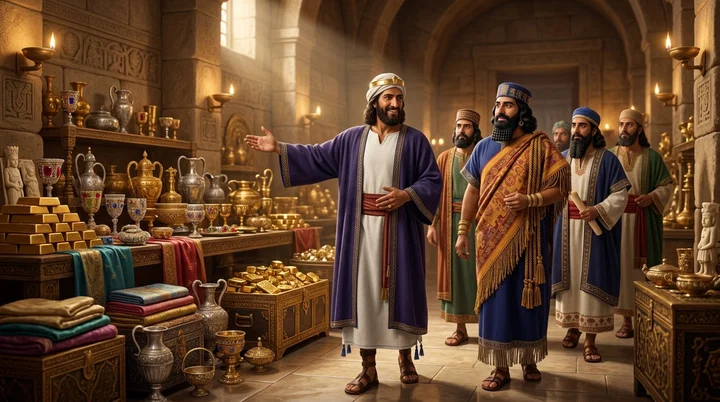
Cross-references
- Isaiah 39
At that time Merodach-baladan, the son of Baladan, king of Babylon, sent letters and a present to Hezekiah: for he had heard that he had been sick, and was recovered.
Records Hezekiah showing his treasures to visitors, followed by a warning.
- 2 Chronicles 32:31
Howbeit in the business of the ambassadors of the princes of Babylon, who sent unto him to enquire of the wonder that was done in the land, God left him, to try him, that he might know all that was in his heart.
Babylon’s ambassadors tested Hezekiah and revealed what was in his heart.
- Isaiah 38:7-8
And this shall be a sign unto thee from the LORD, that the LORD will do this thing that he hath spoken;
The Lord gives Hezekiah a sign by turning the shadow backward.
- 2 Kings 18:13-19
Now in the fourteenth year of king Hezekiah did Sennacherib king of Assyria come up against all the fenced cities of Judah, and took them.
The embassy came after the Assyrian defeat.
- Isaiah 39:6
Behold, the days come, that all that is in thine house, and that which thy fathers have laid up in store until this day, shall be carried to Babylon: nothing shall be left, saith the LORD.
gives Isaiah's prophecy of loss to Babylon
- 2 Kings 20:5-6
Turn again, and tell Hezekiah the captain of my people, Thus saith the LORD, the God of David thy father, I have heard thy prayer, I have seen thy tears: behold, I will heal thee: on the third day thou shalt go up unto the house of the LORD.
God promises Hezekiah recovery and added years after Babylon asks about his illness.
- Daniel 1:3-4
And the king spake unto Ashpenaz the master of his eunuchs, that he should bring certain of the children of Israel, and of the king’s seed, and of the princes;
The Babylonian king later took young Israelites to serve in his palace, fulfilling the prophecy linked to Hezekiah’s display.
- 2 Kings 20:8-11
And Hezekiah said unto Isaiah, What shall be the sign that the LORD will heal me, and that I shall go up into the house of the LORD the third day?
Describes the sign Hezekiah requested and the shadow moving backward.
Commentary
Each commentary is drawn from primary sources: the writings of Ellen G. White and Adventist pioneers and periodicals. Each commentary is separate. Its own words are not a quotation; follow the references to read the source passages.
Ellen G. White
11 sources
Hezekiah answered that the Babylonian visitors and ambassadors had seen everything in his house, with nothing among his treasures withheld from them.Ms 199, 1899, par. 1–410MR 248.1–252.1Ms 196, 1898, par. 6Ms 173, 1902, par. 24Ms 1, 1853, par. 26–27 What he displayed included the treasures in God's house, which were sacred and secret things consisting of riches entrusted to him.Ms 199, 1899, par. 1–4Ms 123, 1902, par. 9Ms 1, 1853, par. 26–27 God left him in this encounter as a test that revealed what was in his heart.Ms 199, 1899, par. 1–4Ms 199, 1899, par. 5–6
He made the display because he thought the visit and the favor of the visitors would gain him influence.10MR 248.1–252.1Ms 173, 1902, par. 24 Instead the display gave the Babylonians knowledge of advantages they could take for themselves, and they left planning how to take those advantages for themselves.10MR 248.1–252.1Ms 173, 1902, par. 24 In showing the Babylonian ambassadors the treasures in his house he began to give himself away, tempting Babylon to come and plunder them.10MR 248.1–252.1Ms 173, 1902, par. 24Ms 197, 1899, par. 5–6 The act was a mistake and a heinous sin of exposing himself to an enemy and betraying a sacred trust by confiding in unbelievers rather than trusting God.4MR 146.2Ms 196, 1898, par. 6Ms 1, 1853, par. 26–27Ms 197, 1899, par. 5–6 God pronounced a heavy judgment upon them for this disclosure.Ms 1, 1853, par. 26–27
What people possess is accountable to God, and the means entrusted to His servants are to be used to advance His work rather than withheld or diverted to personal gain or worldly enterprises.Lt 47, 1901, par. 3–6 Misuse of those means leaves others without needed help and warning and brings guilt before God.Lt 47, 1901, par. 3–6 The verse warns against showcasing the Lord's resources and plans to strangers and unbelievers in hope of gaining favor, and illustrates the danger of displaying valuable possessions and resources to outsiders.Ms 199, 1899, par. 1–410MR 248.1–252.1Ms 123, 1902, par. 9Ms 197, 1899, par. 5–6
Opening the Sanitarium's books to outside inspectors and to public inspection repeats Hezekiah's unwise disclosure.4MR 146.2Ms 123, 1902, par. 9 That disclosure was a mistake whose harm outweighed the money it brought in.4MR 146.2Ms 123, 1902, par. 9 Showing strangers the Sanitarium's riches likewise tested Dr. Kellogg and exposed pride and self-exaltation.Ms 199, 1899, par. 5–6 Applied to homes, the question condemns keeping and displaying so many human likenesses as unnecessary and idolatrous, teaching that the money spent on photographs should instead be used to advance God's work.Lt 48, 1901, par. 3–4
Sources
Pioneers and periodicals
15 sources
Hezekiah was answering for having shown the messengers from Babylon everything in his house and palace, withholding nothing among his treasures, including his wealth and the precious vessels of the house of the Lord.RH Aug 4, 1868RH Jan 12, 1869ST May 3, 1910 They had come after his miraculous recovery from sickness and the defeat of the Assyrians, and in pride and elation over their attention he displayed his riches, weapons and preparations for war to appear formidable and desirable as an ally, leaning on human strength instead of God.RH Aug 4, 1868ST Jan 21, 1886ST Nov 27, 1884ST Apr 15, 1903 He thus missed the opportunity to direct them to Jehovah who had healed him, to tell of the greatness and goodness of God, the riches of His grace, and the gospel of healing for the soul.RH Aug 4, 1868ST May 3, 1910RH Aug 8, 1907 His display was sin that dishonored God, excited Babylon's covetousness for Jerusalem's wealth, and brought Isaiah's word that all in his house and laid up by his fathers would be carried to Babylon and his descendants would serve there.RH Jan 12, 1869ST May 3, 1910ST Jan 21, 1886ST The same question searches every Christian life and congregation, whether visitors who see their activities, buildings and surroundings truly see Jesus and Christ and Him crucified in them.RH Nov 17, 1910
Setting and Motive
The verse belongs to the history of Judah after the ten tribes had been swept away, in the period extending to the Babylonian captivity.ST Dec 9, 1897 It is Hezekiah's answer admitting that he had shown the Babylonian messengers everything in his house and palace, with nothing among his treasures withheld.RH Aug 4, 1868RH Jan 12, 1869ST May 3, 1910ST Jan 21, 1886 That showing included his wealth and the valuable gold and silver vessels in the house of the Lord, and revealed only material things.RH Aug 8, 1907ST Apr 15, 1903 His display was vainglorious and a great mistake, elating him by their attention and preceding the prophecy that his treasures and descendants would be taken to Babylon.RH Jan 12, 1869ST May 3, 1910ST Jan 21, 1886
The visit came after the defeat of the Assyrians and after Hezekiah's miraculous recovery from sickness, when he was saved from death by the gift of indwelling life.RH Aug 4, 1868RH Aug 5, 1902 Envoys from Merodach-baladan, a rebel king in Babylon, came to congratulate him and to inquire concerning his restoration to health.ST Nov 27, 1884ST Apr 15, 1903RH Aug 5, 1902 Hezekiah welcomed their proposed alliance and made his own embassy to them, a serious political blunder.RH Aug 4, 1868ST Nov 27, 1884 He displayed his wealth, weapons, and preparations for war to show that he would be a desirable ally.RH Aug 4, 1868
His motive was pride and ostentation, his heart lifted up and elated by their attention.RH Aug 4, 1868ST Jan 21, 1886 In proud conceit over the greatness of what he possessed and commanded, with vain confidence in his own strength, he published his resources among the nations to appear formidable and to intimidate enemies.RH Sep 11, 1860 He showed his choicest treasures to the nobility of Babylon to show he would be a desirable ally, treating them as evidence of God's favor while leaning on the arm of flesh instead of God.RH Aug 4, 1868RH Sep 11, 1860 By taking the glory to himself he exalted himself in the place of God instead of testifying of Him.RH Aug 5, 1902
The lengthening of Hezekiah's life by his recovery was not used altogether as it should have been.ST Jul 13, 1904 His son Manasseh, who was born three years after the recovery, became one of the most wicked kings the nation ever had.ST Jul 13, 1904
Failed Witness and Judgment
Hezekiah was given an open door to turn the eyes of the Babylonian envoys to Jehovah, whose miracles in defeating Assyria and in healing him had drawn their notice and their inquiry concerning his recovery, yet he missed it.RH Aug 4, 1868ST Apr 15, 1903RH Aug 5, 1902 He should have told them of the greatness and goodness of the God of heaven who had healed him, the riches of God's grace and the gospel, God as the healer of the soul, the testimony that God dwells with flesh, and the gospel of the temple and its services, which is righteousness by faith that does the right thing in the right way at the right time.ST May 3, 1910RH Aug 8, 1907STST Apr 15, 1903RH Aug 5, 1902 His healing was meant to lead them to know that grace, but by showing possessions instead he hid the gospel and lost the spiritual lesson the healing could have taught, so that his descendants later had to carry that message to Babylon in captivity.ST May 3, 1910RH Aug 8, 1907 His course in this stands opposite to Daniel's faithful course under the Babylonian death decree, and it brought great evil upon Jerusalem.RH Aug 5, 1902
Instead of magnifying God he exalted himself and man in His place, showing his own greatness and wealth and revealing only material things.RH Aug 8, 1907ST Apr 15, 1903RH Aug 5, 1902 He treated his treasures and possessions as evidence of God's favor, yet displayed everything in his house without revealing Christ and him crucified. In this he hid the gospel, lost what his healing should have taught, and exalted man.RH Aug 8, 1907
The display was sin against God, who is still the same holy being as when He gave the law on Sinai, unbending and uncorrupted truth that never parleys with evil nor tolerates it in His people. Like David numbering Israel without the consent of the Lord, it was proud conceit over the greatness of what he possessed and commanded, vain confidence in his own strength, publishing his resources among the nations to appear formidable and intimidate enemies, vaunting himself and leaning on the arm of flesh instead of God.RH Sep 11, 1860 It was a great and terrible mistake and a serious political blunder, for his embassy to Merodach-baladan, a rebel king in Babylon, dishonored God and was rightly rebuked by Isaiah.ST Nov 27, 1884ST Apr 15, 1903 A woeful message therefore fell upon his ears by the mouth of the prophet.
That ostentation naturally excited the covetousness of the Babylonians, arousing their cupidity and awakening their desire for Jerusalem's wealth.STST Apr 15, 1903 What was shown in pride became the object of their craving.ST
Isaiah's message from the Lord declared that all that was in his house and laid up by his fathers would be carried to Babylon with nothing left.ST Apr 15, 1903 The surrounding prediction said those treasures would be taken to Babylon and that his descendants would be taken there to serve in the king's palace as eunuchs, bringing captivity upon them.RH Jan 12, 1869 The display was vainglorious and was felt to be elation under their attention, and it preceded that prophecy of removal of treasures and descendants.RH Jan 12, 1869ST Jan 21, 1886 That prideful failure to give God glory or share His grace awakened desire for Jerusalem's wealth, which was later carried to Babylon, so that his descendants had to carry in captivity the message he had failed to give.ST May 3, 1910ST
The outcome is preserved as an admonition against asking God to yield to one's own desire in prayer without complete submission to God's will.RH Dec 29, 1868 It proves it is a fearful thing to sin against God and that sin brings its withering curse and disastrous penalty even upon the favored.
Lesson for Believers
The question of what visitors had seen in the house becomes a searching test of the Christian's life.RH Nov 17, 1910 Those who come may observe activities and surroundings in detail and yet go away without having seen Jesus.RH Nov 17, 1910 The call therefore is to make sure that it is Christ's life that others see in the believer.RH Nov 17, 1910
The same question presses upon God's people together, whether visitors see Jesus in them rather than only their buildings and equipment. For after Hezekiah recovered from illness he welcomed the Babylonian ambassadors and displayed all his treasures and possessions to them, treating them as evidence of God's favor. He showed them everything in his house, but he did not reveal Christ and him crucified. Hezekiah upon the throne of Judah had been healed of his sickness that he individually might be a blessing by telling to the heathen kings the glories of a living God who bestows life and health.ST Jun 18, 1902
Sources