2 Kings 4:27
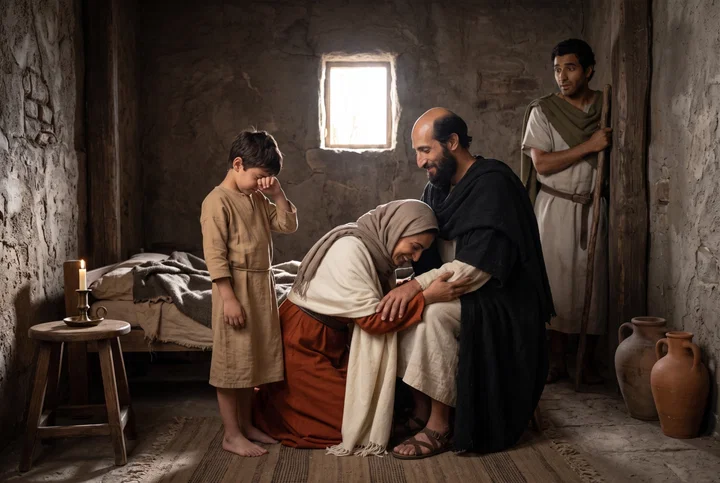
And when she came to the man of God to the hill, she caught him by the feet: but Gehazi came near to thrust her away. And the man of God said, Let her alone; for her soul is vexed within her: and the LORD hath hid it from me, and hath not told me.
Translations
And when she came to the man of God to the hill, she caught him by the feet: but Gehazi came near to thrust her away. And the man of God said, Let her alone; for her soul is vexed within her: and the LORD has hid it from me, and has not told me.
And when she came to the man of God to the hill, she caught him by the feet: but Gehazi came near to thrust her away. And the man of God said, Let her alone; for her soul is vexed within her: and the LORD hath hid it from me, and hath not told me.
And when she came to the man of God to the hill, she caught him by the feet: but Gehazi came near to thrust her away. And the man of God said, Let her alone; for her soul is vexed within her: and the Lord hath hid it from me, and hath not told me.
And when she came to the man of God to the hill, she caught him by the feet: but Gehazi came near to thrust her away. And the man of God said, Let her alone; for her soul is sorrowful within her: and the LORD hath hid it from me, and hath not told me?
And when she came to the man of God to the hill, she caught hold of his feet. And Gehazi came near to thrust her away; but the man of God said, Let her alone: for her soul is vexed within her; and the LORD hath hid it from me, and hath not told me.
And when she came to the man of God to the hill, she caught hold of his feet. And Gehazi came near to thrust her away; but the man of God said, Let her alone: for her soul is vexed within her; and Jehovah hath hid it from me, and hath not told me.
And she cometh in unto the man of God, unto the hill, and layeth hold on his feet, and Gehazi cometh nigh to thrust her away, and the man of God saith, 'Let her alone, for her soul [is] bitter to her, and Jehovah hath hidden [it] from me, and hath not declared [it] to me.'
And she came to the man of God to the mountain, and caught him by the feet; and Gehazi drew near to thrust her away; but the man of God said, Let her alone, for her soul is troubled within her, and Jehovah has hidden it from me, and has not told me.
But, when she came unto the man of God, on the mount, she caught hold of his feet,—and Gehazi drew near to thrust her away, when the man of God said—Let her alone! for, her life, is embittered to her, howbeit, Yahweh, hath hidden it from me, and hath not told me.
Berean Standard Bible, Majority Standard Bible
When she reached the man of God at the mountain, she clung to his feet. Gehazi came over to push her away, but the man of God said, “ Leave her alone, for her soul is in deep distress, and the LORD has hidden it from me and has not told me.”
When she came to the man of God to the hill, she caught hold of his feet. Gehazi came near to thrust her away; but the man of God said, “ Leave her alone, for her soul is troubled within her; and the LORD has hidden it from me, and has not told me.”
And when she came to where the man of God was on the hill, she put her hands round his feet; and Gehazi came near with the purpose of pushing her away; but the man of God said, Let her be, for her soul is bitter in her; and the Lord has kept it secret from me, and has not given me word of it.
And when shee came to the man of God vnto the moutaine, she caught him by his feete: and Gehazi went to her, to thrust her away: but the man of God said, Let her alone: for her soule is vexed within her, and the Lord hath hid it from me, and hath not told it mee.
Douay-Rheims (Challoner revision)
And when she came to the man of God to the mount, she caught hold on his feet: and Giezi came to remove her. And the man of God said: Let her alone for her soul is in anguish, and the Lord hath hid it from me, and hath not told me.
Pictures
Cross-references
- 1 Kings 17:17-24
And it came to pass after these things, that the son of the woman, the mistress of the house, fell sick; and his sickness was so sore, that there was no breath left in him.
Elijah also restores a widow’s son to life.
- 2 Kings 4:32-37
And when Elisha was come into the house, behold, the child was dead, and laid upon his bed.
Elisha restores the Shunammite woman’s son and returns him to his mother.
- 2 Kings 4:10
Let us make a little chamber, I pray thee, on the wall; and let us set for him there a bed, and a table, and a stool, and a candlestick: and it shall be, when he cometh to us, that he shall turn in thither.
The chamber provided for the prophet is where the child was laid.
- 2 Kings 5:20-27
But Gehazi, the servant of Elisha the man of God, said, Behold, my master hath spared Naaman this Syrian, in not receiving at his hands that which he brought: but, as the LORD liveth, I will run after him, and take somewhat of him.
Gehazi’s later conduct illustrates his lack of religious principle.
- 2 Kings 4:20
And when he had taken him, and brought him to his mother, he sat on her knees till noon, and then died.
The child dies, prompting his mother’s distress.
- 2 Kings 8:1-6
Then spake Elisha unto the woman, whose son he had restored to life, saying, Arise, and go thou and thine household, and sojourn wheresoever thou canst sojourn: for the LORD hath called for a famine; and it shall also come upon the land seven years.
Elisha later provides for the woman who had shown him hospitality.
- Luke 8:55
And her spirit came again, and she arose straightway: and he commanded to give her meat.
another raising before Christ rose
Commentary
Each commentary is drawn from primary sources: the writings of Ellen G. White and Adventist pioneers and periodicals. Each commentary is separate. Its own words are not a quotation; follow the references to read the source passages.
Ellen G. White
2 sources
The woman who comes to the man of God on the hill is the Shunammite mother, arriving in deep distress after the death of her son and clinging to Elisha by the feet.PK 237.3–239.2 When Gehazi came near to thrust her away, Elisha stopped him and told him to leave her alone and not drive her away.PK 237.3–239.2 Her soul was vexed within her, and when she reached Elisha she revealed to him the sorrow that burdened her.PK 237.3–239.2
The Lord had hidden the cause of her distress from Elisha and had not told him, a limitation Elisha openly acknowledged.PK 235 Elisha responded to her appeal by going with her.PK 237.3–239.2
Sources
Pioneers and periodicals
17 sources
The grieving mother came to the man of God on the hill over her dead son and clung to his feet, and when Gehazi tried to thrust her away he was told to let her alone because her soul was troubled within her.ST Oct 5, 1904RH Jan 4, 1906ST Oct 5, 1904 The Lord had hidden the cause from Elisha and had not told him, so he did not know it of himself.ST Oct 5, 1904RH Sep 13, 1906RH Jan 4, 1906 Her son's restoration was a genuine resurrection from the dead before Christ's resurrection, though not to immortality.RH Aug 6, 1872RH May 28, 1861ST Mar 30, 1876 Christ being called the firstfruits of them that slept means first in preeminent rank in redemption rather than first in order of time, for the earlier raising centered in Him who is the resurrection and the life and depended on His power.ST Apr 30, 1896 The restoring of the boy illustrates personal work through close personal contact rather than by proxy, and the mother's clinging to the man of God brings comfort when an infant child dies because the dead will live again.RH Jun 24, 1902RH Jul 20, 1916
Words and Setting
She came to the man of God to the hill in deep distress over her dead son and grasped him by the feet, and when Gehazi came near to thrust her away he was told to let her alone because her soul was vexed within her.ST Oct 5, 1904RH Jan 4, 1906ST Oct 5, 1904RH Jun 24, 1902 Her grief was so deep that she fell at his feet and clung to him after her young son died.RH Jan 4, 1906ST Oct 5, 1904RH Jun 24, 1902 The word rendered caught expresses strength and force, meaning to bind fast, to gird tight, to hold fast to anything, to cleave to, to adhere firmly, to make firm and strong, to strengthen, to be strong upon anyone, and to show oneself strong and courageous, with ideas of strength, power, and force prominent in it and its eight derivatives.RH Aug 17, 1876 It stands in the same hiphil future form as layeth hold in Isaiah 56:2, as one of twenty-two places rendered laid hold, took hold, caught hold, held, caught, took, prevail, and be strong, and the word occurs about two hundred and sixty times in the Old Testament.RH Aug 17, 1876 The Lord hid the cause of her vexation from Elisha and had not told him, so he did not know it by himself and recognized her distress without knowing beforehand what troubled her.ST Oct 5, 1904RH Sep 13, 1906RH Jan 4, 1906ST Oct 5, 1904 God does not always reveal everything to his prophet, and a prophet not seeing both sides at once nor comprehending the whole situation until further revelation is given is not a mistake.RH Sep 13, 1906
Her hospitality in entertaining Elisha was remembered and blessed by God with a greatly desired blessing sent to the Shunammite home, first the birth of a son and later the son's restoration from the dead.CO 73.5 After her son died she laid him to rest in Elisha's walled bedchamber, where he had enjoyed blessed seasons of secret prayer, and went to ask him to come and pray that the boy might be raised.RH Jul 25, 1907 There Elisha called upon the Lord to restore life to the deceased child and continued in supplication until God heard and raised the boy, showing that the family's kindness in housing, feeding, and furnishing lodging for him never gave regret and that cooperation with the Lord's servant brings manifestation of God's mighty power.RH Jul 25, 1907 Her son had fallen ill after being overcome by the sun's heat.RH Aug 29, 1871 Shunem lay on the opposite side of the hill from Nain, where Jesus raised a widow's only son, and the nearby setting and memory of the earlier prophets may have led the people at Nain to call Jesus a great prophet.
Resurrection and Christ
The raising of the Shunammite woman's son recorded in 2 Kings 4 was a genuine resurrection from the dead that took place before Christ's resurrection.RH Aug 6, 1872RH May 28, 1861ST Mar 30, 1876 It was a real resurrection even though he was not raised to immortality.RH Aug 6, 1872RH May 28, 1861 That raising was a true resurrection and not merely a return to mortal life, for even the wicked are raised and spoken of as resurrected.ST Apr 30, 1896
Christ being called the firstfruits of them that slept does not mean first in order of time but first in preeminent rank and station in redemption.ST Apr 30, 1896 The earlier raising centered in Christ, who is the resurrection and the life, stood foremost and preeminent in it, and supplied the power on which it depended.ST Apr 30, 1896 The raising is an exception to the general rule that the dead live again through a resurrection by Christ's power.ST Jan 28, 1889
The account records no question from the mother about the child's thoughts or experiences while dead and gives no indication that he was conscious in death.ST The miracle shows that raising the dead, considered by itself, did not prove Jesus to be the Messiah, since Elisha and others also served as instruments in raising the dead.ST Jan 30, 1912 The decisive proof of his Messiahship was that his death, burial, and resurrection fulfilled the Scriptures.ST Jan 30, 1912
Ministry and Comfort
Elisha's restoring of the Shunammite woman's son illustrates personal work done through close personal contact and not by proxy.RH Jul 20, 1916 God likewise wants people to come into close personal touch with others, so that his power working through them may awaken people from death to life.RH Jul 20, 1916 The account of the grieving mother clinging to the man of God after her young son died gives comfort when an infant child dies, because Jesus is the resurrection and the life and the dead will live again.RH Jun 24, 1902
Sources