2 Kings 4:28
Then she said, Did I desire a son of my lord? did I not say, Do not deceive me?
Translations
American King James Version, King James Version, KJV Cambridge Paragraph Bible, Revised Version, American Standard Version
Then she said, Did I desire a son of my lord? did I not say, Do not deceive me?
Then she said, Did I ask a son from my lord? did I not say, Do not deceive me.
And she saith, 'Did I ask a son from my lord? did I not say, Do not deceive me?'
And she said, Did I desire a son of my lord? did I not say, Do not deceive me?
Then said she, Did I ask a son, of my lord? Said I not, Thou must not mislead me?
Berean Standard Bible, Majority Standard Bible
Then she said, “ Did I ask you for a son, my lord? Didn’t I say, ‘Do not deceive me?’”
Then she said, “ Did I ask you for a son, my lord? Didn’t I say, ‘Do not deceive me’?”
Then she said, Did I make a request to my lord for a son? did I not say, Do not give me false words?
Then she said, Did I desire a sonne of my lord? did I not say, Deceiue me not?
Douay-Rheims (Challoner revision)
And she said to him: Did I ask a son of my lord? did I not say to thee: Do not deceive me?
Pictures
Cross-references
- 2 Kings 4:32-35
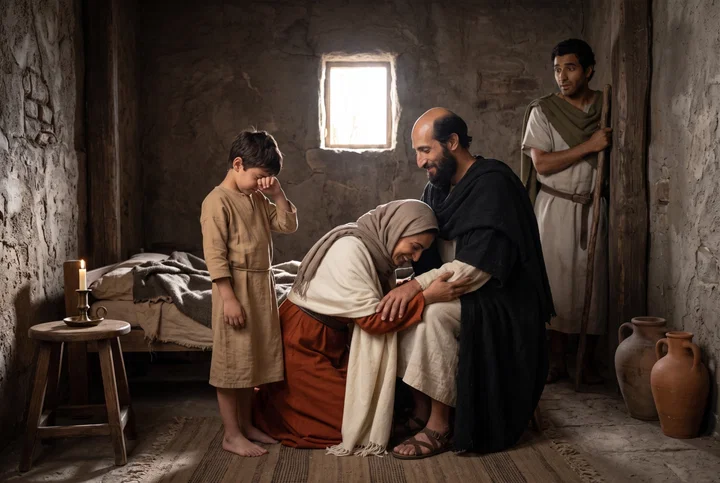
And when Elisha was come into the house, behold, the child was dead, and laid upon his bed.
Elisha prays and restores the Shunammite woman’s son to life.
- 2 Kings 4:16-17
And he said, About this season, according to the time of life, thou shalt embrace a son. And she said, Nay, my lord, thou man of God, do not lie unto thine handmaid.
Elisha promised the Shunammite woman a son, and she conceived as promised.
- 2 Kings 4:16
And he said, About this season, according to the time of life, thou shalt embrace a son. And she said, Nay, my lord, thou man of God, do not lie unto thine handmaid.
recalls her plea not to deceive her when promised
- 2 Kings 8:1-6
Then spake Elisha unto the woman, whose son he had restored to life, saying, Arise, and go thou and thine household, and sojourn wheresoever thou canst sojourn: for the LORD hath called for a famine; and it shall also come upon the land seven years.
later rescue from famine for same hospitality
Commentary
Each commentary is drawn from primary sources: the writings of Ellen G. White and Adventist pioneers and periodicals. Each commentary is separate. Its own words are not a quotation; follow the references to read the source passages.
Ellen G. White
2 sources
The words are spoken by the Shunammite woman to Elisha after the promised child has died.PK 235.1PK 237.3–239.2 In them she reminds him that she had not asked for a son, and that she had warned him not to raise a hope that would end in pain.PK 235.1PK 237.3–239.2 Her appeal recalls her earlier caution against a false hope now broken by loss.PK 235.1PK 237.3–239.2 The utterance expresses grief and reproach, and the pain and distress of a mother bereaved of her son.PK 235.1PK 237.3–239.2
Sources
Pioneers and periodicals
17 sources
The verse is the grieving plea of the Shunammite mother to Elisha on Mount Carmel after her only son died, when she caught hold of his feet with her soul vexed within her.ST Jul 28, 1898ST Oct 5, 1904 By asking whether she had desired a son and recalling her warning not to deceive her, she reminds him that the child was an unsought blessing she had feared to hope for.ST Jul 28, 1898ST Oct 5, 1904ST Oct 5, 1904 That son had been sent by God as a reward for sheltering Elisha and fitting a chamber with bed, table, stool and candlestick for his comfort as a man of God, and God further rewarded her kindness by restoring the boy even from the dead.CO 73.5RH Jul 25, 1907 His return to life was a genuine resurrection from the dead though he was not raised to immortality, and like all such raisings it depended upon the power of Christ who is the resurrection and the life.RH Aug 6, 1872RH May 28, 1861ST Apr 30, 1896 When Christ is called the first-fruits of them that slept he is first in preeminent rank in redemption, not first in order of time, since his sacrifice established in God's purpose made possible this raising before it occurred.ST Oct 12, 1876ST Apr 30, 1896
Words and Story Context
The verse is the Shunammite's plea to Elisha on Mount Carmel after her son died, spoken when she came to the hill and caught hold of the man of God's feet with her soul vexed within her.ST Jul 28, 1898ST Oct 5, 1904 In that posture she reminded him that she did not desire a son of him and had said, Do not deceive me.ST Jul 28, 1898ST Oct 5, 1904 Her words were those of a bereaved mother grieving the death of the promised child.ST Oct 5, 1904
By asking whether she had desired a son and recalling her warning not to deceive her, she recalled that she had not asked for a son and had warned him not to raise a hope that would deceive her.ST Jul 28, 1898ST Oct 5, 1904 The birth had been promised as a blessing she had not sought, and her speech expressed grief over the child's death as an unsought blessing now taken away.ST Oct 5, 1904ST Oct 5, 1904 The child in question was her only son.
He had been given as a return favor for sheltering Elisha, though she had no child and her husband was old.ST Oct 5, 1904 When he grew large enough to go out to the field with his father he was taken suddenly ill and died.ST Oct 5, 1904 She laid him on the prophet's bed in his bedchamber on the wall and rode with a servant to find Elisha and ask him to come and pray that the boy might be raised.ST Oct 5, 1904RH Jul 25, 1907 Her plea led Elisha to speak to Gehazi.ST Jul 28, 1898 The boy had been overcome by sunstroke while out on the plains, the same kind of sunstroke still common upon those plains, showing that the diseases of the Holy Land are of the same types as in Bible times.RH Aug 29, 1871
Resurrection and Christ
The verse belongs to the account of the Shunammite woman's son who was genuinely raised to life from the dead before Christ's resurrection, as one of several people so raised.RH Aug 6, 1872RH May 28, 1861ST Mar 30, 1876 His return to life was a real resurrection from the dead even though he was not raised to immortality.RH Aug 6, 1872RH May 28, 1861 It is not a separate kind of event distinguished by whether the person was raised to mortality or immortality, and to say those raised to mortality were not truly resurrected does violence to Scripture, since even the wicked who are raised to mortality are spoken of as resurrected.RH Aug 6, 1872ST Apr 30, 1896
All such resurrections before and after his own resurrection center in Christ, who is the resurrection and the life, and depended upon his power.ST Apr 30, 1896 When Christ is called the first-fruits of them that slept he is first in preeminent rank and station in redemption, not first in order of time, and he stands foremost and preeminent in them whether they occurred before or after his own resurrection.ST Apr 30, 1896 His restoration to life was made possible by Christ's sacrifice, which had not yet occurred but was established in God's purpose.ST Oct 12, 1876
The raising is an exception to the general rule that the dead live again through resurrection at Christ's coming.ST Jan 30, 1912ST Jan 28, 1889 It shows that other people were raised from the dead, so resurrection by itself does not prove that Jesus is the Messiah.ST Jan 30, 1912 The mother's asking no questions about her son's thoughts or condition while he was dead shows that the dead are not conscious.ST
Hospitality, Comfort, Ministry
The son was a greatly desired blessing sent to the Shunammite home as a reward for entertaining Elisha.CO 73.5 She and her husband had made him a chamber with bed and table and stool and candlestick, and the whole account in 2 Kings 4:11-37 shows God rewarding hospitality to His servant.CO 73.5 Their care in building and furnishing that chamber and in housing and feeding the Lord's servant brought great things to their home in return.RH Jul 25, 1907 That hospitality God later remembered again by saving them from a great famine.CO 73.5 Such sweet cooperation with God's workers opens the way for God's mighty power to be manifested.RH Jul 25, 1907
The son was given for genuine hospitality, because she thought and planned and acted to make Elisha comfortable specially because he was a man of God. A son was the highest aspiration of every wife among Israel, the boon of embracing a son in hope of the coming Messiah. The Lord in loving-kindness further blessed her kindness to His servant by restoring that son to her even from the dead. The Lord remembers and richly rewards acts of kindness shown to His servants, and His mercy is not limited to acts but blesses thought and care for the work and worship and service of God. Those who take such thought and care will receive blessing and grace by setting affection on things above and not on things on the earth.
That chamber on the wall where she laid her dead son to rest was Elisha's own place for secret prayer.RH Jul 25, 1907 There Elisha called upon the Lord to restore life to the child and continued in supplication until God heard and raised the boy to life again.RH Jul 25, 1907 He restored the son through close personal contact, illustrating the need to come personally near to people so that God's power may awaken them from death to life.RH Jul 20, 1916 The account in 2 Kings 4:18-37 supplies words of comfort when parents mourn the death of an infant son only a few months old.RH Jun 24, 1902
Sources