2 Kings 6:5
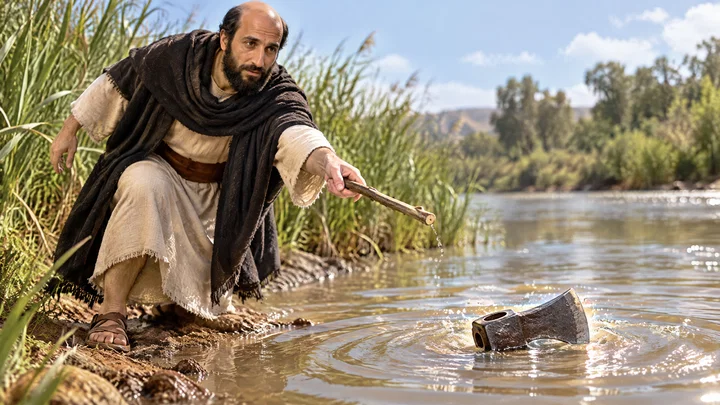
But as one was felling a beam, the axe head fell into the water: and he cried, and said, Alas, master! for it was borrowed.
Translations
American King James Version, Webster Bible
But as one was felling a beam, the ax head fell into the water: and he cried, and said, Alas, master! for it was borrowed.
But as one was felling a beam, the axe head fell into the water: and he cried, and said, Alas, master! for it was borrowed.
But as one was felling a beam, the axe head fell into the water: and he cried, and said, Alas, master, for it was borrowed.
But as one was felling a beam, the axe-head fell into the water: and he cried, and said, Alas, my master! for it was borrowed.
But as one was felling a beam, the axe-head fell into the water; and he cried, and said, Alas, my master! for it was borrowed.
and it cometh to pass, the one is felling the beam, and the iron hath fallen into the water, and he crieth and saith, 'Alas! my lord, and it asked!'
And it came to pass as one was felling a beam, that the iron fell into the water; and he cried and said, Alas, master, and it was borrowed!
And it came to pass, as one was felling a branch, that, the axe-head, fell into the water, so he made outcry and said—Alas! my lord, for, it, was borrowed!
Berean Standard Bible, Majority Standard Bible
As one of them was cutting down a tree, the iron axe head fell into the water. “Oh, my master,” he cried out, “ it was borrowed!”
But as one was cutting down a tree, the ax head fell into the water. Then he cried out and said, “Alas, my master! For it was borrowed.”
But one of them, while cutting a board, let the head of his axe go into the water; and he gave a cry, and said, This is a bad business, my master, for it is another's.
And as one was felling of a tree, the yron fell into the water: then he cryed, and said, Alas master, it was but borowed.
Douay-Rheims (Challoner revision)
And it happened, as one was felling some timber, that the head of the axe fell into the water: and he cried out, and said: Alas, alas, alas, my lord, for this same was borrowed.
Pictures
Cross-references
- Exodus 22:14
And if a man borrow ought of his neighbour, and it be hurt, or die, the owner thereof being not with it, he shall surely make it good.
A borrower must compensate the owner for lost or damaged property.
- 2 Kings 2:14
And he took the mantle of Elijah that fell from him, and smote the waters, and said, Where is the LORD God of Elijah? and when he also had smitten the waters, they parted hither and thither: and Elisha went over.
both named as Jordan miracles
Commentary
Each commentary is drawn from primary sources: the writings of Ellen G. White and Adventist pioneers and periodicals. Each commentary is separate. Its own words are not a quotation; follow the references to read the source passages.
Ellen G. White
6 sources
The loss occurred while students in the schools of the prophets were engaged in useful manual labor in the open air, felling beams to build a dwelling to live in, with teachers and students united in the work.ED 217.1–2RP 26.2–48MR 26.2 The worker was using a borrowed axe, and when the head fell into the water he cried out in distress because it was not his own.PK 260.3ED 217.1–2RP 26.2–4 When shown where it had fallen, Elisha caused the iron to float so the man could retrieve it, saving it from loss and relieving his distress.PK 260.3ED 217.1–2Lt 83, 1896, par. 23–25 The miracle shows God honoring the work of ordinary laborers.ED 217.1–2 The account shows God as an ever-present Helper in difficulty and trial.Lt 83, 1896, par. 23–25
The felling of beams shows instruction combined with vigorous manual work in the open air.8MR 26.2 Such united labor gives the animal passions a healthy outlet and keeps them in proper bounds, while it strengthens the muscles and encourages proper circulation of the blood.8MR 26.2 It helps preserve the body from disease and is a great help to spirituality.8MR 26.2
The school of the prophets in this passage is a school where workers are instructed and the pattern for institutions for educating workers.Lt 93, 1892, par. 24–26 Money put into the treasury is to be used to erect such institutions and to increase their facilities rather than to diminish them even when the coming of the Lord is near.Lt 93, 1892, par. 24–26 This is so that a great work may be done in a short time, and those found doing this work at His coming will be approved.Lt 93, 1892, par. 24–26
Sources
Pioneers and periodicals
16 sources
The school of the prophets had outgrown its quarters, so with Elisha's approval and help the teachers and students went to the Jordan to cut timber and build larger quarters for themselves.ST Oct 22, 1894RH Mar 18, 1915RH Nov 26, 1903 As one was felling a beam his borrowed axe head slipped from the handle into the water, and in distress he cried to his master, whereupon Elisha miraculously caused the iron to rise and float so it could be recovered.ST Feb 10, 1904RH May 15, 1900RH Jan 25, 1912 The outcry shows that what is borrowed must be kept carefully and returned in good condition, with restitution made if it is lost or damaged.RH Nov 14, 1871 God's care to restore a poor student's borrowed tool teaches that even small, ordinary and embarrassing troubles of daily life are worthy of His help.RH Jan 25, 1912ST Jan 26, 1882 The loss of the cutting head means lack of conversion to be restored by the new birth, and the cry over it is the sinner's cry of helpless need for mercy, forgiveness, cleansing and the Holy Spirit, which God is ready to answer.ST Feb 10, 1904
The School and Loss
The school of the prophets at Jericho had become too small in later times when such schools were established, and Elisha agreed to its relocation to the Jordan.RH Mar 18, 1915 At the Jordan the students and teachers cut and carried their own timber and built larger quarters for themselves, a house and school that provided room for learning.ST Jan 18, 1916ST Oct 22, 1894RH Nov 26, 1903 That building work was done with Elisha's approval and participation and help, for he was present with them on the project.RH Nov 26, 1903
As one was felling a beam the head of his borrowed axe came off the handle and fell into the water of the stream, the River Jordan.ST Feb 10, 1904RH May 15, 1900ST May 19, 1881 In distress he cried out to his master because the axe was borrowed.ST Feb 10, 1904 The students lacked enough tools for the work, so the loss of the borrowed axe head was a serious burden for a struggling student, though it might seem a small matter to someone well-off.RH May 15, 1900RH Jan 25, 1912
Elisha miraculously recovered the axe head so the young man could retrieve it, with the iron rising from its bed and floating on the surface at the prophet's bidding.RH May 15, 1900RH Jan 25, 1912ST May 19, 1881 He may have cut a pole and thrust it into the water, trying to catch the axe through its eye and pull it out, when the miracle occurred.ST Jul 13, 1904
Lessons for Life and Faith
The outcry over the axe head falling into the water shows that the borrowed tool mattered to the loser.RH Nov 14, 1871 Borrowed property must be handled carefully and returned in good condition, and if it is damaged or lost the borrower is responsible for making restitution.RH Nov 14, 1871 This duty of restitution for what is borrowed was held sacred among the Israelites.RH Nov 14, 1871
The sons of the prophets cutting and carrying their own timber and building their own house proves that true men of God are not above manual labor.ST Oct 22, 1894 God has honored the work of the everyday toiler, and in this building of a house for themselves by students at school a miracle was wrought to save from loss the axe that was borrowed.ST Jan 18, 1916 His Spirit is the spirit of earnest, faithful, honest labor wherever duty calls, and He never has lazy children.ST Oct 22, 1894
The school at work building larger quarters together under Elisha's approval and participation was providing room for learning and at the same time training its students for service.RH Nov 26, 1903 It was a missionary training school to educate men and women to labor in the cause of God, where priests, ministers, and prophets received instruction for a short period and then went out to labor, returning when they found themselves deficient and unqualified.ST Sep 20, 1883 There habits of industry, the art of reaching hearts, the best manner of instructing in the things of God, and training for service were taught, with the Bible holding supreme place in Christian education.RH Nov 26, 1903ST Sep 20, 1883RH Jul 21, 1903
The axe head is the important part of the tool, and its loss means lack of conversion.ST Feb 10, 1904 That loss must be restored by the miracle of the new birth before a student can properly begin or successfully carry on the work of restoring the moral image of God in himself.ST Feb 10, 1904 He is not told to do the best he can with the handle alone, but the head must be restored by miracle before he can go on with his work.ST Feb 10, 1904
The cry, Alas, master, for it was borrowed, is the sinner's cry when he sees and feels his need of Jesus, undone and lost and helpless.ST Feb 10, 1904 It is asking for mercy, forgiveness of sins, cleansing from all unrighteousness, and the Holy Spirit.ST Feb 10, 1904 Upon confession God is just as ready now to work a miracle, being faithful and just to forgive sin and to cleanse from all unrighteousness.ST Feb 10, 1904
The recovery of the axe shows that God works with people's feeble efforts rather than despising them.ST Jul 13, 1904 God's care to restore a poor man's lost, borrowed axe teaches that even small, embarrassing, and ordinary troubles are worthy of His care and help.ST Jan 26, 1882 Losing a borrowed axe head in the river was a serious burden for a struggling student, though it might seem a small matter to someone well-off, and by causing the iron to float God showed He can help with ordinary troubles and lighten the burdens of daily life.RH Jan 25, 1912ST Jan 26, 1882
A Genuine Miracle
Causing the iron to swim was a miracle contrary to any law known to man, yet done in harmony with certain fixed laws beyond the scope of man's knowledge.ST Feb 8, 1883 It is surpassed by the creation of the earth and the raising of a dead man to life.ST Feb 8, 1883 It is beyond understanding, for if it could be understood it would not be a miracle.ST Feb 8, 1883 It is one of the most stupendous miracles ever witnessed on the banks of the Jordan, showing the love and power of God and also his judgments.ST May 19, 1881 Together with the other great events connected with the river it makes the memory of the stream sacred to the child of God.ST May 19, 1881
The return of the axe head from the water, swimming or floating, is to be accepted as a real, actual, true event in the history of Elisha.ST Jan 24, 1906 It stands with Creation, the Fall, the Flood, the confusion of tongues, and the other miracles of Elijah and Elisha.ST Jan 24, 1906 It is not to be dismissed as impossible or as a pious legend or myth.ST Jan 24, 1906 It is part of the Old and New Testament narratives to be taught to children as true throughout.ST Jan 24, 1906
Taken by itself as a bare assertion unsupported by evidence, the floating of iron does not appear scientifically reasonable.RH Aug 29, 1912 Like a balloon flying upward does not disprove the law of gravitation but must be examined under a more comprehensive law, this isolated fact must not decide the truth of Scripture.RH Aug 29, 1912 Reason itself, used as in scientific investigation, compels acceptance of the miracle as true once a person of infinite knowledge and unquestionable truth of character has accepted as divinely inspired the book containing it.RH Aug 29, 1912 For the greater includes the less and every other assertion in the book must also be accepted, with its inherent reasonableness as an isolated fact having nothing to do with the matter.RH Aug 29, 1912
Sources