2 Kings 2:14
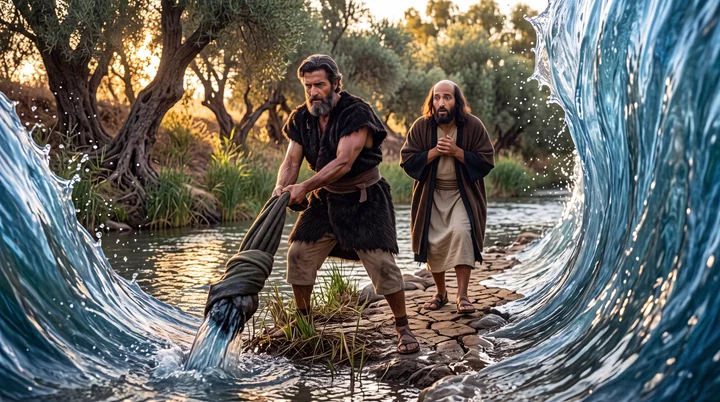
And he took the mantle of Elijah that fell from him, and smote the waters, and said, Where is the LORD God of Elijah? and when he also had smitten the waters, they parted hither and thither: and Elisha went over.
Translations
And he took the mantle of Elijah that fell from him, and smote the waters, and said, Where is the LORD God of Elijah? and when he also had smitten the waters, they parted here and thither: and Elisha went over.
And he took the mantle of Elijah that fell from him, and smote the waters, and said, Where is the LORD God of Elijah? and when he also had smitten the waters, they parted hither and thither: and Elisha went over.
and he took the mantle of Elijah that fell from him, and smote the waters, and said, Where is the Lord God of Elijah? and when he also had smitten the waters, they parted hither and thither: and Elisha went over.
And he took the mantle of Elijah that fell from him, and smote the waters, and said, Where is the LORD God of Elijah? And when he also had smitten the waters, they parted hither and thither: and Elisha went over.
And he took the mantle of Elijah that fell from him, and smote the waters, and said, Where is the LORD, the God of Elijah? and when he also had smitten the waters, they were divided hither and thither: and Elisha went over.
And he took the mantle of Elijah that fell from him, and smote the waters, and said, Where is Jehovah, the God of Elijah? and when he also had smitten the waters, they were divided hither and thither; and Elisha went over.
and he taketh the robe of Elijah that fell from off him, and smiteth the waters, and saith, 'Where [is] Jehovah, God of Elijah — even He?' and he smiteth the waters, and they are halved, hither and thither, and Elisha passeth over.
and he took the mantle of Elijah which had fallen from him, and smote the waters, and said, Where is Jehovah, the God of Elijah? He also smote the waters, and they parted hither and thither, and Elisha went over.
and took the mantle of Elijah which had fallen from him, and smote the waters, and said, Where is Yahweh, the God of Elijah? And, when, he also, smote the waters, they were divided, hither and thither, and Elisha, passed over.
Berean Standard Bible, Majority Standard Bible
Then he took the cloak of Elijah that had fallen from him and struck the waters. “ Where now is the LORD, the God of Elijah?” he asked.And when he had struck the waters, they parted to the right and to the left, and Elisha crossed over.
He took Elijah’s mantle that fell from him, and struck the waters, and said, “ Where is the LORD, the God of Elijah?” When he also had struck the waters, they were divided apart, and Elisha went over.
And he took Elijah's robe, which had been dropped from him, and giving the water a blow with it, said, Where is the Lord, the God of Elijah? and at his blow the waters were parted this way and that; and Elisha went over.
After, he tooke the cloke of Eliiah, that fell from him, and smote the waters, and sayde, Where is the Lord God of Eliiah? And so he also, after he had striken the waters, so that they were deuided this way and that way, went ouer, euen Elisha.
Douay-Rheims (Challoner revision)
And he struck the waters with the mantle of Elias, that had fallen from him, and they were not divided. And he said: Where is now the God of Elias? And he struck the waters, and they were divided, hither and thither, and Eliseus passed over.
Pictures
Cross-references 20 of 25
- 2 Kings 2:8
And Elijah took his mantle, and wrapped it together, and smote the waters, and they were divided hither and thither, so that they two went over on dry ground.
Elisha repeats Elijah’s parting of the Jordan with his mantle.
- 1 Kings 19:19-21
So he departed thence, and found Elisha the son of Shaphat, who was plowing with twelve yoke of oxen before him, and he with the twelfth: and Elijah passed by him, and cast his mantle upon him.
Elijah’s mantle marks Elisha’s call to follow and succeed him.
- 2 Kings 2:9
And it came to pass, when they were gone over, that Elijah said unto Elisha, Ask what I shall do for thee, before I be taken away from thee. And Elisha said, I pray thee, let a double portion of thy spirit be upon me.
Elisha’s request for a double portion is fulfilled in the miracle.
- Joshua 3:15-16
And as they that bare the ark were come unto Jordan, and the feet of the priests that bare the ark were dipped in the brim of the water, (for Jordan overfloweth all his banks all the time of harvest,)
both tell of Jordan stopped for dry passage
- 1 Kings 18:36-40
And it came to pass at the time of the offering of the evening sacrifice, that Elijah the prophet came near, and said, LORD God of Abraham, Isaac, and of Israel, let it be known this day that thou art God in Israel, and that I am thy servant, and that I have done all these things at thy word.
God’s power vindicates Elijah’s words and ministry.
- 2 Kings 6:6
And the man of God said, Where fell it? And he shewed him the place. And he cut down a stick, and cast it in thither; and the iron did swim.
A prophet’s action parts the Jordan’s waters and makes iron float.
- 2 Kings 6:17
And Elisha prayed, and said, LORD, I pray thee, open his eyes, that he may see. And the LORD opened the eyes of the young man; and he saw: and, behold, the mountain was full of horses and chariots of fire round about Elisha.
The fiery chariots display God’s power at work through Elisha.
- Matthew 17:3
And, behold, there appeared unto them Moses and Elias talking with him.
Elijah appears bodily on the mount.
- 2 Kings 5:10-14
And Elisha sent a messenger unto him, saying, Go and wash in Jordan seven times, and thy flesh shall come again to thee, and thou shalt be clean.
Both make the Jordan the commanded place of blessing.
- Matthew 3:13
Then cometh Jesus from Galilee to Jordan unto John, to be baptized of him.
Both events occur at the Jordan River.
- 1 Kings 18:42-44
So Ahab went up to eat and to drink. And Elijah went up to the top of Carmel; and he cast himself down upon the earth, and put his face between his knees,
Elijah’s prayer is linked to the drought and the coming rain.
- 2 Kings 4:33-35
He went in therefore, and shut the door upon them twain, and prayed unto the LORD.
Elisha’s prayer is answered when the child returns to life.
- 2 Kings 13:18-19
And he said, Take the arrows. And he took them. And he said unto the king of Israel, Smite upon the ground. And he smote thrice, and stayed.
Joash receives deliverance in proportion to how much he ventures.
- 2 Kings 2:10
And he said, Thou hast asked a hard thing: nevertheless, if thou see me when I am taken from thee, it shall be so unto thee; but if not, it shall not be so.
promise tested at the Jordan
- Exodus 14:21-22
And Moses stretched out his hand over the sea; and the LORD caused the sea to go back by a strong east wind all that night, and made the sea dry land, and the waters were divided.
God answered Moses’ cry by dividing the waters.
- Joshua 3:17
And the priests that bare the ark of the covenant of the LORD stood firm on dry ground in the midst of Jordan, and all the Israelites passed over on dry ground, until all the people were passed clean over Jordan.
same crossing that makes Jordan revered
- 1 Kings 19:16
And Jehu the son of Nimshi shalt thou anoint to be king over Israel: and Elisha the son of Shaphat of Abel-meholah shalt thou anoint to be prophet in thy room.
Elijah is told to anoint Elisha as his successor.
- 1 Kings 17:1
And Elijah the Tishbite, who was of the inhabitants of Gilead, said unto Ahab, As the LORD God of Israel liveth, before whom I stand, there shall not be dew nor rain these years, but according to my word.
Elijah’s prayers are linked to drought and rain.
- 1 Kings 19:1-3
And Ahab told Jezebel all that Elijah had done, and withal how he had slain all the prophets with the sword.
Jezebel pursues Elijah and seeks his life after the events at Carmel.
- Psalms 114:3
The sea saw it, and fled: Jordan was driven back.
The sea and Jordan part as Israel passes through.
Commentary
Each commentary is drawn from primary sources: the writings of Ellen G. White and Adventist pioneers and periodicals. Each commentary is separate. Its own words are not a quotation; follow the references to read the source passages.
Ellen G. White
13 sources
After Elijah was taken away, Elisha took up his fallen mantle, struck the waters of the Jordan, called out for the Lord God of Elijah, and crossed over on dry ground when the waters divided to either side.ED 60.1–2Ms 114, 1901, par. 5–7Lt 12, 1897, par. 34–36 His cry was an appeal to the God who had guided Elijah, seeking the Lord's help as he took up the work Elijah had carried.Ms 114, 1901, par. 5–7Lt 12, 1897, par. 34–36 The parting of the waters confirmed that Elijah's spirit rested upon Elisha and that the prophetic work and authority had passed to him and would continue through him, as the sons of the prophets recognized.ED 60.1–2Ms 114, 1901, par. 5–7Lt 12, 1897, par. 34–36 He received a double portion of the spirit that had rested upon Elijah, joined with gentleness, mercy, and tender compassion.Lt 93, 1902, par. 8–10 His faithful service through humble, ordinary duties had prepared him to be faithful in greater responsibility and larger work for God.ED 60.1–2Lt 64, 1897, par. 9–13
Succession at the Jordan
After Elijah was taken away, Elisha picked up Elijah's fallen mantle, struck the waters of the Jordan with it, cried out, Where is the LORD God of Elijah, and crossed over on dry ground when the waters parted hither and thither.ED 60.1–2Ms 114, 1901, par. 5–7Lt 12, 1897, par. 34–36Lt 12, 1897, par. 24–28PK 228.2 The taking up of the mantle and the smiting of the river belong together as one act of succession, with the dividing of the water opening the way for Elisha to go over.Ms 114, 1901, par. 5–7Lt 12, 1897, par. 34–36Lt 12, 1897, par. 24–28PK 228.2GC88 695.4 In that moment he stood in Elijah's place and entered upon the work Elijah had done.ED 60.1–2Ms 114, 1901, par. 5–7PK 228.2
His cry was a calling upon the Lord as the God who had guided Elijah, seeking the Lord's own help for the task now laid upon him.Ms 114, 1901, par. 5–7Lt 12, 1897, par. 34–36 The answer came in the parted waters, which were the mark of the Lord's help as Elisha took up Elijah's work.Ms 114, 1901, par. 5–7Lt 12, 1897, par. 34–36 The dividing of the Jordan confirmed that Elijah's spirit rested on Elisha and that the prophetic work and authority had passed to him and would continue through him.ED 60.1–2Lt 12, 1897, par. 34–36Lt 12, 1897, par. 24–28PK 228.2GC88 695.4 This was recognized by the onlooking prophets, the sons of the prophets, who discerned that the spirit of Elijah rested upon Elisha.ED 60.1–2Lt 12, 1897, par. 34–36Lt 12, 1897, par. 24–28PK 228.2
What rested upon him was a double portion of the spirit that had rested on Elijah, joined with gentleness and mercy and tender compassion.Lt 93, 1902, par. 8–10 The transfer took place in a time of idolatry and widespread wickedness, when God chose prophets to carry His warnings and to serve as instruments of divine wisdom.Ms 31, 1889, par. 77 Elijah's own labor in that age had been that of a preacher of righteousness, accomplished under God's direction by the Holy Spirit, and it was that God-directed work which now passed forward.Ms 31, 1889, par. 77
Prepared for Greater Work
Elisha had left a wealthy, beloved home to attach himself to Elijah, serving him faithfully through their final journey together once he learned that Elijah was to be taken away, accepting even the humblest duties and relying on God through trials, and that steadfast service revealed in him qualities that could endure testing.Lt 64, 1897, par. 9–13 His faithfulness in smaller, ordinary duties was the preparation that made him faithful in greater responsibility and fitted him for larger work for God.ED 60.1–2Lt 64, 1897, par. 9–13 Elijah had given him opportunity to learn at his side, and in that pattern experienced ministers are to train younger workers by showing them how to teach the truth to others.YGBCOEP 49.1RH Nov 19, 1903
The taking up of the fallen mantle and the smiting of the Jordan so that its waters parted mark the younger worker's readiness, after being thus educated, to continue the work entrusted to him.Ms 82, 1899, par. 6–7 Elisha's gentler, lamb-like kindness was what the work of that time needed, showing that the Lord knows what the situation requires and provides the right person when workers are ready for change.Lt 93, 1902, par. 1–7
Sources
Pioneers and periodicals
51 sources
The fallen mantle was Elijah's literal outer cloak, left behind when he was taken up bodily to heaven, and Elisha picked it up to cross the Jordan back toward Jericho.ST Oct 12, 1876ST May 13, 1908ST May 27, 1913ST Oct 12, 1876RH Aug 29, 1871 He stood on the bank, struck the river with the mantle while calling on the Lord God of Elijah, and the waters parted hither and thither so he went over on dry ground, just as they had parted for Elijah and himself shortly before.ST Oct 12, 1876ST Aug 20, 1902ST Jul 21, 1898ST May 27, 1913 That parting proved his commission as Elijah's successor, showing he had received the promised double portion of Elijah's spirit, which the watching sons of the prophets recognized resting upon him.ST Jul 21, 1898ST Dec 7, 1904RH Nov 16, 1916ST Jul 21, 1898ST Aug 4, 1898 His cry, Where is the Lord God of Elijah, was not despair but confident prayer, for the God who empowered Elijah still lives and hears and is able to do for His servants now all He ever did then and more.RH May 6, 1902ST Jul 12, 1883RH Jan 26, 1860ST Jul 12, 1883 The falling of the mantle is therefore the passing of the work from one servant to those who remain, who are to take it up and carry it forward in the same Spirit and power.ST Dec 22, 1881RH Dec 28, 1911RH Feb 2, 1911RH Jul 31, 1900RH May 19, 1859
Mantle, Waters, Setting
The fallen mantle was a literal cloak, not flesh or a body dropping away at translation.ST Oct 12, 1876ST Oct 12, 1876 It was a real outer garment of ancient fashion, a style that has never changed in the East and can still be met any day in the streets of Jerusalem, standing as witness to the marvelous accuracy of the word.RH Aug 29, 1871 The verse belongs to the account of Elijah's last days and translation and Elisha's succession to his prophetic work, recording the miracle by which Elisha took the fallen mantle, struck the waters, and crossed the Jordan after Elijah was taken up to heaven.ST May 13, 1908ST May 27, 1913
The departure account includes the claim that the Lord's Spirit might have carried Elijah away and the search for him by fifty men. It shows Elijah was taken and could not be found, distinguishing his translation from the deaths of other faithful men.ST Aug 28, 1901 The miracles of Elijah and Elisha are true events rather than pious legends or myths.ST Jan 24, 1906 Elijah was taken to heaven bodily and therefore appeared bodily on the mount of transfiguration, which gives no proof of the immortality of the soul.ST Oct 12, 1876ST Oct 12, 1876
Crossing The Jordan
Elisha picked up the fallen mantle of Elijah, went back to the bank of the Jordan, struck the waters while calling upon the Lord, the God of Elijah, and when they divided hither and thither he crossed over on dry ground.ST Aug 20, 1902ST Jul 21, 1898ST May 27, 1913ST Dec 8, 1887 His passage followed Elijah's earlier crossing, striking the river as Elijah had done and obtaining the same opening through the waters.ST Apr 1, 1880
God's power first divided the Jordan so that Elijah and Elisha could pass over unhindered together, and the same wonder was then repeated for Elisha alone on his return.ST Oct 12, 1876ST Oct 12, 1876 He performed the same act by the same means with the same result, taking that same literal mantle on the bank and smiting and parting the waters just as Elijah had done before him.ST Oct 12, 1876ST Oct 12, 1876ST Apr 1, 1880ST Jul 21, 1898
His smiting of the waters was prayer, and his cry, Where is the LORD God of Elijah, was answered when God parted the river so that he went over.ST Sep 5, 1900STRH Aug 7, 1855RH Aug 1, 1871RH Dec 18, 1913 The dividing of the Jordan in response to that call stands as a wonder accomplished through prayer and one proof of the power of prayer.ST Sep 5, 1900STRH Aug 7, 1855RH Aug 1, 1871RH Dec 18, 1913
When struck with Elijah's mantle the Jordan stopped and left a dry passage from shore to shore, for the power belonged to God's appointed way.RH Jul 23, 1872ST Apr 1, 1880 The rivers of Damascus could not take Jordan's place, and sincerity without exact obedience to God's command brings no blessing.RH Jul 23, 1872 The miracle worked by Elisha there makes the Jordan memorable and gives reason for reverencing the river and gathering on its banks.ST Mar 23, 1904
Succession Confirmed
The parting opened Elisha's prophetic mission, and the dry path left for him stands as assurance to all whom God sends that all things are possible for the God who sent them.ST Aug 20, 1902 His return to the Jordan with the fallen mantle, his striking of the water while calling on the Lord the God of Elijah, and the dividing of the waters again to let him cross verified his commission and confirmed that God's power was with him as the successor taking Elijah's place.ST Jul 21, 1898ST Dec 7, 1904RH Nov 27, 1860 The crossing demonstrates that he had received the promised blessing and the spirit that had rested on Elijah, which the sons of the prophets recognized in him.RH Nov 16, 1916 He succeeded Elijah in prophetic ministry with a double portion of his spirit, whereas Gehazi, though holding office under Elisha, did not share that faithful successorship.RH Dec 23, 1915
He had been bold to venture much in asking for more of God's Spirit than Elijah had, and the granting of his request proves that those who through God ask great things and venture much receive much, and that in venturing faith grows and with it all the other Christian graces.ST Sep 17, 1896 The smiting of the Jordan with the mantle was the test whether the Spirit that had guided and strengthened Elijah was really with Elisha, and the parting encouraged him as successor because he trusted God would not fail him.ST Sep 21, 1904RH Jul 20, 1916 It was testimony also to the sons of the prophets, the students of the school at Jericho, that they were hereafter to recognize Elisha as Elijah's successor.ST Sep 21, 1904 Going back to the Jordan alone was the first opportunity to test the promise because he had seen Elijah taken, and the Lord honored the word spoken through Elijah by parting the waters for Elisha as for Elijah.ST Jul 21, 1898
Doing the same act by the same means with the same result gave the watching sons ocular evidence that the spirit of Elijah, the spirit of prophecy, rested on Elisha, and the mantle therefore fell to him in more than a literal sense as a symbol of succession to office and authority.ST Jul 21, 1898 That succession had been revealed beforehand and he had been ordained to the work before the translation, an exception to any general rule of prophetic succession, for God chooses messengers from different backgrounds and at His own discretion.RH Aug 19, 1915 He took up the fallen mantle with the double portion of Elijah's spirit and carried on his work, returning to Bethel where children mocked him and wished him to follow Elijah and paid dearly for the contempt.RH Jan 10, 1865 God's power accompanied him as he carried forward Elijah's work, and the falling of the mantle is a picture of successors receiving faithfulness and power for God's work as they ask the same God for help.ST Dec 22, 1881RH May 19, 1859
He took up the mantle with the mighty anointing of the Spirit at Elijah's translation, called on the Lord God of Elijah for the same divine help shown to Elijah, and received divine power to part the waters and cross over.RH Nov 16, 1916 He was thus the recognized successor of Elijah, and the king of Israel the son of Ahab knew this as he knew Elijah's victory over Baal's prophets.ST Aug 4, 1898 Since the God of Israel has all power and His recognized prophet was accessible, the king when asked to heal leprosy should have looked to God through Elisha instead of rending his clothes.ST Aug 4, 1898
God Of Elijah Now
The cry for the Lord God of Elijah is not to be uttered in despair, for the God of past generations is still the God of the present and is here now.RH May 6, 1902 He waits to do for His people all that He ever did for Elijah, and more.RH May 6, 1902 When accursed things are put away and His people are clean, the power of the Holy Spirit will fall upon them, and the restitution of all things will soon come as the result.RH May 6, 1902
The question is a call for the same divine help shown to Elijah, affirming that God is present and able to empower His servants now as in ancient times. The Lord, the God of Elijah, still lives and hears and answers those who cry to Him.RH Jan 26, 1860 The God who empowered Elijah remains enthroned in heaven, so supernatural power is still possible.ST Jul 12, 1883 Faith in Elijah's God is therefore ground for asking and expecting demonstrations of divine power, as Elisha took the fallen mantle, struck the water, called on the Lord God of Elijah, and crossed when the waters parted.ST Jul 12, 1883
Calling on the Lord by that name before the waters parted expresses confidence in God as a source of strength.ST Oct 23, 1884 The name affirms that God continues to care for His work on earth, and unexpected financial provision in hard times is evidence of that care and reason to give Him glory and trust Him more.RH Aug 27, 1914 The appeal recalls divine power and asks whether God's grace is still as mighty as when Elijah experienced it, asking God to pour out the Holy Spirit anew. The parting is an example of God opening a way through an otherwise impassable obstacle, and in present danger God's wonder-working Spirit is a greater help than Elijah's mantle.ST Dec 8, 1887
Mantle Passed On
The falling of the mantle supplies prayer that Elijah's spirit of faithful witness and rebuke will rest on many who expose the sins of church and nation and call them to turn to God.RH Sep 9, 1862 After Elijah was taken his mantle fell to Elisha, who continued the work for which he had been prepared as a counselor of Israel, marking how God's work goes on through a successor when a previous servant's task ends.RH Feb 2, 1911 The falling mantle means the work of one generation passing to those who remain when former workers die, settling on their shoulders as the call to dare and to care to speak for another at any and all times.RH Jul 31, 1900
The passing of the mantle as inherited work and spirit applies to the Reformation, where a double spirit of the Reformers and the mantle of Protestantism fall to those who must carry forward the warning and stand loyally for God's truth.RH Dec 28, 1911 Elisha's taking up the mantle and continuing after Elijah's departure pictures a task passing on, as the work in one place continues after a messenger is laid to rest.RH Oct 29, 1903 The image of the fallen mantle passing on expresses the hope that a young man will take up gospel work with the same faithfulness and devotion.RH Oct 23, 1913 The falling of the mantle is used as an image of receiving the love and zeal of faithful people who have died.RH Mar 7, 1865
The mantle represents the work Elisha is to carry on, echoed in asking for grace to continue a mother's work. A mantle falling from one servant to another passes on his work of upholding the Bible as God's Word, so that receivers continue issuing pamphlets and papers that bless readers, give light to the pathway, and dissipate false and erroneous teachings.RH Dec 9, 1915 The mantle serves as an image of succession, applied even to one man taking on another's former anti-Sabbath stance.RH Dec 10, 1861 Elisha's taking up the mantle with God's power accompanying him expresses the hope that the mantle will fall on others to carry on a faithful worker's earnest zeal and service.ST Sep 12, 1878
The mantle represents prophetic authority passed from Elijah to Elisha, used as the image of the mantle of prophecy claimed by religious leaders directing civil government as God's spokesmen.RH Feb 2, 1911 Elijah's giving Elisha opportunity to learn illustrates the training ministers are to give younger workers in how to teach the truth to others.RH Nov 19, 1903 The verse belongs to Elisha's example of right companionship: after faithfully serving Elijah and taking in his words, he received the higher position that came from following the man of God. God takes individual notice of His people and has a plan for each life which only the individual can hinder, and Elisha helped that plan, showing what it means to be a co-worker with God rather than to hinder Him.RH May 21, 1901
Sources