2 Samuel 1:22
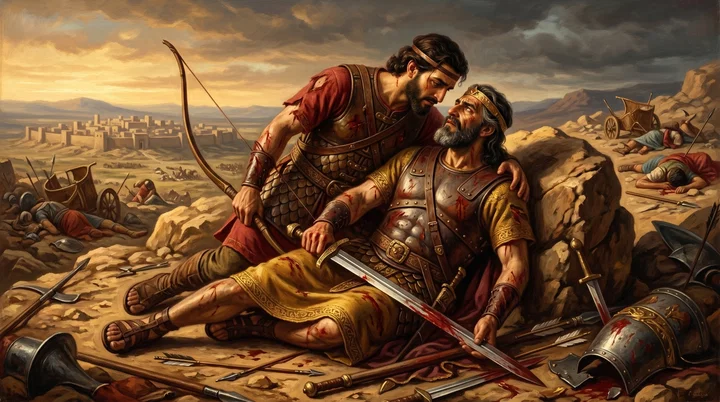
From the blood of the slain, from the fat of the mighty, the bow of Jonathan turned not back, and the sword of Saul returned not empty.
Translations
American King James Version, King James Version, Webster Bible, Revised Version
From the blood of the slain, from the fat of the mighty, the bow of Jonathan turned not back, and the sword of Saul returned not empty.
From the blood of the slain,
From the fat of the mighty,
The bow of Jonathan turned not back,
And the sword of Saul returned not empty.American Standard Version, Darby Translation
From the blood of the slain, from the fat of the mighty,
The bow of Jonathan turned not back,
And the sword of Saul returned not empty.From the blood of the wounded, From the fat of the mighty, The bow of Jonathan Hath not turned backward; And the sword of Saul doth not return empty.
From the blood of the slain, from the fat of the mighty, the bow of Jonathan ne’er drew back,—and, the sword of Saul, ne’er returned, empty.
Berean Standard Bible, Majority Standard Bible
From the blood of the slain,
from the fat of the mighty,
the bow of Jonathan did not retreat,
and the sword of Saul did not return empty.From the blood of the slain,
from the fat of the mighty,
Jonathan’s bow didn’t turn back.
Saul’s sword didn’t return empty.From the blood of the dead, from the fat of the strong, the bow of Jonathan was not turned back, the sword of Saul did not come back unused.
The bow of Ionathan neuer turned backe, neither did the sword of Saul returne emptie from the blood of the slaine, and from the fatte of the mightie.
Douay-Rheims (Challoner revision)
From the blood of the slain, from the fat of the valiant, the arrow of Jonathan never turned back, and the sword of Saul did not return empty.
Pictures
Cross-references
- 1 Samuel 31:1-6
Now the Philistines fought against Israel: and the men of Israel fled from before the Philistines, and fell down slain in mount Gilboa.
Saul and Jonathan are killed at Gilboa.
- 2 Samuel 1:18
(Also he bade them teach the children of Judah the use of the bow: behold, it is written in the book of Jasher.)
Names the lament for Saul and Jonathan as the Song of the Bow.
- 1 Samuel 18:4
And Jonathan stripped himself of the robe that was upon him, and gave it to David, and his garments, even to his sword, and to his bow, and to his girdle.
Jonathan gives David his bow and sword, the weapons praised in the verse.
Commentary
Each commentary is drawn from primary sources: the writings of Ellen G. White and Adventist pioneers and periodicals. Each commentary is separate. Its own words are not a quotation; follow the references to read the source passages.
Ellen G. White
1 source
Jonathan's bow is remembered as never failing to strike, showing his strength in battle.PP 696.1 Saul's sword is remembered as never returning without victory, showing his strength in battle.PP 696.1 Together the unfailing bow and the victorious sword celebrate both men for their power in combat.PP 696.1
Sources
Pioneers and periodicals
6 sources
The verse belongs to David's lament over Saul and Jonathan after their deaths, the lamentation honoring the fallen warriors known as the Song of the Bow.STST Apr 7, 1909RH Apr 23, 1901RH Apr 14, 1859 It is a triumph poem recalling their victories over Israel's enemies, praising them as mighty warriors whose weapons never failed in battle.ST Apr 11, 1911ST Apr 7, 1909RH Apr 23, 1901 Jonathan's bow never turned back from the blood of the slain and the fat of the mighty, and Saul's sword never returned empty without having struck the enemy and dealt its blows.ST Apr 11, 1911RH Oct 12, 1905RH Apr 23, 1901RH Apr 14, 1859 By remembering their courage, military strength, prowess, and success in battle even while mourning their deaths, it honors their valor and presents that valor as a virtue.ST Apr 7, 1909RH Apr 14, 1859 Though it celebrates weapons that had been effective, it mourns warriors slain at Gilboa whose weapons ultimately failed to save them.RH Oct 12, 1905
Sources