2 Samuel 11:3
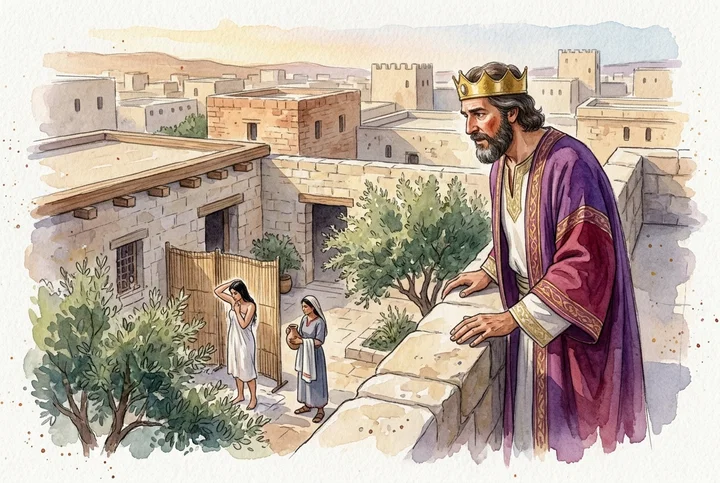
And David sent and enquired after the woman. And one said, Is not this Bath-sheba, the daughter of Eliam, the wife of Uriah the Hittite?
Translations
And David sent and inquired after the woman. And one said, Is not this Bathsheba, the daughter of Eliam, the wife of Uriah the Hittite?
And David sent and enquired after the woman. And one said, Is not this Bath-sheba, the daughter of Eliam, the wife of Uriah the Hittite?
KJV Cambridge Paragraph Bible, Webster Bible, Revised Version, American Standard Version
And David sent and inquired after the woman. And one said, Is not this Bath-sheba, the daughter of Eliam, the wife of Uriah the Hittite?
and David sendeth and inquireth about the woman, and saith, 'Is not this Bath-Sheba, daughter of Eliam, wife of Uriah the Hittite?'
and David sent and inquired after the woman. And one said, Is not this Bathsheba, the daughter of Eliam, the wife of Urijah the Hittite?
And David sent and enquired after the woman,—and one said—Is not, this, Bath-sheba, daughter of Eliam, wife of Uriah the Hittite?
Berean Standard Bible, Majority Standard Bible
So David sent and inquired about the woman, and he was told, “ This is Bathsheba, the daughter of Eliam and the wife of Uriah the Hittite.”
David sent and inquired after the woman. One said, “Isn’t this Bathsheba, the daughter of Eliam, Uriah the Hittite’s wife?”
And David sent to get knowledge who the woman was. And one said, Is this not Bath-sheba, the daughter of Eliam and wife of Uriah the Hittite?
And Dauid sent and inquired what woman it was: and one sayde, Is not this Bath-sheba the daughter of Eliam, wife to Vriah the Hittite?
Douay-Rheims (Challoner revision)
And the king sent, and inquired who the woman was. And it was told him, that she was Bethsabee the daughter of Eliam, the wife of Urias the Hethite.
Pictures



Cross-references
- 2 Samuel 12:9-14
Wherefore hast thou despised the commandment of the LORD, to do evil in his sight? thou hast killed Uriah the Hittite with the sword, and hast taken his wife to be thy wife, and hast slain him with the sword of the children of Ammon.
Nathan rebukes David for his sin and announces its consequences.
- Psalms 51:1-4
Have mercy upon me, O God, according to thy lovingkindness: according unto the multitude of thy tender mercies blot out my transgressions.
David's humble confession of transgression
- 2 Samuel 12:14
Howbeit, because by this deed thou hast given great occasion to the enemies of the LORD to blaspheme, the child also that is born unto thee shall surely die.
David’s sin gives the Lord’s enemies occasion to blaspheme.
- 2 Samuel 23:34
Eliphelet the son of Ahasbai, the son of the Maachathite, Eliam the son of Ahithophel the Gilonite,
Eliam is identified as Ahithophel’s son, linking Ahithophel to Bath-sheba’s family.
- 2 Samuel 23:39
Uriah the Hittite: thirty and seven in all.
Uriah the Hittite is listed among David’s mighty men.
- Psalms 51:10
Create in me a clean heart, O God; and renew a right spirit within me.
David prays for a clean heart and renewed spirit after his sins.
- 1 Kings 15:5
Because David did that which was right in the eyes of the LORD, and turned not aside from any thing that he commanded him all the days of his life, save only in the matter of Uriah the Hittite.
David’s general obedience is contrasted with his sin involving Uriah.
- 2 Samuel 12:24
And David comforted Bath-sheba his wife, and went in unto her, and lay with her: and she bare a son, and he called his name Solomon: and the LORD loved him.
Records Bath-sheba as Solomon’s mother.
- 2 Samuel 11:27
And when the mourning was past, David sent and fetched her to his house, and she became his wife, and bare him a son. But the thing that David had done displeased the LORD.
David’s actions displeased the Lord.
- 2 Samuel 11:14-17
And it came to pass in the morning, that David wrote a letter to Joab, and sent it by the hand of Uriah.
David’s inquiry about Bath-sheba leads to his order that Uriah be killed.
- Leviticus 20:10
And the man that committeth adultery with another man’s wife, even he that committeth adultery with his neighbour’s wife, the adulterer and the adulteress shall surely be put to death.
Adultery was punishable by death.
- 2 Samuel 12:13
And David said unto Nathan, I have sinned against the LORD. And Nathan said unto David, The LORD also hath put away thy sin; thou shalt not die.
David confesses his sin and receives forgiveness.
- 2 Samuel 12:7
And Nathan said to David, Thou art the man. Thus saith the LORD God of Israel, I anointed thee king over Israel, and I delivered thee out of the hand of Saul;
Nathan's rebuke brought David to repentance.
- Psalms 32
Blessed is he whose transgression is forgiven, whose sin is covered.
The psalm is linked to David’s sin and forgiveness.
Commentary
Each commentary is drawn from primary sources: the writings of Ellen G. White and Adventist pioneers and periodicals. Each commentary is separate. Its own words are not a quotation; follow the references to read the source passages.
Ellen G. White
20 sources
David remained at ease in Jerusalem while Joab conducted the war, and his inquiry identified the woman as Bath-sheba, the wife of Uriah the Hittite, one of his bravest and most faithful officers.PP 719.4–720.1PP 718.1PP 718.2PP 718.3 Her beauty proved a fatal snare, for in desire for her he yielded to appetite and lustful passion until Satan overcame one specially favored by God and brought him under divine displeasure.PP 719.4–720.1LC1 136.2LC1 47.1–22RED 32.2 In idleness and self-security he had let go his hold upon God, leaving his mind open to the tempter, when close connection with God should have kept his character unblemished.PP 718.14T 411.1–412.2GW92 168.321MR 169.1 Already guilty and unrepentant, he sought to extricate himself by arranging Uriah's death in battle to take Bath-sheba as his wife and preserve his honor, misusing God-given authority in heinous crime against Uriah and Bath-sheba.PP 719.1PP 719.2–3SG4 86.2–87.1PP 718.2PP 718.3 His fall shows how sensual temptation can overcome even a strong, faithful person entrusted with great responsibility, and the record stands as a warning to later generations, yet when Nathan reproved him he confessed with sincere repentance and God forgave and spared his life, though punishment still followed because his conduct gave the Lord's enemies occasion to blaspheme.SG4 86.2–87.11SP 378.1–379.1PP 457.2ST May 31, 19104T 12.1–3
Setting and Identities
David remained at ease in Jerusalem, unguarded and self-secure near the end of the war with the Ammonites, after the Syrians had submitted and the complete overthrow of the Ammonites seemed certain.PP 718.1 He had left the conduct of the army to Joab while he himself was surrounded by the fruits of victory and the honors of his wise and able rule.PP 718.1 The answer to his inquiry after the woman identified her as Bath-sheba, the daughter of Eliam and the wife of Uriah the Hittite.PP 719.4–720.1PP 718.2PP 718.3 Her beauty proved a fatal snare to the king.PP 718.2
Uriah was one of David's bravest and most faithful officers, a faithful soldier whom David's adultery shamefully wronged.PP 719.4–720.1PP 718.2PP 718.3 The verse belongs to the account that continues with Uriah's death, for David ordered Uriah's death in battle.PP 719.1 In doing so he misused the authority God had given him, and Joab gave sinful obedience to the king's command.PP 719.2–3
Already guilty and unrepentant, David sought to extricate himself from the dangers in which sin had involved him instead of asking help and guidance from Heaven.PP 718.2 He arranged Uriah's death in battle, reasoning that this would leave Bath-sheba free to become his wife, avert suspicion, and preserve his royal honor.PP 718.3 Discovery of the crime could bring death or revolt, because God's law pronounced the adulterer guilty of death.PP 718.2PP 718.3 The shamefully wronged, proud-spirited soldier might avenge himself by taking the king's life or by exciting the nation to revolt.PP 718.2
Sin, Judgment, and Warning
The inquiry after the woman marks the moment of yielding to appetite and passion through desire for Bath-sheba. LC1 136.22RED 32.2RH Jul 28, 1874 It was gratification of lustful passions by which Satan overcame a man specially favored by God and brought him under God's displeasure. LC1 47.1–22RED 32.2ST Feb 22, 18831RED 47.1–2RH Jul 28, 1874 His fall shows how sensual temptation can overcome even a strong and faithful person. PP 457.2 It stands as an example of how a person favored by God and entrusted with great responsibility can be overcome by temptation. ST May 31, 1910
David's idleness left him open to temptation and led to grave sin, including adultery with Bath-sheba and the murder of her husband Uriah. 4T 411.1–412.2GW92 168.3 Useful, sustained, purposeful work would have helped guard his mind against foolish thoughts that give rise to evil actions and would have helped keep him from the murder of Uriah. 4T 411.1–412.2GW92 168.3 In ease and self-security the tempter seized the opportunity to occupy his mind, and letting go his hold upon God David yielded to Satan and brought the stain of guilt upon his soul. PP 718.1 Close connection with God and the great favor shown him should have kept his character unblemished, but as the Heaven-appointed leader of the nation chosen to execute God's law he trampled its precepts and by his own act strengthened the hands of evil-doers whom he should have terrified. PP 718.1 Having been steadfast while keeping God's Word beside him as king, he turned from its teaching and stained one of the fairest reputations. 21MR 169.1
The episode was a heinous crime against Uriah and Bath-sheba. SG4 86.2–87.11SP 378.1–379.1 David's sin was not justified or excused by his former favor with God, for he had departed from God and one wrong step led to further sin. SG4 86.2–87.11SP 378.1–379.1 Nathan reproved and rebuked him, and David acknowledged his guilt with remorse and sincere, humble confession rather than excusing it. SG4 86.2–87.11SP 378.1–379.1 Because he repented, God forgave him and pities the repentant sinner, averted part of the threatened calamity, and spared his life. SG4 86.2–87.11SP 378.1–379.14T 12.1–3 Yet David still faced punishment because sin brings punishment and his conduct gave the Lord's enemies occasion to blaspheme. SG4 86.2–87.11SP 378.1–379.14T 12.1–3
The record of David's sin and the failings of even faithful people is laid bare and preserved as a warning and lesson for later generations. ST May 31, 19104T 12.1–3 Their struggles and falls, followed by renewed courage and victory through God's grace, encourage others to renew the struggle against sin and to overcome temptation. ST May 31, 19104T 12.1–3
Sources
Pioneers and periodicals
68 sources
David sent to enquire about the woman he had seen bathing, and was told she was Bath-sheba, the daughter of Eliam and the wife of Uriah the Hittite.RH Sep 11, 1860ST Apr 29, 1913ST Mar 31, 1881 That enquiry was the beginning of his grave fall, for his lustful design toward another man's wife was already adultery in heart before the outward act, and it grew into the double crime of adultery and murder uniting lust, cruelty, treachery and ingratitude.RH Apr 26, 1870RH Jul 27, 1869ST May 6, 1897ST Sep 27, 1883 The fall came late in life after great favor and success, when prosperity intoxicated him and he was idle, unwatchful and neglecting prayer instead of fleeing temptation and watching unto prayer.ST Dec 16, 1880RH May 3, 1870RH Jun 9, 1868RH Feb 16, 1911ST Dec 19, 1916 It brought pointed reproof through Nathan and lifelong retribution in kind, especially in his own house in the death of Bath-sheba's child, the sin of Amnon, and the rebellion and crimes of Absalom, showing that even repented sin is not passed over without chastening.ST Mar 31, 1881RH Apr 26, 1870RH Oct 12, 1869ST Sep 10, 1896 Yet his humble, unfeigned repentance was fully forgiven and he was restored to his throne, and the candid record without excuse or palliation stands as proof of Scripture's truthfulness and as warning, not permission, to later generations.RH Sep 11, 1860ST Sep 10, 1896RH Mar 19, 1861ST Apr 19, 1910
Persons and Historical Setting
David sent and made inquiry concerning the woman he had seen from the roof, and was answered that she was Bath-sheba, the daughter of Eliam, the wife of Uriah the Hittite.RH Sep 11, 1860ST Apr 29, 1913ST Mar 31, 1881ST Dec 16, 1880 That answer made plain she was another man's wife, Eliam's daughter and Uriah's wife.ST Apr 29, 1913ST Mar 31, 1881
Eliam was the son of Ahithophel, so Bath-sheba was Ahithophel's granddaughter and Uriah was his grandson by marriage.ST Mar 22, 1883RH Nov 23, 1905ST Mar 22, 1883 David's adultery with Bath-sheba and murder of Uriah therefore dishonored and injured Ahithophel's own family.ST Mar 22, 1883RH Nov 23, 1905 That disgrace put a spirit of revenge in Ahithophel to remove it from his house, helping explain his later support for Absalom and the weakening of the people's loyalty to David, a personal link behind the later consequences of the sin.ST Mar 22, 1883RH Nov 23, 1905ST Mar 22, 1883
Uriah's designation as a Hittite shows Hittites were living in David's time and belonged to the world of his reign.RH Oct 8, 1861ST Oct 1, 1885 A stranger, a Hittite, could dwell in Jerusalem and serve as one of David's leading officers, and his wife Bath-sheba afterward became queen of Israel and the mother of Solomon, illustrating that strangers were counted among the inhabitants of the land.RH Oct 8, 1861ST Oct 1, 1885 The inquiry belongs after the setting of David's throne in Jerusalem, his victories over enemies, his plan to build a temple for God, and his kindness to the house of Saul for Jonathan's sake, amid internal troubles and the establishing of his reign.ST The fall came about 1035 B.C., when David was about fifty years old.ST Jul 27, 1904
That was about sixty years after and many years after he had been called a man after God's own heart, late in life and after that commendation, not in connection with it, for the commendation was spoken before his great sin and must not be taken as God's approval of his crime.ST Jul 27, 1904RH Oct 12, 1869ST Nov 11, 1880ST Nov 11, 1880 The inquiry after Bath-sheba and involvement with Uriah's wife marks the turning point in his life and the end of the period when his ways were good.ST Nov 11, 1880ST Sep 22, 1898 Before this his chastity had been unimpeachable by the standards of the time, and this verse marks the beginning of his grave wrongdoing.ST Nov 11, 1880
Nature of David's Sin
The inquiry after the woman marks the start and beginning of David's grave fall and wicked conduct toward Uriah in taking Bath-sheba.RH Apr 26, 1870ST Nov 11, 1880 The answer he received — that she is Bath-sheba, Eliam's daughter, the wife of Uriah the Hittite — makes clear that what followed involved another man's wife. He became an adulterer when he formed his design concerning Uriah's wife, before the outward act, for sinful desire and intent already violate God's law in the heart.ST Sep 27, 1883 His terrible fall came from cherishing iniquity in his heart, and before this turning point his chastity had been unimpeachable by the standards of the time, so the account records wrongdoing, not God's approval of it.ST Nov 11, 1880
David's taking her violated marriage, for Uriah had one wife and to take her was an immoral wrong.RH Mar 30, 1869ST Feb 27, 1893 It was a double crime of adultery and murder, with murder the only crime more heinous than adultery.RH Jul 27, 1869ST May 6, 1897 From beginning to end it united lust, cruelty, treachery and base ingratitude with awful intensity, as a fearful combination of many dreadful sins against God and man and an abyss of sin and shame.RH Jul 27, 1869 It was a work of iniquity wrought when Satan had complete control of a man, done when the Devil had caught him in his snare before he knew his danger and while the blindness that sin brings upon its victims was upon him until Nathan most pointedly rebuked him.RH Jul 27, 1869RH Jul 27, 1869 These were grave sins late in life that God condemned and punished, yet even such grave sin can be pardoned when the sinner meets the conditions of forgiveness.ST May 6, 1897ST Nov 11, 1880
The sin cruelly harmed Uriah, grievously wronged Bath-sheba, and brought harm on the nation, but its chief guilt was that it was committed against God.RH Sep 2, 1862 It was flagrant, deliberate wickedness directly contrary to God's command, peculiarly abhorrent and odious to God.ST Jun 9, 1881ST Apr 17, 1907 It cannot be justified by anyone with regard for the Bible, for the truth taught in David's age condemned the wrong, and had he lived up to the light of that age he would not have done it.RH Aug 22, 1871 It was a crime deserving lifelong imprisonment in state prison and even hell forever, showing not how good David was but how grace brings salvation to the very worst and makes saints of the vilest sinners.ST Nov 1, 1910 Though he repented sincerely and was accepted for life eternal, the sin could not be altogether passed over without consequence, and God caused him to suffer deeply in this life to show divine abhorrence of adultery and deception, for no sin is so secret that God cannot see it, deception will not avail before Him who knows the heart, and the way of the transgressor is hard.RH Mar 30, 1869ST Jun 9, 1881
The transgression gave great occasion to the enemies of the Lord to blaspheme, in every age since and in all succeeding generations.RH Oct 12, 1869RH Jul 27, 1869RH Nov 15, 1870 It brought rejoicing to demons and brought great reproach upon the truth as an immoral practice by a professed friend of God that left a stain upon his character.ST Apr 3, 1907ST Apr 7, 1881 It shows how the sinful conduct of one who professes faith can discredit that faith.ST Apr 3, 1907
Circumstances Behind the Fall
The inquiry about the woman belongs to David's near-fatal fall when prosperity became his portion and well-nigh ruined him.ST Dec 16, 1880RH May 3, 1870RH Jun 9, 1868ST Jul 28, 1881ST Dec 8, 1881 Prosperity intoxicated him and almost brought ruin upon him, showing how dangerous an exalted station is even after long preparation for the throne.RH May 3, 1870RH Jun 9, 1868ST Jul 28, 1881 God had schooled him for the throne through years of poverty, humiliation, sorrow and suffering injustice at Saul's hands, permitting that affliction of inestimable value so he would learn to hate such wickedness and never act that way when he himself became king.RH May 3, 1870ST Jul 28, 1881ST Dec 8, 1881 Yet when overwhelmed with what flowed in upon him he nearly made a fatal plunge and was almost lost, standing as a lighthouse built beside most dangerous rocks to warn others.RH May 3, 1870ST Jul 28, 1881ST Dec 8, 1881 His case proves that a lowly station in life is far preferable and infinitely safer than an elevated one, and that no one should seek honor before humility has prepared him.RH May 3, 1870ST Jul 28, 1881ST Dec 8, 1881
David failed to flee temptation when he should have done so, like an unwary soldier who did not choose his battleground wisely. His unwatchfulness began when he saw Bath-sheba, and that failure led him on into adultery and murder.RH Dec 12, 1865 He was swept into adultery by a powerful spiritual undercurrent while conscience failed to restrain him.RH Oct 2, 1866
The sin arose while he was idle, and keeping busy is a way to resist temptation.RH Feb 16, 1911 He was indolently sleeping in the evening instead of watching and praying, and that failure left a dark blot on his otherwise illustrious life.ST Dec 19, 1916 The verse belongs to a grave course of sin committed while he was neglecting prayer.ST Jun 23, 1887RH Jul 23, 1857 His failure to watch and pray left him spiritually vulnerable and stained his religious character.RH Jul 23, 1857
Though especially favored by God, he was led through appetite and passion into conduct that incurred God's displeasure.ST Feb 22, 1883RH Jul 28, 1874 He was overcome by Satan in taking another man's wife, exemplifying Satan's success in tempting even people especially favored by God.RH Jul 28, 1874ST Apr 3, 1907 The fall came after the setting of his throne in Jerusalem, his victories over enemies, his plan to build a temple, and his kindness to Saul's house for Jonathan's sake, amid internal troubles and the establishment of his reign, showing that even one who thinks he stands must take heed lest he fall.ST The surrounding history traces much of his resulting misery to the evil of having many wives.ST Apr 14, 1909 It is given as an example of falling after great service, honor or consolation, when danger comes upon returning from success with the guard down.RH May 30, 1865 It was not the sin of a young man in the heat of passion but the sin of a man old in years, experience and wisdom, standing with the recorded sins of other aged believers as startling proof that those who profess to follow God can still fall late in life, teaching that believers must persevere to the end.RH Jun 10, 1875
Consequences and Divine Judgment
David's inquiry after Bath-sheba, the wife of Uriah the Hittite, began his wrong against Uriah for which he received retribution through all the rest of his life, especially in his own family.ST Mar 31, 1881RH Apr 26, 1870 That retribution came back in kind upon him in the sad history of Amnon and Tamar and in the rebellion and unnatural crimes of Absalom, with even Adonijah's rebellion and death as part of it.RH Apr 26, 1870 This proves that wrongdoing brings calamity and sorrow on the wrongdoer in the very kind of evil he caused, for sin pays in its own kind.RH Apr 26, 1870
The great wickedness and outbreaking crimes in the case of Uriah were not covered up nor excused but were met by the terrible denunciation, warning and reproof of the prophet Nathan, accomplished in the judgments that came upon David in his subsequent history.RH Oct 12, 1869ST Sep 10, 1896ST Jul 17, 1884 Those judgments included the death of Bath-sheba's child, continued domestic troubles, calamities and long-lasting anguish, and no lasting peace on the throne.ST Sep 10, 1896RH Mar 19, 1861RH Jul 27, 1869 David's humble confession and repentance were placed on record, and he was forgiven by God despite punishment, yet repentance did not remove the chastening that followed.RH Oct 12, 1869ST Sep 10, 1896RH Jul 27, 1869 The turning from obedience was thus marked with disapproval and punishment, warning that sin brings no lasting profit.RH Jul 27, 1869ST Jul 17, 1884
Though David sincerely repented and was accepted for life eternal, the sin of adultery and deception was so peculiarly abhorrent and odious to God that it could not be altogether passed over without consequence.RH Mar 30, 1869ST Jun 9, 1881 God caused him to suffer deeply in this life for his departure from the commandment, to show divine abhorrence of adultery and deception.ST Jun 9, 1881 The wrong could not remain hidden from God, for no sin can be so secret that God cannot see it, deception will not avail before Him who knows the heart, and though a person may flatter himself that his schemes have succeeded, the way of the transgressor is hard.RH Mar 30, 1869ST Jun 9, 1881
Repentance Forgiveness and Restoration
The inquiry after Bath-sheba belongs to the account of David's sin that brought him to repentance and forms the setting for his prayer for cleansing, a clean heart, and renewal by God's Spirit.ST Jul 29, 1889ST Aug 19, 1886 Under deep conviction that double crime of adultery and murder brought him to deep sorrow and sincere repentance joined with strong abiding faith.RH Nov 15, 1870 That repentance was expressed in hearty and humble confession of transgression kept ever before him, and in prayer for mercy and thorough washing and cleansing from iniquity and sin, poured out until his plea for deliverance from blood-guiltiness.RH Nov 15, 1870 He mourned repeatedly over that sin with Uriah, and as a person grows in holiness its full ugliness and harm become clearer.RH Oct 4, 1864
His unfeigned repentance was followed by God's forgiveness despite punishment, with humble repentance, confession, Nathan's reproof and warning, and the death of Bath-sheba's child all belonging together.RH Sep 11, 1860ST Sep 10, 1896 Even so grave a sin as adultery and murder can be pardoned when the sinner meets the conditions of forgiveness.ST May 6, 1897 Though in all else honorable, upright, frank, generous, humble and noble, he repented sincerely and was accepted for life eternal, yet the sin could not be altogether passed over without deep suffering in this life.ST Jun 9, 1881 His sincere repentance was unsurpassed in deep heartfelt penitence and firm faith, and the recovery of those who fell through God's grace encourages others to renew their struggle against sin.ST May 31, 1910
He acknowledged the righteousness of God's judgment and repented with deep anguish, showing both the nature of genuine repentance and the consolation available to a penitent soul.RH Mar 19, 1861 When people hate and loathe their sin, Christ sends the Comforter within, so comfort is drawn even from this sorrow and disgrace over taking Uriah's wife.ST Apr 10, 1893 His sins and their terrible effects should dismay the presumptuous and proud, while his example can encourage those who have erred.RH May 25, 1876
His grievous sin while he was king did not end his role as God's leading prophet, for God gave him opportunity to repent and after he repented restored him to his throne.RH Apr 26, 1906 After he repented he was still known as a man after God's own heart, even though the account belongs to his two grave crimes.RH Sep 25, 1856 He came nearer to perdition than any man ever came and yet escaped, with only a bare possibility of escape remaining that he could use only because of most noble qualities in his character.RH Jul 27, 1869 He was caught in the Devil's snare in blindness until most pointedly rebuked by Nathan, and when rebuked he was made to see his awful guilt and aroused to truly repent with most heartfelt repentance.RH Jul 27, 1869 His fall is a warning to all who fear God never for a moment to forget danger, and his repentance furnishes not the slightest ground of hope for the deliberate transgressor of God's law, for had he ever afterward returned to the like transgression God would not have extended pardon to him.RH Jul 27, 1869 His crime in obtaining Bath-sheba brought bitter lasting repentance and terrible punishment, and because he did not afterward relapse into sin against the marriage law, his repentance rather than his wrongdoing is the example to follow.RH Feb 6, 1879
Truthfulness of Scripture Record
The inquiry about Bath-sheba, identifying her as the wife of Uriah, opens the account of David's grave fall into adultery and murder, and that account is given without excuse or palliation and without shading or partiality.RH Sep 11, 1860RH Mar 19, 1861ST Apr 19, 1910 Unlike secular biography that depicts only the good, Scripture faithfully portrays even this one great sin, showing the power of sin manifest even in a true servant of God.ST Apr 19, 1910ST Dec 21, 1915 That candid telling demonstrates the truthfulness of the Bible and shows that God records the deeds of the great just as He records those of the small, and the honest record stands for encouragement.RH Sep 11, 1860ST Apr 19, 1910ST Dec 21, 1915 David's sin was condemned by God and met with severe judgments, in the death of the child, in continued domestic troubles, and in no lasting peace on the throne.RH Mar 19, 1861 He acknowledged the righteousness of God's judgment and repented with deep anguish and unfeigned repentance, showing both the nature of genuine repentance and the consolation available to a penitent soul, as a lesson for sinners.RH Sep 11, 1860RH Mar 19, 1861
The sin is recorded and rebuked rather than glossed over, faithfully revealing the misdeeds of even a king and highly honored servant of God.ST May 1, 1907STST Jul 17, 1884 His crime was later rebuked and punished, and he openly confessed his grievous sin.ST Jul 17, 1884 God's chosen servants could commit serious wrongs, and their sins were recorded to warn later generations through the sins and resulting punishment of those who came before.ST Jul 17, 1884ST Jan 29, 1885 That the record is inspired does not mean the conduct had God's approval; the record is reliable while the actions it recounts are judged by God's standard of righteousness.RH Jul 9, 1908 The account is not there to show how good David was, but to show how the grace of God brings salvation to the very worst of men and makes saints out of the vilest sinners, though his crime deserved lifelong imprisonment in state prison and even hell forever.RH Jul 9, 1908ST Nov 1, 1910
The chapter presents David's desire as the beginning of wicked conduct, given as a warning and not as an example to follow.RH Sep 11, 1860 In pursuing another man's wife his sin gives no permission to sin, for the wrongdoing of a godly person never licenses others.RH Aug 17, 1869 His failure does not make the wrong acceptable, though people may point to it to excuse their own wrongdoing.ST Aug 26, 1880 The sin of David, an immoral practice by a professed friend of God, brought great reproach upon the truth and left a stain upon his character, yet it is impartially recorded in Scripture though enemies of truth feed upon such failures.ST Apr 7, 1881 The evil injures and ruins those who commit it, but God's cause itself remains in its native purity despite the reproach brought upon it.ST Apr 7, 1881 The account thus illustrates the human frailty of a person through whom God could still speak words of eternal life.RH Feb 26, 1914
Sources