2 Samuel 12:7
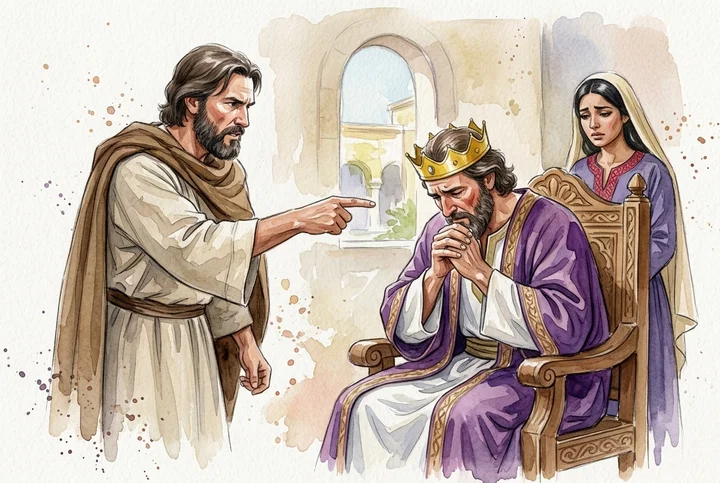
And Nathan said to David, Thou art the man. Thus saith the LORD God of Israel, I anointed thee king over Israel, and I delivered thee out of the hand of Saul;
Translations
And Nathan said to David, You are the man. Thus says the LORD God of Israel, I anointed you king over Israel, and I delivered you out of the hand of Saul;
And Nathan said to David, Thou art the man. Thus saith the LORD God of Israel, I anointed thee king over Israel, and I delivered thee out of the hand of Saul;
And Nathan said to David, Thou art the man. Thus saith the Lord God of Israel, I anointed thee king over Israel, and I delivered thee out of the hand of Saul;
And Nathan said to David, Thou art the man. Thus saith the LORD God of Israel, I anointed thee king over Israel, and I delivered thee from the hand of Saul;
And Nathan said to David, Thou art the man. Thus saith the LORD, the God of Israel, I anointed thee king over Israel, and I delivered thee out of the hand of Saul;
And Nathan said to David, Thou art the man. Thus saith Jehovah, the God of Israel, I anointed thee king over Israel, and I delivered thee out of the hand of Saul;
And Nathan saith unto David, 'Thou [art] the man! Thus said Jehovah, God of Israel, I anointed thee for king over Israel, and I delivered thee out of the hand of Saul;
And Nathan said to David, Thou art the man! Thus saith Jehovah the God of Israel: I anointed thee king over Israel, and I delivered thee out of the hand of Saul;
Then said Nathan unto David: Thou, art the man! Thus, saith Yahweh, God of Israel—I, anointed thee to be king over Israel, and, I, delivered thee out of the hand of Saul;
Berean Standard Bible, Majority Standard Bible
Then Nathan said to David, “ You are that man! This is what the LORD, the God of Israel, says: ‘ I anointed you king over Israel, and I delivered you from the hand of Saul.
Nathan said to David, “ You are the man! This is what the LORD, the God of Israel, says: ‘ I anointed you king over Israel, and I delivered you out of the hand of Saul.
And Nathan said to David, You are that man. The Lord God of Israel says, I made you king over Israel, putting holy oil on you, and I kept you safe from the hands of Saul;
Then Nathan sayd to Dauid, Thou art the man. Thus sayth the Lord God of Israel, I anoynted thee King ouer Israel, and deliuered thee out of the hand of Saul,
Douay-Rheims (Challoner revision)
And Nathan said to David: Thou art the man. Thus saith the Lord the God of Israel: I anointed thee king over Israel, and I delivered thee from the hand of Saul,
Pictures



Cross-references
- Psalms 51:1-4
Have mercy upon me, O God, according to thy lovingkindness: according unto the multitude of thy tender mercies blot out my transgressions.
David confesses his sin and seeks God’s mercy and cleansing after Nathan’s reproof.
- 2 Samuel 11
And it came to pass, after the year was expired, at the time when kings go forth to battle, that David sent Joab, and his servants with him, and all Israel; and they destroyed the children of Ammon, and besieged Rabbah. But David tarried still at Jerusalem.
David’s wrongdoing against Uriah and Bathsheba is the sin Nathan confronts.
- 2 Samuel 12:13
And David said unto Nathan, I have sinned against the LORD. And Nathan said unto David, The LORD also hath put away thy sin; thou shalt not die.
David confesses his sin after Nathan’s rebuke, and Nathan declares his forgiveness.
- Psalms 51:1-2
Have mercy upon me, O God, according to thy lovingkindness: according unto the multitude of thy tender mercies blot out my transgressions.
David seeks God’s mercy and cleansing after Nathan’s rebuke.
- Psalms 32:3-5
When I kept silence, my bones waxed old through my roaring all the day long.
David describes the anguish of hiding his sin and the forgiveness that followed confession.
- Psalms 51:10
Create in me a clean heart, O God; and renew a right spirit within me.
David pleads for forgiveness and a clean heart after Nathan confronts his sin.
- Psalms 51:14
Deliver me from bloodguiltiness, O God, thou God of my salvation: and my tongue shall sing aloud of thy righteousness.
David pleads for deliverance from bloodguilt after Nathan rebukes him.
- 1 Samuel 16:1-13
And the LORD said unto Samuel, How long wilt thou mourn for Saul, seeing I have rejected him from reigning over Israel? fill thine horn with oil, and go, I will send thee to Jesse the Beth-lehemite: for I have provided me a king among his sons.
Records the Lord’s choice and Samuel’s anointing of David.
- 2 Samuel 12:11-12
Thus saith the LORD, Behold, I will raise up evil against thee out of thine own house, and I will take thy wives before thine eyes, and give them unto thy neighbour, and he shall lie with thy wives in the sight of this sun.
These verses foretell public punishment corresponding to David’s secret sin.
- 2 Samuel 7:8
Now therefore so shalt thou say unto my servant David, Thus saith the LORD of hosts, I took thee from the sheepcote, from following the sheep, to be ruler over my people, over Israel:
The Lord took David from tending sheep and made him ruler over Israel.
- 2 Samuel 16:21-22
And Ahithophel said unto Absalom, Go in unto thy father’s concubines, which he hath left to keep the house; and all Israel shall hear that thou art abhorred of thy father: then shall the hands of all that are with thee be strong.
Absalom’s public outrage is compared with the judgment foretold in chapter 12.
- 1 Kings 15:5
Because David did that which was right in the eyes of the LORD, and turned not aside from any thing that he commanded him all the days of his life, save only in the matter of Uriah the Hittite.
It notes David’s lapse in duty.
- 2 Samuel 11:27
And when the mourning was past, David sent and fetched her to his house, and she became his wife, and bare him a son. But the thing that David had done displeased the LORD.
David’s actions displeased the Lord.
- 1 Kings 21:19
And thou shalt speak unto him, saying, Thus saith the LORD, Hast thou killed, and also taken possession? And thou shalt speak unto him, saying, Thus saith the LORD, In the place where dogs licked the blood of Naboth shall dogs lick thy blood, even thine.
Elijah confronts Ahab over Naboth’s murder.
- 1 Samuel 24:5-6
And it came to pass afterward, that David’s heart smote him, because he had cut off Saul’s skirt.
David’s earlier scruple over harming Saul contrasts with his later sin.
- Psalms 51:12
Restore unto me the joy of thy salvation; and uphold me with thy free spirit.
David asks God to restore the joy of his salvation and uphold him.
- 2 Samuel 8:15
And David reigned over all Israel; and David executed judgment and justice unto all his people.
Contrasts proper use of God-given kingship.
Commentary
Each commentary is drawn from primary sources: the writings of Ellen G. White and Adventist pioneers and periodicals. Each commentary is separate. Its own words are not a quotation; follow the references to read the source passages.
Ellen G. White
40 sources
After Nathan's parable of the ewe lamb led David to condemn the wrongdoer and pass sentence on himself without seeing himself in it, Nathan applied it directly by declaring that David himself was the man.Lt 106, 1896, par. 1–3Lt 57, 1897, par. 13–16Ms 76, 1900, par. 19Lt 19a, 1875, par. 18–24Ms 13, 1886, par. 5 The charge exposed his grievous crimes in taking Uriah's wife and having Uriah killed, and was spoken not as his own word but as God's sent messenger with Thus saith the Lord God of Israel.RH Oct 22, 1901Lt 48, 1887, par. 23–24PP 719.4–720.11SP 378.1–379.1SG4 86.2–87.1 In the same utterance he set before David God's favors in anointing him king over Israel and delivering him from Saul, upbraiding him for abusing mercy whose authority was given to be exercised only in harmony with divine law.PP 719.2–3Lt 48, 1887, par. 23–24SG4 88.2–89.1Lt 74, 1886, par. 6 It is the pattern for plain, pointed rebuke that names sin and sets testimony home to the individual by name instead of resting in general preaching, requiring fearless speech without flattery, excusing, or crying peace when God has not spoken peace.PK 141.2–3Lt 17, 1861, par. 4–5GW 149.2–150.1Lt 1e, 1890, par. 15–16Lt 113, 1893, par. 16–17 The words brought sudden overwhelming conviction that left David without defense, and he bore it with humility without turning against the prophet, confessing with sincere grief and repentance toward God, and though forgiven and spared, he was still punished because past favor does not excuse transgression.Lt 57, 1897, par. 13–16Ms 76, 1900, par. 19Lt 19a, 1875, par. 18–245T 683.1EDFCP 16.1
Nathan Confronts David
Nathan told David the parable of the ewe lamb and let him condemn the wrongdoer in the story, leading him to pass sentence on himself without recognizing himself in it.Lt 57, 1897, par. 13–16Lt 19a, 1875, par. 18–24Ms 13, 1886, par. 5Ms 12, 1893, par. 6–7ST Aug 12, 1875 He heard the story without realizing it spoke of himself and judged what should be done to the man in it, and had he realized the application his judgment would have been different.Lt 57, 1897, par. 13–16Ms 13, 1886, par. 5Ms 12, 1893, par. 6–7 The story set before him a figure of his own case so that general recognition of wrongdoing did not yet become self-application until the personal identification came.Lt 19a, 1875, par. 18–24Ms 12, 1893, par. 6–72T 687.2–688.3
He then applied the story directly by identifying David himself as the guilty man, exposing him as the wrongdoer he had failed to see in himself.Lt 106, 1896, par. 1–3Lt 57, 1897, par. 13–16Ms 76, 1900, par. 19Lt 113, 1893, par. 16–172T 687.2–688.3 That personal charge confronted him with sin against God and fellow men and brought sudden conviction of grave crime with overwhelming guilt.Lt 106, 1896, par. 1–3Ms 76, 1900, par. 192T 687.2–688.3 The charge concerned his grievous crimes involving Bath-sheba and Uriah the Hittite, in taking Uriah's wife and having Uriah killed through Joab's battle plan.PP 719.4–720.11SP 378.1–379.1SG4 86.2–87.1Lt 74, 1886, par. 6 Joab sent a carefully worded report to hide responsibility, and David excused the death as the ordinary chance of war and told Joab to strengthen the battle and overthrow the city.PP 719.4–720.1
He spoke not his own words but as God's sent messenger, watchman and herald, with Thus saith the Lord God of Israel.RH Oct 22, 1901Lt 48, 1887, par. 23–24 The reproof was the keenest, sharpest and most resolute, given him by God and spoken contrary to his own nature, even though David was a king ruling kingdoms.Lt 48, 1887, par. 23–24 In the same utterance he laid before David the favors God had bestowed on him, upbraiding him for abusing and misapplying divine mercies.Lt 48, 1887, par. 23–24 Specifically God had anointed him king over Israel and delivered him out of the hand of Saul and rescued him from Saul.PP 719.2–3Lt 48, 1887, par. 23–24SG4 88.2–89.1
That royal position and authority were given by God to be exercised only in harmony with divine law, so position did not excuse conduct.PP 719.2–3Lt 74, 1886, par. 6 Even while still holding God-given authority, David had departed from God and yielded himself to the wicked one and become for the time the agent of Satan in commanding Uriah's death.PP 719.2–3 When as God's agent turned agent of Satan he commanded what was contrary to God's law, it became sin to obey him, since the obedience he claimed on the ground of his position would imperil the soul of him who yielded it.PP 719.2–3 His method of concealing direct rebuke in a parable and letting the hearer judge himself was later used by Christ with Simon, so that Simon could see his guilt was greater than the woman's.DA 566.4–5 The scene presents the prophet speaking emphatically while the king appears distressed and reflective.PK 75
Pattern for Faithful Rebuke
The declaration to David is the pattern for straight, pointed testimony set home to individuals by name.Lt 17, 1861, par. 4–5Lt 1e, 1890, par. 15–16Lt 113, 1893, par. 16–17 It teaches that sin must be plainly rebuked and personally identified, with the guilty warned of danger by reproof, rebuke, censure and warning.Lt 17, 1861, par. 4–5Lt 1e, 1890, par. 15–16Lt 113, 1893, par. 16–17 General preaching alone is not enough, nor is addressing a congregation without singling out the responsible person.Lt 1e, 1890, par. 15–16Lt 113, 1893, par. 16–17 Shunning such pointed testimony to sympathize with and shield the disaffected and crooked from deserved reproof makes a man weak and out of harmony with duty.Lt 17, 1861, par. 4–5
God's messengers must speak the truth entrusted to them directly and fearlessly, naming sin and reproving, rebuking, censuring, warning and exhorting whatever the consequences.PK 141.2–3GW 149.2–150.1PK 140.3–141.1RH Sep 11, 1913 Such plain confrontation must not be left unspoken to preserve approval or to avoid anger and unpleasant results.PK 141.2–3GW 149.2–150.1RH Sep 11, 1913 When this kind of rebuke is rare and almost unheard, the church misses the power of God that would be seen if it were common.GW 149.2–150.1RH Oct 22, 1901 True love seeks first God's honor and the salvation of souls, and does not evade truth when souls in peril are in danger.PK 141.2–3RH Sep 11, 1913
Faithful rebuke refuses love for approbation and desire to please men, refuses to suppress the truth, flatter, dissemble, excuse or palliate evil, and refuses to cry peace and safety when God has not spoken peace.PK 141.2–3RH Oct 22, 1901RH Sep 11, 1913 It exposes evil without excusing it, and when souls are in peril it does not consider self or evade unpleasant results.PK 141.2–3RH Oct 22, 1901RH Sep 11, 1913 Ministers are divinely appointed messengers to follow the example of Nathan with Elijah and John the Baptist.RH Oct 22, 1901 Laboring in Christ's stead as stewards of the mysteries of heaven, they encourage the obedient and warn the disobedient, speaking not their own words but Thus saith the Lord, giving no weight to worldly policy, going forward in faith surrounded by a cloud of witnesses and bearing the message faithfully regardless of consequences though it calls for the sacrifice of all they have.RH Oct 22, 1901
Those whom the Lord has placed in responsible positions must faithfully discharge their God-given responsibility to reprove sin and not connive at it by letting it pass unreproved.Ms 106, 1902, par. 22Lt 17, 1861, par. 4–5Lt 48, 1887, par. 23–24 They must apply the direct warning to themselves without evading it out of fear or favor when their conduct departs from God's word and pure principles.Ms 106, 1902, par. 22Lt 48, 1887, par. 23–24 If they shield others from deserved reproof and those shielded fail to reform, that failure is laid to their account, and the Lord holds them accountable for the sins that remain and the evils resulting from them.Lt 17, 1861, par. 4–5Lt 48, 1887, par. 23–24 When teaching general principles does not set things right because those needing reform are fixed in the idea that their own way is perfect and do not apply the teaching to themselves, plain, decided personal accusation is necessary.Lt 9, 1887, par. 2–62MR 143.1 Such direct testimony convicts of specific wrongs such as wrong preparation of food and failure in health reform, makes a decided stir, and exposes responsibility.Lt 9, 1887, par. 2–62MR 143.1
Conviction Repentance Accountability
The declaration struck David with sudden conviction, exposing his grave crime and humbling him with an overwhelming sense of guilt that left him without defense.Lt 57, 1897, par. 13–16Ms 76, 1900, par. 19 No sensational songs or humorous anecdotes were used to move feeling; a figure of his own case was set before him, he was led to pass sentence upon himself, and then the charge was brought directly home.Lt 19a, 1875, par. 18–24 That exposure saved him from continuing unconvicted toward ruin, and he repented for the rest of his life.Lt 57, 1897, par. 13–16
Before that direct reproof he had only flashes of guilt with reproof upon his conscience, and he had excused his sin to himself without compunction working true heart repentance.Lt 48, 1887, par. 23–241SP 378.1–379.1SG4 86.2–87.1 Recognizing the seriousness of sin is necessary for true repentance and thorough conversion.ST Aug 12, 1875 God's favor does not excuse transgression, and past righteousness cannot save one who turns from righteousness to do evil.SG4 86.2–87.1
He bore the rebuke with the spirit of a converted man, accepting the full charge with humility and meekness and with fear and trembling at the word of the Lord.5T 683.1SG4 88.2–89.11SP 380.2–381.2 He humbled himself under correction and did not turn against the prophet, though surrounding rulers would have used throne and unlimited power to take the reprover's life.EDFCP 16.11SP 380.2–381.2 Faithful portrayal of his true state made him aware of his sins and helped him put them away, and he learned wisdom through God's dealings and chastisement.5T 683.14T 14.3–15.1
He acknowledged guilt with sincere grief rather than excuses, repented before God whose law he had broken, and relied for pardon on the efficacy of Christ's blood.Lt 19a, 1875, par. 18–241SP 378.1–379.14MR 185.1–186.2 He kept his transgression before him with bitter cries of anguish and despair, making a humiliating confession.Lt 51, 1886, par. 4–1021MR 379.5–6 He entreated forgiveness in dust and ashes, openly confessed before the great men and even servants of his kingdom, and composed and published a penitential psalm recounting his sin and repentance so after generations would be instructed by the sad history and learn in whom was his trust and hope for pardon.1SP 380.2–381.2
God forgave him after humble confession and spared his life, but did not justify or excuse his sins.1SP 378.1–379.1SG4 86.2–87.1 Punishment remained because he had given the Lord's enemies occasion to blaspheme.1SP 378.1–379.1SG4 86.2–87.1 Warning and chastisement were meant to lead to repentance, not despair, and were accompanied by mercy.4T 14.3–15.1 His strength lay in sincere contrition and trust in God's mercy as just and merciful, not in never falling into temptation.EDFCP 16.1
The declaration acts as a mirror revealing true character, exposing how judgment is passed upon another without self-knowledge.Lt 57, 1897, par. 13–16Ms 13, 1886, par. 5 David heard the story without realizing it spoke of himself and condemned the man in it, and had he realized it spoke of him his judgment would have been different.Ms 13, 1886, par. 5 People may recognize wrongdoing in general and judge what should be done, yet fail to apply the lesson to themselves unless they examine their spiritual position and conduct.Ms 12, 1893, par. 6–7 Asking who informed the reprover of one's faults shows not being right before God, and rather than looking at others people should examine and do the work required at home and in the church.Ms 13, 1886, par. 5Ms 13, 1886, par. 11
The personal charge comes close with startling truth to those who go only so far in faith and try to hold with both church and world, exposing choosing one's own way above God's requirements, keeping mental reservations, putting business and idols first, and keeping a heart with the world while conscience sides with truth.Ms 3, 1885, par. 19 It urges conversion and separation from the world, lest when church and world separate they be swept away with the world.Ms 3, 1885, par. 19 Turning from God's revealed will after once keeping His Word brings accountability and stains a good reputation.21MR 169.1
The same direct charge is for people entrusted with responsibility when conduct departs from God's word and pure principles, and for careless, world-loving people, to be applied to oneself without evasion from fear or favor.Ms 106, 1902, par. 22GW92 225.2 When sin is exposed the one warned recognizes the charge applies to him and that he is in danger.Lt 39, 1896, par. 7–8 The warning may move him through the Holy Spirit, but prolonged resistance and clinging to old habits can wear away its effect and leave indifference to danger.Lt 39, 1896, par. 7–8 Those on dangerous ground let Satan take the warning from heart and mind, see no real force in it, let feeling rise against God, and refuse to obey His voice.Ms 3, 1885, par. 19
Sources
Pioneers and periodicals
83 sources
Nathan first told of a rich man taking a poor man's lamb, drew David to condemn the offender as worthy of death, and then turned the story on David himself as the guilty man who had sentenced himself.RH Sep 7, 1869ST Oct 11, 1899ST Mar 11, 1889 The setting was David's adultery with Uriah's wife and his part in Uriah's death, for which God reproved him through Nathan.ST Nov 11, 1880ST Apr 29, 1913ST May 8, 1884 God condemned rather than approved what David did, and Scripture gives an impartial record that exposes even a king as sinful and accountable to the same moral standard as all others.ST Nov 11, 1880RH Mar 19, 1861ST Mar 11, 1913ST Feb 20, 1879ST Nathan as God's messenger spoke with divine authority, courageously and humbly confronting a king answerable to no human authority with a direct, personal and plain rebuke that named the sin, aimed to save him from ruin and lead him to genuine repentance.RH Jul 20, 1911RH Jun 22, 1911RH Jun 15, 1911ST Feb 19, 1885RH Dec 22, 1868 Sin had blinded David until confronted face to face, but he received the rebuke, humbled himself and confessed his sin against the Lord with deep sorrow as expressed in Psalm 51, and upon hearty repentance was pardoned through Christ though terrible punishment still followed.RH Sep 7, 1869ST Apr 29, 1913ST Apr 29, 1908RH Sep 14, 1869
Wording and Historical Setting
Nathan first approached David with a parable of a rich man stealing a poor man's lamb, led him to condemn the wrongdoer in anger and declare that such a man should surely die, and then turned the story directly upon David himself as the guilty man in the story.ST Aug 12, 1875ST Oct 11, 1899ST Mar 11, 1889ST Aug 19, 1880RH Apr 3, 1879 By that judgment David had unwittingly pronounced sentence against himself, and the plain confrontation exposed his wrongdoing and drew from him the sentence he justly deserved.RH Sep 7, 1869ST Mar 11, 1889RH Apr 3, 1879 The indirect, figurative address held his attention and brought conviction home before he realized its lesson concerned him, leading him to pass judgment on himself and then to recognize that he was the sinner.ST Aug 12, 1875ST Aug 19, 1880RH Apr 3, 1879 He understood the rebuke, received it rather than attacking the prophet, and confessed his sin against the Lord.RH Sep 7, 1869
The wording stresses definiteness, identifying David specifically as the man rather than merely as one man, so that changing the to a would weaken the statement and remove its force.RH Apr 11, 1854 The setting is David's adultery with Uriah's wife Bath-sheba and his role in Uriah's death, after which God reproved him through Nathan.ST Nov 11, 1880ST Apr 29, 1913ST Apr 29, 1908RH Jul 20, 1911ST Sep 10, 1896 Nathan's parable of the stolen lamb exposed the enormity of the sin, and God condemned rather than approved David's actions.ST Nov 11, 1880 Though David had been a man after God's own heart, he sinned against the Lord and brought judgment upon himself.ST May 8, 1884
The rebuke illustrates that prophets corrected not only the common people but also kings who were not answerable to human authority, even though such confrontation could put them in danger.RH Jul 20, 1911 Punishment was pronounced for the crime, including continuing violence in David's household, trouble through Absalom's rebellion, and the death of his child.ST Nov 11, 1880ST May 8, 1884ST Sep 10, 1896 His child by Bathsheba was struck with disease and died despite earnest prayer, and the later calamities in his family and kingdom were understood as consequences of his transgression.RH Jul 27, 1869ST Sep 10, 1896 David responded to the reproof with humility, confessed his sin to God, and was forgiven.ST Apr 29, 1913ST Apr 29, 1908ST Sep 10, 1896
The verse also recalls that God had anointed David king over Israel and delivered him from Saul.RH Jul 27, 1869 David's receiving Saul's wives and concubines when he succeeded him followed a customary right among the kings of the surrounding nations and gave him full power as king, but the custom was not declared right.ST Feb 27, 1893ST Jul 21, 1898 God designed a king to have only one wife, and this allowance did not mean God approved polygamy.ST Feb 27, 1893ST Jul 21, 1898 Having received Saul's wives gave David further reason not to take Uriah's wife, and his sin was to take the poor man's wife and cause the man's death.ST Feb 27, 1893ST Jul 21, 1898
A recognized holy man could confront an Oriental king directly, denounce his actions, and tell him truths that powerful ministers would not dare to speak.ST Nov 5, 1885 Such a rebuke could be heard and its warning heeded, though a bold critic might sometimes be made to disappear.ST Nov 5, 1885 The phrase has been used merely as a title with no further explanation of the verse or its setting. Students have mistakenly attributed it to Judas speaking to Christ or to a prophet teaching a man from a chariot, though it records Nathan confronting David by identifying him as the man in his parable.RH Nov 16, 1911
Sin Judgment and Consequences
God condemned David's actions rather than approving them, and being called a man after God's own heart did not mean he was approved in his sin but only for the just and humble things he did.ST Nov 11, 1880RH Mar 19, 1861ST Feb 20, 1879 Scripture gives an impartial record that does not hide his wrongdoing or excuse him because he was king, and though chosen as God's instrument to do justice and uphold righteousness he is exposed as sinful and selfish and held accountable to the same moral standard as every other person.ST Mar 11, 1913ST His transgression was not covered up or excused in any way but was placed on record, and by it he gave great occasion to the enemies of the Lord to blaspheme.RH Oct 12, 1869 The denunciation was completely accomplished in the judgments that came upon him through his whole subsequent history, while he himself placed on record for all future time a most humble confession of his great transgression.RH Oct 12, 1869
Punishment was both pronounced and accomplished for the crime of adultery with Uriah's wife and the role in Uriah's death, including continuing violence in the household and the death of the child.ST Nov 11, 1880 The child by Bathsheba was struck with disease and died despite earnest prayer, domestic peace ended, trouble arose within his own household, and his reign was troubled, including Absalom's rebellion.ST May 8, 1884RH Jul 27, 1869RH Mar 19, 1861 The rebuke recalls that God had anointed him king over Israel and delivered him from Saul, and the later calamities in family and kingdom are understood as consequences of the transgression.RH Jul 27, 1869 The sin brought a severe penalty on his family, showing that God's law remains unchanging and that even a king is accountable to God, with forgiveness following confession.ST Sep 10, 1896
The confrontation marks the turn to retribution that followed him through all the rest of his life, principally in his own family.RH Apr 26, 1870ST Mar 31, 1881 Wrongdoing brings calamity and sorrow on the wrongdoer in the very kind of evil he caused others, for what a man sows that he shall reap, and sin pays in its own kind so that it never pays to do wrong.RH Apr 26, 1870 In David this is seen in the sad history of Amnon and Tamar and in the rebellion and unnatural crimes of Absalom, with even Adonijah's rebellion and death as part of the same retribution.RH Apr 26, 1870ST Mar 31, 1881 Much of the king's misery and sorrow is also traced to his having many wives, within the history of the troubles that came upon him after his awful sin against Uriah.ST Apr 14, 1909 His conduct in that matter was flagrant, open wrongdoing directly contrary to God's command, unlike failures whose wrongness he had not clearly understood, and his submitting to God when he had done wrong tested his loyalty.ST Apr 17, 1907
The rebuke stands as God's object lesson that he forgot his duty to God and his dignity as ruler of Israel and shepherd of the flock, and envied Uriah because of his wife.ST Mar 25, 1889 It warns against letting feelings run unchecked and calls for care regarding envy and malice and hatred.ST Mar 25, 1889 Sin begins in the thoughts of the heart, and harboring sinful thought defiles a person and is crime in Heaven's sight.ST Mar 25, 1889 Envy leads to anger and hatred and murder, and those who indulge it are left unlike Christ and finally outside the city of God unless repented of.ST Mar 25, 1889
Faithful Rebuke and Repentance
Nathan was a true prophet who spoke with divine authority and power as God's messenger and counselor, saying Thus saith the Lord.RH Jun 22, 1911RH Jun 15, 1911ST Jul 3, 1884 His confrontation of David with sin is an example of God's will and presence spoken through a prophet, whose authority could call even a king to account.RH Jun 15, 1911ST Jul 3, 1884ST Oct 10, 1911ST Aug 2, 1910 He carried the Lord's reproof to the king as a definite message delivered through a human messenger.ST Oct 10, 1911ST Aug 2, 1910
He courageously and humbly confronted a king who was not answerable to human authority, plainly telling him of his guilt in the matter of Uriah's wife.RH Jul 20, 1911RH Mar 31, 1868RH Apr 23, 1872 Humility did not keep him from giving needed reproof, for he spoke because he believed God and understood his duty, not from a sense of personal importance.RH Mar 31, 1868 He boldly rebuked the king because he trusted that God's judgment cannot be silenced or reversed, even though correcting kings as well as common people could put a prophet in danger.RH Jul 20, 1911ST Mar 11, 1913 His courage is the example behind the phrase reproving Nathans for religious leaders who boldly rebuke powerful wrongdoing.RH Apr 23, 1872
The rebuke was direct, personal and plain, naming the sin and identifying David as the man implicated by the charge rather than concealing or softening it.ST Feb 19, 1885ST Dec 3, 1874ST May 11, 1904ST Feb 7, 1900 It did not flatter, dissemble, excuse or palliate evil, nor cry peace and safety when God had not spoken peace.RH Oct 22, 1901RH Sep 11, 1913 Such preaching addresses the hearer's own conduct and reaches the conscience even when the truth hurts, calling sin by its right name and confronting the person with his own sin to call him to change.ST Dec 3, 1874ST Jun 18, 1885ST Feb 7, 1900 That force of personal appeal brought David low before God, though it can vex those who would rather keep their habits undisturbed.RH Oct 2, 1866ST Jun 18, 1885 When souls are in peril, true love seeks first the honor of God and the salvation of souls, without considering self or evading unpleasant results.RH Oct 22, 1901
That kind of plain speaking is almost unheard now, and if it were common more of the power of God would be seen.RH Oct 22, 1901 God's messengers as divinely appointed stewards laboring in Christ's stead are to follow Nathan's example with Elijah and John the Baptist, reproving, rebuking and exhorting with all long-suffering.RH Oct 22, 1901RH Sep 11, 1913 They are to encourage the obedient and warn the disobedient, exposing evil without excusing it when people are in peril, from love for God and for souls.RH Oct 22, 1901RH Sep 11, 1913 They must speak not their own words but Thus saith the Lord, with no weight to worldly policy and no suppressing of entrusted truth to win approval or avoid unpleasant consequences.RH Oct 22, 1901RH Sep 11, 1913 They are to refuse love for approbation and desire to please men, and to go forward in faith surrounded by a cloud of witnesses, bearing God's message faithfully regardless of consequences though it calls for the sacrifice of all they have.RH Oct 22, 1901
The severe reproof after a terrible crime was given with wisdom aimed not only at rebuking him but at saving him from ruin and leading him to genuine repentance.RH Dec 22, 1868ST Aug 26, 1875 It is an example of wisdom in correcting someone caught in sin.ST Aug 26, 1875 Sin had blinded David to his danger until Nathan first exposed his wrongdoing through a parable and then pointedly confronted him face to face with his guilt.RH Sep 7, 1869RH Jul 27, 1869 He then understood the rebuke, received it rather than attacking the prophet, and responded with humility.RH Sep 7, 1869ST Apr 29, 1913ST Apr 29, 1908 He humbled himself, acknowledged the justice of the judgment, renounced sin, and with deep sorrow confessed his sin against the Lord, praying for cleansing, a clean heart and renewal by God's Spirit, as expressed in Psalm 51.ST Jul 29, 1889RH Jul 27, 1869RH Mar 19, 1861 Correction so received is excellent oil that can lead to confession and repentance.RH Sep 7, 1869
David believed the prophetic word that led him to pass judgment on himself, repented heartily, and found pardon through Christ.ST Aug 12, 1875RH Sep 14, 1869 His great sin was forgiven after he confessed it to God, and afterward he prospered.RH Sep 14, 1869ST Sep 10, 1896 His bitter, lasting repentance restored him to favor and made him a more spiritual channel for God's word, though terrible punishment still came, including the death of Bathsheba's child, the end of domestic peace, and a troubled reign.ST Sep 10, 1896RH Mar 19, 1861RH Feb 6, 1879 Psalm 51 may be read alongside the chapter as likely referring to his sin, confession and prayer for forgiveness, though that connection is not stated positively. His example does not excuse taking many wives or violating the marriage law, and he did not return to that violation afterward.RH Feb 6, 1879
His experience shows that conversion is a radical change wrought in each person through the Spirit of God.ST Aug 19, 1886 Recognizing the seriousness of sin is necessary for true repentance and thorough conversion.ST Aug 12, 1875 Remembering the yearly Day of Atonement and its symbols of pardon and removal of sin gave him hope in God's mercy and drew him to pray for forgiveness.RH Jan 15, 1861 His sin in Uriah's case brought sorrow and disgrace, in which hating and loathing sin brings Christ's Comforter within.ST Apr 10, 1893 The account shows a specific sin exposed directly, with Nathan telling David that he is the man in the parable and applying God's rebuke to his own actions, illustrating that the Spirit's gifts can identify faults and errors that a general commandment alone does not point out in a particular situation.RH May 15, 1856
Personal Address in Preaching
The declaration identifies a single person as the guilty one, confronting each hearer directly with individual responsibility before God.RH May 16, 1865RH May 22, 1900ST Aug 22, 1916 Each must live and act as an individual and answer for himself, and the final reckoning is personal.RH May 16, 1865 The divine message is addressed personally, so that each is to hear warning and instruction as spoken to himself, and the same warning against walking in pride given to Nebuchadnezzar through his dream and its interpretation still applies to all.RH May 22, 1900 That personal address holds one answerable for such things as idolatry or taking God's name in vain.ST Aug 22, 1916
Divine counsel and correction are to be taken to oneself rather than directed toward others.RH Jul 2, 1867RH Mar 9, 1869RH Sep 19, 1871RH Apr 21, 1863RH Aug 28, 1856 One must not rejoice that another receives reproof but must recognize the Spirit speaking to himself when guilty of the sin reproved.RH Mar 9, 1869 Scripture is to be received as speaking to each reader, calling for personal self-application, and recognizing the message as addressed to oneself makes one ready to heed it and receive spiritual good.RH Jul 2, 1867RH Aug 28, 1856 That self-recognition is expressed in owning oneself to be the man charged with wrongdoing.RH Sep 19, 1871RH Apr 21, 1863 It presses each reader to face personal guilt and responsibility rather than shift duty onto someone else, including whether one has faithfully supported God's work and the poor through giving.RH Sep 27, 1870
The moment when a rebuke is seen to apply to oneself after hearing pointed counsel is itself that self-recognition, applied in self-examination.RH Nov 23, 1869 Before rightly confronting another with such an identification, one must first heed truth when it exposes one's own life, since living by truth already revealed is necessary to recognize further truth and to speak with authority.RH Nov 5, 1903
Faithful teaching sometimes requires more than stating principles; it must plainly confront a person with sin and probe the conscience.ST Dec 3, 1874RH Jun 15, 1905RH May 10, 1864ST Jun 8, 1904RH Dec 24, 1867 Like the confrontation of the king after the parable of the ewe lamb, preaching should address the hearer's own conduct and reach the conscience even when the truth hurts.ST Dec 3, 1874RH Jun 15, 1905 There is need to address a person directly and identify whom a warning or correction is meant for, so that a loving appeal, kind rebuke, or personal invitation addresses a particular soul and not merely a congregation in general.RH May 10, 1864ST Jun 8, 1904 A sermon should carry that direct personal application, making the hearer recognize that the moral charge applies to himself and bringing conviction and trembling.RH Dec 24, 1867
Rebuke of sin in high places is as hard now as when the prophet stood alone to confront a sinning king to his face as the guilty man, since successful wrongdoing on a large scale brings wealth, respect, and influence and makes plain rebuke difficult.ST Dec 30, 1889 Sin among the powerful and respected must still be rebuked faithfully, wisely, kindly, and searchingly in order to make the church pure and keep it pure and to maintain its distinctive character for righteousness.ST Dec 30, 1889 The same identification exposes hidden wrongdoing and rebukes the hypocrisy of condemning the sins of others while concealing one's own.RH Mar 13, 1879 As David judged the presented case before facing his own guilt, it warns against judging another without examining oneself.RH Mar 13, 1879RH Apr 1, 1873 The indirect story held attention and brought conviction home before its lesson was seen to concern the hearer himself, a pattern for securing attention.ST Aug 19, 1880
Scripture Links and Applications
Psalm 51 belongs beside the chapter as the confession and prayer for forgiveness arising from the sin with Uriah, the reproof, humble repentance and forgiveness, and it is likely referring to that sin and forgiveness though the connection is not stated positively.ST Jul 17, 1884 The rebuke brought conviction of sin and forms the setting for that confession and prayer.ST Jul 17, 1884
Jesus follows the same method as Nathan when the parable of the two sons exposes the priests for failing to do what God required even while they judged others, just as the parable led David to condemn the wrongdoer and then recognize his own guilt.ST Oct 11, 1899 He does so again when the creditor parable exposes Simon's failure to show love and courtesy in contrast to the forgiven woman's love, bringing the lesson home to conscience with direct rebuke.ST Jun 9, 1881
As God spoke personally to Nebuchadnezzar through his dream and its interpretation, the personal address of thou art the man means each person must hear warning and instruction as spoken to himself or herself, and the same warning against walking in pride still applies to all.RH May 22, 1900 Bitter and lasting repentance restored David to favor, yet his example does not excuse taking many wives or violating the marriage law, for his sin brought terrible punishment and he did not return to that violation afterward.RH Feb 6, 1879 Submitting to God when reproved for flagrant open wrongdoing directly contrary to God's command tested loyalty, unlike failures whose wrongness had not been clearly understood.ST Apr 17, 1907
The direct identification of the guilty man is the pattern for confronting concealed violation of the seventh commandment when hidden sin is revealed through prophecy, and so addressed the man confesses his wrongdoing.GSAM 319.2PGGC 60.1–2 The same personal charge confronts matching wrongs, as when one who condemns another for exhausting his wife through overwork is shown to be doing the same himself. Applied to a man who had mistreated his wife and children, the identifying rebuke leads to confession of sins, resolve by grace to do right, and joining the church.ST Sep 8, 1898 It presses each reader to recognize personal guilt and responsibility rather than shift duty to another, calling for faithfulness in supporting God's work and the poor through giving.RH Sep 27, 1870 It confronts the rich lover of money with covetousness and calls him not to turn away but to acknowledge it by giving to the poor and making restitution.RH Jan 31, 1856
The phrase turns accusation back on the accuser, whether against one charged with twisting the issue or against a speaker who accuses others of changing sound words while himself guilty through repeated use of Immortal Soul, Jewish Sabbath and Christian Sabbath.RH Feb 19, 1867RH Jun 24, 1862 The rebuke of confronting guilt applies to rulers who use greed and power to harm others, in connection with the commandment against coveting. It applies to the unexpected moment when the Lord singles someone out for responsibility, warning that ordinary activities are occasions of observation and testing and that faithfulness in them prepares for more important duties.RH Feb 25, 1915 It applies to the individual held personally responsible and answerable for idolatry or taking God's name in vain.ST Aug 22, 1916 Turned into the question art thou the man, it asks the reader directly whether he will be the person who refuses to join in evil speaking.RH Jun 20, 1854
Definite personal application turns principle directly upon the person, and the warning stands that frail erring mortals refuse to be guided by the light of the Word, are enshrouded in error's night because they do not search the Scriptures, and search them to prove peculiar theories rather than to find what they teach.RH Feb 14, 1856 That warning applies directly to one who states those principles well yet has departed from them.RH Feb 14, 1856
Sources