2 Samuel 7:2
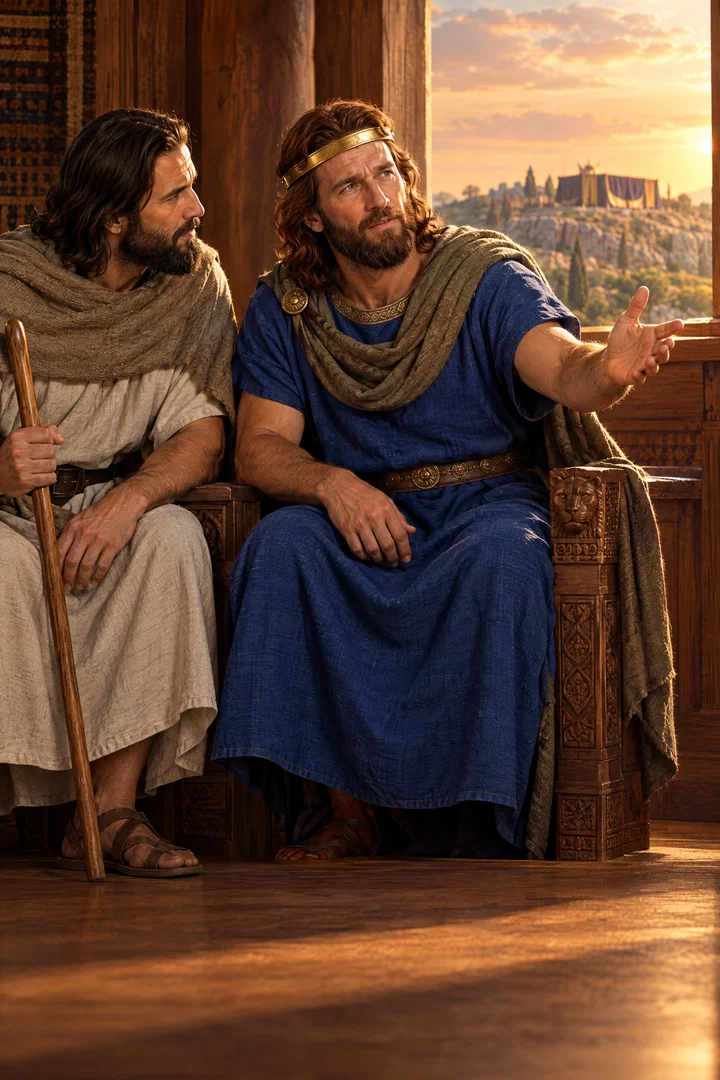
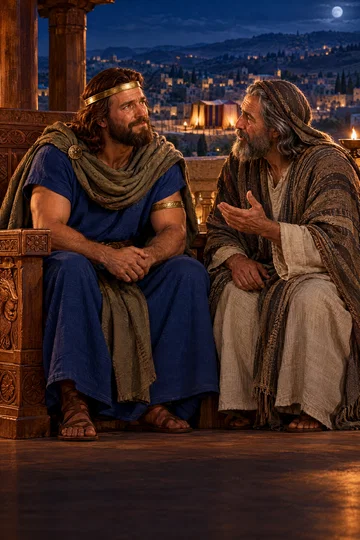
That the king said unto Nathan the prophet, See now, I dwell in an house of cedar, but the ark of God dwelleth within curtains.
Translations
That the king said to Nathan the prophet, See now, I dwell in an house of cedar, but the ark of God dwells within curtains.
That the king said unto Nathan the prophet, See now, I dwell in an house of cedar, but the ark of God dwelleth within curtains.
KJV Cambridge Paragraph Bible, American Standard Version
that the king said unto Nathan the prophet, See now, I dwell in a house of cedar, but the ark of God dwelleth within curtains.
That the king said to Nathan the prophet, See now, I dwell in a house of cedar, but the ark of God dwelleth within curtains.
that the king said unto Nathan the prophet, See now, I dwell in an house of cedar, but the ark of God dwelleth within curtains.
that the king saith unto Nathan the prophet, 'See, I pray thee, I am dwelling in a house of cedars, and the ark of God is dwelling in the midst of the curtain.'
that the king said to Nathan the prophet, See now, I dwell in a house of cedars, and the ark of God dwells under curtains.
that the king said unto Nathan the prophet, See, I pray thee—I, have my abode in a house, of cedar, but, the ark of God, abideth in, the midst, of curtains.
Berean Standard Bible, Majority Standard Bible
he said to Nathan the prophet, “Here I am, living in a house of cedar, while the ark of God remains in a tent.”
the king said to Nathan the prophet, “ See now, I dwell in a house of cedar, but God’s ark dwells within curtains.”
The king said to Nathan the prophet, See now, I am living in a house of cedar, but the ark of God is housed inside the curtains of a tent.
The King saide vnto Nathan the Prophet, Beholde, nowe I dwel in an house of cedar trees, and the Arke of God remayneth within the curtaines.
Douay-Rheims (Challoner revision)
He said to Nathan the prophet: Dost thou see that I dwell in a house of cedar, and the ark of God is lodged within skins?
Pictures
Cross-references 20 of 45
- 1 Chronicles 22:7-10
And David said to Solomon, My son, as for me, it was in my mind to build an house unto the name of the LORD my God:
David could not build the house because of his wars; Solomon would build it.
- 1 Chronicles 17:1
Now it came to pass, as David sat in his house, that David said to Nathan the prophet, Lo, I dwell in an house of cedars, but the ark of the covenant of the LORD remaineth under curtains.
David tells Nathan that he lives in a cedar house while God’s ark remains under curtains.
- 2 Samuel 7:12-16
And when thy days be fulfilled, and thou shalt sleep with thy fathers, I will set up thy seed after thee, which shall proceed out of thy bowels, and I will establish his kingdom.
God promises David an enduring house, throne, and descendant whose kingdom lasts forever.
- Acts 7:46-47
Who found favour before God, and desired to find a tabernacle for the God of Jacob.
Stephen recalls David’s desire for God’s dwelling and Solomon’s building of the house.
- 1 Kings 8:17-19
And it was in the heart of David my father to build an house for the name of the LORD God of Israel.
Solomon recalls David’s desire to build the Lord’s house and that his son would build it.
- Psalms 132:1-5
LORD, remember David, and all his afflictions:
David vows to find a dwelling place for God.
- 1 Kings 8:27
But will God indeed dwell on the earth? behold, the heaven and heaven of heavens cannot contain thee; how much less this house that I have builded?
God cannot be contained in a house or even the heavens.
- 2 Samuel 6:6-7
And when they came to Nachon’s threshingfloor, Uzzah put forth his hand to the ark of God, and took hold of it; for the oxen shook it.
The ark’s transport shows the holiness of God’s presence and the need to follow his way.
- 1 Chronicles 17:4
Go and tell David my servant, Thus saith the LORD, Thou shalt not build me an house to dwell in:
God forbids David to build him a house.
- 1 Chronicles 28:2
Then David the king stood up upon his feet, and said, Hear me, my brethren, and my people: As for me, I had in mine heart to build an house of rest for the ark of the covenant of the LORD, and for the footstool of our God, and had made ready for the building:
David wanted to build a house for the ark of God.
- 2 Samuel 7:6-7
Whereas I have not dwelt in any house since the time that I brought up the children of Israel out of Egypt, even to this day, but have walked in a tent and in a tabernacle.
gives God's answer to the desire
- Exodus 25:8
And let them make me a sanctuary; that I may dwell among them.
The sanctuary was made as a dwelling for God.
- Acts 7:48
Howbeit the most High dwelleth not in temples made with hands; as saith the prophet,
God does not dwell in houses made by human hands.
- Isaiah 66:1
Thus saith the LORD, The heaven is my throne, and the earth is my footstool: where is the house that ye build unto me? and where is the place of my rest?
God declares heaven his throne and asks what house could contain him.
- 2 Samuel 7:18-29
Then went king David in, and sat before the LORD, and he said, Who am I, O Lord GOD? and what is my house, that thou hast brought me hitherto?
God’s promises prompt David’s thanks.
- 2 Samuel 6:12
And it was told king David, saying, The LORD hath blessed the house of Obed-edom, and all that pertaineth unto him, because of the ark of God. So David went and brought up the ark of God from the house of Obed-edom into the city of David with gladness.
David brings the ark of God into the city of David.
- 1 Kings 8:10-11
And it came to pass, when the priests were come out of the holy place, that the cloud filled the house of the LORD,
God’s glory filling the temple approved David’s plan.
- Psalms 89
I will sing of the mercies of the LORD for ever: with my mouth will I make known thy faithfulness to all generations.
It recounts the promise concerning Christ’s kingship.
- 2 Chronicles 3:1
Then Solomon began to build the house of the LORD at Jerusalem in mount Moriah, where the Lord appeared unto David his father, in the place that David had prepared in the threshingfloor of Ornan the Jebusite.
Places Solomon’s temple on Mount Moriah, at Ornan’s threshing floor.
- 2 Chronicles 5:7-14
And the priests brought in the ark of the covenant of the LORD unto his place, to the oracle of the house, into the most holy place, even under the wings of the cherubims:
The ark is placed in the completed temple, which is filled with God’s glory.
Commentary
Each commentary is drawn from primary sources: the writings of Ellen G. White and Adventist pioneers and periodicals. Each commentary is separate. Its own words are not a quotation; follow the references to read the source passages.
Ellen G. White
4 sources
David dwelt in a house or palace of cedar in Jerusalem while the ark of God dwelt within curtains in a tent or tabernacle.PP 711.3–712.3Ms 23, 1886, par. 1–2Ms 23, 1886, par. 14Ms 49, 1886, par. 2–3 This occurred nearly three thousand years ago when God's chosen nation was greatly favored.Ms 23, 1886, par. 1–2 The tabernacle had been constructed in the wilderness and borne all the way from Horeb to Jerusalem during a pilgrimage of nearly forty years, and the nation had now ended that pilgrimage, obtained a permanent location, and settled in the goodly land of Canaan in costly buildings of cedar.Ms 23, 1886, par. 1–2Ms 49, 1886, par. 2–3 The curtained Tabernacle was where the Shekinah, the visible emblem of God's presence, dwelt between the cherubim, and the ark symbolized His presence as the mighty God, the Maker of the heavens and the earth.Ms 23, 1886, par. 1–2Ms 49, 1886, par. 2–3
Seeing his own magnificent palace and the costly dwellings of the inhabitants, David was impressed and filled with remorse and a disturbed conscience that he dwelt so well while the ark was provided for so much more poorly, feeling it was unfitting and without a suitable dwelling place.PP 711.3–712.3Ms 23, 1886, par. 1–2Ms 49, 1886, par. 2–3 He therefore conceived the idea and purpose to build a more honorable and worthy residence for God, a magnificent temple in Jerusalem to honor God, prepare a place for worship, and make the city the nation's religious center.PP 711.3–712.3Ms 23, 1886, par. 1–2Ms 49, 1886, par. 2–3 David made his conviction known to Nathan the prophet, who encouraged him to carry out his purpose of building a temple for the Lord to dwell in, but God in His providence had a special work for David to perform and had selected his son Solomon to accomplish the great work.PP 711.3–712.3Ms 23, 1886, par. 1–2 The site of the building was indicated and the most complete instructions were given, and Solomon entered upon the great work.Ms 49, 1886, par. 2–3
David's comparison of his own house of cedar with the curtains sheltering the ark teaches God's people to look at their own conveniences and then at the poor accommodations provided for His service, and the difference should move every man and woman, old and young, parents and children, to arise and build a house for God with deep heart interest, bringing gifts and donations and showing as great and even greater interest than in building houses for themselves, for their own good and for the glory of God.Ms 23, 1886, par. 14 Such building for God is to be done in harmonious, faithful, cautious labor under acknowledged leaders without rivalry, strikes, or dissatisfaction, with each stone fashioned to fit its place.Ms 23, 1886, par. 14 It is not to be hindered by trying times over means, because God's blessing is wanted in working the works of God.Ms 23, 1886, par. 14
Sources
Pioneers and periodicals
28 sources
David, settled in his cedar house after God had given him rest from his enemies, contrasts his own dwelling with the ark of God still housed in the tent he had pitched for it, the tabernacle dwelling that held the Ten Commandments, and out of gratitude purposes to build a permanent temple for God's worship.RH May 27, 1902STRH Jul 31, 1900 Nathan at first bade him do all that was in his heart, but that counsel was his own private judgment and not divine inspiration, so the Lord reversed it that same night, though others held it was no mistake but spoke from what had been revealed so far before God showed more.ST Oct 8, 1885ST Aug 10, 1904RH Sep 13, 1906 God would not let David himself build, because as a man of war who had shed much blood he could only gather the materials, while his son Solomon would raise the house.RH May 27, 1902RH Jan 6, 1853RH May 27, 1915RH Nov 10, 1863 In return the Lord would make David a house, establishing his throne forever, a promise fulfilled only in part by Solomon and his temple and pointing ultimately to Christ, the greater Son of David.RH May 27, 1902RH Apr 12, 1860RH Jul 15, 1873 Such care for the place of worship is richly blessed even when the work is refused, for God's denial of a cherished purpose shows human plans are not always His plans and He overrules in loving care while still using the one refused.ST Dec 8, 1914ST Oct 8, 1885RH Nov 12, 1903
Words and Historical Setting
The king David speaks to Nathan the prophet, sitting in his own house of cedar while the ark of God remains within curtains in a tent.RH May 27, 1902ST Jul 3, 1884 Nathan first appears here as David's adviser.ST Jul 3, 1884 That kings sought prophetic counsel in important matters is shown by Nathan serving as prophetic counselor to David, with prophetic speech carrying divine authority before which kings bowed.RH Jun 15, 1911
The curtains are the tent David had pitched for the ark in Jerusalem, in the city of David.RH Jan 6, 1853 They are the tabernacle home of the ark, its dwelling place, going back to the sanctuary built by Moses that had housed God's dwelling since Israel's wilderness journey.RH Jul 31, 1900ST May 14, 1902ST May 14, 1902 The ark contained the law of God, the Ten Commandments.ST May 14, 1902
The words are spoken after God had given David rest from all his enemies round about, after many years of warfare.RH May 27, 1902ST Oct 21, 1889 Then Israel's journeyings and the troublous period of the Judges were ended and the tribes were consolidated into a powerful kingdom under David's broad sway. This is dated to Jerusalem about B.C. 1042, when David was about 44 years old and his wars were over.ST Jul 9, 1896
By contrasting his cedar house with the ark in curtains, David expresses care for God's work and worship and concern for the ark's setting.RH Jan 6, 1853 From gratitude and reflection on God's goodness he purposes to build a fitting permanent house and temple for the ark, a suitable permanent structure for its abiding place.STRH Jan 6, 1853ST Jul 9, 1896 He first conceives the design of building a house worthy of God's majesty and opens his mind about it to Nathan, desiring a fitting sanctuary for God and planning a place specially set apart for God's worship and for teaching His principles of truth.RH Jan 6, 1853RH Nov 10, 1863 The materials for the house were provided by David before his death, though the edifice itself was raised by his son Solomon.RH Nov 10, 1863
The contrast comes after the bringing up of the ark and before David's prayer and thanksgiving.ST Apr 14, 1909 This comparison of his own cedar house with the ark remaining in a tent leads directly into the account of the promise to David in the chapter.ST May 21, 1902 The contrast occurs as Israel has settled into a more permanent home: God had accompanied the people while they journeyed and lived in tents, and would now permit a permanent temple for worship.ST May 21, 1902
Promise and Prophetic Fulfillment
Nathan at first told David to go and do all that was in his heart, for the Lord was with him, approving the purpose to build a house for God out of the contrast between his own cedar house and the ark within curtains.ST Aug 10, 1904RH Oct 27, 1863 That approval was Nathan's personal opinion from his own private judgment, not divine inspiration, and was erroneous.ST Aug 10, 1904 That same night the Lord gave Nathan information that reversed the decision, giving him a different message to deliver to David.ST Oct 8, 1885ST Aug 10, 1904RH Oct 27, 1863 By a different reckoning, Nathan's first counsel was not a mistake but was given on the circumstances as he understood them, because God did not reveal everything to him at once but revealed further information afterward.RH Sep 13, 1906
God forbade David to build Him a house to dwell in because David had been a man of war and had shed much blood.RH May 27, 1915 The work was holy and important, holding out peace from Heaven to a rebellious world, so only those whose lives had been passed in peace could be employed in its erection. God accepted David's good intentions and his first conceiving of a design worthy of God's majesty, but refused him the honor of building it.RH Nov 10, 1863 David was permitted only to gather and provide the materials before his death, while the edifice itself was raised by his son.RH May 27, 1915RH Nov 10, 1863
David himself should not build the house, but his son should build it, and Solomon carried out the building and replaced the tabernacle with a permanent house.RH May 27, 1902RH Jan 6, 1853ST Oct 8, 1885ST Jun 14, 1883 The promise to David in that chapter was renewed to Solomon to encourage him in building the temple and to remind him that God's favor was not unconditional.ST Oct 9, 1884 In return the Lord would make David a house, establishing David's house and kingdom and throne forever.ST Oct 8, 1885 Although David was not allowed to build, his concern for God's work and worship was thus rewarded, and his desire was connected with God establishing his throne forever and bringing Christ from his line.RH Mar 4, 1902
The presence of details applying only to Solomon does not prevent the promise from also applying to Christ, for Scripture uses prophecies in this way.RH Apr 12, 1860 Solomon's temple fulfilled the plan only in a limited way, while the promise of a house and a son ultimately pointed to Christ.RH May 27, 1902RH Jul 31, 1900 The setting points beyond Solomon's temple to the greater Son of David, who brings peace and makes flesh His tabernacle, with Christ coming from David's line.RH May 27, 1902RH Mar 4, 1902 The chapter connects the word of the Lord to David with Christ's destined rule as King on the throne of God's kingdom, the fifth universal kingdom on earth.RH Jul 15, 1873 Its prophetic view of God's sanctuary is fulfilled in God's sanctuary among His people in the earth made new, where the Lord reigns forever and Israel is planted permanently.RH Feb 3, 1853
Worship and Divine Guidance
David sitting in his cedar house while the ark remained under curtains belongs to the lesson itself and not merely to its background, and his wish to build a house for the ark came after the rest given him from his enemies.RH May 27, 1902 His unease at dwelling in a fine house while the ark dwelt within curtains was care for God's work and worship and for the place of worship.ST Oct 8, 1885 Such concern is doing God's will, because God Himself has great care for the place of His worship.ST Oct 8, 1885 The house of the Lord is a house of rest, and David's intention was good, though he himself was not to build it but his son was to build it.RH May 27, 1902
Such care is richly rewarded, for although David was not allowed to build a house for the Lord, in return the Lord promised to make David a house and to establish his house and kingdom and throne forever.ST Oct 8, 1885 That answer came that very night, directing that David himself should not build the house but his son should build it.ST Oct 8, 1885 Although David was not permitted to carry the thought of a house of worship fully through, he was blessed for cherishing it, and his descendants were more greatly blessed because of it.RH Nov 12, 1903 A thought of care for the house of the Lord bears fruit to all eternity with eternal glory.ST Oct 8, 1885
The care God regards and rewards is not fitting up the place of worship for theatricals, operatic airs, feasts, and festivals.ST Oct 8, 1885 David knew that God could not be contained in a temple, yet he saw that no place on earth had been specially set apart for teaching God's principles of truth, and he intended to build such a house.RH Mar 4, 1902 This desire was connected with the establishing of his throne forever and the bringing of Christ from his line.RH Mar 4, 1902
Refusal of David's very best intention shows that human plans are not always God's plans and that He sees what is best for the person and for His cause.ST Dec 8, 1914 The refusal came from loving care by One who understands a person better than he understands himself, to keep him from selfishly seeking the gratification of ambition and from passing by the homely but sacred duties lying next to him.ST Dec 8, 1914 Those homely duties often give the very training essential to prepare for higher work.ST Dec 8, 1914 Those who sincerely devote themselves and all they have to God's glory will still be blessed and used in the advancement of His cause, for when God sees it best not to grant their desires He counterbalances the refusal with tokens of His love and entrusts them with another service, letting human plans fail so that God's plans may succeed.ST Dec 8, 1914
Sources