Acts 16:15
And when she was baptized, and her household, she besought us, saying, If ye have judged me to be faithful to the Lord, come into my house, and abide there. And she constrained us.
Translations
And when she was baptized, and her household, she sought us, saying, If you have judged me to be faithful to the Lord, come into my house, and abide there. And she constrained us.
King James Version, KJV Cambridge Paragraph Bible, Revised Version, American Standard Version
And when she was baptized, and her household, she besought us, saying, If ye have judged me to be faithful to the Lord, come into my house, and abide there. And she constrained us.
And when she was baptized, and her household, she besought us, saying, If ye have judged me to be faithful to the Lord, come into my house, and abide there: And she constrained us.
and when she was baptized, and her household, she did call upon us, saying, 'If ye have judged me to be faithful to the Lord, having entered into my house, remain;' and she constrained us.
And when she had been baptised and her house, she besought [ us], saying, If ye have judged me to be faithful to the Lord, come into my house and abide [ there]. And she constrained us.
And, when she was immersed, and her house, she besought [us], saying—If ye have judged me to be a believer in the Lord, come into my house, and abide [there]. And she constrained us.
Berean Standard Bible, Majority Standard Bible
And when she and her household had been baptized, she urged us, “ If you consider me a believer in the Lord, come and stay at my house.” And she persuaded us.
When she and her household were baptized, she begged us, saying, “ If you have judged me to be faithful to the Lord, come into my house and stay.” So she persuaded us.
And when she and her family had had baptism, she made a request to us, saying, If it seems to you that I am true to the Lord, come into my house and be my guests. And she made us come.
And when she was baptized, and her houshold, she besought vs, saying, If ye haue iudged me to be faithfull to ye Lord, come into mine house, and abide there: and she constrained vs.
Douay-Rheims (Challoner revision)
And when she was baptized, and her household, she besought us, saying: If you have judged me to be faithful to the Lord, come into my house, and abide there. And she constrained us.
Pictures
Cross-references
- Acts 16:33
And he took them the same hour of the night, and washed their stripes; and was baptized, he and all his, straightway.
The jailer and his household were baptized that night.
- Acts 2:38
Then Peter said unto them, Repent, and be baptized every one of you in the name of Jesus Christ for the remission of sins, and ye shall receive the gift of the Holy Ghost.
Baptism follows repentance and acceptance of the message.
- Matthew 28:19
Go ye therefore, and teach all nations, baptizing them in the name of the Father, and of the Son, and of the Holy Ghost:
Christ’s disciple-making command includes baptizing those taught.
- Acts 16:40
And they went out of the prison, and entered into the house of Lydia: and when they had seen the brethren, they comforted them, and departed.
The later reference to Lydia’s house recalls her earlier hospitality and household.
- Romans 6:4
Therefore we are buried with him by baptism into death: that like as Christ was raised up from the dead by the glory of the Father, even so we also should walk in newness of life.
Baptism marks burial with Christ and the beginning of new life.
- Acts 16:9-10
And a vision appeared to Paul in the night; There stood a man of Macedonia, and prayed him, saying, Come over into Macedonia, and help us.
The vision called the missionaries to Macedonia, where Lydia received them.
- Acts 10:47-48
Can any man forbid water, that these should not be baptized, which have received the Holy Ghost as well as we?
Peter called for the Gentile believers to be baptized.
- Mark 16:16
He that believeth and is baptized shall be saved; but he that believeth not shall be damned.
Both connect belief and baptism with salvation.
- Luke 24:29
But they constrained him, saying, Abide with us: for it is toward evening, and the day is far spent. And he went in to tarry with them.
The disciples urge the stranger to stay, as Lydia urges the disciples.
- 1 Corinthians 1:16
And I baptized also the household of Stephanas: besides, I know not whether I baptized any other.
Paul mentions baptizing the household of Stephanas.
- Acts 10:2
A devout man, and one that feared God with all his house, which gave much alms to the people, and prayed to God alway.
Cornelius is another example of a household devoted to God.
- Acts 18:8
And Crispus, the chief ruler of the synagogue, believed on the Lord with all his house; and many of the Corinthians hearing believed, and were baptized.
Both texts describe households believing and being baptized.
- John 3:5
Jesus answered, Verily, verily, I say unto thee, Except a man be born of water and of the Spirit, he can not enter into the kingdom of God.
Water and the Spirit are connected with entrance into God’s kingdom.
Commentary
Each commentary is drawn from primary sources: the writings of Ellen G. White and Adventist pioneers and periodicals. Each commentary is separate. Its own words are not a quotation; follow the references to read the source passages.
Ellen G. White
7 sources
This verse belongs to the advance of the gospel from Asia Minor into Europe, prepared at Troas on the Mediterranean coast when Paul received a night vision of a man from Macedonia pleading for help.AA 211.1 It took place at Philippi, a leading city of that part of Macedonia and a colony, after Paul with Silas, Timothy and Luke became assured the Lord had called them to preach there.AA 211.2 From Troas they sailed directly to Samothrace, then to Neapolis, then to Philippi.AA 211.2
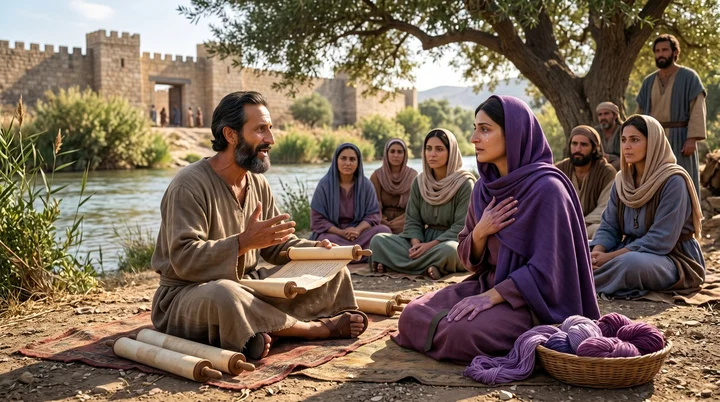
At Philippi on the Sabbath, outside the city by a riverside set apart for prayer where women had gathered, Lydia of Thyatira, a seller of purple who worshiped God, heard the gospel from the apostles.AA 212.1 The Lord opened Lydia's heart so that she gladly received the truth with an open heart.AA 212.1SLP 74.1 She and her household were converted and baptized together.AA 212.13SP 379.3SLP 74.18RED 37.1ST Jul 3, 1879
After the baptism she earnestly asked the apostles to come to her house and make it their home during their stay.AA 212.13SP 379.3SLP 74.18RED 37.1ST Jul 3, 1879
Sources
Pioneers and periodicals
54 sources
The verse tells of Lydia, a seller of purple from Thyatira doing business at Philippi, whose heart the Lord opened as she heard Paul at the riverside prayer meeting on the Sabbath, leading to the baptism of her and her household and her pressing invitation for Paul and his companions to stay in her house as those judged faithful to the Lord.RH Mar 4, 1862RH Nov 16, 1916ST Jun 24, 1880ST Jan 13, 1898 Her heeding the gospel in faith followed by prompt baptism shows conversion and baptism joined together, forming the beginning and nucleus of the Philippian church, the first church in Europe.RH Mar 4, 1862RH May 5, 1874ST Jul 8, 1880RH Feb 12, 1857 The meeting itself confirms the apostles and first believers were still worshiping on the seventh-day Sabbath, with no new day introduced.RH May 5, 1874RH Nov 21, 1871RH Mar 27, 1856RH Nov 29, 1853 The household baptized with her believed and received instruction with her, and household baptism gives no authority for baptizing infants, since true baptism requires being taught, repenting, believing and understanding its meaning, which unconscious children cannot do.ST Jun 24, 1880ST Sep 6, 1883ST Nov 25, 1889RH Mar 27, 1913RH Mar 28, 1871 Her constraining them to abide there made her house a home of Christian hospitality and peace for the missionaries, offered as proof of faithfulness and love for God's servants.RH Nov 16, 1916ST Jan 13, 1898ST Nov 29, 1910ST Jun 21, 1883
Lydia and Philippi Setting
Lydia was a seller of purple cloth and dealer in purple dyes from Thyatira, doing business far from home at Philippi, the chief city of that part of Macedonia.RH Mar 4, 1862ST Jun 24, 1880ST Jan 13, 1898ST Jun 4, 1902ST Jun 4, 1902 She is identified as Paul's first convert at Philippi.RH Mar 4, 1862ST Jun 24, 1880 Paul met her on the Sabbath at a riverside place of prayer outside Philippi, where he spoke to the women gathered there.RH Mar 4, 1862ST Jan 13, 1898ST Jun 4, 1902ST Jun 4, 1902ST Jul 8, 1880 Those gathered were mostly devout Gentiles worshiping God, with Jewish proselytes among them, including Jewish women meeting on the seventh-day Sabbath.RH Mar 4, 1862ST Jun 4, 1902ST Jun 4, 1902ST Jul 8, 1880ST Jun 17, 1897
The Lord himself opened Lydia's heart to attend and give heed to the things spoken by Paul.RH Mar 4, 1862ST Jan 13, 1898ST Jun 4, 1902ST Jun 4, 1902 This was a work neither she nor Paul could do, by which her heart was gently made fit to be God's temple.RH Mar 4, 1862ST Jan 13, 1898ST Jun 4, 1902ST Apr 15, 1889 Her giving heed with a heart so opened resulted in faith.RH Mar 4, 1862ST Jan 13, 1898ST Jun 4, 1902 God's providence brought her to salvation through change of place, for though she was a native of Thyatira, probably long resident there in the very region where Paul had been forbidden to preach, in the course of worldly business she was brought to the strange city of Philippi and there heard the word of life from that same Paul.ST Apr 15, 1889 God appoints the bounds of habitation and often removes them, making change of outward condition or place of abode serve the designs of grace for salvation.ST Apr 15, 1889
Though living in a heathen city where none but Jewish residents would observe the Sabbath, she put worship before business.ST Apr 15, 1889 Though she could have stayed to carry on her trade and sell her purple cloth, she knew the God who at creation blessed the Sabbath day and hallowed it, so she left the market and went out of the city to the riverside where prayer was wont to be made and joined those who worshiped God.ST Apr 15, 1889 The Lord distinguished her with this blessing because she had sought God in this way.ST Apr 15, 1889 The event belongs to Paul's Spirit-guided crossing to Macedonia in answer to the Macedonian cry, Come over and help us, and to his vision directing him to Macedonia.RH Jun 26, 1855ST Jun 4, 1902 Paul was in company with Silas, Timothy, and Luke when he visited Philippi about A.D. 51 or 52, beginning gospel work in Europe, and through their ministry the first church in Europe was established there, with Lydia and her household as the first converts and the entrance of God's words giving light in this beginning work.RH Jun 26, 1855ST Jun 4, 1902
Conversion and Baptism Pattern
Lydia's giving heed with a heart opened by the Lord resulted in faith, and that faith was followed by the baptism of Lydia and her household, with faith then displayed by baptism and by urging hospitality.ST Mar 31, 1914ST Jun 4, 1902 Conversion and baptism stand closely connected, for baptism is the birth of water which, together with conversion and the spirit of adoption, prepares those who remain faithful for the spiritual birth at the resurrection and entrance into the kingdom.RH Feb 12, 1857 The household joined her in believing and receiving the Christian teaching, and its members are identified as believers and as brethren in Acts 16:40.ST Jun 24, 1880RH Mar 27, 1913 The accounts of household baptism generally also record belief, though the verse itself does not state that the household believed.ST Jun 24, 1880RH Mar 27, 1913
Baptism came promptly after hearing and repenting, without delay, and Paul and Silas taught it as part of the gospel rather than avoiding the subject.RH Dec 20, 1853ST May 15, 1884 Candidates are first taught its sacred meaning, that baptism signifies death to the world and faith in Christ's death and resurrection, with mystical washing away of sin after professing Jesus as Messiah, and hope in the resurrection of the saints in Christ's likeness at his second coming.RH Dec 20, 1853ST Oct 20, 1914 The baptism so described is understood as immersion.ST Oct 20, 1914
A household conversion through Paul's preaching at Philippi shows the power of the gospel as it crossed into Greece to turn idolaters into saints and martyrs and to transform individual character, which opposition to the truth could not prevent or stop from saving souls.ST Jan 19, 1882RH Oct 16, 1860 Yet the baptism of Lydia and her household does not mean the whole world would be converted in this age, though it belongs among the examples of apostolic gospel work showing God accomplishing his purpose.ST Jul 19, 1883ST Jan 19, 1882 The Philippi account in which the verse stands also includes Paul and Silas meeting the spirit of divination in a damsel who followed them until it was cast out, showing one trace through the Bible of the same wicked system of seeking wisdom from familiar spirits, then called witchcraft and now called mediums and modern Spiritualism.ST Sep 15, 1898
Household and Infant Baptism
The verse does not say that Lydia had a husband or children, nor does it specify who or how many were in her household that was baptized with her.ST Jun 24, 1880ST Jun 21, 1883 Those baptized with her had joined her in believing and receiving the Christian teaching, and are identified elsewhere as brethren, while she herself was doing business in Philippi far from Thyatira where she was from.ST Jun 24, 1880 Her welcome in offering her home and insisting that Paul and his companions stay made her house a place of Christian hospitality and peace, an early example of family religion.ST Jun 21, 1883
Household means the people living under one roof and does not imply they were infants or even include infants.ST Sep 6, 1883 A statement about a household may apply only to those old enough to respond and act, as with the household of Stephanas whose service to the church need not include infants, so household baptism alone does not prove that every member including any infants was baptized.ST Sep 6, 1883ST Dec 13, 1883 The verse explicitly connects Lydia's baptism with her faith, but does not say that her household was baptized merely because she believed.ST Sep 6, 1883 It records Lydia's baptism and the baptism of her household, but does not say that the household believed, and therefore provides little direct support for infant baptism, while the household-baptism accounts generally also record belief.ST Sep 6, 1883RH Mar 27, 1913
The household baptized with Lydia received instruction, exercised faith, and shared in consolation, showing that all baptized in household baptisms were able to understand and believe in Jesus Christ.RH Mar 28, 1871 True Christian baptism commanded by Christ requires being taught, repenting, believing in the Lord Jesus upon confession of faith when the will is formed, with reason, voluntary submission, obedience, and understanding of its meaning and walking in newness of life, none of which infants can do.ST Sep 6, 1883ST Nov 25, 1889RH Mar 28, 1871 Baptism belongs with personal belief, and treating the household's baptism as valid without belief would conflict with the apostles' teaching and commission.ST Sep 6, 1883
Mention of household baptism therefore gives no scriptural authority for baptizing infants or unconscious little children, does not answer that specific question, and alone is not sufficient proof.RH Feb 3, 1852RH Jun 24, 1852ST Nov 25, 1889ST Feb 18, 1886ST Oct 25, 1883 The claim that her household and the other households Paul baptized must have contained young children is mere conjecture, not Bible teaching.ST Nov 25, 1889 The household cases are not conclusive evidence for infant baptism and are not a secure basis for the practice.ST Feb 18, 1886RH Mar 7, 1865ST Oct 25, 1883 The verse is cited alongside Acts 16:33 as a text from which infant baptism might be inferred, yet such an inference alone is not sufficient proof of a doctrine and does not establish it.RH Feb 3, 1852RH Jun 24, 1852
Sprinkling babies as dedication does not answer to Christ's positive and prominent command, but displaces it with a rite born of tradition, sentiment, and ecclesiastical usage.ST Nov 25, 1889 Infant sprinkling is not the baptism Scripture commands but is opposed to the word of God, and to substitute sprinkling of infants for immersion of believers breaks one of Christ's least commandments and fails to seek God after the due order.ST Nov 25, 1889RH Mar 28, 1871 Children who die in infancy before they can understand are saved through Christ's death without baptism.RH Mar 28, 1871 Whole-household baptisms alongside the promise to hearers and their children in Acts 2:39 are offered as material for an inferential argument, but they do not establish rules for Sunday observance or prove Sunday blessed or sanctified.RH Jul 29, 1873 Citing the verse to say the apostles baptized infants and changing denominations on that ground is poor logic, for no one should change from one Christian denomination to another except where loyalty to truth demands it.
Sabbath and Philippian Church
Lydia and her household were Gentile worshipers of the true God, not Jews, who were already meeting with the Jewish people on the Sabbath when they accepted the gospel.RH Mar 4, 1862RH Mar 4, 1862RH Mar 4, 1862 Lydia, with those employed by her in her business, were evidently Sabbath observers.RH Mar 4, 1862RH Mar 4, 1862 Paul began his work at Philippi with a small company of devout Sabbath-keepers, mostly women, who met for prayer by the riverside on the Sabbath.ST Jul 8, 1880RH Jan 9, 1908RH Nov 23, 1905 Lydia, a Grecian merchant woman from Thyatira, was the first convert from that Sabbath-keeping company, and she and her household responded to Paul's teaching and became the first members there, their readiness linked to their being a praying group seeking further light under the Holy Spirit's guidance.ST Jul 8, 1880RH Jan 9, 1908ST Oct 20, 1914
Their conversion and baptism during Paul's Sabbath visit formed the origin and nucleus of the Philippian church.RH Mar 4, 1862RH May 5, 1874ST Jul 8, 1880 That founding is placed at the riverside place of prayer and at Lydia's house, where she urged Paul and his companions to stay on the ground that they judged her faithful to the Lord.RH May 5, 1874ST Nov 29, 1910RH Mar 27, 1856 It was the first introduction of the gospel to the people of Philippi, where devout Sabbath-keepers gladly accepted it, and the first church in Europe.ST Jul 8, 1880RH Jan 9, 1908 The record of their baptism confirms the meeting day was the seventh day still called the Sabbath.RH Mar 4, 1862RH Nov 21, 1871
The episode is an example of the apostles and primitive Christians assembling for worship on the Sabbath.RH Nov 21, 1871RH Mar 27, 1856 There is no hint that Paul introduced a new Sabbath among those pious Gentiles in the habit of assembling on the Sabbath for worship.RH Nov 21, 1871RH Mar 27, 1856 Nor is there any hint that they treated the following day as a Sabbath, but Paul and his companions kept the seventh day.RH Nov 21, 1871RH Nov 29, 1853 Lydia and those employed by her likely helped introduce the gospel into their own city of Thyatira.RH Mar 4, 1862RH Mar 4, 1862
Hospitality and Faithful Welcome
After she and her household were baptized, Lydia asked Paul and his companions to come into her house and remain there, making her offer of hospitality the evidence of her faithfulness to the Lord.RH Nov 16, 1916ST Jan 13, 1898ST Jun 4, 1902ST Jun 4, 1902 She grounded her appeal on their judgment that she was truly faithful, asking them to stay if they so judged her, and she earnestly urged them to become her guests.ST Jan 13, 1898ST Jun 4, 1902ST Jun 4, 1902RH May 5, 1874 The one who so invited them was Lydia of Thyatira, the seller of purple and dealer in purple dyes who worshiped God and whose heart the Lord had opened to give heed to what Paul spoke on the Sabbath by the riverside outside Philippi.ST Jan 13, 1898ST Jun 4, 1902ST Jun 4, 1902 Her conversion and hospitality belong with that Sabbath-keeping company at Philippi from which the church began.RH May 5, 1874
She pressed and constrained them until they consented and stayed, persuading them to accept her invitation to come in and abide.ST Jun 4, 1902ST Jun 21, 1883ST Jun 21, 1883 Her insistence reflected a host's desire to have guests remain, and a heart full of love for God and his servants.RH Jan 26, 1860 Her urging of Paul and his fellow workers to enter her house and stay there was itself set forth as proof that they judged her faithful to the Lord.ST Jun 4, 1902 Her welcome displayed faith by baptism followed by hospitality to the apostles, and reflected the women's desire for God to send them help.ST Jun 4, 1902ST Jun 21, 1883ST Jun 21, 1883
Her welcome made her house a place of Christian hospitality and peace, giving the missionaries a home in Philippi after they had preached to the worshipers gathered by the river.ST Jun 21, 1883ST Mar 20, 1884 The founding of the church at Philippi is placed at that place of prayer where Paul met in Lydia's house, the house of prayer and meeting.ST Nov 29, 1910 The verse stands as an early example of family religion and apostolic hospitality.ST Jun 21, 1883
Women Family and Example
Women took part in the worship of God and were honored in the Christian church, and Lydia stands among the women whose names appear in the records of the primitive church, showing women's conspicuous place in its early history and their recognized gifts and service with a place in God's work.ST Apr 15, 1903 Acts 16:13-15 shows that participation, with Lydia and her household baptized and with her welcoming the believers into her home after being baptized with her household. Lydia is cited together with Cornelius and the jailer as encouragement to hope and work for the salvation of one's family, trusting that a whole household that was baptized along with her may enter God's kingdom if faith does not fail, as she, believing herself judged faithful to the Lord, urged the messengers to stay in her home.RH Mar 22, 1860
Lydia's beginning among the women at Philippi is a model of consecration and diligence in missionary work for others to follow, whose like consecration and diligence might bring similar success.RH Mar 18, 1875 As a trader in purple dye she shows how honest work can serve God, for when a Christian consecrates a calling to Christ and carries it out patiently and honestly, that work helps the Christian grow in grace and be fitted for heaven.ST May 1, 1884 She remained at work in her cloth store as a fruitful Christian, always abounding in the work of the Lord, putting faith into action and bringing love close to Christ.RH Mar 21, 1871 Her example proves that every genuine revival has a human side of quickened activity by free men and women alongside the divine gift, with the Christian doing the living so the Holy Spirit can spread fragrance through the life, and such bearing trees in ordinary callings gave the apostolic church its success and tremendous power.RH Mar 21, 1871
Though not called like David and Paul to a mighty public work, Lydia was natural, unaffected, quiet, zealous, useful, and strong in the faith, faithful in a subordinate place.RH Aug 19, 1862 By abiding faithfully in that place she will share alike in the rich rewards of the righteous (1 Sam. 30:24). RH Aug 19, 1862 She is an example for Christian daughters to emulate, in contrast with the daughter of Herodias.ST Apr 14, 1881
Sources