Acts 16:28
But Paul cried with a loud voice, saying, Do thyself no harm: for we are all here.
Translations
But Paul cried with a loud voice, saying, Do yourself no harm: for we are all here.
King James Version, KJV Cambridge Paragraph Bible, Webster Bible, Revised Version, American Standard Version
But Paul cried with a loud voice, saying, Do thyself no harm: for we are all here.
and Paul cried out with a loud voice, saying, 'Thou mayest not do thyself any harm, for we are all here.'
But Paul called out with a loud voice, saying, Do thyself no harm, for we are all here.
But Paul called out with a loud voice, saying—By no means, do thyself harm, for we are, one and all, here.
Berean Standard Bible, Majority Standard Bible
But Paul called out in a loud voice, “ Do not harm yourself! We are all here!”
But Paul cried with a loud voice, saying, “Don’t harm yourself, for we are all here!”
But Paul said in a loud voice, Do yourself no damage, for we are all here.
But Paul cryed with a loude voyce, saying, Doe thy selfe no harme: for we are all here.
Douay-Rheims (Challoner revision)
But Paul cried with a loud voice, saying: Do thyself no harm, for we all are here.
Pictures


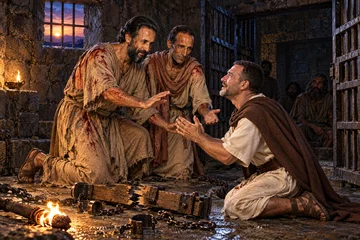

Cross-references
- Acts 16:33
And he took them the same hour of the night, and washed their stripes; and was baptized, he and all his, straightway.
The jailer tends their wounds and is baptized that night.
- Acts 16:35-40
And when it was day, the magistrates sent the serjeants, saying, Let those men go.
same night leads to morning release
- Acts 16:32
And they spake unto him the word of the Lord, and to all that were in his house.
word spoken to household after rescue
- 1 Thessalonians 2:2
But even after that we had suffered before, and were shamefully entreated, as ye know, at Philippi, we were bold in our God to speak unto you the gospel of God with much contention.
Paul recalls suffering shameful treatment at Philippi before boldly preaching the gospel.
Commentary
Each commentary is drawn from primary sources: the writings of Ellen G. White and Adventist pioneers and periodicals. Each commentary is separate. Its own words are not a quotation; follow the references to read the source passages.
Ellen G. White
26 sources
At Philippi in Macedonia the keeper woke to open doors after the earthquake and drew his sword to kill himself supposing the prisoners had fled and expecting death for their escape.Ms 66, 1905, par. 33–37Ms 26, 1894, par. 22–24SG1 96.1–97.1 Paul called out loudly and cheerfully to stop him from harming himself because no one had escaped but all remained in place restrained by God's power.8RED 40.1–3Ms 66, 1905, par. 33–37ST Jul 3, 1879 The cry showed no malice or revenge toward the man who had treated them cruelly with beating and stocks, but Christlike love and kindness that repaid harshness with care for his life.8RED 40.1–3ST Jul 3, 1879ST Jul 20, 1904 That intervention convicted the jailer as he saw divine support and forgiveness in their suffering, so he dropped his sword, asked forgiveness and what he must do to be saved, then believed, washed their wounds, was baptized with his household and rejoiced in God.Ms 66, 1905, par. 33–37Ms 26, 1894, par. 22–24ST Jul 20, 1904ED 66.4 God allowed the imprisonment so the light of truth could reach inside the prison, making the dungeon His church flooded with heavenly light and turning apparent failure into the salvation of the jailer and his whole house.Ms 66, 1905, par. 33–37Ms 6, 1884, par. 7–8MC 32.1GW 107.3
Setting and Prison Deliverance
The cry belongs to the advance of the gospel beyond the confines of Asia Minor into Europe.AA 211.2AA 211.1 At Troas on the borders of the Mediterranean Sea preparation was made by the night vision of the man of Macedonia calling for help.AA 211.1 In answer to that call Paul with Silas, Timothy and Luke crossed from Troas to Macedonia to preach there.AA 211.2 They came to Philippi, the chief city of that part of Macedonia.AA 211.2
After Paul and Silas were beaten and put in prison with their feet in the stocks, angels were with them and ministered to them.Ms 66, 1905, par. 33–37GC88 512.1 Though pain-racked in body they broke the midnight silence with prayer and songs of praise to God.Ms 66, 1905, par. 33–37ST Jul 20, 1904SG1 96.1–97.1 Then suddenly a great earthquake shook the foundations, opened all the doors and loosed every band.Ms 66, 1905, par. 33–37SG1 96.1–97.1 The angel of God loosed the bands.SG1 96.1–97.1
The keeper awoke from sleep and saw the doors open.Ms 66, 1905, par. 33–37 He supposed the prisoners had fled.Ms 66, 1905, par. 33–37SG1 96.1–97.1 Affrighted at the open doors, he drew his sword to kill himself.Ms 66, 1905, par. 33–37SG1 96.1–97.1 He expected to be punished with death, for he thought escape would bring his death sentence.Ms 26, 1894, par. 22–24SG1 96.1–97.1ST Jul 3, 1879SLP 79.48RED 43.2–3
Paul cried with a loud voice, urgently and with cheer, telling him to do himself no harm.8RED 40.1–3Ms 66, 1905, par. 33–37ST Jul 3, 1879ST Jul 20, 1904 He assured him that all were still there and none had escaped.8RED 40.1–3Ms 66, 1905, par. 33–37ST Jul 3, 1879Ms 26, 1894, par. 22–24 Paul knew they had not fled.ED 66.4 Every prisoner remained in his place, restrained by God's power working through Paul and by the presence of one fellow prisoner holding them back.ST Jul 20, 1904ED 66.4
Christlike Love and Conversion
The loud call to do no harm was care for the life of the very man who had inflicted wounds and fastened feet in stocks, and it carried no malice, resentment, or desire for revenge.8RED 40.1–3ST Jul 3, 1879AA 216.1–217.13SP 382.2–383.2SLP 76.3–77.2 Though pain-racked and cruelly treated, Paul and Silas acted with presence of mind, courage, and faithfulness under opposition and persecution, repaying cruelty with kindness from love like Christ's.8RED 40.1–3ST Jul 3, 1879AA 216.1–217.18RED 43.2–3GW 107.3 That cheerful restraint in the dungeon, with every prisoner held in place by God's power working through Paul and by the presence of one fellow prisoner, revealed the reality of the faith that sustained them.ST Jul 20, 1904ED 66.4AA 216.1–217.1
By keeping the freed prisoners from fleeing, Paul's control spared the keeper the death penalty that escape would have brought upon him.ST Jul 3, 1879SLP 79.48RED 43.2–3SLP 80.1–2 It also kept flight from making the apostles look guilty as criminals.ST Jul 3, 1879SLP 80.1–2 So shown to the Philippians was the spirit, nobility, and generosity of Christ's religion.ST Jul 3, 18798RED 43.2–3
The kindness struck the keeper with conviction, for he saw divine support, joy amid suffering, fearlessness in the earthquake, and Christlike forgiveness, tranquillity, and cheerfulness under abuse.Ms 26, 1894, par. 22–24AA 216.1–217.1AA 426.2SLP 244.1 He dropped his sword and asked forgiveness, recognizing God's power in the men he had abused.Ms 26, 1894, par. 22–24AA 216.1–217.1RH Jun 29, 1905 From despair he turned to the cry for salvation, asking what he must do to be saved.Ms 26, 1894, par. 22–24ST Jul 20, 1904ED 66.4RH Jun 29, 1905
That assurance brought full conversion in the same night, as he called for a light, sprang in trembling, fell before Paul and Silas, and brought them out.Ms 66, 1905, par. 33–37 He heard that he must believe on the Lord Jesus Christ, he and his house, heard the word of the Lord, washed their stripes in that same hour, was baptized at once with all his household, brought them into his house, set food before them, and rejoiced believing in God.Ms 66, 1905, par. 33–37 What had looked like failure in jail ended in the jailer and his whole household uniting with the persecuted band of Christ's disciples, welcoming the Spirit of God into heart and home, receiving pardon, and choosing life as a child of God and heir of heaven.ST Jul 20, 1904ED 66.4RH Jun 29, 1905AA 426.2SLP 244.1 Unlike Felix, who was convicted yet dismissed it and refused to repent, the jailer humbly sought the way and chose to serve God.SLP 244.1
The call belongs to God's direct providence in permitting the imprisonment so the light of truth could enter within prison walls.Ms 6, 1884, par. 7–8 Christ presided there so that the prison became His church, and the glory of God flooded the darkest dungeon with heavenly light.17MR 81.4–82.1 It is the pattern of obeying God rather than man when laws oppose God, of bearing the message and letting light shine wherever placed even in prison, and of being brought into strait places with reproach and persecution for stemming prevailing iniquity when the message goes with a loud cry.Ms 6, 1884, par. 7–8 The steadfast soul that trusts fully in God is not shaken by the bitterest opposition.17MR 81.4–82.1 There in the Macedonian dungeon among convicted sinners Paul lifted up Christ as the One who hates sin and loves the sinner, who bore our sins and imparts His righteousness, and suffering like the apostles of old spreads faith, wins souls, and glorifies His name.MC 32.1GW 107.3CEv 27.117MR 81.4–82.1Ms 23, 1890, par. 5
Sources
Pioneers and periodicals
65 sources
Paul called out loudly and urgently to stop the jailer from killing himself, assuring him that no prisoner had escaped and all remained in place.ST Jul 20, 1904ST Jun 24, 1897ST Jun 26, 1893ST Jun 26, 1893ST Jan 28, 1903 The cry came at midnight after he and Silas had been beaten, thrust into the inner prison with feet in stocks, yet prayed and sang praises, when a great earthquake shook the foundations, opened the doors and loosed every band.ST Jul 20, 1904ST Dec 17, 1902RH Nov 21, 1912RH Jul 16, 1872ST Jan 9, 1912 The jailer, waking to open doors, supposed the prisoners fled and drew his sword to kill himself to escape execution by the government, for by Roman law the keeper who lost his prisoners suffered their penalty.RH Nov 16, 1916ST Dec 17, 1902ST Jan 13, 1898 Though wronged and suffering, Paul stayed and put his persecutor's life before his own freedom, showing kindness without resentment and sparing the jailer from death and disgrace to the gospel that flight would have brought.ST Jul 3, 1879ST Jul 20, 1904ST Jul 3, 1879ST Jan 28, 1903 That intervention broke the jailer's heart so that trembling under guilt and dread of judgment he fell down to ask how to be saved, believed in the Lord Jesus with his household, washed the apostles' wounds and was baptized with rejoicing before morning.ST Dec 17, 1902ST Jun 26, 1893ST Jun 13, 1900RH Jun 16, 1874
Night in Philippian Prison
The cry belongs to the night Paul and Silas lay beaten with stripes in the inner prison at Philippi with feet fast in stocks, clothes torn off and backs bare and bleeding, yet breaking the midnight silence with prayer and songs of praise to God from a pain-racked body instead of losing faith and saying all things were against them.RH Jul 16, 1872ST Jan 9, 1912ST May 12, 1890RH Jan 31, 1871RH Aug 5, 1873 Their meek patient suffering without murmur brought heavenly help, for their singing brought angelic hosts while murmuring would have kept angels away, and their joyful trusting spirit revealed the reality of the faith that sustained them.ST Jul 20, 1904RH Jan 31, 1871RH Aug 5, 1873 Even severely whipped and manacled they praised God and continued to preach Christ in their circumstances.ST May 12, 1890RH Aug 5, 1873
At midnight God answered with a great earthquake that shook the prison foundations, opened all doors and loosed every band and the stocks after prayer and singing.ST Dec 17, 1902RH Nov 21, 1912ST Dec 3, 1896ST Jan 13, 1898RH Jun 16, 1874 Though imprisoned to silence preaching, God's purpose did not fail but gave truth opportunity to advance, and the region could hear how the singing and intervention opened the doors.ST Dec 3, 1896ST Jan 19, 1882 The jailer woke, saw the doors open, supposed the prisoners had escaped, and drew his sword to kill himself.RH Nov 16, 1916ST Dec 17, 1902ST Jan 13, 1898ST May 10, 1905 He was about to take his own life to avoid being put to death by the government for allowing escape when specially charged to keep Paul and Silas secure, for by Roman law a jailer was subject to the same penalty as an escaped prisoner would have suffered.ST Dec 17, 1902ST Jan 13, 1898ST Dec 17, 1902
Paul, though imprisoned and beaten, remained self-possessed and cried with a loud voice with urgency, saying do thyself no harm, to stop the jailer from killing himself and save him from self-destruction when none had escaped.ST Jun 24, 1897ST Jun 26, 1893ST Jun 26, 1893ST Jun 24, 1897 His urgent concern for the man despite harsh treatment showed no resentment but Christ's love toward a persecutor, speaking cheer to the heathen jailer.ST Jul 3, 1879ST Jul 20, 1904 The assurance that we are all here meant no prisoner had fled and no harm was needed, for every prisoner remained in his place and still present after the earthquake.ST Mar 31, 1914ST Jan 28, 1903RH Jan 31, 1871 They were restrained by God in place and so perfectly controlled by Paul that not one attempted to escape, restrained by the presence of one fellow prisoner.ST Jul 20, 1904ST Mar 31, 1914
The verse belongs to the account in Acts 16:14-34 that includes the opening of Lydia's heart to the preaching and her baptism with her household, and the casting out of the spirit of divination from the soothsaying maid in the name of Jesus Christ.ST Jan 13, 1898 It belongs to the crossing to Europe with Silas on a tour to strengthen the churches in Syria and Cilicia after separating from Barnabas and John Mark.ST Jun 4, 1902 At Philippi pious Gentiles were in the habit of assembling on the Sabbath for worship, where Paul laid the foundation of the Philippian church with not one hint that he introduced a new Sabbath.RH Nov 21, 1871 It belongs to the occurrences in the night of the imprisonment, immediately before the morning when the magistrates sent to let them go and they left the prison, saw the brethren, and departed toward Thessalonica and Berea.ST Jan 20, 1898ST Jan 20, 1898
Paul's Saving Intervention
Paul put the jailer's safety before his own escape and stayed when the doors stood open, calling out with urgency to stop him from taking his own life and assuring him that all remained in place.ST Jul 3, 1879ST Mar 31, 1914ST Jul 3, 1879ST Jan 28, 1903ST Jun 26, 1893 Though beaten and thrust into cruelty, he held no resentment but acted with kindness, cheer and the love of Christ toward his persecutor, remaining self-possessed even with a pain-racked body.ST Jul 3, 1879ST Jul 20, 1904ST Mar 31, 1914ST Jul 3, 1879 Every prisoner remained in his place, restrained by God and so perfectly controlled by Paul that not one attempted to escape.ST Jul 20, 1904ST Mar 31, 1914 His prayer and singing in the midnight silence, joined with that kindness amid the supernatural opening, broke the jailer's heart and moved him to seek salvation from sin.ST Jul 20, 1904ST Jan 28, 1903ST Jun 26, 1893
By calling out and remaining, Paul prevented the jailer's death and avoided an escape that would have brought the jailer a death sentence and made the apostles appear guilty.ST Jul 3, 1879 Flight would have acknowledged they were criminals, disgraced the gospel, exposed the jailer to the penalty of death, and made a bad general influence, while staying spared the jailer and displayed in deportment and presence of mind the nobility and generosity of the religion of Jesus.ST Jul 3, 1879 That restraint and concern showed the Spirit of Christ and led to the conversion of the keeper and of the prisoners, with the news of unjust imprisonment and miraculous deliverance noised through all that region to many otherwise unreached.ST Jul 3, 1879
The episode belongs to a time when the apostles suffered together in unity, prayed and sang with courage, thankfulness and living faith rather than merely formal worship.RH Jan 13, 1874ST Jun 21, 1883RH Mar 28, 1912 Their joyful and trusting spirit and their meek, patient suffering without murmur or complaint brought heavenly help, for singing praises at midnight brought angelic hosts to shake the prison, while murmuring would have kept angels away.RH Jan 31, 1871RH Mar 4, 1909 They sang in an unpleasant position with feet fast in the stocks and an unfavorable outlook because they knew God would work good out of trial, and they were not disappointed, for the jailer's conversion was due in large measure to that joyful spirit and patient endurance.RH Jan 31, 1871RH Mar 4, 1909 Their unity and faithfulness under beating and imprisonment accompanied God's powerful work and the jailer's response to the gospel.RH Jan 13, 1874ST Jun 21, 1883RH Mar 28, 1912
The confinement was within God's providence and gave peace, joy and comfort that could not have been had elsewhere, showing that Christ gives peace and joy even amid suffering and confinement.ST Oct 16, 1893ST Mar 25, 1903 Though Paul and Silas had been imprisoned to silence their preaching, God's purpose did not fail but the crisis gave the truth opportunity to advance and save souls.ST Jan 19, 1882 Their beating and imprisonment came before success in Philippi and Thessalonica, so that affliction preceded blessing and furthered God's cause through the conversion of the jailer, his household and others.ST Jan 19, 1882RH Aug 11, 1863RH Aug 18, 1863
The Holy Spirit directed Paul and his companions to Macedonia because waiting hearts were there, including the jailer whose heart could be reached.RH Mar 6, 1913RH Jun 11, 1901 He foresaw beforehand the stripes and the stocks in the inner prison, yet foresaw also that they would be victors in the end, and the loud cry to do no harm because all were still there belongs to that victorious outcome.RH Jun 11, 1901 Their imprisonment became an occasion for the Lord to glorify His name, and before morning they were encouraged by a company of baptized believers.RH Mar 6, 1913RH Jun 11, 1901 The account is of unlawful beating and imprisonment at Philippi, where Paul as a Roman citizen beaten without legal condemnation could have used the law to trouble the magistrates and obtain substantial indemnity, but he did not seek compensation.ST Jun 17, 1903
Jailer's Conversion and Baptism
Paul's loud assurance that all remained stopped the jailer from taking his own life and turned him to seek salvation, so that he called for lights, sprang in trembling, fell down before Paul and Silas, and asked what he must do to be saved.ST Dec 17, 1902ST Jun 13, 1900RH Jun 16, 1874RH Nov 23, 1905 That cry came at midnight after prayer and singing, when the earthquake had shaken the foundations, opened every door and loosed every band, and the waking jailer had supposed the prisoners escaped and drawn his sword.ST Dec 17, 1902ST May 12, 1890 He trembled not only from the earth rocking beneath him and dread of Roman justice if prisoners escaped, but from guilt and premonition of the great judgment he had heard them preach.ST May 12, 1890 Prayer, singing, and kindness amid the supernatural opening broke his heart, for Paul put the jailer's safety before his own escape and stayed.ST Jun 26, 1893ST May 12, 1890
Paul and Silas answered that he and his household would be saved by believing in the Lord Jesus Christ, and they preached the word of the Lord to them all.RH Jun 16, 1874ST Jan 17, 1878 The jailer was convicted, confessed his sins, received pardon, and welcomed the Spirit of God, unlike Felix who trembled but refused to repent.RH Nov 2, 1911 Grace thus reached him in the very prison that had been the scene of his cruelty to the saints, and led him to rejoice in God that night with his household.ST Jan 17, 1878RH Jun 16, 1863
The jailer and his household believed, were converted, and were baptized immediately, even in the night before dawn, with rejoicing following, and before morning he washed their wounds.ST Jul 3, 1893ST Jan 17, 1878RH Nov 23, 1905 That immediacy shows baptism belongs close to true conviction and conversion and must not be delayed for months to test firmness. He was baptized after he had brought them out of the prison, which stands against sprinkling and supports baptism by immersion.ST Jan 17, 1878ST Jun 13, 1878 The imprisonment therefore led to the jailer and his household becoming Christians and being baptized, helping establish the Philippian church.RH Jan 9, 1908RH Nov 23, 1905
That work made the prison the beginning of the European church among a Jewish working woman and a Greek jailer, and the first European Christian song of praise sung at night in a Greek dungeon after beating.ST Feb 28, 1884 It turned idolaters into saints and martyrs, showing the power of the gospel to change character.RH Oct 16, 1860 The apostles could have fled but remained with nobility and generosity, so perfectly controlling the liberated prisoners that not one attempted to escape, and staying spared the jailer from the penalty of death. The news of the unjust imprisonment and miraculous deliverance was noised through all that region, bringing the apostles and their ministry before many who would not otherwise have been reached, and before morning they were encouraged by a company of baptized believers.RH Mar 6, 1913
God's providential deliverance left Paul, Silas, and the other prisoners alive and led to the jailer's conversion.RH Aug 21, 1856 In that favor a prison was turned into a paradise, while guilt turns a palace into a prison.RH Aug 12, 1862
Mission Work and Example
The night in Philippi stands as an example of personal labor for souls and individual work for Christ outside the pulpit.ST Mar 30, 1882ST Jun 8, 1904 A brief conversation with an awakened sinner in prison brought the man to the Saviour, showing ministry carried on person to person.ST Mar 30, 1882ST Jun 8, 1904 Paul and Silas labored personally with the jailer and his household through the midnight hours, and before dawn the jailer and his household were converted and baptized. Even in the dungeon they continued their mission to preach Jesus despite confinement.ST Oct 29, 1885
Their preaching to the jailer and his family shows the work was not confined to territories assigned by a human religious body, for the Spirit could lead servants wherever God called.ST Sep 11, 1907 The singing of the worshipers and God's intervention in opening the doors could be heard by the people of the region.ST Dec 3, 1896 The same prison experience has brought comfort to others later imprisoned, as proof that God is with His people in confinement.RH Dec 19, 1907 It is held up as the pattern of Paul converting his jailer, in hope that opponents may be won in the same way.RH Jul 1, 1858 The midnight freeing from the stocks gave the opportunity to preach the gospel to the jailer and his household, teaching that God can act in this way today and that recognizing His direction in one's own affairs is knowing Him.ST Jan 19, 1915
Present Application and Encouragement
The same God who worked through imprisonment at Philippi can still use presence in jail for conscience' sake to save a jailer and his family, and to reach someone in despair and keep him from taking his own life.RH May 23, 1907
The warning not to injure oneself is applied as an appeal to young people to abstain from tobacco because of its damage to health and its enslaving power.RH Jan 30, 1866 It is applied also to those endangering health and strength by overwork, that they should not harm themselves by pushing beyond their limits.RH Jan 7, 1873 It is applied further as a direct appeal not to damage oneself through zeal, distress, or impatience over disagreements about images and idolatry, but to remain faithful to God and wait patiently for Him to make matters clear.RH Apr 5, 1864 The words about doing no harm to oneself are also used as a brief summary of the moral law, paired with treating others as one would wish to be treated, expressing its enduring principles including the Sabbath commandment.RH Feb 23, 1860
The declaration that all remain present supplies reassurance in danger that all survived an earthquake alive, prompting gratitude to God and hope that the experience would teach its lesson.ST Jun 27, 1906 Seeming disaster becomes deliverance and blessing in God's hands, for all things in heaven and earth are His instruments, angels who excel in strength wait to do His bidding, He withholds no good thing and perfects what concerns His children, so believers should not be downcast and embittered but declare with gratitude that all things work together for their good.ST Jan 9, 1912 Though escape seemed impossible with torn clothes, feet bound in stocks, and bare bleeding backs, prayer and praise instead of despair were answered by the earthquake, the opening of doors, and the conversion of the jailer and his whole household.ST Jan 9, 1912 With feet fast in the stocks in an unpleasant position and with an unfavorable outlook, singing praises from knowledge that God would bring good out of trial was not disappointed, for the jailer's conversion was due in large measure to that joyful trusting spirit.RH Mar 4, 1909 Their example teaches Christians on trial to be brave and hopeful, to praise God in darkness knowing He stands near in the shadow, and to trust that light will break forth in His own time.RH Mar 4, 1909
Sources