Acts 20:9
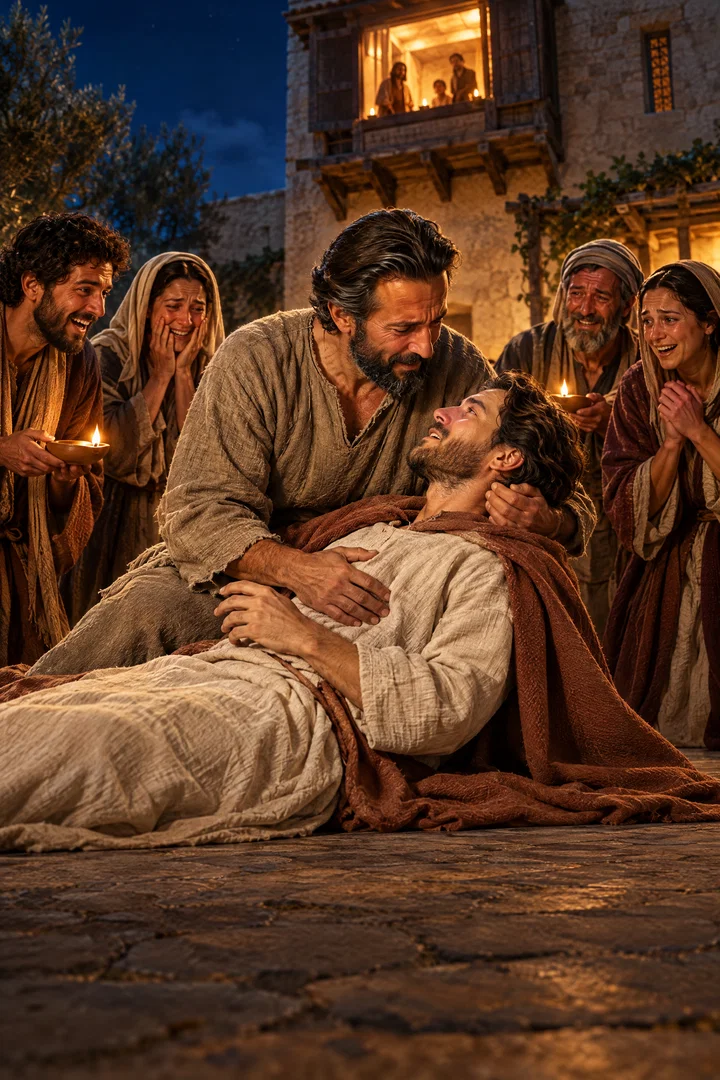
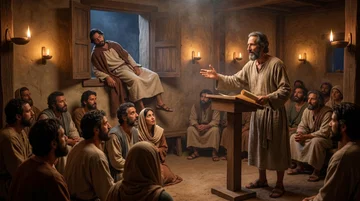
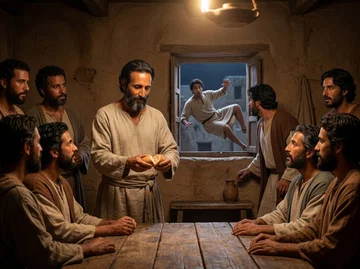
And there sat in a window a certain young man named Eutychus, being fallen into a deep sleep: and as Paul was long preaching, he sunk down with sleep, and fell down from the third loft, and was taken up dead.
Translations
American King James Version, King James Version, KJV Cambridge Paragraph Bible
And there sat in a window a certain young man named Eutychus, being fallen into a deep sleep: and as Paul was long preaching, he sunk down with sleep, and fell down from the third loft, and was taken up dead.
And there sat in a window a certain young man named Eutychus, having fallen into a deep sleep: and as Paul was long preaching, he sunk down with sleep, and fell from the third loft, and was taken up dead.
Revised Version, American Standard Version
And there sat in the window a certain young man named Eutychus, borne down with deep sleep; and as Paul discoursed yet longer, being borne down by his sleep he fell down from the third story, and was taken up dead.
and there was sitting a certain youth, by name Eutychus, upon the window — being borne down by a deep sleep, Paul discoursing long — he having sunk down from the sleep, fell down from the third story, and was lifted up dead.
And a certain youth, by name Eutychus, sitting at the window-opening, overpowered by deep sleep, while Paul discoursed very much at length, having been overpowered by the sleep, fell from the third story down to the bottom, and was taken up dead.
And there sat, a certain young man by name Eutychus, in the window, who was getting overpowered by a deep sleep; and, while Paul was discoursing yet further, being overpowered by his sleep, he fell, from the third story, down, and was taken up dead.
Berean Standard Bible, Majority Standard Bible
And a certain young man named Eutychus, seated in the window, was sinking into a deep sleep as Paul talked on and on. When he was sound asleep, he fell from the third story and was picked up dead.
A certain young man named Eutychus sat in the window, weighed down with deep sleep. As Paul spoke still longer, being weighed down by his sleep, he fell down from the third floor and was taken up dead.
And a certain young man named Eutychus, who was seated in the window, went into a deep sleep; and while Paul went on talking, being overcome by sleep, he had a fall from the third floor, and was taken up dead.
And there sate in a windowe a certaine yong man, named Eutychus, fallen into a dead sleepe: and as Paul was long preaching, hee ouercome with sleepe, fell downe from the thirde loft, and was taken vp dead.
Douay-Rheims (Challoner revision)
And a certain young man named Eutychus, sitting on the window, being oppressed with a deep sleep, ( as Paul was long preaching,) by occasion of his sleep fell from the third loft down, and was taken up dead.
Pictures
Cross-references
- Acts 20:13-14
And we went before to ship, and sailed unto Assos, there intending to take in Paul: for so had he appointed, minding himself to go afoot.
Paul’s journey from Troas to Assos shows travel on the first day.
- Acts 9:40
But Peter put them all forth, and kneeled down, and prayed; and turning him to the body said, Tabitha, arise. And she opened her eyes: and when she saw Peter, she sat up.
Peter raises Tabitha to life.
- John 11:11
These things said he: and after that he saith unto them, Our friend Lazarus sleepeth; but I go, that I may awake him out of sleep.
Both use sleep language for death.
- 2 Kings 4:32-37
And when Elisha was come into the house, behold, the child was dead, and laid upon his bed.
Elisha restores a dead child to life.
- 1 Kings 17:17-24
And it came to pass after these things, that the son of the woman, the mistress of the house, fell sick; and his sickness was so sore, that there was no breath left in him.
Elijah restores a dead child to life.
- Luke 7:14-15
And he came and touched the bier: and they that bare him stood still. And he said, Young man, I say unto thee, Arise.
listed together as exceptions to general rule
- 1 Corinthians 15:16-18
For if the dead rise not, then is not Christ raised:
all others live only by resurrection
Commentary
Each commentary is drawn from primary sources: the writings of Ellen G. White and Adventist pioneers and periodicals. Each commentary is separate. Its own words are not a quotation; follow the references to read the source passages.
Ellen G. White
2 sources
The gathering took place on the last evening of a seven-day stay at Troas, when a larger company than usual assembled in an upper room on the third story.SLP 196.4–197.1 It was a warm spring evening after dark, and that upper chamber was the coolest and most pleasant place, with many lights burning in the night.SLP 196.4–197.1 The shutters of the windows had been thrown open to the air.SLP 196.4–197.1 Paul continued preaching until midnight because his mind was impressed with the perils awaiting him and the uncertainty of ever meeting the brethren again, and because he had matter of great interest and importance to present to them in earnest love and solicitude for them.SLP 196.4–197.1
A youth named Eutychus had taken his seat on the broad sill of the open window, a dangerous and perilous position.AA 391.2–3SLP 196.4–197.1 There he sank into a deep sleep and fell from his seat down into the court below, breaking off the discourse.AA 391.2–3SLP 196.4–197.1 He was taken up dead, lifted lifeless amid alarm and confusion with cries and mourning.AA 391.2–3SLP 196.4–197.1
Sources
Pioneers and periodicals
72 sources
Eutychus was a young man sitting in a window of the crowded upper chamber on the third story at Troas at night, who sank into deep natural sleep while Paul preached at length and fell down and was taken up dead.ST Apr 12, 1883ST Oct 23, 1884ST Feb 20, 1879ST Nov 25, 1886ST Jul 22, 1897 Paul interrupted his discourse, went down and embraced him and restored him to life by divine power, so they brought the young man alive and were comforted, and then Paul went up again and broke bread and talked till break of day before departing.ST Feb 13, 1912ST May 27, 1875ST Aug 21, 1893ST Aug 13, 1874ST Jul 22, 1897 By Bible reckoning the night portion of the first day of the week was Saturday night after the Sabbath was past, and the gathering was a special one-time all-night farewell because Paul was to depart on the morrow, not an ordinary service or evidence of a regular weekly first-day worship custom.ST Apr 12, 1883ST Oct 23, 1884RH May 1, 1900RH May 10, 1860ST May 27, 1875 That the disciples met and heard preaching that evening and broke bread after midnight does not make the day holy, and Paul and his companions spending its daylight in travel and labor on foot from Troas to Assos and by ship to Mitylene proves positively that the first day was not kept with Sabbatic honors.ST Feb 20, 1879ST Aug 21, 1893RH May 10, 1860ST Aug 21, 1893ST Oct 17, 1878 His sleep is literal sleep, he was truly dead and then revived with no conscious experience in death, and his raising was a miraculous gift through the power of Christ, not the general resurrection of the just at His coming nor of the wicked after the thousand years.ST Jan 27, 1914RH Apr 24, 1900ST Feb 11, 1903RH Aug 24, 1905ST Jan 28, 1889
Time and Place Described
The meeting was at Troas in an upper chamber on the third story, lit with many lamps because it was night, where Paul preached at length until midnight and then after the interruption talked a long while even till break of day before departing at daybreak.ST Feb 20, 1879ST Jul 22, 1897ST Oct 5, 1882ST Sep 15, 1887 While he spoke at length Eutychus sank down with sleep and fell from the third loft and was taken up dead, and Paul went down and restored him to life before going up again to break bread and eat.ST Feb 20, 1879ST Jul 22, 1897ST Oct 5, 1882ST Oct 11, 1877 The many lamps mean only that the gathering was at night, not that heat, smoke, poor air, or lack of ventilation caused the sleep.ST Oct 5, 1882ST Jan 8, 1885 The long preaching through midnight and till daybreak proves an all-night night meeting, not a daytime service.ST Feb 20, 1879ST Jul 22, 1897ST Sep 15, 1887
By Bible reckoning of days from sunset to sunset, the night portion of the first day of the week was what is now called Saturday night after the Sabbath was past.RH May 1, 1900RH May 10, 1860ST May 27, 1875ST Aug 21, 1893 The whole night service beginning after Sabbath sunset therefore belonged to the first day ending Sunday sunset, beginning Saturday evening and continuing past midnight into Sunday.RH May 10, 1860ST Aug 21, 1893ST Aug 13, 1874 The lights in the upper room show it was held at night, and the fall interrupted the preaching before Paul healed him and returned to the gathering as part of the final visit before departing at daybreak.RH May 10, 1860ST May 27, 1875ST Oct 11, 1877 Under this reckoning the meeting at Troas with its lengthy nighttime sermon belongs to Saturday evening.RH May 1, 1900ST May 27, 1875ST Feb 10, 1887
If days are reckoned from midnight to midnight, the breaking of bread after midnight fell on the second day, Monday morning.ST Aug 13, 1874 Paul preached until midnight, then healed Eutychus, and afterward broke bread, so the breaking of bread occurred after midnight between midnight and daybreak.ST Aug 13, 1874 Counted without Jewish reckoning the breaking of bread would fall on what is now called Monday morning, which defenders of Sunday sacredness do not accept, and if the night was Sunday night it could not have taken place on the first day.ST Jan 8, 1885ST Jul 21, 1909 The account thus places the meeting either on the evening at the close of the Sabbath with bread broken early on the first day, or with bread broken on Monday by midnight reckoning.ST Aug 13, 1874
Paul had stayed seven days at Troas, waiting to spend one Sabbath with the church and delaying his voyage to Jerusalem from Macedonia, so the meeting on the first day does not establish a weekly Sabbath.ST Aug 21, 1893ST Jun 13, 1906ST Feb 24, 1898 Being anxious to reach Jerusalem he waited a full seven days in order to spend one Sabbath with the church, sending his traveling companions ahead by boat as soon as the Sabbath ended while he himself remained for this one last night meeting.ST Nov 30, 1882ST Feb 24, 1898RH Dec 12, 1871 His companions went before to ship and sailed to Assos intending to take in Paul there as he had appointed to go afoot, and when he met them at Assos they took him in and came to Mitylene.ST Aug 21, 1893ST Jul 22, 1897 Then at daybreak he walked about nineteen to twenty miles overland by the direct road to Assos to join the ship, which sailed a longer voyage of nearly twice as far around the point and around Cape Lectum to Mitylene.ST Aug 21, 1893ST Nov 30, 1882RH Dec 12, 1871
Paul and his companions spent the daylight part of that same first day in travel and business, Paul going on foot from Troas to Assos and sailing with them to Mitylene.ST Aug 21, 1893RH May 10, 1860 As soon as it was light he started on his long journey to Jerusalem about nine hundred miles distant, ending the night meeting at daybreak to attend to business and travel that day.RH Mar 31, 1874RH Jan 1851 His companions in labor spent the entire twenty-four hours of that day in travel and Paul himself spent all the light part of the same day in the same business, with the vessel about to sail Sunday morning.ST Aug 21, 1893RH Dec 12, 1871 His journey began on Sunday, not Monday, leaving for the long voyage toward Jerusalem.RH Feb 27, 1872RH May 10, 1860RH Mar 31, 1874
What Happened to Eutychus
A certain young man named Eutychus, probably a Greek, sat in a window of the upper chamber at Troas where many lights were burning, the room being crowded with listeners even to the windows while Paul preached long into the night until midnight at a special farewell gathering before his departure.ST Apr 12, 1883ST Oct 23, 1884ST Nov 25, 1886ST Aug 21, 1893ST Jun 18, 1894 Being overcome by deep sleep as Paul was long preaching, he sank down with sleep and fell down from the third loft and was taken up dead.ST Apr 12, 1883ST Oct 23, 1884ST Nov 25, 1886ST Feb 14, 1911ST Aug 21, 1893
The many lamps mean only that the meeting was at night, and the verse does not say that heat, smoke, poor air, or lack of ventilation caused his sleep.ST Jan 8, 1885ST Jan 8, 1885 Claims that the room was hot and close conflict with claims that it was large and airy with a cooling breeze, and the verse does not establish that it was stuffy or poorly ventilated or that he sat at the window to get relief.ST Jan 8, 1885ST Jan 8, 1885
The fall and the taking up dead interrupted and arrested Paul's discourse.ST May 27, 1875ST Aug 21, 1893ST Oct 17, 1878 Paul went down, fell on him and embraced him and said his life was in him, and by divine power through the gift of miracle restored him to life, an event showing God's power in raising the dead.ST Feb 13, 1912ST Jul 22, 1897ST Nov 11, 1889ST Oct 17, 1878ST Jan 20, 1909 They brought the young man alive and were comforted, and the account allows Paul to leave at daybreak without waiting for him to be brought back.ST Feb 13, 1912ST May 27, 1875ST Jul 22, 1897
After the restoration Paul went up again and healed him after midnight before breaking bread with the disciples, breaking bread and eating between midnight and daybreak.ST Aug 21, 1893ST Aug 13, 1874RH Mar 31, 1874RH Jun 24, 1852 He then talked a long while even till break of day and departed, continuing his preaching till break of day after the bread was broken.ST Aug 21, 1893ST Jul 22, 1897
Kind of Meeting Recorded
The gathering at Troas was a special, one-time, all-night farewell meeting held because Paul was to depart on the morrow and they would see his face no more, not an ordinary service.ST Oct 23, 1884ST Feb 20, 1879ST Jun 18, 1894ST Oct 17, 1878ST Apr 11, 1906 It lasted through the night with preaching until midnight and then talking until break of day before departure in the morning, after breaking bread and eating between midnight and daybreak.ST Feb 20, 1879ST Oct 5, 1882ST Oct 17, 1878 It gives no evidence of a regular weekly first-day worship custom, of any requirement to meet and break bread on that day, or of any custom to meet on that day before or afterward, in contrast to the eighty-four Sabbaths on which Paul preached.ST Feb 20, 1879ST Jun 18, 1894ST Aug 16, 1883ST Oct 17, 1878ST Jul 18, 1878 An evening meeting can occur on any day of the week without making the day holy, so this evening meeting proves nothing about holiness.ST Feb 20, 1879ST Oct 17, 1878 He probably preached on each of the seven days he remained there, though only this farewell night is recorded.ST Apr 12, 1883
It is the only religious meeting on the first day of the week recorded in the New Testament, indeed in the entire word of God.ST Feb 20, 1879ST Aug 21, 1893ST Oct 17, 1878ST Jul 18, 1878ST Jun 4, 1874 It is the only first-day meeting after the resurrection connected with the name of an apostle, resting on Paul alone and not on the apostles together.ST Feb 20, 1879ST Aug 21, 1893 The naming of the first day in this connection serves to show the circumstances of a night meeting continued past midnight, not to establish sacredness.ST Jul 18, 1878ST Jun 4, 1874ST Apr 11, 1906
The account is recorded because of its extraordinary features, not because of any sacredness belonging to the day.ST Apr 12, 1883ST Feb 20, 1879ST Oct 17, 1878ST May 25, 1915ST Mar 30, 1882 Those features were the unusually long preaching and the notable miracle by which Eutychus, fallen asleep during the long discourse and fallen from the third story and taken up dead, was restored to life by Paul.ST Apr 12, 1883ST Feb 20, 1879ST Oct 17, 1878ST Mar 18, 1889ST May 25, 1915 That raising of the dead is why the meeting was mentioned.ST Apr 12, 1883ST Oct 17, 1878
Those who held Sunday sacredness taught beside this that the meeting and its breaking of bread show the disciples had a regular first-day meeting for breaking bread. In that teaching Paul's long preaching at Troas during his seven-day stay and his departure are used as proof that Paul held meetings on the first day, supporting keeping of the first day even though there is no direct command for it.RH Jan 2, 1866
First Day Not Made Sacred
The first day is never in this connection called the Sabbath, the Lord's day, or by any sacred title, and the passage gives no precept for its observance.ST Feb 20, 1879ST Oct 17, 1878ST Oct 22, 1912ST Sep 23, 1897 It is the only religious meeting on the first day of the week recorded in the New Testament, with nothing to show it was the custom to meet on that day before or afterward, in contrast to the eighty-four Sabbaths on which Paul preached.ST Feb 20, 1879ST Oct 17, 1878 It was only an evening meeting, and evening meetings occur on any day of the week without making the day holy, so it furnishes no evidence that Sunday was a holy day.ST Feb 20, 1879ST Oct 17, 1878 It was an extraordinary all-night farewell meeting because Paul was to depart on the morrow, marked by unusually long preaching and by the raising of a dead man, and it is recorded for those reasons and not for any sacredness belonging to the day.ST Feb 20, 1879ST Oct 17, 1878 The first day so mentioned is one particular day distinguished by that notable miracle of the falling and restoring of Eutychus, not a recurring sacred day, and early Christians never spoke of it as the Sabbath or as a sacred worship day.ST Jan 30, 1896ST Sep 23, 1897
That the disciples came together to break bread and heard preaching on that evening does not make the day holy.ST Feb 20, 1879RH May 10, 1860ST Oct 17, 1878 Breaking bread proves nothing, since Jesus kept the supper on Thursday evening and the disciples sometimes broke bread daily from house to house, any more than breaking bread daily makes every day to be kept.RH May 10, 1860 Meeting on a day does not make that day a Sabbath, since the apostles met on other days also.ST Jan 30, 1896 The lights in the upper room show the meeting was held at night, and by Bible reckoning of days from sunset to sunset the first day began on what is now called Saturday evening, with Paul preaching through the night and leaving on foot Sunday morning.RH May 10, 1860 That same day Paul continued his journey, so the gathering to break bread is not proof of a command to keep the first day holy or that it had replaced the Sabbath.ST Aug 23, 1883RH May 19, 1851
The naming of the first day and the use of its daylight for travel and labor prove positively that Sunday was not sacredly observed or kept with Sabbatic honors and abstinence from labor.ST Aug 21, 1893ST Aug 21, 1893RH Mar 31, 1874 Paul's companions in labor spent the entire twenty-four hours of that day in travel and Paul himself spent all the light part of the same day in the same business, which serves to prove positively that Sunday was not kept.ST Aug 21, 1893ST Aug 21, 1893 After the bread was broken between midnight and daybreak and Paul talked till break of day, he walked nineteen and one-half to about twenty miles overland from Troas to Assos while the vessel sailed a longer voyage around the point to Mitylene, and thence continued his long journey toward Jerusalem about nine hundred miles distant.ST Aug 21, 1893RH Mar 31, 1874 His walking more than twenty Sabbath-day's journeys allowed by the Jews and his companions' sailing show common work and business travel, giving no warrant for transferring rest from the seventh day to the first.ST Dec 25, 1893ST Jan 25, 1910 The meeting and bread-breaking thus fell in the early hours before Sunday morning, and as soon as it was light he started on his journey, which proves he did not regard Sunday as the Sabbath.RH Mar 31, 1874ST Jan 25, 1910
Paul had been delayed on the voyage and waited a full seven days at Troas in order to spend one Sabbath with the church, sending his traveling companions ahead by boat as soon as the Sabbath ended while he himself remained for this one last night meeting on the night part of the first day, in present language Saturday night after the Sabbath was past.ST Feb 24, 1898RH Dec 12, 1871 His waiting till the Sabbath was past and then journeying on first-day morning on foot to join the vessel at Assos about twenty miles by the direct road while the voyage round the point was nearly twice as far shows sacred regard for the ancient Sabbath.ST Feb 24, 1898RH Dec 12, 1871 This proves he did not regard the first day of the week as the Christian Sabbath.RH Dec 12, 1871
To claim apostolic example for Sunday-keeping from this all-night night meeting is to follow the example by going directly contrary to it.ST Sep 15, 1887ST Sep 15, 1887 The meeting was at night and all night, Paul preaching until midnight and then talking a long while even till break of day, with the bread broken shortly after midnight, and in the daytime Paul departed afoot on a long journey while his companions sailed as he had appointed.ST Sep 15, 1887ST Sep 15, 1887 There is no instance in the apostolic record of a meeting in the daytime on the first day after the resurrection, so if the example binds at all it binds to meet in the night, to preach in the night and all night, to break bread after midnight, and to journey in the daytime.ST Sep 15, 1887ST Sep 15, 1887 To use it for daytime meetings of perhaps two hours, for preaching from half an hour to an hour in the daytime, for breaking bread about midday, and for refusing to journey on that day denies the authority claimed and leaves no apostolic example for Sunday-keeping.ST Sep 15, 1887ST Sep 15, 1887
Those who held the variant position place the evening meeting before the first day began, describing it as held on the Sabbath continuing over into part of the first day, not as a Sunday Sabbath service at all.RH Sep 17, 1857ST Jan 30, 1896 On that reckoning the rest of that Sunday after the night meeting was spent in secular work, with Paul traveling on foot part of the way while the ship sailed around to meet him.RH Sep 17, 1857ST Jan 30, 1896
Words Death and Resurrection
The falling asleep is natural sleep, the ordinary Greek word hypnos in its literal sense of sleep, repose, rest, not death or a supernatural hypnotic state.RH Apr 24, 1900ST Feb 11, 1903 The same word is also used of sleeping in death, death being called sleep figuratively because of its likeness to sleep and its similar awaking.ST Feb 11, 1903 He was truly taken up dead after the fall from the window during the long preaching, then restored to life after life had ceased.RH Aug 24, 1905 One so revived reported no conscious experience of death, showing death to be a state of total unconsciousness.RH Aug 24, 1905
The restoration was by a miraculous gift exercised through divine power, the dead living again only through the power of Christ.ST Jan 27, 1914ST Jan 28, 1889 It was not the general resurrection of the just at Christ's coming nor the resurrection of the wicked after the thousand years, but a special exception to that general rule.ST Jan 28, 1889 It stands as one of several such special raisings both before and since the first advent of Christ.ST Jan 28, 1889 It belongs with the exercises of the gifts of miracle-working and healing, alongside healings through handkerchiefs carried from the body.ST Mar 6, 1901
That raising did not by itself prove Messiahship in the one used as instrument to restore life.ST Jan 30, 1912 True servants do not advertise power to work miracles or to heal, and do not heal according to their own will or desire, but according to the faith of the needy and as the Spirit indicates, for the gifts of the Spirit are divided and exercised as the Spirit wills.ST Mar 6, 1901 That is why the same one who raised the dead left Trophimus sick at Miletum, and why Jesus could do no mighty work where there was unbelief.ST Mar 6, 1901
Scripture Setting and Ministry Lessons
Acts 20 is chiefly occupied with one account whose principal events occurred in two places, including Paul's talk with the elders of Ephesus.ST Jun 9, 1898 The setting belongs to Paul's wider experience through Thessalonica, Berea, Athens, Corinth, Ephesus, and Troas, where the word triumphed in every place notwithstanding persecution, and to his farewell to the elders of Ephesus.ST Jul 7, 1909 In that same chapter Paul tells the elders that he coveted no one's silver, gold, or clothing, and that he worked with his own hands to provide for himself and his companions.RH Nov 4, 1873
Paul's exceptionally long preaching provides precedent for holding very long meetings of several hours and for meetings continued late into the evening.RH Jun 18, 1901RH Apr 8, 1875 Such long meetings are supported only on extraordinary occasions and are not otherwise approved.ST Apr 15, 1875RH Apr 8, 1875 Paul continued his service through the night and walked to Assos the following morning to give the church more time for thorough work.RH Dec 12, 1907 His preaching could continue in an informal setting even when a hearer fell asleep and dropped from a window, without the incident interrupting his discourse or imposing the stiffness of formal decorum.ST Oct 8, 1885 The late hour and the drowsiness of the listeners recall lengthy meetings.ST Dec 4, 1893
Paul's farewell sermon in the upper chamber at Troas was spoken not for glory nor display, not to astonish nor amaze, and not for self-aggrandizement.RH Oct 10, 1865ST Apr 5, 1877 Its rhetorical and poetical beauties were merely incidental, for it was spoken to instruct hearers and make them better, for God's glory and not Paul's own, and for the world's advantage.RH Oct 10, 1865 This stands opposite to Demosthenes composing his oration to win the crown of eloquence, Socrates devoting fifteen years to a prize panegyric, Herodotus and Thucydides composing histories for popular applause, and Pindar quickening at Olympic praise.RH Oct 10, 1865 Scripture's words were given to instruct and benefit people, not to win applause or establish the speaker's fame.ST Apr 5, 1877
The fall occurred during Paul's long sermon at about midnight, and Paul restored Eutychus to life.ST Nov 11, 1889 The event shows God's power in raising the dead.ST Nov 11, 1889ST Oct 15, 1912 That miracle is one example of His varied and wonderful works.ST Oct 15, 1912 Afterward Paul went up with the disciples and broke bread in the Lord's Supper in remembrance of the death and sufferings of Christ as a fitting solemnizing of the last meeting before departing, then preached again until break of day.ST Oct 22, 1912 The Christian meeting at Troas continued until nearly daybreak, after which the believers departed on their journeys.RH Aug 14, 1860ST Oct 22, 1912
Sources