Acts 20:10
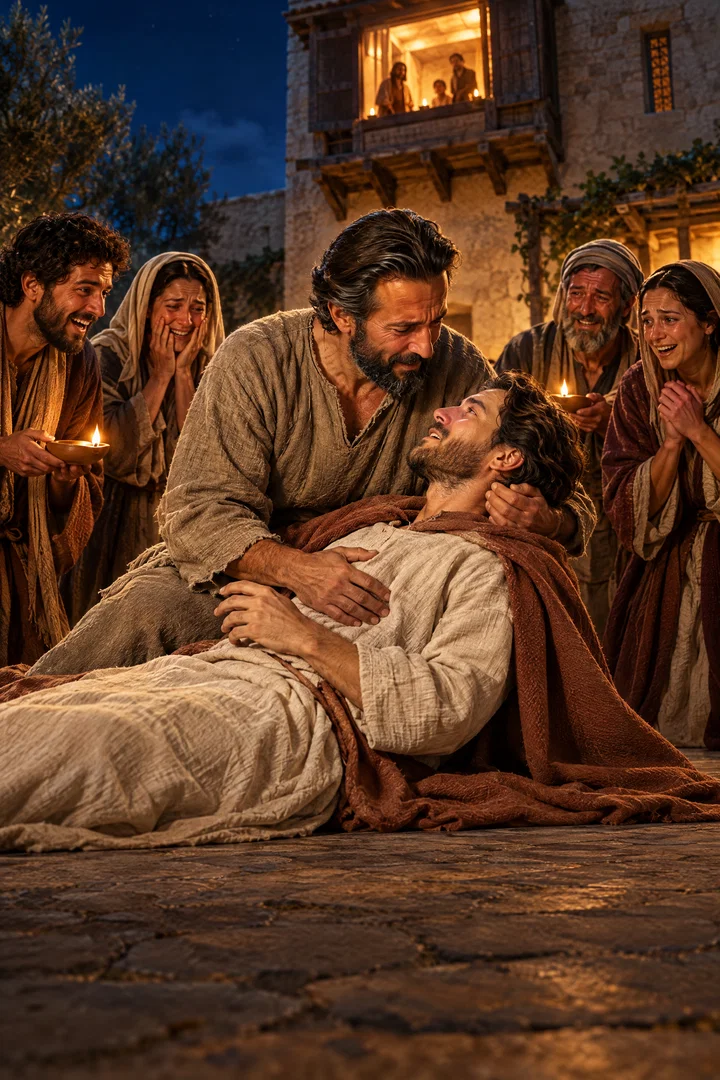
And Paul went down, and fell on him, and embracing him said, Trouble not yourselves; for his life is in him.
Translations
American King James Version, King James Version, KJV Cambridge Paragraph Bible
And Paul went down, and fell on him, and embracing him said, Trouble not yourselves; for his life is in him.
And Paul went down, and fell on him, and embracing him, said, Trouble not yourselves; for his life is in him.
Revised Version, American Standard Version
And Paul went down, and fell on him, and embracing him said, Make ye no ado; for his life is in him.
And Paul, having gone down, fell upon him, and having embraced [him], said, 'Make no tumult, for his life is in him;'
But Paul descending fell upon him, and enfolding [ him] [ in his arms], said, Be not troubled, for his life is in him.
Going down, however, Paul fell upon him, and, embracing him, said—Be not making confusion; for, his soul, is, in him.
Berean Standard Bible, Majority Standard Bible
But Paul went down, threw himself on the young man, and embraced him. “ Do not be alarmed!” he said. “ He is still alive!”
Paul went down and fell upon him, and embracing him said, “Don’ t be troubled, for his life is in him.”
And Paul went down and, falling on him, took him in his arms and said, Do not be troubled, for his life is in him.
But Paul went downe, and layde himselfe vpon him, and embraced him, saying, Trouble not your selues: for his life is in him.
Douay-Rheims (Challoner revision)
To whom, when Paul had gone down, he laid himself upon him, and embracing him, said: Be not troubled, for his soul is in him.
Pictures
Cross-references
- 1 Kings 17:17-24
And it came to pass after these things, that the son of the woman, the mistress of the house, fell sick; and his sickness was so sore, that there was no breath left in him.
Elijah, like Paul, was an instrument in raising someone from the dead.
- 2 Kings 4:32-37
And when Elisha was come into the house, behold, the child was dead, and laid upon his bed.
Elisha raises the Shunammite’s son from the dead.
- Acts 9:40-41
But Peter put them all forth, and kneeled down, and prayed; and turning him to the body said, Tabitha, arise. And she opened her eyes: and when she saw Peter, she sat up.
Peter raises Tabitha from the dead.
- 1 Kings 17:21-22
And he stretched himself upon the child three times, and cried unto the LORD, and said, O LORD my God, I pray thee, let this child’s soul come into him again.
Both show life restored through prayer.
- 2 Timothy 4:20
Erastus abode at Corinth: but Trophimus have I left at Miletum sick.
Paul left Trophimus sick at Miletum.
- 1 Corinthians 12:4-11
Now there are diversities of gifts, but the same Spirit.
gifts exercised as the Spirit wills
- 2 Kings 13:20-21
And Elisha died, and they buried him. And the bands of the Moabites invaded the land at the coming in of the year.
A dead man revives when he touches Elisha’s bones.
- Acts 20:6
And we sailed away from Philippi after the days of unleavened bread, and came unto them to Troas in five days; where we abode seven days.
Paul’s journey brings him to Troas before the gathering.
Commentary
Each commentary is drawn from primary sources: the writings of Ellen G. White and Adventist pioneers and periodicals. Each commentary is separate. Its own words are not a quotation; follow the references to read the source passages.
Ellen G. White
2 sources
The verse concerns Eutychus after he fell from the window of the upper room and was taken up dead.SLP 196.4–197.1AA 391.2–3 Paul went down to where he lay, embraced him, and prayed for God to restore him to life.SLP 196.4–197.1AA 391.2–3 God answered the prayer by fully restoring the youth to life.SLP 196.4–197.1AA 391.2–3
Paul therefore told the gathered believers not to be troubled, because his life was in him and the young man was alive.SLP 196.4–197.1AA 391.2–3 The restoration brought comfort and joy to the believers.SLP 196.4–197.1
Sources
Pioneers and periodicals
76 sources
Paul went down after Eutychus fell dead from the third-loft window during his all-night farewell preaching in the lighted upper chamber at Troas, embraced him and told the disciples not to be troubled because his life was in him again.ST Sep 15, 1887ST May 27, 1875ST Oct 23, 1884ST Oct 11, 1877ST Jun 4, 1874 The word rendered life is the Greek psuche, elsewhere rendered soul, here meaning that the lad was alive again at that moment, raised from the dead by God's power working through Paul.ST Apr 12, 1883ST Feb 20, 1879RH Oct 24, 1854ST Jun 6, 1878 The gathering was a special one-time evening meeting on the dark part of the first day after the Sabbath was past, continued past midnight till break of day, and is recorded to give the setting for this notable miracle, not because of any sacredness belonging to the day.ST Aug 21, 1893ST Apr 12, 1883ST Dec 11, 1884RH May 1, 1900ST Feb 20, 1879 It gives the day no sacred title, no command for a new Sabbath, and no abstinence from labor, and its breaking of bread no more makes Sunday the Sabbath than the disciples' daily breaking of bread from house to house makes every day the Sabbath.ST Oct 17, 1878RH Jul 20, 1911ST Mar 18, 1889ST Jul 22, 1897 As soon as it was light Paul walked about nineteen miles to Assos while his companions sailed around the cape to meet him, spending Sunday in strenuous travel and ordinary missionary labor, which shows he did not regard it as the Sabbath or keep it as a rest day.ST Aug 21, 1893ST Aug 13, 1874ST Jul 22, 1897RH Jan 1851
Night Meeting at Troas
The verse breaks into Paul's farewell preaching in an upper chamber on the first day of the week, where with many lights burning he preached until midnight ready to depart on the morrow.ST Aug 21, 1893ST Sep 15, 1887ST Jul 22, 1897 Eutychus sat in a third-loft window, sank into deep sleep during the long discourse, fell down and was taken up dead, arresting the preaching.ST Aug 21, 1893ST Sep 15, 1887ST Jul 22, 1897ST Feb 24, 1898 The many lights are explained by the meeting taking place after dark.ST Jan 8, 1885 By Bible reckoning from sunset the dark part of the first day is what is now called Saturday night, so the evening meeting belonged to the beginning of the first day after the Sabbath was past.ST Aug 21, 1893ST Dec 11, 1884RH May 1, 1900RH May 10, 1860ST Oct 5, 1882 Paul's companions had rested on the Sabbath, then continued their work after sunset.RH May 1, 1900
In order, Paul preached until midnight, went down after the fall, fell on Eutychus and embraced him and said not to be troubled for his life is in him.ST Sep 15, 1887ST May 27, 1875ST Oct 23, 1884ST Nov 25, 1886ST Aug 13, 1874 Then he went up again, broke bread and ate, talked a long while even till break of day, and departed.ST Sep 15, 1887ST Jul 22, 1897ST Feb 24, 1898 The young man was brought in alive to great comfort of those present.ST Sep 15, 1887ST Feb 14, 1911ST Jul 22, 1897ST Feb 24, 1898 If days are reckoned from midnight the breaking of bread after midnight fell on Monday, while if reckoned from sunset as the Bible reckons it fell early Sunday morning.ST Aug 13, 1874RH Mar 31, 1874ST Jan 8, 1885 The word morrow means simply the next period of daylight.RH Dec 12, 1871
The gathering was a special one-time all-night farewell because Paul was leaving and would see them no more.ST Jun 18, 1894RH Feb 27, 1872ST Oct 17, 1878ST Jan 20, 1909 It was held during a seven-day stay at Troas on his voyage from Philippi toward Jerusalem, after waiting to spend one Sabbath with the believers.ST Jun 13, 1906ST Feb 24, 1898 To lose no more time he sent his companions ahead by boat to overtake them on foot in the morning by a shorter route.ST Feb 24, 1898 The miracle occurred about four hours before daybreak, around five in the morning, and Paul left before Eutychus was brought back to the group.ST Feb 13, 1912 The narration is in the third person because Luke had gone ahead with the boat party.ST Feb 24, 1898
One position holds that Paul waited to travel until Monday morning, which is presented as consistent with keeping the Sabbath. Another position holds that the meeting was held on the seventh-day Sabbath and continued over into part of the first day, with the remainder of Sunday then used in a secular way.ST Jan 30, 1896
Raising of Eutychus
Paul went down to Eutychus after the fall, fell upon him and embraced him, embracing him while praying, and told those present not to be troubled or distressed because his life was in him.ST Oct 11, 1877ST Jun 4, 1874ST Jun 2, 1898 He had healed the lad, and God answered the prayer by restoring the boy's life.ST Oct 11, 1877ST Jun 2, 1898 His words did not mean that life had remained in him the whole time, but that he was alive again at the moment he spoke.ST Jun 2, 1898ST Jun 6, 1878 The word rendered life means that the young man is alive, that his life remained in him and the person's life was restored.ST Oct 11, 1877ST Jun 6, 1878ST Oct 15, 1912
The verse records a miracle in which a dead man taken up dead was restored to life and healed.ST Apr 12, 1883ST Feb 20, 1879ST Oct 17, 1878 Paul embraced Eutychus after he fell and assured those present that the young man was alive, demonstrating God's power in restoring him to life.ST Nov 11, 1889ST Jan 20, 1909 The word translated life is the Greek psuche, also translated soul in the New Testament.RH Oct 24, 1854 Here it means life in the sense that the person is alive and those present need not be troubled.RH Oct 24, 1854ST Jun 6, 1878
Healing and raising the dead are works of God, who acts through people and grants this miraculous power in his wisdom where it will do good rather than harm.ST Jan 27, 1914 Paul raised Eutychus to life through miraculous power given by God, showing how wonderfully God worked through him at Troas with the word triumphing despite persecution.ST Jan 27, 1914ST Jul 7, 1909 God's miracles take varied forms, and this account is an example of his power raising the dead.ST Oct 15, 1912 Raising the dead was God's true miracle-working through his servants, not Paul's own power to advertise or use at will or desire.ST Mar 6, 1901 The gifts are divided and used not as the servant wills but as the Spirit wills, exercised only according to the faith of the needy and as the Spirit indicated, so that the same Paul who raised the dead and whose handkerchiefs healed the sick left Trophimus sick at Miletum.ST Mar 6, 1901
First Day Not Sacred
This is the only religious meeting on the first day of the week recorded in the New Testament, and the only first-day meeting connected with the name of an apostle after belief in the resurrection, so the whole question of apostolic example must be summed up in Paul alone.RH Jul 20, 1911ST Jul 18, 1878ST Jun 4, 1874ST Jan 13, 1881RH Feb 6, 1879 It was only an evening night meeting continuing past midnight and till break of day, not a daytime service.ST Aug 16, 1883ST Jul 18, 1878ST Jan 13, 1881RH Feb 6, 1879RH Jun 16, 1874 There is no statement that the disciples had met on that day before or afterward, and no stated custom or requirement to meet and break bread on that day.ST Aug 16, 1883ST Oct 17, 1878ST Jul 18, 1878RH Feb 6, 1879RH Jun 16, 1874
The gathering began with Paul's sermon lasting about five hours from the evening with which the first day begins until midnight, with no earlier daytime service and no pause before the fall, and after breaking bread he talked a long while even till break of day before departing.ST Oct 17, 1878ST Jan 20, 1909RH Dec 12, 1871 It was an uncommon all-night farewell meeting held because Paul was leaving and would see them no more, never repeated.ST Oct 17, 1878ST Jan 20, 1909RH Dec 12, 1871 The meeting gives the day no sacred title such as Sabbath or Lord's day, gives no command or teaching for a new Sabbath, and records no abstinence from labor.ST Oct 17, 1878RH Jul 20, 1911ST Mar 18, 1889AUST Jun 21, 1920ST Jan 30, 1896 It does not show the day sanctified to commemorate Christ's resurrection, and meeting on it for preaching no more makes it a Sabbath than meeting on other days does.ST Mar 18, 1889ST Jul 13, 1882ST Jan 30, 1896
The meeting is recorded because of the extraordinary all-night preaching and the notable miracle of raising Eutychus, and the first-day gathering is mentioned to give the setting for this miracle, not because of any sacredness belonging to the day.ST Apr 12, 1883ST Feb 20, 1879ST Oct 17, 1878ST Jan 20, 1909ST Mar 18, 1889 The restoration of the dead man makes the meeting extraordinary rather than ordinary and explains why preaching continued till midnight and till break of day.ST Feb 20, 1879ST Jan 20, 1909ST Mar 30, 1882 Breaking bread that night does not make the first day the Sabbath or require its observance, any more than breaking bread from house to house daily makes every day the Sabbath, since the disciples broke bread daily.ST Jul 22, 1897
If the example binds men to meet on the first day it binds them to meet in the night of that day, and if it binds a minister to preach more than at any other time it binds him to preach in the night and all night.ST Sep 15, 1887ST Sep 15, 1887 It gives no authority for daytime Sunday meetings of an hour or two, midday breaking of bread, daytime preaching of half an hour to an hour, or refusal to journey on Sunday, but stands contrary to that practice and directly contrary to its terms.ST Sep 15, 1887ST Sep 15, 1887 There is no apostolic instance of a meeting in the daytime on the first day after belief in the resurrection, the bread being broken shortly after midnight and the daytime of that same first day being spent by Paul departing afoot on a long journey to Assos.ST Sep 15, 1887ST Sep 15, 1887 Holding this meeting, even if it honored Jesus' resurrection, does not establish that Sunday is a Sabbath or a day of rest from daily duties, and the verse furnishes no evidence that Sunday was holy or observed as the Sabbath.ST Oct 23, 1884ST Feb 20, 1879ST Jan 20, 1909ST Oct 22, 1912ST Apr 15, 1875 The account of the gathering and breaking bread gives no foundation or support for first-day observance, for Paul continued his journey that same day.ST Oct 22, 1912ST Apr 15, 1875RH May 19, 1851
Sunday Spent in Travel
After talking till break of day Paul departed on foot for Assos while his companions who had gone before to ship sailed to Assos to take him in, proving the whole service belonged to the dark part and Sunday was spent in ordinary travel and not in sacred observance.ST Aug 21, 1893ST Jul 22, 1897RH Jan 1851ST Nov 30, 1882RH May 5, 1851 The midnight interruption when the young man seated in the window fell asleep and fell from the third loft of the upper chamber and was taken up dead arrested the discourse, and Paul went down and restored him to life, and only after this break was the bread broken between midnight and daybreak, after which Paul preached until break of day and then departed.ST Aug 21, 1893ST Jul 22, 1897RH Jan 1851ST Nov 30, 1882ST Mar 18, 1889 The meeting continued through the night, and Paul left at daybreak to travel and conduct other business that day, with no daytime Sunday religious gathering described.ST Aug 21, 1893ST Jul 22, 1897RH Jan 1851ST Nov 30, 1882RH May 5, 1851 After preaching through the night at Troas he traveled from Troas to Assos on Sunday, and the meeting is placed on the night following the Sabbath with Paul leaving Troas in the morning and walking to Assos.ST Aug 21, 1893RH Jan 1851ST Nov 30, 1882ST Mar 18, 1889RH May 5, 1851
Paul walked about nineteen miles across country to Assos while Luke and the rest sailed about forty-five to fifty miles around the cape.RH Jul 20, 1911ST Nov 30, 1882ST Mar 18, 1889ST Mar 18, 1889ST Sep 15, 1887 In one reckoning the distance was nearly nineteen and a half miles and about twenty miles on foot, with his companions rowing about fifty miles around the promontory that same day, and in another reckoning Luke and the rest of the company sailed about forty-five miles around the cape.RH Jul 20, 1911ST Mar 18, 1889ST Mar 18, 1889ST Sep 15, 1887RH Dec 12, 1907 The journey was more than twenty times the Sabbath day's journey allowed by the Jews, proving that travel and labor were permitted on the first day and that the New Testament gives no warrant for transferring the weekly festival of rest from the seventh to the first day.RH Jul 20, 1911ST Mar 18, 1889ST Sep 15, 1887ST Jan 29, 1902RH Dec 12, 1907 The meeting was in the evening of the first day, by Bible reckoning Saturday night as the many lights prove, and after the healing Paul ate supper and preached until Sunday morning daybreak, then walked across the isthmus while his companions went on to Mitylene.RH Jul 20, 1911ST Mar 18, 1889ST Sep 15, 1887ST Jan 29, 1902RH Dec 12, 1907 Neither Paul, Luke, nor his companions regarded the first day as holy or as a sacred rest-day, and the day is mentioned only because of this notable miracle and to show they did not keep it as holy.RH Jul 20, 1911ST Mar 18, 1889ST Sep 15, 1887ST Jan 29, 1902RH Dec 12, 1907
Paul set out on his long journey to Jerusalem as soon as it was light and continued his journey that same day, showing he did not regard Sunday as the Sabbath and did not keep it as a Sabbath or rest day.ST Aug 13, 1874ST Oct 5, 1882RH Mar 31, 1874 After Eutychus fell from the third story and was taken up dead, Paul went down, embraced him, and told the people not to be troubled because his life was in him, and this happened after midnight, following Paul's preaching until midnight and before the breaking of bread.ST Aug 13, 1874ST Oct 5, 1882RH Mar 31, 1874 If days are reckoned from midnight the breaking of bread occurred on Monday or on the second day of the week, and if days begin at sunset as the Bible counts it the meeting began at the close of the Sabbath and the bread was broken early on Sunday morning after an evening meeting.ST Aug 13, 1874ST Oct 5, 1882RH Mar 31, 1874RH Feb 7, 1916 The gathering occurred during the hours after sunset Saturday and before sunrise Sunday under the Jewish reckoning, as a particular farewell event with Paul ready to depart in the morning, not as evidence of a regular first-day worship custom or a Sunday Sabbath.ST Aug 13, 1874ST Oct 5, 1882RH Mar 31, 1874RH Feb 7, 1916 The episode belongs to an evening meeting after the Sabbath during an all-night farewell rather than establishing a sacred first-day observance, and at daylight Paul set out on his long journey to Jerusalem.ST Aug 13, 1874ST Oct 5, 1882RH Mar 31, 1874RH Feb 7, 1916
The account describes strenuous missionary labor and ordinary work on the first day, not a holiday or restful vacation, with no rebuke or instruction that the day was sacred.ST Mar 18, 1889ST Apr 11, 1906RH Jun 17, 1873RH May 27, 1873 The day is treated as an ordinary, secular day, not a sacred day, and the meeting as a farewell gathering rather than evidence that the first day was kept holy, with the apostles engaging in ordinary travel and work on it and not observing it as a Sabbath.ST Mar 18, 1889ST Apr 11, 1906RH Jun 17, 1873RH May 27, 1873 Paul and his companions traveled on it and labored on the first day of the week, and their activity is presented as incompatible with treating that day as the Sabbath.ST Mar 18, 1889ST Apr 11, 1906RH Jun 17, 1873RH May 27, 1873 Those who held that the first day was a time for Christian worship including communion and preaching taught that Paul's companions traveled while Paul remained to preach and then walked to Assos, so that first-day worship did not prohibit necessary travel.ST Mar 18, 1889ST Apr 11, 1906RH Jun 17, 1873RH Jun 24, 1873
Paul's action in waiting till the Sabbath was past and then traveling on first-day morning is entirely consistent with sacred regard for the ancient Sabbath and is absolutely fatal to the idea that he regarded the first day of the week as the Christian Sabbath.ST Aug 13, 1874RH Mar 31, 1874RH Dec 12, 1871RH Dec 12, 1871 The preaching continued unbroken from the beginning of the Troas meeting until midnight when Eutychus fell, lasting about five hours from the evening with which the first day of the week begins at sunset Saturday night until midnight, with no earlier daytime service and no pause before the fall.ST Aug 13, 1874ST Oct 5, 1882RH Dec 12, 1871RH Dec 12, 1871 The meeting therefore began with Paul's sermon, and the breaking of bread came afterward when the sermon was closed.ST Aug 13, 1874RH Mar 31, 1874RH Dec 12, 1871RH Dec 12, 1871 It was an unusual nighttime farewell gathering held after the Sabbath was past to celebrate the love of the dying Lord before Paul's departure on first-day morning, not a stated daytime service, with Paul joining the vessel at Assos about twenty miles by direct road on Sunday morning.ST Oct 5, 1882RH Mar 31, 1874RH Dec 12, 1871RH Dec 12, 1871 The word morrow does not necessarily mean another day of the week but simply the next period of daylight.ST Aug 13, 1874RH Mar 31, 1874RH Dec 12, 1871RH Dec 12, 1871
Practice and Other Scripture
The prolonged meeting at Troas gives warrant for unusually long meetings of three or four hours on extraordinary occasions, while showing that such long meetings are not to be approved as a rule.ST Apr 15, 1875RH Apr 8, 1875 Paul's farewell discourse in the upper chamber stands in contrast to speeches composed to win fame or applause.STRH Feb 17, 1863RH Oct 10, 1865ST Apr 5, 1877 It was not delivered for glory or display, not to astonish or amaze the hearers nor to win a crown, but to instruct them and make them better, for God's glory rather than his own and for the world's advantage rather than self-aggrandizement.RH Oct 10, 1865ST Apr 5, 1877
Eutychus, restored to life after falling from the window and being taken up dead, is one of the exceptions to the general rule that the dead live again through a future resurrection by Christ's power.RH Aug 24, 1905ST Jan 28, 1889 Those thus raised gave no account of consciousness while dead, and his return to life is an example that death is a state of total unconsciousness.RH Aug 24, 1905ST Jan 28, 1889 The raising of the dead by Paul was a miracle, yet the miracle by itself did not prove that he — or Jesus — was the Messiah.ST Jan 30, 1912 Jesus' Messiahship is proved by his death, burial, and resurrection in fulfilment of Scripture.ST Jan 30, 1912
The account to which the verse belongs chiefly occupies Acts 20, whose principal events occurred at two places during the visits to Troas and Miletus.ST Jun 9, 1898ST Oct 22, 1912 It belongs to Paul's experience at Troas, showing how wonderfully God worked through him there, with the word triumphing despite persecution.ST Jun 9, 1898ST Oct 22, 1912ST Jul 7, 1909
Sources