Acts 21:12
And when we heard these things, both we, and they of that place, besought him not to go up to Jerusalem.
Translations
And when we heard these things, both we, and they of that place, sought him not to go up to Jerusalem.
King James Version, KJV Cambridge Paragraph Bible, Webster Bible
And when we heard these things, both we, and they of that place, besought him not to go up to Jerusalem.
Revised Version, American Standard Version
And when we heard these things, both we and they of that place besought him not to go up to Jerusalem.
And when we heard these things, we called upon [him] — both we, and those of that place — not to go up to Jerusalem,
And when we heard these things, both we and those of the place besought [ him] not to go up to Jerusalem.
And, when we heard these things, both, we, and they of the place began beseeching him, not to go up unto Jerusalem.
Berean Standard Bible, Majority Standard Bible
When we heard this, we and the people there pleaded with Paul not to go up to Jerusalem.
When we heard these things, both we and the people of that place begged him not to go up to Jerusalem.
And hearing these things, we and those who were living in that place made request to him not to go to Jerusalem.
And when we had heard these things, both we and other of the same place besought him that he would not go vp to Hierusalem.
Douay-Rheims (Challoner revision)
Which when we had heard, both we and they that were of that place, desired him that he would not go up to Jerusalem.
Pictures
Cross-references
- Acts 20:23
Save that the Holy Ghost witnesseth in every city, saying that bonds and afflictions abide me.
The Spirit repeatedly warned Paul that bonds and afflictions awaited him.
- Acts 21:4
And finding disciples, we tarried there seven days: who said to Paul through the Spirit, that he should not go up to Jerusalem.
Believers at Tyre warn Paul not to go to Jerusalem.
- Acts 23:23-24
And he called unto him two centurions, saying, Make ready two hundred soldiers to go to Cæsarea, and horsemen threescore and ten, and spearmen two hundred, at the third hour of the night;
Roman soldiers escort Paul safely from Jerusalem to Caesarea.
- Acts 21:26
Then Paul took the men, and the next day purifying himself with them entered into the temple, to signify the accomplishment of the days of purification, until that an offering should be offered for every one of them.
Paul’s temple purification exemplifies his conduct.
- Acts 9:16
For I will shew him how great things he must suffer for my name’s sake.
The Lord foretold that Paul would suffer for His name.
Commentary
Each commentary is drawn from primary sources: the writings of Ellen G. White and Adventist pioneers and periodicals. Each commentary is separate. Its own words are not a quotation; follow the references to read the source passages.
Ellen G. White
2 sources
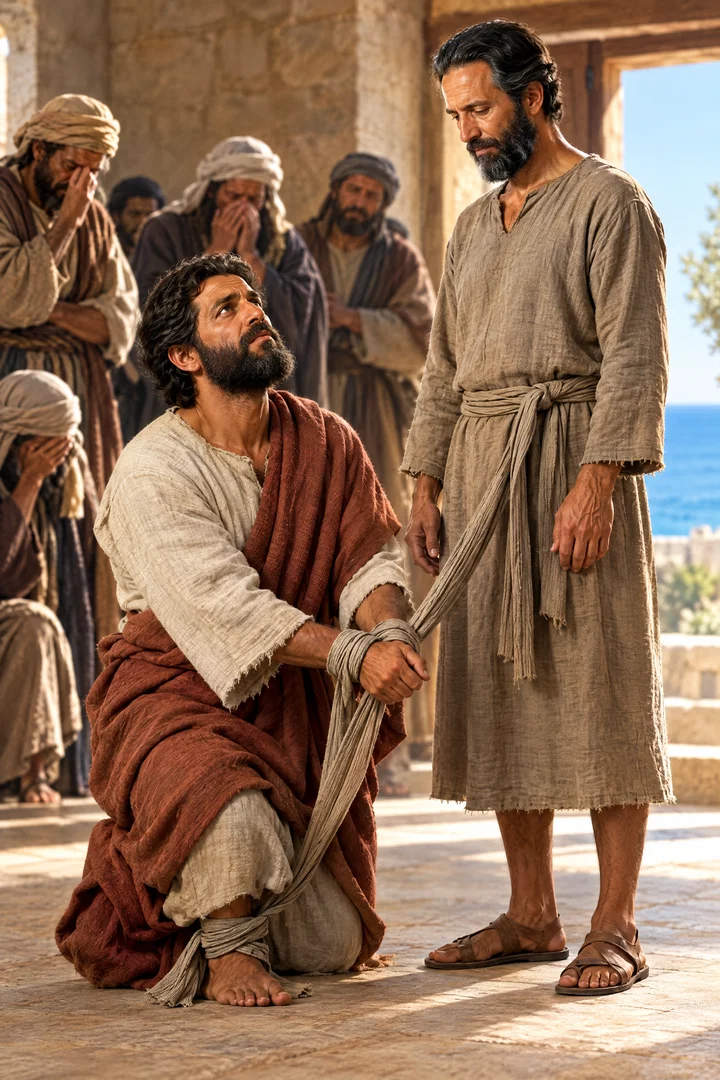
The verse records what happened at Caesarea after Agabus took Paul's girdle, bound his own hands and feet with it, and foretold by the Holy Spirit that the Jews at Jerusalem would so bind the owner of the girdle and deliver him to the Gentiles.AA 397.2–3SLP 204.2 Those who pleaded had already known that the visit to Jerusalem would bring great peril without foreseeing its full extent, and now apprehension had become certainty, with the horrors of Roman imprisonment added to the dangers from the Jews.SLP 204.2 Both Paul's traveling companions, including Luke, and the believers and brethren of that place where Paul was staying urgently begged him not to go up to Jerusalem.AA 397.2–3SLP 204.2 Their entreaty was earnest and urgent, made with prayers and tears and weeping.AA 397.2–3SLP 204.2
They urged him to remain at Caesarea and let them carry to Jerusalem the contributions from the Gentile churches, asking why he should face such peril and expose his precious life to the malice of the Jews and whether it would be presumptuous to go on after definite warning from the Spirit of God.SLP 204.2 Their weeping and pleading pained Paul's heart and sought to turn him from the path of duty, but he would not swerve and held himself ready not only to be bound but also to die at Jerusalem for the name of the Lord Jesus, to follow Christ if need be to prison and to death.AA 397.2–3 Seeing that they caused him pain without changing his purpose, the brethren ceased their importunity and yielded to the will of the Lord being done.AA 397.2–3
Sources
Pioneers and periodicals
21 sources
At Caesarea, after Agabus bound his own hands and feet with Paul's girdle and declared by the Holy Spirit that the Jews at Jerusalem would so bind its owner and deliver him to the Gentiles, both Paul's traveling companions and the believers of that place begged him not to go up to Jerusalem.ST Apr 15, 1903ST Mar 17, 1898ST Jun 9, 1898 The plea was made while lodging in the house of Philip the evangelist, where Paul stayed many days on his way to Jerusalem on his fifth and last visit to the Jewish capital.ST Sep 16, 1897ST Sep 16, 1897ST Dec 22, 1898 His companions and the local disciples took the Spirit's revelation of coming bonds and afflictions to mean the Spirit was counseling him not to go, when the Spirit had only foretold the suffering that awaited him, as he had been warned in every city.ST Sep 16, 1897 Their pleading, offered with weeping and deep concern and strong appeals, showed sympathy for God's worker and moved his heart, but it did not turn him from his willingness to suffer for Jesus or change his resolution.ST Sep 16, 1897ST Sep 20, 1905ST Feb 4, 1889 He refused because he knew his mission and was ready not only to be bound but to die at Jerusalem for the name of the Lord Jesus, and his steadfastness is true courage, the loyalty of the true soldier of Christ in every call of duty.ST Sep 16, 1897ST Feb 4, 1889ST May 6, 1913
Setting and Plea
Agabus took Paul's girdle, bound his own hands and feet with it, and declared by the Holy Spirit that the Jews at Jerusalem would so bind the man who owned the girdle and deliver him into the hands of the Gentiles.ST Apr 15, 1903ST Mar 17, 1898ST Sep 16, 1897ST Sep 16, 1897ST Dec 22, 1898 When they heard this prophecy of captivity and the danger awaiting Paul at Jerusalem, both his traveling companions and the believers of that place at Caesarea pleaded with him, urging him not to go up to Jerusalem.ST Apr 15, 1903ST Mar 17, 1898ST Jul 31, 1893ST Dec 9, 1897ST Sep 16, 1897 Those who heard the warning about what awaited him joined in the entreaty that he turn back from the journey.ST Jun 9, 1898ST Jul 31, 1893ST Dec 9, 1897
The entreaty was made at Caesarea in Syria, where they were lodging in the house of Philip the evangelist.ST Sep 16, 1897ST Sep 16, 1897ST Dec 22, 1898 Paul stayed there many days while on his way from Greece to Jerusalem, on his fifth and last visit to the Jewish capital.ST Sep 16, 1897ST Dec 22, 1898 It was his last journey back to his old home.ST Sep 16, 1897ST Sep 16, 1897 At Tyre also believers had warned him against going to Jerusalem.ST Jul 31, 1893
The forebodings of the Christians at Caesarea were quickly fulfilled, for Paul arrived at Jerusalem chained to a horseman and surrounded by Roman soldiers.ST Feb 12, 1885 That was his last time outdoors and at liberty before two years of imprisonment and his voyage to Rome.ST Feb 12, 1885 The plea not to go up belongs to the further trials Paul faced at Jerusalem during the later years of his ministry, fulfilling the Lord's word that he would suffer for His name.ST Jan 24, 1884
Warning, Resolve, Courage
Prophetic visions and instruction were active in the early church to help believers discern their duties in particular circumstances, and the warning about Paul's journey to Jerusalem was part of that guidance, given as important preparation for events ahead and as a test of the believers' hearts.RH Apr 21, 1868 Paul's companions and the local disciples took the Spirit's revelation that he would suffer persecution and bonds at Jerusalem to mean the Spirit was counseling him not to go, when the Spirit had only revealed coming bonds and afflictions, the same warning Paul had received in every city.ST Sep 16, 1897
The pleading for him not to go up to Jerusalem showed sympathy with God's worker and set before him an obstacle and danger calling for faithfulness to duty.ST Sep 16, 1897 With weeping and deep concern his companions and the believers pleaded with him not to go after learning that bonds awaited him there.ST Sep 20, 1905 Their strong appeals moved him and touched his heart, yet they did not turn him from his willingness to suffer for Jesus or change his resolution.ST Sep 20, 1905ST Feb 4, 1889ST May 6, 1913 He remained resolved to follow his duty to Christ even at the cost of suffering or death.ST Feb 4, 1889
Paul refused the plea because he knew his mission and was ready to die if need be that the cause of Christ might be advanced.ST Sep 16, 1897 He was ready not only to be bound but to die at Jerusalem for the name of the Lord Jesus, and nothing turned him aside from duty.ST May 6, 1913 His refusal reveals steadfastness of character and unwavering devotion to the work appointed him by the Lord.ST Dec 22, 1898 To him it mattered little whither the Spirit led him, into what depths of suffering, to what surrender of natural desires, will, and plans, or to what travail over wavering disciples.ST Dec 22, 1898
His steadfastness is true courage, the loyalty of the true soldier of Christ in all conflict with the enemy and in every call of duty.ST May 6, 1913 It is the faith and loyalty demanded of the soldiers of Christ now.ST May 6, 1913
Wider Chapter Doctrines
The chapter preserves the record of Paul finding four daughters of one family who prophesied among the men prophets and were counted worthy of mention in the sacred annals.RH Jun 29, 1911 That record proves God is no respecter of sex in His gifts and callings but bestows them on those who will use them faithfully.RH Jun 29, 1911 The accusations brought against Paul in the chapter concerned circumcision, not teaching that the first day had replaced the seventh day as holy.ST Jul 13, 1882
The leaders of the Jerusalem church, including James, urged Paul to demonstrate to Jewish believers that he still observed the ceremonial law.ST Oct 16, 1884 Their aim in this was to prevent unrest, retain popular favor, and avoid persecution.ST Oct 16, 1884 In advising Paul to follow human policy the apostles and leading brethren made a serious mistake.RH Aug 10, 1916 Unless God's providence had intervened, their advice would have cost Paul his life.RH Aug 10, 1916
Paul's taking part in animal sacrifices after Christ had been recognized as the true sacrifice is cited from this chapter as an example.RH Feb 18, 1873 That conduct concerned political offenses under the Mosaic code and therefore did not conflict with Christ's sacrifice for sins affecting the conscience and future judgment.RH Feb 18, 1873
Sources