Acts 26:29
And Paul said, I would to God, that not only thou, but also all that hear me this day, were both almost, and altogether such as I am, except these bonds.
Translations
And Paul said, I would to God, that not only you, but also all that hear me this day, were both almost, and altogether such as I am, except these bonds.
King James Version, KJV Cambridge Paragraph Bible, Webster Bible
And Paul said, I would to God, that not only thou, but also all that hear me this day, were both almost, and altogether such as I am, except these bonds.
Revised Version, American Standard Version
And Paul said, I would to God, that whether with little or with much, not thou only, but also all that hear me this day, might become such as I am, except these bonds.
and Paul said, 'I would have wished to God, both in a little, and in much, not only thee, but also all those hearing me to-day, to become such as I also am — except these bonds.'
And Paul [ said], I would to God, both in little and in much, that not only thou, but all who have heard me this day, should become such as I also am, except these bonds.
And, Paul, [answered] —I could pray unto God that, both almost and altogether, not only thou but all they who are hearing me this day, might become such,—as even, I, am, excepting these bonds.
Berean Standard Bible, Majority Standard Bible
“ Short time or long,” Paul replied, “ I wish to God that not only you but all who hear me this day may become what I am, except for these chains.”
Paul said, “ I pray to God, that whether with little or with much, not only you, but also all that hear me today, might become such as I am, except for these bonds.”
And Paul said, It is my prayer to God that, in little or great measure, not only you, but all those hearing me today might be even as I am, but for these chains.
Then Paul sayd, I would to God that not onely thou, but also all that heare me to day, were both almost, and altogether such as I am, except these bonds.
Douay-Rheims (Challoner revision)
And Paul said: I would to God, that both in a little and in much, not only thou, but also all that hear me, this day, should become such as I also am, except these bands.
Pictures

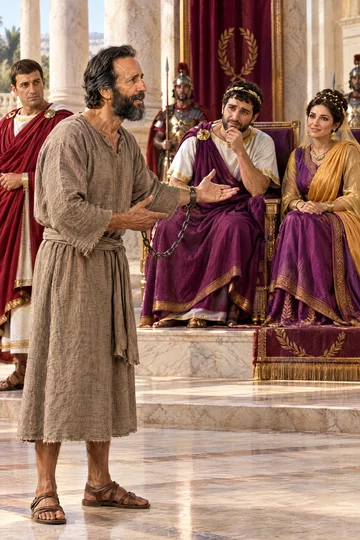
Cross-references
- Acts 25:13-27
And after certain days king Agrippa and Bernice came unto Cæsarea to salute Festus.
Describes the events leading to Paul’s hearing before Agrippa.
- Acts 25:11-12
For if I be an offender, or have committed any thing worthy of death, I refuse not to die: but if there be none of these things whereof these accuse me, no man may deliver me unto them. I appeal unto Cæsar.
Paul’s appeal to Caesar explains why he remains a prisoner.
- Acts 24:24
And after certain days, when Felix came with his wife Drusilla, which was a Jewess, he sent for Paul, and heard him concerning the faith in Christ.
Paul also spoke about faith before the governor Felix.
- 1 Corinthians 9:1
Am I not an apostle? am I not free? have I not seen Jesus Christ our Lord? are not ye my work in the Lord?
Paul cites having seen Jesus as evidence of his apostleship.
Commentary
Each commentary is drawn from primary sources: the writings of Ellen G. White and Adventist pioneers and periodicals. Each commentary is separate. Its own words are not a quotation; follow the references to read the source passages.
Ellen G. White
16 sources
Paul spoke these words in his defense and testimony before King Agrippa in the court of Festus, where before rulers and leading people he explained his faith and preached Christ and his own conversion.ST Jul 20, 1904AA 433.1EW 172.3 They were his answer when Agrippa, convicted by the truth of the gospel, admitted he was almost persuaded to become a Christian.AA 438.1–2RH Nov 16, 1911ST Jul 20, 1904 By them Paul wished that Agrippa and all who heard him would become believers in Christ like himself, sharing his faith, hope, confidence and peace with God, yet remain free from his chains, imprisonment and hardships.ST May 29, 1884AA 438.1–2RH Nov 16, 1911 The wish was spoken with gentle courtesy and dignified kindness toward rulers, showing a mild and self-sacrificing spirit that sought the good he had found for his hearers and even his persecutors without revenge and without their suffering as he had suffered.ED 67.1–2ST Jul 20, 1904SLP 259.2–3GW92 431.2 Upheld by the Holy Spirit, his confident witness carried the gospel through imprisonment to rulers and nobles, becoming a pattern for its later proclamation before the princes and lords of the empire at Augsburg.GC88 207.3Ms 90, 1903, par. 214SP 167.1
Setting and Meaning
Paul's words belong to his defense and testimony before King Agrippa in the court of Festus, before the other leading people of Caesarea and before kings and governors.ST Jul 20, 1904AA 433.1EW 172.3 There he had opportunity to explain the reasons for his faith and to preach about Jesus and his own conversion.AA 433.1EW 172.3 They are his answer to Agrippa's admission that he was almost persuaded to become a Christian.AA 438.1–2RH Nov 16, 1911ST Jul 20, 1904 Agrippa spoke when convicted of the truth of the gospel.ST Jul 20, 1904
By wishing his hearers were such as he is, Paul wished that Agrippa and all who heard him that day would become believers in Christ and Christians like himself.ST May 29, 1884AA 438.1–2RH Nov 16, 1911ED 67.1–2ST Jul 20, 1904 He wished them to share his faith, hope, confidence, and peace with God.SLP 259.2–3SLP 260.1 By adding except these bonds, while pointing to his own chain, he wished them to remain free of his chains, imprisonment, and hardships.ST May 29, 1884AA 438.1–2RH Nov 16, 1911ED 67.1–2ST Jul 20, 1904 He wanted them to receive the good he had found without suffering as he had suffered.SLP 259.2–3
To be almost persuaded means to recognize the right way and to feel conviction about grace, pardon, and mercy, yet to refuse the offered mercy and the cross of Christ.SLP 260.1 Many who are almost persuaded put off deciding and lose the opportunity.EW 172.3
Courtesy and Courage in Witness
Paul's reply to Agrippa is the model of true Christian courtesy, refinement, and persuasive eloquence.ED 67.1–2GW92 431.2MYP 421.2MH 489.5GW 123.2 It was spoken with gentle courtesy and dignified kindness of heart toward rulers, even while he himself was persecuted and imprisoned.ST Jul 20, 1904GW92 431.2MYP 421.2 In the court of Festus, when Agrippa was convicted of the truth of the gospel and exclaimed that he was almost persuaded to be a Christian, Paul answered by pointing to his own chain and wishing to God that not only Agrippa but all who heard him that day might become altogether such as he was as a Christian, except for his bonds.ED 67.1–2ST Jul 20, 1904GW 123.2 His wish that his hearers should share his condition, except for his bonds, exemplifies that courtesy before Agrippa and his hearers.ED 67.1–2GW92 431.2GW 123.2
The wish reveals a mild, self-sacrificing spirit of earnest concern rather than revenge, even toward persecutors.SLP 259.2–3GW92 431.2 He desired that Agrippa and everyone listening should share his faith, hope, confidence, and peace with God.SLP 259.2–3 At the same time he desired that they be spared his imprisonment and hardships and not suffer as he had suffered.SLP 259.2–3 He wanted them to receive the good he had found, without the suffering through which he held it.SLP 259.2–3GW92 431.2
Faith in Christ is what gave him confidence before Agrippa.Ms 90, 1903, par. 21 Upheld by the power of the Holy Spirit against the tide of persecution, he presented truth in a way that fastened upon Agrippa the conviction that Christ is the Son of God.Ms 90, 1903, par. 21
Gospel Before Rulers
Paul's imprisonment became the means by which the gospel was brought before rulers and nobles.GC88 207.34SP 167.1 Though held as a prisoner, he was set before kings and governors to present his faith in the full hearing of Acts 26:1-32.4SP 167.1 His wish that his royal hearers and all who heard him might share his faith, except for his bonds, belongs to that testimony before royalty.4SP 167.1 That presentation before rulers and nobles became the pattern for the later proclamation of the gospel before the princes and lords of the empire at Augsburg.GC88 207.34SP 167.1
Sources
Pioneers and periodicals
43 sources
Before a king Paul turns aside the claim of being almost persuaded into a prayer to God that the king and every listener that day would become a believer in Christ just as he is, without his chains.ST May 29, 1884RH Nov 16, 1911ST Aug 14, 1893ST Oct 7, 1897ST May 13, 1903
The prayer is sincere and earnest, reaching beyond the king to all who hear and showing goodwill and forgiveness toward those holding power over him.RH Nov 16, 1911ST Oct 7, 1897ST Aug 14, 1893
By little or much, whether slightly moved or fully convinced, he desires them to become Christians.ST Oct 7, 1897ST Aug 14, 1893ST May 13, 1903
What he wants them to share is his faith, peace of conscience, godliness and standing with God, but not his imprisonment and suffering.ST Jun 5, 1884
To be almost persuaded by hearing truth without deciding to obey it is not enough, for becoming altogether like him means fully embracing the truth as Bible Christians who keep God's commandments and the testimony of Jesus, a godliness believers are to live so plainly that they can honestly wish others to share it.ST Jun 5, 1884RH Jul 3, 1860RH Jun 6, 1871RH Jul 10, 1856
Setting Before Agrippa
Agrippa is convicted of the truth of the gospel and exclaims that he is almost persuaded to become a Christian, and the verse is Paul's answer to that exclamation.RH Nov 16, 1911ST Jul 20, 1904 Paul turns the remark into an earnest wish to God that not Agrippa only but also all that hear him that day might become such as he is, whether by little or by much persuasion.RH Nov 16, 1911ST May 13, 1903ST May 13, 1903 What he desires for them is to become as he is as a believer in Christ and a Christian in faith, except for the bonds and chains he wears.RH Nov 16, 1911ST Jul 20, 1904ST May 13, 1903 The answer is given with gentle courtesy while pointing to his own chain, a beautiful reply made after Agrippa received the personal turn in Paul's speech before him.ST Jul 20, 1904ST May 12, 1898
The hearing is Paul's answer to King Agrippa in the court of Festus.ST Jul 20, 1904 It is a public defense before a king about the Christian faith, spoken with courage and persuasive power, and connected with reasoning about righteousness, self-control, and the coming judgment.ST Feb 14, 1884 It takes place while Paul is imprisoned at Caesarea, as part of the account of that hearing before he is sent to Rome.ST Jan 8, 1885 The Agrippa addressed, called simply Agrippa, is Herod Agrippa II, the son of Herod Agrippa I, the first ruler since Herod the Great to bear the title Herod the King over Judea.ST Jul 26, 1883
The verse belongs to Paul's testimony before Agrippa, in which he declares that having obtained help of God he continues in witness unto this day.ST Jun 17, 1903 In that testimony before Festus and Agrippa he recounts how Christ appeared to him and how he received his ministry from heaven.ST Oct 17, 1895 That encounter with the risen Jesus grounds his apostleship and gives him confidence to proclaim the gospel.ST Oct 17, 1895
Meaning of Paul's Wish
Paul wished to God that Agrippa and all who heard him that day would become as he was, a believer in Christ and a Christian, except for his bonds.ST May 29, 1884ST Aug 14, 1893ST Oct 7, 1897ST May 13, 1903ST Dec 9, 1897 His desire was for their conversion, not for them to share his imprisonment and chains.ST Aug 14, 1893ST May 13, 1903RH Sep 8, 1874 He would have them share his faith and standing while remaining free of his imprisonment.ST Dec 9, 1897RH Sep 8, 1874
The wish was sincere and earnest, offered as prayer, and it extended to everyone listening, not to the king only.RH Nov 16, 1911ST Oct 7, 1897ST Aug 14, 1893 It embraced even the distinguished people who held power over him, expressing forgiveness and goodwill toward them. What he earnestly desired them to share was what he himself had, that they should be persuaded by his message and become followers of Christ without suffering his imprisonment.RH Nov 16, 1911ST Aug 14, 1893
The words almost and altogether mean whether by little or much persuasion, whether slight or great, whether almost or fully persuaded.ST Oct 7, 1897ST Aug 14, 1893ST May 13, 1903ST Mar 3, 1881RH Jul 3, 1860 With little or with much, not Agrippa only but also all that heard him that day, Paul desired them to become such as he is, except his bonds.ST Oct 7, 1897ST Aug 14, 1893ST May 13, 1903 The revision of the wording clarifies that the wish applies whether persuasion is slight or great, excepting only his chains and not his faith or Christian standing.ST Oct 7, 1897ST Mar 3, 1881
What he wanted them to share was his faith, peace of conscience, spiritual standing, godliness, and relationship with God, but not his suffering and imprisonment.ST Jun 5, 1884RH Jul 31, 1900 He would have them become altogether like him in faith and godliness while remaining free of his chains.ST Jun 5, 1884 His personal account made the gospel known through testimony, that others might share his standing before God without sharing his bonds.RH Jul 31, 1900
Manner and Witness
Paul answered with tact, politeness, and the truest and broadest Christian courtesy marking every word, joining deep and forceful logic and powerful reasoning with a gentle and kindly manner that melted the heart even while the reasoning made the king tremble, for mere logic without such courtesy would be of no avail. His reply displayed gracious Christian conviction and the graciousness that communion with God and his word can give, wishing that all who heard would become altogether like him in faith and godliness while remaining free of his chains.ST Jun 5, 1884 Such godliness reflected in believers, living so near to God as honestly to desire others to share likeness to Christ, is within everyone's reach as both privilege and duty.ST Jun 5, 1884
Though in chains he spoke with courage, dignified composure, and conscious innocence before the king, and his defense belonged to his public testimony of prophecy and the judgment.RH Oct 15, 1857 That courage carried persuasive power about the Christian faith, joined to reasoning about righteousness, self-control, and the coming judgment.ST Feb 14, 1884
He made the most of his imprisonment as a prisoner of the Roman government to preach Christ and advance his mission of preaching Jesus, using the hearing at Caesarea and at least five years as a Roman prisoner to carry this prison witness to kings and governors and to rulers, commanders, and nobles.ST Dec 20, 1905ST Oct 29, 1885RH Oct 22, 1872 He did so without complaining against the government, while showing his accusers had no ground for their charges.ST Dec 20, 1905
His witnessing showed a sincerity for Christ equal to the sincerity he had when he persecuted the church, proving that with a heart deceitful above all things and desperately wicked a person can fail to see himself as God sees him and can think he is doing God service when he is only satisfying self.RH Oct 24, 1912 He proclaimed the whole counsel of God plainly before Agrippa and Festus without softening the message to please his hearers, wanting them and everyone listening to share what he had except his imprisonment.ST Mar 5, 1894 He did not treat them as equally right simply to avoid urging them toward the gospel, but desired them to become as he was in faith while not sharing his chains.RH Jul 28, 1910 His defense before Agrippa is also an example of a preacher speaking without reading from a prepared manuscript.ST Jun 5, 1884
His suffering and earnest appeal, wishing that the king and everyone hearing him would become as he was in faith but without his bonds, form a powerful Christian witness that can move others toward God.ST Oct 20, 1887 His account of his conversion before the king's court made the gospel known there through personal testimony, sharing his relationship with God while not sharing his imprisonment.RH Jul 31, 1900 In this he bore witness to God before a ruler of the Roman world, presented as an example to compare with the woman's personal testimony which drew the people of her city to hear Jesus.ST Aug 6, 1896ST Dec 29, 1887
Greek Word Order
The Greek word semeron, rendered today or this day, does not always stand first or at the beginning of the clause to which it belongs.RH Jan 23, 1908ST Jan 30, 1912ST Jan 21, 1913ST Feb 24, 1898 Its position can vary rather than being fixed at the head of the clause it qualifies.RH Jan 23, 1908ST Jan 30, 1912ST Jan 21, 1913ST Feb 24, 1898 It can occur after the words it qualifies, as this verse illustrates.ST Apr 18, 1911RH Jan 23, 1908ST Dec 16, 1913
Its position therefore does not by itself determine which part of Luke 23:43 it belongs with.ST Apr 18, 1911RH Jan 23, 1908ST Dec 16, 1913 This supports the possibility of reading it with the preceding words I say rather than with the following promise of being in Paradise.ST Apr 18, 1911RH Jan 23, 1908ST Dec 16, 1913
Call to Full Decision
To be almost persuaded is to hear the truth and be moved by it without fully deciding to obey it, which is not the same as choosing to live as a Christian.RH Jun 6, 1871RH Jul 10, 1856 To be altogether such as Paul was is to fully embrace the whole truth and become an altogether persuaded Bible Christian.RH Jun 6, 1871RH Jul 10, 1856 That means keeping God's commandments and the testimony of Jesus and holding firm instead of turning away when the truth presses closely.RH Jun 6, 1871RH Jul 10, 1856
The same call applies to those nearly persuaded to believe the third angel's message, accept the Sabbath, and live by its requirements.RH Jul 3, 1860 Paul's stand before Agrippa's tribunal was a public decisive test of faithfulness to right under pressure, of the same kind as standing in Nero's judgment hall, before a Popish inquisitor, or in sight of Smithfield's martyr fire.RH Sep 25, 1860 It is distinct from the private test of a minister deciding in his quiet study whether to speak the truth in the pulpit.RH Sep 25, 1860 His reply sets a challenge for Christians to live so near to God that they can honestly desire others to share their likeness to Christ.ST Jun 5, 1884 Such godliness reflected in believers is within everyone's reach as both privilege and duty.ST Jun 5, 1884
Sources