Acts 27:19
And the third day we cast out with our own hands the tackling of the ship.
Translations
American King James Version, King James Version, Webster Bible
And the third day we cast out with our own hands the tackling of the ship.
and the third day we cast out with our own hands the tackling of the ship.
Revised Version, American Standard Version
and the third day they cast out with their own hands the tackling of the ship.
and on the third [day] with our own hands the tackling of the ship we cast out,
and on the third day with their own hands they cast away the ship furniture.
and, on the third day, with their own hands, the tackling of the ship, they cast away.
On the third day, they threw the ship’s tackle overboard with their own hands.
On the third day, we threw the ship’s tackle overboard with our own hands.
On the third day, they threw out the ship’s tackle with their own hands.
And on the third day, they let all the sailing apparatus go over the side.
And the third day we cast out with our owne hands the tackling of the ship.
Douay-Rheims (Challoner revision)
And the third day they cast out with their own hands the tackling of the ship.
Pictures
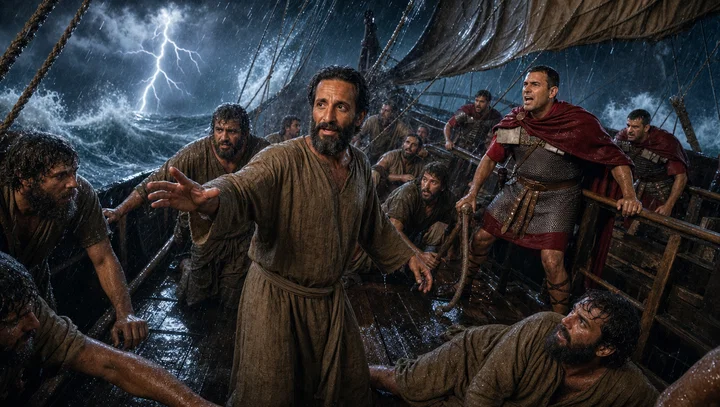
Cross-references
- Acts 28:1-10
And when they were escaped, then they knew that the island was called Melita.
Continues the account of the shipwreck and Paul’s voyage.
- Acts 27:1-2
And when it was determined that we should sail into Italy, they delivered Paul and certain other prisoners unto one named Julius, a centurion of Augustus’ band.
Introduces the voyage described in Acts 27.
Commentary
Each commentary is drawn from primary sources: the writings of Ellen G. White and Adventist pioneers and periodicals. Each commentary is separate. Its own words are not a quotation; follow the references to read the source passages.
Ellen G. White
7 sources
Sea travel in the first century was perilous, and navigation was difficult when sun and stars were hidden, so that signs of a storm made shipowners afraid to venture into open water and some seasons were nearly impossible for safe sailing.AA 439.2 On the third day of the storm those aboard threw the ship's tackling overboard with their own hands, sacrificing necessary equipment in an effort to survive.AA 439.3AA 442.1SLP 265.2 Crew and passengers joined in that desperate work to lighten the leaking vessel as it was battered by the gale, badly damaged and struggling to stay afloat even at the cost of what was needed to sail her.AA 439.3AA 442.1RH Nov 23, 1911SLP 265.2
The voyage was a means by which God carried forward Paul's work, for the crew saw God's power through him and those who did not know God heard about Jesus.EW 172.3 In this way it became an occasion through which many could be converted by his teaching and miracles.EW 172.3
The verse reflects Paul's constant travel on the water in storm and tempest as part of his many trials as an unwearied worker.Lt 107, 1904, par. 2–6 His lot was far harder without modern conveniences, yet he allowed nothing to hinder his work as God's servant carrying out His will.Lt 107, 1904, par. 2–6 His example gives courage not to become discouraged, and by spoken word and by letter he bore a message that has ever since brought help and strength to the church.Lt 107, 1904, par. 2–6 To those living on the eve of the close of earth's history that message speaks plainly about dangers that will threaten the church and false doctrines the people of God will have to meet.Lt 107, 1904, par. 2–6
Sources
Pioneers and periodicals
23 sources
On the third day of the storm the crew threw the ship's tackling overboard with their own hands to lighten the leaking, battered vessel, after first securing and undergirding it and then casting out its freight the day before when earlier measures had failed.ST Jun 12, 1884ST Mar 30, 1904 The third day is counted by inclusive reckoning in which the day of distress is the first day, the lightening of the ship is the second day, and the casting out of the tackling is the third day.ST Feb 3, 1881RH Feb 7, 1871RH Aug 12, 1875 This belonged to Paul's dangerous winter voyage to Rome as a prisoner under Roman guard, when the tempestuous wind called Euraquilo drove the ship off course and Satan sought to destroy Paul by the enraged sea.RH Apr 21, 1903ST May 12, 1898ST Aug 21, 1901ST Aug 27, 1896 In that crisis Paul comforted crew and passengers with the angel's message that they would survive though the ship would be wrecked, so a whole shipload escaped death because God's servant was on board.ST Dec 9, 1897ST Jul 23, 1885 What seemed disastrous was truly prosperous as God's answer to Paul's prayer for a prosperous journey to Rome, for God brought him there where his imprisonment furthered the gospel, teaching that all things work together for good to them that love God.ST Oct 24, 1895ST Jul 21, 1909ST Nov 25, 1889ST Feb 25, 1889
Shipwreck Voyage Setting
Acts 27:19 belongs to Paul's dangerous winter voyage to Rome as a prisoner under guard of Roman soldiers, which ended in shipwreck while he was being taken to Rome.RH Apr 21, 1903ST Feb 25, 1889ST Feb 16, 1915RH Oct 4, 1906 The journey did not go as he expected, but God brought him to Rome where his imprisonment furthered the gospel.ST Feb 25, 1889
The storm was the tempestuous wind called Euraquilo that caught the ship and drove it off course.ST May 12, 1898 It broke over that part of the Mediterranean past southern Italy and Sicily after passing out of sight of land, and wrecked Paul's vessel.ST Aug 21, 1901 It was Satan seeking to destroy Paul by the enraged sea, as he had sought to destroy Christ and then His disciples by the sea, showing the restless, raging, roaring, turbid, angry sea bringing danger and destruction, though the sea is His and He made it and all God made is good.ST Aug 27, 1896
After the ship was caught and driven, the boat was secured at Cauda, the ship was undergirded, and the gear was lowered for fear of the Syrtis.ST May 12, 1898 While laboring exceedingly in the storm those on board threw the freight overboard the next day, then on the third day cast out the tackling of the ship with their own hands to lighten the leaking, battered vessel.RH Nov 23, 1911ST Jun 12, 1884ST Mar 30, 1904ST May 12, 1898 Paul and the others worked with their own hands in these desperate measures to lighten the vessel after earlier measures had failed, in a disheartening crisis in which neither sun nor stars appeared for many days and all hope of being saved was taken away.ST Jun 12, 1884ST Mar 30, 1904ST Dec 9, 1897ST May 12, 1898
The third day is counted by inclusive reckoning in which the day of distress in verse 17 is the first day, the next day when the ship was lightened is the second day, and the day the tackling was thrown overboard is the third day.ST Feb 3, 1881RH Feb 7, 1871RH Aug 12, 1875 This usage shows that a partial first day is counted as day one, with the day an event begins counted as day one.ST Feb 3, 1881RH Feb 7, 1871RH Aug 12, 1875
The verse records a historical detail whose factual reliability is supported by study of the shipwreck, and gives a picture of emergency relief of a ship's load.ST Jul 5, 1910 It belongs to a setting where travel by sea was tedious and perilous, which helps explain the exposure that led to Epaphroditus's serious illness.ST Dec 8, 1887 Paul faced that storm with a power of endurance greater than ordinary travelers have, acting as both sailor and minister giving directions for the company, soldiers, and ship, with he and the others throwing the ship's equipment overboard with their own hands by the third day of the storm.ST Aug 21, 1901
In that setting Paul comforted the crew and passengers with the angel's message that they would survive though the ship would be wrecked.ST Dec 9, 1897 So a whole shipload of reckless and wicked men escaped death at sea because God's servant was on board.ST Jul 23, 1885
Instruction and Application
What most would call disastrous in the casting out of the tackling with their own hands on the third day was truly prosperous.ST Oct 24, 1895 It was part of the answer to earnest prayer for a prosperous journey by the will of God to visit Rome.ST Oct 24, 1895 There was no complaint about it, because all things work together for good to them that love God.ST Oct 24, 1895 Troubles are to be looked at as God looks at them and not from the wrong side, and what is regarded as disastrous will then be found prosperous.ST Oct 24, 1895 God knows far better than men how prayers should be answered, and remembering this would save much mourning.ST Oct 24, 1895
The journey did not go as expected, yet God brought the prisoner to Rome where imprisonment furthered the gospel.ST Feb 25, 1889 This shows the Lord's marvelous working with His servant.ST Jul 21, 1909 The shipwreck stands as a New Testament divine deliverance together with the deliverance of Shadrach, Meshach, and Abednego from the fiery furnace.ST Nov 25, 1889 The Old Testament deliverance and the New Testament deliverance stand or fall together, because the Old and New Testaments are one system with Christ as the product and perfection of Old Testament facts and theories.ST Nov 25, 1889
The verse belongs to a terrifying journey by sea as a prisoner after two years at Caesarea on the way to several years in chains at Rome testifying of Christ before kings and emperors. Through patient sturdy toil and untold suffering patience was learned. He was God's mightiest instrument to carry the gospel to the Gentiles to the ends of the earth. Instead of living to be changed when the Lord should come, his lot was to toil and labor and suffer and at the end be a martyr at Rome for the truth's sake.
The shipwreck is counted among the great trials of life alongside murderous mobs, testimony before kings and courts, plots of assassins, the viper bite, and the soldiers' decision over life.ST Apr 29, 1903 In it sublime faith and courage rose superior to danger and cheered discouraged companions, showing that great trials did not discourage the Christian soul.ST Apr 29, 1903 Only the later long, wearying journey in heavy chains told upon him and let courage wane.ST Apr 29, 1903 That waning was weakness of flesh and not of spirit.ST Apr 29, 1903
The trip to Rome was labor and sacrifice and suffering, not a holiday rest or vacation.ST Mar 18, 1889 The casting out of the tackling with their own hands belongs to that hardship, set alongside tent labor at Corinth and a night and day in the deep.ST Mar 18, 1889 It is the true apostolic example ministers should make much of to save souls instead of finding justification for clerical holidays.ST Mar 18, 1889
The desperate effort to survive by throwing the tackle overboard applies as a call to support and preserve the church rather than leave it.RH Feb 4, 1915 That preserving includes keeping it in good order.RH Feb 4, 1915
Sources