Acts 28:1
And when they were escaped, then they knew that the island was called Melita.
Translations
American King James Version, King James Version, KJV Cambridge Paragraph Bible
And when they were escaped, then they knew that the island was called Melita.
And when they had escaped, then they knew that the isle was called Melita.
Revised Version, American Standard Version
And when we were escaped, then we knew that the island was called Melita.
And having been saved, then they knew that the island is called Melita,
And when we got safe [ to land] we then knew that the island was called Melita.
And, when we were safely through, then, we knew that the island was called, Melita.
Berean Standard Bible, Majority Standard Bible
Once we were safely ashore, we learned that the island was called Malta.
When we had escaped, then they learned that the island was called Malta.
And when we were safe, we made the discovery that the island was named Melita.
And when they were come safe, then they knewe that the Yle was called Melita.
Douay-Rheims (Challoner revision)
And when we had escaped, then we knew that the island was called Melita. But the barbarians shewed us no small courtesy.
Pictures
Cross-references
- Acts 27:44
And the rest, some on boards, and some on broken pieces of the ship. And so it came to pass, that they escaped all safe to land.
The travelers escaped the shipwreck and reached land safely before reaching Melita.
- Acts 27:22-25
And now I exhort you to be of good cheer: for there shall be no loss of any man’s life among you, but of the ship.
Paul’s assurance of survival leads to the shipwreck and arrival on the island.
- Acts 28:8-9
And it came to pass, that the father of Publius lay sick of a fever and of a bloody flux: to whom Paul entered in, and prayed, and laid his hands on him, and healed him.
Paul healed Publius’s father and others on the island.
Commentary
Each commentary is drawn from primary sources: the writings of Ellen G. White and Adventist pioneers and periodicals. Each commentary is separate. Its own words are not a quotation; follow the references to read the source passages.
Ellen G. White
8 sources
The verse names the place where Paul and the shipwrecked company came ashore after escaping the sea as the island of Melita, later called Malta.AA 445.2SLP 270.2RH Nov 30, 1911SLP 270.1 The landing there concludes the voyage and shipwreck, set against the hardships and dangers of first-century sea travel.AA 439.2RH Nov 30, 1911EW 172.3 Nearly three hundred people reached land safely, and some joined Paul and his companions in thanking God for preserving their lives through the dangers of the sea.SLP 270.1
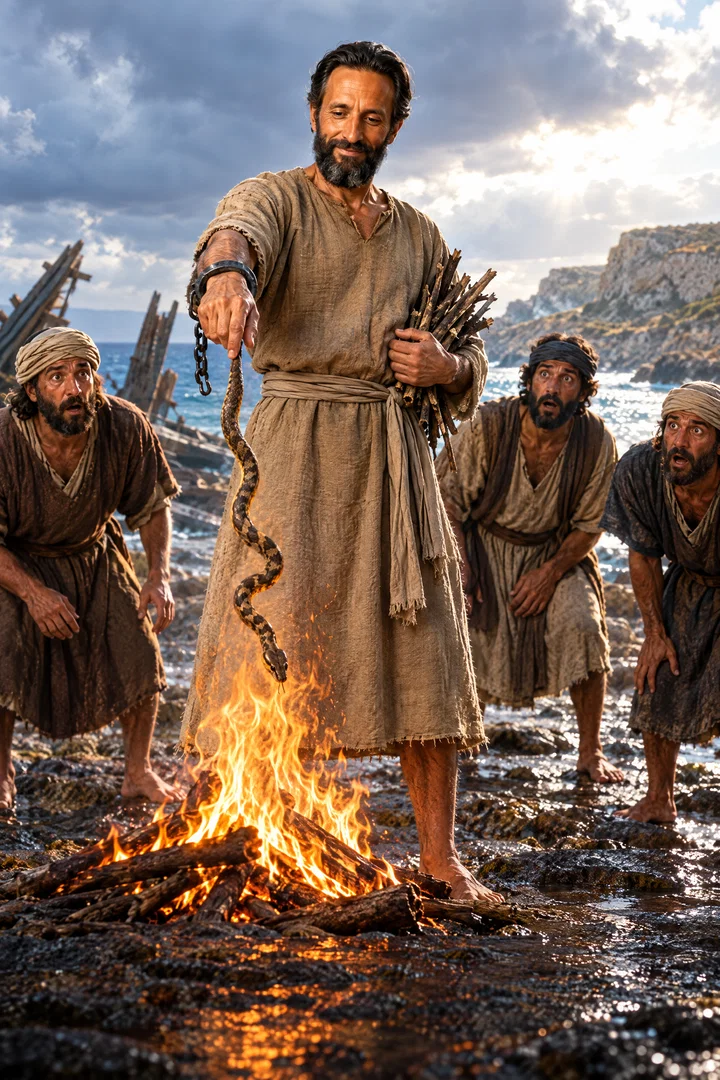
Though its people were called barbarous, they kindly welcomed, received, and cared for the chilled survivors.AA 445.2RH Nov 30, 1911ST Nov 6, 1879 After being driven to the island, Paul remained calm and helpful, gathering wood for a fire for the passengers.ST Nov 6, 1879 When a viper fastened on his hand he shook it into the fire without fear, trusting that God would keep it from harming him.ST Nov 6, 1879
The sea journey and landing served God's purpose: the crew witnessed God's power through Paul, and the island's people heard about Jesus, with Paul's teaching and miracles leading many to believe.EW 172.3 The people of Melita were in the depths of heathenism, without knowledge of God's written law and without ever having heard the name of Christ.COL 385.1 Yet their kindness in receiving and protecting God's servants at the risk of their own lives reveals the working of God's Holy Spirit and divine power.COL 385.1 The Holy Spirit had implanted the grace of Christ in the heart of the savage, quickening a sympathy contrary to nature and contrary to education, for the Light which lights every man was shining in their souls, and if heeded that light will guide their feet to the kingdom of God.COL 385.1
Sources
Pioneers and periodicals
16 sources
After escaping the shipwreck at sea and reaching land, Paul and the other survivors learned that the island where they had landed was called Melita, the certain island where they would be saved and cast ashore.RH Nov 30, 1911ST Dec 9, 1897ST Oct 21, 1897 Melita is Malta, where Paul and his companions came ashore after the storm-driven voyage and shipwreck on the way to Rome, lying about sixty miles south of Sicily and two hundred miles north of Africa, where they stayed for three months.ST Aug 26, 1897ST Oct 21, 1897ST Oct 21, 1897ST Feb 16, 1915 The verse belongs to the closing chapters of Acts concerning Paul's arrest and trial and his voyage to Rome, which end with Paul in Rome, an inspiring record of the work of men who trusted God.RH Nov 23, 1916ST Oct 24, 1911ST Oct 29, 1912 The people of Melita welcomed and lodged Paul and his companions and built a fire for them, and Paul's delayed and hardship-marked journey to Rome thus gave him opportunities for missionary work along the way rather than a vacation.RH Nov 30, 1911ST Mar 30, 1904CO 73.4ST Mar 18, 1889ST Aug 28, 1898 When a venomous viper fastened on his hand as he gathered wood for the chilled passengers he shook it into the fire without fear and suffered no harm, which the islanders first took as divine punishment and then as deity, giving Paul opportunity to direct them to the true God who protects His servants, while God also worked cures through him and the islanders supplied the company for the journey to Rome.ST Nov 6, 1879ST Aug 28, 1898
Context and Island Identity
Acts 28:1 belongs to the closing chapters of Acts concerning Paul's arrest and trial and his voyage to Rome, chapters that end with Paul in Rome.RH Nov 23, 1916ST Oct 24, 1911 The closing of the book tells of Paul's arrival in Rome, his reception there, his effort to reach his own people and the twofold result of that effort, but it does not tell of his last imprisonment and death.ST Oct 29, 1912 The whole book is an inspiring record of the work of men who trusted God.ST Oct 29, 1912
After escaping the shipwreck at sea and reaching land, Paul and the other survivors learned that the island where they had landed was called Melita.RH Nov 30, 1911ST Dec 9, 1897ST Oct 21, 1897ST Oct 21, 1897 This naming introduces the islanders who welcomed them.RH Nov 30, 1911 The verse thus gives the name Melita for the certain island where it had been said the shipwrecked company would be saved and cast ashore.
Melita is Malta, the island where Paul and his companions came ashore after the storm-driven voyage and shipwreck on the way to Rome.ST Aug 26, 1897 Malta lies about 60 miles south of Sicily and 200 miles north of Africa.ST Oct 21, 1897ST Oct 21, 1897 It is also described as lying a few miles south of Sicily.ST Aug 28, 1898
The shipwreck occurred about November 1, A.D. 60, and the departure from the island occurred about February 8, when navigation in that region opened.ST Oct 21, 1897 Paul and the other survivors stayed on Melita for three months.ST Feb 16, 1915 During that time Roman soldiers shared the island with him, some of whom were a better help to him than Jewish religious leaders.ST Feb 16, 1915
Welcome Ministry and Meaning
Paul's voyage to Rome was delayed and marked by hardship, yet it still brought him to his intended destination and opened opportunities for missionary work along the way.ST Mar 30, 1904 That trip stands as an example of labor and sacrifice, not a vacation.ST Mar 18, 1889 The people of Melita lodged Paul and his companions after their escape from the shipwreck, welcomed them and built a fire for them.RH Nov 30, 1911CO 73.4ST Aug 28, 1898 In return they received great benefits.CO 73.4ST Aug 28, 1898
After being shipwrecked and driven to the island, Paul remained calm and helpful, gathering wood for a fire for the chilled passengers.ST Nov 6, 1879 When a viper fastened on his hand he shook it into the fire without fear, trusting God to keep it from harming him.ST Nov 6, 1879 Though a venomous viper bit him as he gathered fuel, he suffered no harm.ST Aug 28, 1898 The islanders first took this as a sign of divine punishment and then regarded him as a god, which gave opportunity to direct them to the true God who protects His servants, while God also worked cures through him and the islanders gave the company presents and supplies for the journey on to Rome.ST Aug 28, 1898 In this encounter the island is the setting in which the island represents truth, so that standing on that foundation means error cannot harm him.RH Sep 22, 1863
Sources