Acts 27:22
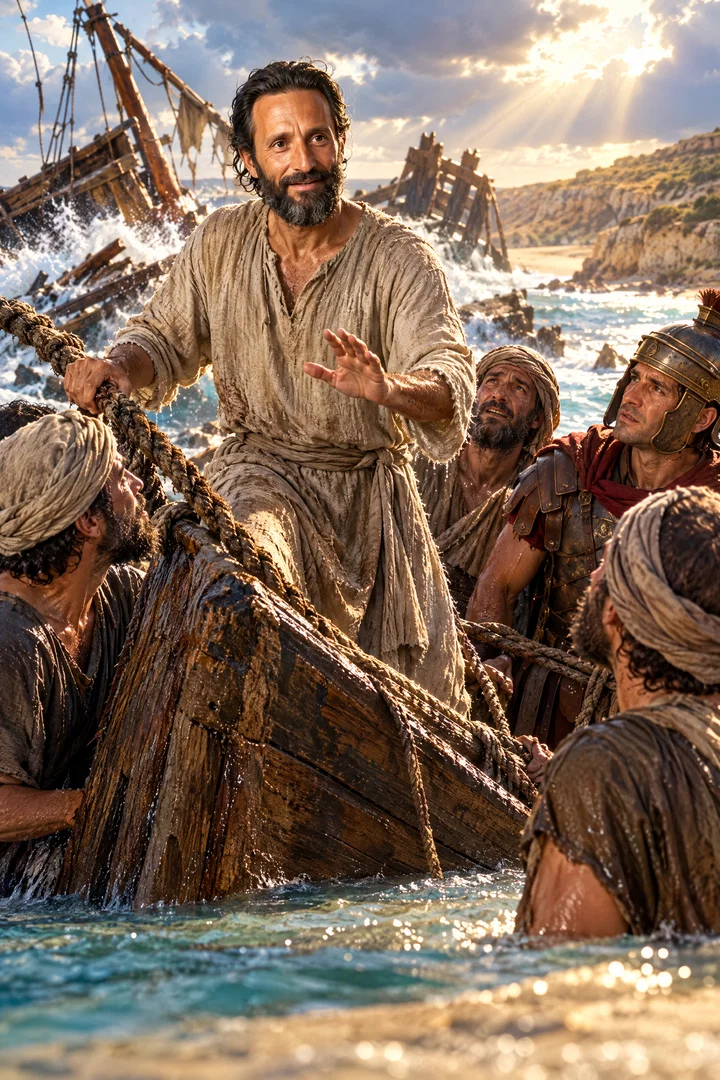
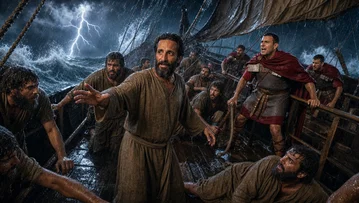
And now I exhort you to be of good cheer: for there shall be no loss of any man’s life among you, but of the ship.
Translations
American King James Version, King James Version, KJV Cambridge Paragraph Bible
And now I exhort you to be of good cheer: for there shall be no loss of any man’s life among you, but of the ship.
And now I exhort you to be of good cheer: for there shall be no loss of life among you, but of the ship.
And now I exhort you to be of good cheer: for there shall be no loss of life among you, but only of the ship.
And now I exhort you to be of good cheer; for there shall be no loss of life among you, but only of the ship.
and now I exhort you to be of good cheer, for there shall be no loss of life among you — but of the ship;
And now I exhort you to be of good courage, for there shall be no loss at all of life of [ any] of you, only of the ship.
And, now, I recommend you to be of good courage; for, loss of life, shall there be, none at all, from among you,—only the ship.
Berean Standard Bible, Majority Standard Bible
But now I urge you to keep up your courage, because you will not experience any loss of life, but only of the ship.
Now I exhort you to cheer up, for there will be no loss of life among you, but only of the ship.
But now, I say to you, be of good heart, for there will be no loss of life, but only of the ship.
But now I exhort you to be of good courage: for there shalbe no losse of any mans life among you, saue of the ship onely.
Douay-Rheims (Challoner revision)
And now I exhort you to be of good cheer. For there shall be no loss of any man’s life among you, but only of the ship.
Pictures
Cross-references
- Acts 27:44
And the rest, some on boards, and some on broken pieces of the ship. And so it came to pass, that they escaped all safe to land.
The ship is lost, but everyone aboard reaches land safely, as promised.
- Acts 23:11
And the night following the Lord stood by him, and said, Be of good cheer, Paul: for as thou hast testified of me in Jerusalem, so must thou bear witness also at Rome.
The Lord assures Paul he will survive to bear witness in Rome.
- Acts 27:34
Wherefore I pray you to take some meat: for this is for your health: for there shall not an hair fall from the head of any of you.
Paul assures the passengers that they will survive without loss of life.
- Acts 27:31
Paul said to the centurion and to the soldiers, Except these abide in the ship, ye cannot be saved.
Staying aboard is necessary for the promised rescue.
- Acts 27:26
Howbeit we must be cast upon a certain island.
The people will survive, though the ship is wrecked on an island.
- Acts 28:3-6
And when Paul had gathered a bundle of sticks, and laid them on the fire, there came a viper out of the heat, and fastened on his hand.
Paul survives the viper unharmed after the shipwreck.
- Acts 28:13
And from thence we fetched a compass, and came to Rhegium: and after one day the south wind blew, and we came the next day to Puteoli:
same journey recalled at Rhegium and in storm
- Acts 27:10
And said unto them, Sirs, I perceive that this voyage will be with hurt and much damage, not only of the lading and ship, but also of our lives.
Paul warns that the voyage will bring damage and threaten lives.
- Acts 27:29
Then fearing lest we should have fallen upon rocks, they cast four anchors out of the stern, and wished for the day.
same shipwreck story given church meaning
- Acts 27:30
And as the shipmen were about to flee out of the ship, when they had let down the boat into the sea, under colour as though they would have cast anchors out of the foreship,
The sailors try to escape despite God’s guarantee of survival.
- Acts 27:32
Then the soldiers cut off the ropes of the boat, and let her fall off.
The soldiers cut the boat loose, preventing the sailors from escaping the shipwreck.
- Colossians 4:10
Aristarchus my fellowprisoner saluteth you, and Marcus, sister’s son to Barnabas, ( touching whom ye received commandments: if he come unto you, receive him;)
Aristarchus, Paul’s companion on the voyage, is called his fellow prisoner.
- 2 Corinthians 11:25
Thrice was I beaten with rods, once was I stoned, thrice I suffered shipwreck, a night and a day I have been in the deep;
Paul’s time in the deep exemplifies his hardship.
Commentary
Each commentary is drawn from primary sources: the writings of Ellen G. White and Adventist pioneers and periodicals. Each commentary is separate. Its own words are not a quotation; follow the references to read the source passages.
Ellen G. White
12 sources
The words belong to Paul's perilous sea voyage to Rome, at a time when sailing was especially dangerous and storms could make safe navigation nearly impossible, an account centered on the voyage and shipwreck.AA 439.1AA 439.2 He spoke them while standing on deck during a lull in the tempest, after fourteen days drifting under a sunless and starless heaven, while he himself was suffering physically.AA 442.2–443.1 The setting was one of deepest darkness and exhaustion, with human help appearing hopeless.AA 442.2–443.1
To panic-stricken soldiers, sailors and other passengers facing what seemed certain destruction, he urged courage and cheerfulness.SLP 266.2–3ST Nov 6, 1879GW 107.3 He promised that not one life among them would be lost, though the ship itself would be lost.ED 255.3–4AA 439.1RH Nov 23, 1911SLP 266.2–3AA 442.2–443.1 The call was to take courage because preservation of life was assured even while the vessel was doomed.SLP 266.2–3ST Nov 6, 1879
That assurance had come from God through an angel, who promised Paul that he would stand before Caesar and reach Rome to witness for the truth of Christ.ED 255.3–4RH Nov 23, 1911SLP 266.2–3AA 442.2–443.1 The angel declared that God had given him all who sailed with him.ED 255.3–4SLP 266.2–3 Out of pity for the sinful, degraded souls around him who were unprepared to die, Paul had earnestly pleaded for their lives, and it was revealed to him that his prayer was granted, so their survival was connected with his preservation.RH Nov 23, 1911SLP 266.2–3AA 442.2–443.1
He spoke with steady hope and courage because by faith he grasped the arm of Infinite Power and his heart was stayed upon God.AA 442.2–443.1 He had no fear for himself, trusting the message would come true.AA 442.2–443.1SLP 266.1 His faith upheld him to keep serving Christ despite danger and opposition, and he followed his words with practical action to help save the passengers.ST Nov 6, 1879GW 107.3
As promised, the whole shipload of soldiers and sailors survived and reached land.ED 255.3–4 The ship was wrecked and those aboard were cast upon an island.RH Nov 23, 1911SLP 266.2–3
The promise was words of hope for the darkest hour, showing a helping hand in every emergency.AA 442.2–443.1 It revived hope so that the passengers and crew made every effort to avert destruction.ST Nov 6, 1879RH Nov 23, 1911 The episode reveals God's protecting presence and how faith in His promise gives courage amid danger.ED 255.3–4 It gives an example of holy angels ministering to God's people.GC88 512.1 It also served God's purpose so the crew witnessed divine power through Paul and those who heard of Jesus could be converted.EW 172.3
Sources
Pioneers and periodicals
36 sources
Paul urged the storm-tossed company to be of good cheer because not one person's life would be lost in the wreck, though the ship itself would be lost.ST Jun 12, 1884 The assurance rested on a visit that night from an angel of the God whose he was and whom he served, telling him not to fear because he must stand before Caesar and that God had granted him the lives of all who sailed with him.ST May 19, 1898ST May 19, 1898RH Mar 17, 1910 Their survival was granted in connection with God's purpose to preserve Paul to reach Rome, and the lives of the wicked aboard were spared on account of the presence of the righteous man.RH Nov 23, 1911ST Feb 18, 1886ST Mar 9, 1888ST Jul 23, 1885ST Mar 19, 1885 Trust in the promise did not set aside practical action, for Paul urged them to eat, gave direction as sailor as well as minister, and kept the sailors aboard because their work was needed.ST Nov 6, 1879ST Feb 18, 1886 The promised outcome depended on using the means needed to bring it about, so certainty called for effort rather than unconcern, and trying to save themselves by a way contrary to God's appointed way was unbelief leading to disaster.ST Jun 12, 1884ST Jun 12, 1884
Voyage Setting and Wording
Paul stood amid a storm-tossed ship and urged all aboard to take courage, for not one person among them would die, though the vessel itself would be lost.ST Jun 12, 1884ST Feb 18, 1886 His words gave reason for good cheer in the midst of mortal danger, turning a hopeless company toward confidence.ST Jun 12, 1884 He spoke after they had long gone without food and when all hope had been given up, and in that despair he remained steady and became their consolation.ST Jun 12, 1884ST May 19, 1898ST May 19, 1898 The assurance was that the storm would destroy the ship but take no life.ST Feb 18, 1886
The word rendered life is psuche, the only New Testament word translated soul.RH Oct 24, 1854ST Jan 24, 1884ST Jun 6, 1878 Here it means individual physical life, a person's life.RH Oct 24, 1854ST Jan 24, 1884ST Jun 6, 1878 The promise is therefore that no man's physical life among those on the ship would be lost in the wreck, but the ship itself would be lost.RH Oct 24, 1854ST Jan 24, 1884
The setting is Paul's voyage to Italy and to Rome as a prisoner under the charge of Julius.ST Mar 19, 1885ST Feb 16, 1915 It was a late-season passage made increasingly perilous by uncertain weather and the approaching close of navigation for the year, a tedious and perilous winter voyage.ST Mar 19, 1885ST Dec 8, 1887ST Feb 16, 1915 A violent storm broke over that part of the Mediterranean off southern Italy and Sicily and wrecked his vessel, making the journey a terrifying sea passage to Rome.ST Mar 19, 1885ST Aug 21, 1901 Imprisonment and delays had obstructed his plans, yet the journey brought him to his desired destination at government expense and allowed missionary work along the way, supplying the pattern for difficult travel such as carrying the Philippians' gift to Paul.ST Mar 30, 1904ST Dec 8, 1887
The ship was unmanageable in violent tempest, driven for fourteen days without seeing sun, moon, or stars, until the men thought all was lost.ST May 19, 1898RH Feb 4, 1915ST Jul 16, 1885 The company had long gone without food, all hope was given up, and crew and passengers were hopeless and disheartened.ST May 19, 1898ST May 19, 1898RH Feb 4, 1915 Paul alone among them did not despair, but kept the spirits of the ship's company and crew through fourteen days of tempest by his courage and endurance.ST Jun 12, 1884ST Jul 16, 1885
He stood up and first reminded them that they should have listened to him not to set sail from Crete, and that by not hearkening they had brought this injury and loss upon themselves.ST May 19, 1898ST May 19, 1898 Afterward the vessel ran aground and the stern was broken up.ST May 19, 1898 Yet all two hundred threescore and sixteen souls escaped safe to land.ST May 19, 1898 The survivors, Paul and the other prisoners among them, spent three months on an island under the soldiers' guard.ST May 19, 1898ST Feb 16, 1915
Divine Promise and Fulfillment
Paul's call to take courage rested on a visit the night before from an angel of the God to whom he belonged and whom he served.ST May 19, 1898ST May 19, 1898RH Jun 30, 1903 The angel told him not to fear because he must stand before Caesar, and that God had granted him the lives of all who sailed with him.ST May 19, 1898ST May 19, 1898RH Mar 17, 1910 This was given as a sign of grace, that no life among them would be lost though the ship itself would be lost.RH Mar 17, 1910RH Jun 30, 1903ST Mar 19, 1885 The word was fulfilled when the vessel ran aground with its stern broken up, yet all two hundred threescore and sixteen souls escaped safe to land.ST May 19, 1898
Paul believed the message would come to pass exactly as spoken, and on that basis he urged the others to share his confidence.ST May 19, 1898ST May 19, 1898ST Mar 19, 1885 He foretold that they would be wrecked upon a certain island with no loss of life but only loss of the ship.ST May 19, 1898ST May 19, 1898ST Dec 9, 1897 He spoke this after the company had long gone without food and all hope had been given up, comforting the disheartened crew and passengers in the storm.RH Nov 23, 1911ST May 19, 1898ST Dec 9, 1897 Their survival was nevertheless to come through being cast upon an island.RH Nov 23, 1911ST May 19, 1898ST May 19, 1898
Their preservation was granted in connection with God's purpose to keep Paul to reach Rome and be brought before Caesar.RH Nov 23, 1911ST Feb 18, 1886ST Mar 19, 1885 God would preserve Paul for that end, and would also spare those sailing with him.RH Nov 23, 1911ST Feb 18, 1886ST Mar 19, 1885 The lives of the wicked men aboard were spared on account of the presence of the righteous man.ST Mar 9, 1888ST Mar 19, 1885ST Mar 19, 1885 Paul's presence on the ship thus brought deliverance to the other passengers, as a sign of grace.ST Mar 9, 1888ST Jul 23, 1885ST Mar 19, 1885ST Mar 19, 1885
Trust and Obedient Action
Paul stayed courageous and steady in danger and became the consolation of the hopeless company aboard the storm-tossed vessel, encouraging them that no life would be lost though the ship would be lost.ST Nov 6, 1879ST Jun 12, 1884RH Mar 17, 1910ST Aug 21, 1893 His courage rested on the promise that he must stand before Caesar and that all sailing with him would be spared, showing that people may rest in God's care even amid danger when circumstances seem hopeless.ST Feb 18, 1886RH Mar 17, 1910 His hope and courage held firm through fourteen days of tempest when he alone did not despair, and that endurance in keeping up the spirits of crew and company is an example of grit.ST Nov 6, 1879ST Jul 16, 1885
Trust in the promise did not mean ignoring danger or neglecting practical action, for Paul urged the passengers to eat and kept the sailors aboard because their work was needed to save the others.ST Feb 18, 1886 As a shipwrecked voyager he adapted himself to the occasion, not ashamed to act the part of a sailor as well as a minister, giving practical directions concerning the company and the soldiers and the ship and taking practical action to help save the passengers.ST Nov 6, 1879 The assurance that no one aboard would die though the ship would be lost revived their hope and moved them to make every effort to avert destruction.RH Nov 23, 1911
The promised outcome depended on using the means needed to bring it about, for God's purposes include both the end and the means, so certainty about salvation calls for effort rather than unconcern.ST Jun 12, 1884 God's guarantee of life contrasted with the sailors' selfish attempt to escape in distrust of the assurance given through Paul.ST Jun 12, 1884 Trying to save themselves by a way contrary to God's appointed way is unbelief and selfish ambition leading to disaster unless God's mercy restrains it.ST Jun 12, 1884ST Jun 12, 1884
Paul's prediction of ultimate safety with no loss of life though the ship itself would be lost was enabled by long abstinence, showing that fasting prepares God's people to receive divine guidance and blessing.RH Jan 26, 1860 The stormy voyage to Rome with loss of the ship was nevertheless a prosperous journey by the will of God in answer to earnest prayer to visit Rome.ST Oct 24, 1895ST Feb 25, 1889 After imprisonment and delays had obstructed his plans, the journey brought him to his desired destination at government expense and allowed him to do missionary work along the way.ST Mar 30, 1904 Most would say such a voyage was not prosperous and was not as expected, yet he made no complaint, and it must have been prosperous because all things work together for good to them that love God.ST Oct 24, 1895 God looks at matters from a different side than men do and knows much better than men how prayers should be answered, so things regarded as disastrous are prosperous when seen as God sees them, and remembering this saves much mourning.ST Oct 24, 1895ST Feb 25, 1889
Broader Lessons and Connections
The vessel in the promise cannot stand for the church, for the promise is that the vessel itself will be lost and broken to pieces, which would leave no church remaining if the vessel were the church.RH Aug 18, 1874 The wreck belongs to history as an actual voyage to Rome, and its credibility upholds the vital truths bound up with it.ST Jul 5, 1910 It displays the Lord's marvelous working with His servant in deliverance.ST Jul 21, 1909 As a New Testament account of divine deliverance it belongs with the Old Testament stories of divine deliverance, so that the two stand or fall together.ST Nov 25, 1889
The storm around the promise shows the restless, raging, roaring, turbid, angry sea employed to attempt Paul's destruction, as had been attempted against Christ and then against the disciples.ST Aug 27, 1896 The sea is God's good creation and has its useful lessons, yet of itself it does not convey the comfort, consolation and strength of the hills and mountains.ST Aug 27, 1896 The foundation of Paul's hope in that hour was God's promise to the fathers, a promise still to be fulfilled.ST Dec 19, 1878 That promise belongs to those who are Christ's, who become Abraham's seed and heirs by faith, without distinction of Jew or Greek, slave or free, male or female.ST Dec 19, 1878
The journey to Rome was tedious and perilous, and it supplies the setting for difficult travel such as carrying the Philippians' gift to Paul.ST Dec 8, 1887 The storm that broke over that part of the Mediterranean off southern Italy and Sicily wrecked Paul's vessel, and Paul met that wreck with a power of endurance greater than later workers have.ST Aug 21, 1901 The same Lord who once said to the troubled Sea of Galilee, Peace, be still, speaks peace to the Great Sea to bear His workers safely upon its quiet bosom.ST Aug 21, 1901 He is the Lord who calls workers from the West to go on mission to the East.ST Aug 21, 1901
Sources